
Original Research
Teacher Students' Views on the Anchoring of the Shoah into the Czech Normative Educational Curriculum


- Abstract
- Full text
- Metrics
This paper presents ways and forms of anchoring the term Shoah in normative educational documents. The partial results of a research investigation are presented to find out the preconceptions of students of teaching in the field, including the phenomenon of the Shoah in the educational process. The quantitative research survey was conducted through a non-standardized, twenty-four-question questionnaire. The first eight were aimed at obtaining information about the respondents (e.g., year and form of study, study program, etc.). We presented the results as a comparison of partial results of research investigations, i.e., the research partial results and the results of a survey we conducted among practicing teachers. Based on the results of the questionnaire item concerning their opinion on the normative framing of the concept of the Shoah in Framework Educational Program for Primary Education, it can be stated that both groups of respondents would have welcomed it; however, a higher percentage of positive answers came from future teachers (55% versus 77.04%). We perceive the presented research as a first step towards a possible targeted intervention in the field of teacher training in possible work with the topic of the Shoah and its possible cross-cutting inclusion in the educational process. On the other hand, it must be stated that the young generation, i.e., student teachers, are aware of the necessity to apply the problems of the contemporary world to teaching, with or without the support of its curricular anchoring.
Teacher Students´ Views on the Anchoring of the Shoah into the Czech Normative Educational Curriculum
Faculty of Education, The Department of Czech Language and Literature, Palacký University Olomouc, Czech Republic
Abstract
This paper presents ways and forms of anchoring the term Shoah in normative educational documents. The partial results of a research investigation are presented to find out the preconceptions of students of teaching in the field, including the phenomenon of the Shoah in the educational process. The quantitative research survey was conducted through a non-standardized, twenty-four-question questionnaire. The first eight were aimed at obtaining information about the respondents (e.g., year and form of study, study program, etc.). We presented the results as a comparison of partial results of research investigations, i.e., the research partial results and the results of a survey we conducted among practicing teachers. Based on the results of the questionnaire item concerning their opinion on the normative framing of the concept of the Shoah in Framework Educational Program for Primary Education, it can be stated that both groups of respondents would have welcomed it; however, a higher percentage of positive answers came from future teachers (55% versus 77.04%). We perceive the presented research as a first step towards a possible targeted intervention in the field of teacher training in possible work with the topic of the Shoah and its possible cross-cutting inclusion in the educational process. On the other hand, it must be stated that the young generation, i.e., student teachers, are aware of the necessity to apply the problems of the contemporary world to teaching, with or without the support of its curricular anchoring.
Keywords: Shoah, Czech Curriculum Documents, Framework Educational Program for Primary Education, Educational Process, Implementation
The main aim of the paper is to present partial results of two research surveys conducted through the same research instrument, a questionnaire. In the first research, we observed the opinions of practicing teachers on the implementation of the Shoah (Holocaust) theme into the teaching of literature education at lower-secondary schools, while the aim of the second research was to find out the experience of students of teacher study programmes implemented at the Department of Czech Language and Literature of the Faculty of Education of Palacký University in Olomouc with the integration of the Shoah (Holocaust) phenomenon into the teaching of primary and lower-secondary schools, which they have completed.
The term Shoah is considered by some scholars to be a more accurate description of the persecution and murder of European Jewry between 1933 and 1945 than the commonly used term Holocaust (De Kessel, 2018). Shoah connotes a sudden disaster or catastrophe, while the Holocaust implies a sacrifice consumed by fire, which does not accurately reflect the experiences of the victims (Hayes, 2010). Overall, the difference between the Shoah and the Holocaust lies in the connotations and representations of these terms, with the Shoah emphasizing the catastrophic nature of the events and the difficulty of fully comprehending them.
Intentionally, both research surveys were conducted based on almost identical research instruments so that we could compare the findings with each other and thus point out the current situation in pedagogical practice and its possible improvement after the student teacher enters practice.
In this paper, we present the results of a questionnaire item in which we investigated whether the respondents would welcome a normative anchoring of the concept of the Shoah in the Czech normative curricular educational document, the Framework Educational Programme. We are convinced that by comparing our findings, it will be possible to predict the development of the situation in the given area in a certain way and possibly undertake appropriate intervention to improve it.
Literature Review
System of Czech Educational Documents
Singh et al. (2023), Yashchyk et al. (2023), and Hassanpour et al. (2023) state that educational documents play a crucial role in professional life, serving as proof of professional achievements. However, traditional paper-based degrees and certificates are prone to damage, loss, and forgery. The process of issuing and verifying these documents is time-consuming and cumbersome, leading to delays in job offers. To address these challenges, blockchain technology can be implemented. By converting paper certificates to digital certificates and storing their hash values on the blockchain, the authenticity and verification of educational certificates can be ensured. This implementation guarantees the safety, authenticity, and immutability of stored data, simplifies the verification process, and eliminates the possibility of forgery. Blockchain technology can also enhance public trust, transparency, and efficiency in the education system, contributing to the unification of approaches to the recognition of foreign educational documents.
Curricular normative educational documents play a crucial role in shaping educational practices and policies. The analysis of various documents reveals the importance of including specific topics in the curriculum. The study by Feitosa and Ferreira (2022) highlights the need to incorporate traffic education into the Brazilian education system. Similarly, the research conducted by Brasil and Guimarães (2021) focuses on inclusive perspectives in the educational systems of Portugal and Brazil. Zanetoni and Leão (2022) emphasize the significance of environmental education in the Brazilian context, particularly in relation to chemistry and natural sciences. Kniphoff da Cruz et al. (2023) discuss the recent norms regarding computer education in Brazilian schools, emphasizing the need for teacher training and appropriate teaching materials. Herrera et al. (2016) examine the normative frameworks for special education in Latin American and Caribbean countries, with a focus on inclusion in higher education.
Many authors underline the fact that Czech educational curriculum documents are influenced by many aspects. Wirthová (2020) discusses the existence of divergent knowledge regimes and contradictory legitimizations within the reform of Czech educational curricula Koželuhová et al. (2020) analyze the planning and implementation of educational content in Czech and Slovak preschools, focusing on the topics, goals, and approaches used in creating educational programs. Lesňák and Štěrba´s (2016) study examines the history and current state of moral education in the Czech Republic, evaluating the quality of ethical education programs and character development subjects in primary and secondary schools. Svobodová and Hofmann´s (2018) paper explores the barriers to the implementation of cross-curricular education in the Czech environment, emphasizing the need for interdisciplinary cooperation and teacher training. Moravcová et al.´s (2019) research compares the Czech mathematics curriculum with Estonia, Slovenia, and Poland, identifying differences in goals, content, and required student outcomes. Vlček et al. (2018) discuss the curricular revisions in the Czech Republic but do not provide information about specific Czech curricular normative educational documents. Poupová et al. (2019) discuss the revision of national curricular documents for primary and secondary education in the Czech Republic, called the Framework Educational Programmes.
Czech Schools Autonomy
“Since January 1st 2003, all schools have been granted the status of legal entities. School heads were given full responsibility for the quality of the educational process, financial management of the school, appointing and dismissing teachers, and relations with their local community and the general public. By law, the school organizing body must establish a School Council enabling parents, pupils, teaching staff (except for the school head), and the public to participate in the administration of the school. Organizing bodies appoint school heads on the basis of a tender, and they can only be dismissed for reasons defined by law. Public higher education institutions were granted autonomy at all levels of management. Internal management of institutions, the establishment of self-governing academic bodies, content and organization of study, labor relations, and funding are exercised by the Academic Senate, the rector, the Academic (Art) Board and a Disciplinary Commission. The Board of Trustees safeguards public interest in the institution’s activities and efficient property management. The faculties also have autonomous bodies, but these are not legal entities. Higher education institutions also have a representative body, the Higher Education Council, made up of representatives from the academic community. State higher education institutions (The University of Defence and The Police Academy) are established by the relevant ministries, and their autonomy is limited” (Gergelová Šteigrová, 2011, p. 9). Figure 1 presents the system of Czech curricular educational documents.
System of Czech Curricular Educational Documents
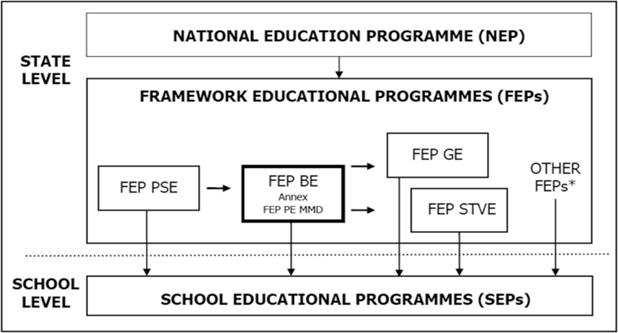
Note. Source: Hošpesová & Novotná (2020)
Teacher Training
“Education for would-be teachers is described in the relevant chapters. The obligation to ensure in-service training of teachers in public and state schools is stipulated in the Act on Educational Staff. In-service training is organized by higher education institutions, institutions for in-service training of educational staff, and other facilities on the basis of accreditation granted by the MEYS. Teachers may prefer the self-study option, where they are entitled to 12 working days off for study in the school year. In-service training programs for teachers are mainly provided by the National Institute for Further Education, which consists of a center and thirteen regional stations. Higher education institutions offer refresher training courses for teachers returning to the profession after a long interval, qualification training courses providing upgrading of educational qualifications, specialized courses, and educational studies for graduates from non-teacher training faculties” (Gergelová Šteigrová, 2011, p. 9).
Method
The research investigation aimed at finding out the opinions of teachers of the Czech Language and Literature at the lower-secondary schools in the Vysočina Region on the implementation of the Shoah theme in the teaching of Literature Education consists of three parts (two qualitative and one quantitative). The main objectives of the research investigation: 1) to find out what is the opinion of teachers of Czech language and literature professionally working at the lower-secondary schools in the Vysočina Region on the implementation of the Shoah theme in the teaching of Literature Education; 2) to provide a comprehensive description of the integration of the Shoah phenomenon into the educational process at lower-secondary school education with a focus on teachers of the Czech Language and Literature.
Research Methodology to Determine the Views of Teacher Participants
A complete list of complete and incomplete primary schools in the region is available on the website of the School Portal of the Vysočina Region. Based on this freely available document, we contacted the principals of all 134 complete primary schools via e-mail and asked them to forward the link to the web questionnaire to all teachers of Czech language and literature in the given primary school.
Before starting the quantitative phase of the research, we determined the sample size of respondents based on quota sampling. The quotas were based on the document Teaching Staff in Regional Education according to data from the Salary Information System (ISP, 2017), which is available on the website of the Ministry of Education, Youth and Sports of the Czech Republic. We confronted the information obtained with the Statistical Yearbook of the Vysočina Region 2017, which presents the nominal and percentage representation of the respondents in the second phase of the research. Of course, the distribution of respondents based on gender was also observed.
Sciberras and Dingli (2023) state that quantitative research is a systematic approach to studying social issues using numerical data. It involves the quantification and measurement of the subject being assessed. This type of research requires the collection of quantifiable data through methods such as surveys and questionnaires (Lenardic, 2023). T It offers advantages such as a higher sample size, quick data collection, and the generalizability of findings (Hsieh, 2023).
The total number of teachers tested under quota fulfillment is 114: see n = tα2.p(1-p)/d2. (Chráska, 2017, p. 22) The sum was obtained by estimating the sample size in the case of nominal or ordinal data at the required relative precision of 4%, at a confidence level of 95 %, and at a relative frequency of 0.05. We believe that on this basis, the survey did not meet the quota of respondents and that we reached several 80 fully completed questionnaires. There are no specific statistics related to the number of Czech Language and Literature teachers in the Vysočina Region. We are of the opinion that in the context of teachers of Czech Language and Literature, the number is telling and sufficient: we assume that in 134 complete primary schools, there are, on average, two teachers of the given educational field; thus, the potential number of all teachers of Czech Language and Literature is 268, which in comparison with 80 filled questionnaires and taking into account the fact that the quantitative research survey was preceded by a qualitative phase of research with eight teachers from the Vysočina Region, leads us to claim a certain informative value of the postulated research survey.
The research, which aimed to find out student teachers´ experiences of integrating the Shoah into their teaching, was carried out using a non-standardized questionnaire, which was verified in the framework of a research that focused on finding out the opinions of teachers of Czech Language and Literature professionally working at the lower-secondary schools on the implementation of the Shoah theme into the teaching of Literary Education (see above). The statistical processing of the data obtained by this research instrument was used to verify the validity and reliability of the questionnaire.
Research Methodology to Determine the Views of Students Participants
The respondents of the quantitative research were students of the Department of Czech Language and Literature at the Faculty of Education of Palacký University in Olomouc (see the respondents’ information in Table 1 and Table 2). Data collection was carried out via an online questionnaire, which was sent to the respective potential respondents at their university e-mail addresses. This phase of the research was conducted in cooperation with the management of the Department of Czech Language and Literature of Palacký University in Olomouc and its secretariat. Students of full-time, combined, and extension studies of all study programs implemented at the given department or whose study plans include a course professionally staffed by the given department were contacted with a request to participate in the research.
The Age Distribution of Respondents
|
Age of respondents |
Frequencies |
|
|
absolute |
relative |
|
|
19 years |
16 |
5.0 % |
|
20 years |
52 |
16.3 % |
|
21 years |
45 |
14.1 % |
|
22 years |
37 |
11.6 % |
|
23 years |
49 |
15.4 % |
|
24 years |
27 |
8.5 % |
|
25 years |
18 |
5.6 % |
|
26 years |
8 |
2.5 % |
|
27 years and more |
67 |
21.0 % |
|
Total |
319 |
100 % |
The Level of Study of the Respondents
|
Frequencies |
||
|
Answers |
absolute |
relative |
|
Bachelor´s degree program (BA) |
151 |
47.3 % |
|
Master´s degree program (MA) |
102 |
32.0 % |
|
Postgraduate Master´s degree program (MA) |
54 |
16.9 % |
|
Doctoral study program (Ph.D.) |
5 |
1.6 % |
|
Lifelong learning |
5 |
1.6 % |
|
Other |
2 |
0.6 % |
|
Total |
319 |
100 % |
In this paper, we present a comparison of partial results of the above-presented research investigations, respectively their quantitative phase, in respondents´ (i.e., future teachers and teachers in practice) opinions on the implementation of the term Shoah into the Framework Educational Programmes in the Czech Republic. Starting from the fact that the term Shoah is not part of these curricular documents, the term Holocaust is part of the curriculum in the third year of lower-secondary school within the subject curriculum of History (Faltýn, 2021, p. 57). We see the necessity to normatively anchor the concept of the Shoah in as many educational documents as possible in as wide a range of disciplines as possible, especially in the topicality of the events that can be summarized by this term. Patt (2017) states that the Shoah holds significant importance for contemporary society. Rodman (2019) adds that the horrors of the Shoah have also served to mute anti-Semitism in much of the world, although it continues to persist in certain regions. The Shoah represents the destruction of the rules of genealogy and filiation, leading to the creation of the abject (Perelberg, 2022). Shoah education is a topic that is addressed in various contexts and settings. The importance of using images in the teaching of the history of the Shoah is emphasized, as images played a significant role in the manipulation of mass thought and the construction of the enemy (Tiburzi, 2023). Chernivsky and Lorenz-Sinai (2022) state that the impact of the Shoah on education and upbringing is explored, including the transmission of knowledge and references to the Shoah between generations. According to Vaccarelli and Iadarola (2022), the family aspect should be emphasized as an example of pedagogical and educational action in the context of Shoah education.
Results and Discussion
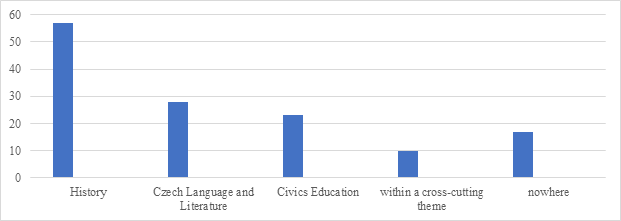
First, we present the opinions of teachers from practice on the anchoring of the concept of the Shoah in the Framework Educational Programme. The distribution of the concept within the individual educational disciplines according to the teachers´ opinions is demonstrated in Figure 2. The distribution of subjects is quite expected, with a slightly surprisingly high proportion of responses for Czech Language and Literature - we believe that this situation is due to the orientation of the questionnaire survey towards the research object.
Anchoring the Term Shoah Within Subjects
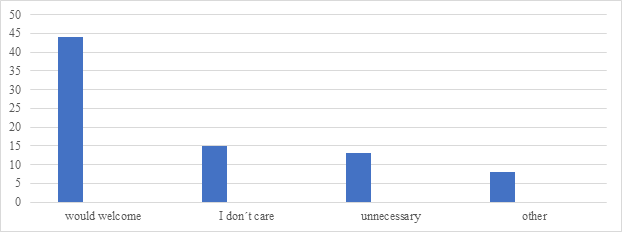
We also investigated whether teachers would welcome the normative anchoring of the concept of the Shoah in the Framework Educational Programme. The statement was formulated in general terms; we did not specify a specific educational area. The results are presented in Figure 3. In our opinion, the significant number of positive choices - would welcome - was due to the subject matter of the survey and the desire to answer as most likely as expected.
Would you Welcome the Anchoring of the Term Shoah Framework Educational Programme?
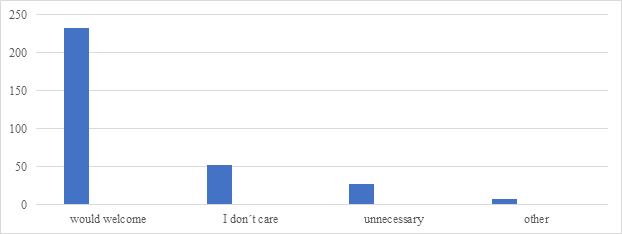
In this part of the paper, we present the relevant results of a research survey conducted among prospective teachers, i.e., students of teacher education programs. A summary of the responses to this question is presented in Figure 4.
Would you Like to See the Term Shoah Anchored in the Framework Educational Program for Primary Education?
A percentage comparison of the above results is presented in Figure 5.
Figure 5
A Percentage Comparison of the Results
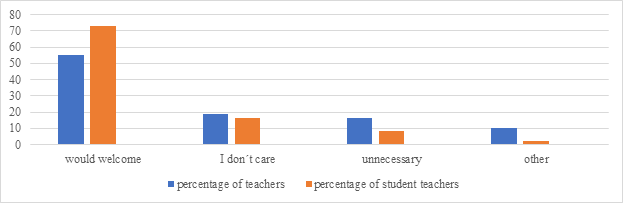
As can be seen from the summary graphic, the respondents´ answers reflected their previous experience with teaching reality. Practicing teachers are perhaps more aware of the complexity of curriculum reform, namely the change in the content of the normative curriculum, which would be accompanied by a necessary change in the content of school curricula. Our findings correspond to some extent with those of Yli-Panula et al. (2022), who point out that there are differences between the views of teachers and student teachers. Teacher students in Finland identified problems in introducing Climate Change Education (CCE) into school culture, such as views that deny climate change and question the transformation of school culture to support sustainable development. In relation to media literacy, Lähdesmäki and Maunula (2022) report that student teachers have recognized new literacies as a cultural phenomenon of our time, including the value of social media as a new form of literacy. Olatunde-Aiyedun (2021) found out that in the context of grammar teaching, there was a lack of congruence between teachers´ views and their actual classroom practices, particularly in methods, techniques, resources, and activities. In contrast to de Jager et al.´s (2017) findings that student teachers had a negative attitude towards teaching practice, which affected their performance, comparisons of the relevant results of our research indicate a certain initiative and enthusiasm of prospective teachers, especially in their efforts to adapt existing normative curricular documents to current social and student needs. Of course, we agree with the statement of Sorokovykh et al. (2021) that the pivotal role of personal initiative in the education of future teachers and the development of their socio-cultural competencies stems largely from the teaching methods of the university faculties educating future teachers.
Based on the comparison, it can be concluded that future teachers are aware of the necessity of curricular transformation of Czech education, which has already begun, but which tends rather to limit the compulsory curriculum and increase the autonomy of individual Czech educational institutions, without significantly reflecting the socially topical and acute issues, which undoubtedly include the warnings presented by the issue of the Shoah. Sekerák and Valeš (2021) state that despite positive shifts in educational policy, legislation, and teacher professionalization, there are still barriers to implementing real systemic reform at the intermediate and micro levels of the educational system. The lack of political consensus and a steering and monitoring mechanism in the educational sector have hindered progress (Walterová, 2007).
Conclusion
In this paper, we present a comparison of partial results of quantitative research investigations, in which we focused on the findings of practicing teachers on their experiences with the implementation of the Shoah into teaching at lower-secondary schools and on the findings of the experiences of students of the teaching degree programs implemented by the Department of Czech Language and Literature of the Faculty of Education of Palacký University in Olomouc with the inclusion of the Shoah into teaching at primary schools.
Based on the results of the questionnaire item concerning their opinion on the normative framing of the concept of the Shoah in Framework Educational Program for Primary Education, it can be stated that both groups of respondents would have welcomed it; however, a higher percentage of positive answers came from future teachers. This is mainly explained by the fact that the practicing teachers are aware of the complexity of the gradual transformation of the educational curriculum, which has been taking place in the Czech Republic with some interruptions since 1989, i.e., with the fall of communism in Czechoslovakia. Dvořák (2021) notes that the educational curriculum in the Czech Republic has undergone significant changes since 1989. Following the Velvet Revolution, citizens and teachers demanded reform, but the conservative-liberal government preferred incremental steps. Although even practicing teachers are aware of the need to acquaint pupils with the warnings that the events of the Shoah present to us, they are of the opinion that this topic can be implemented in the curriculum without explicitly introducing the concept of the Shoah into the content of the curriculum, based on the considerable educational autonomy of school institutions. Greger and Walterová (2018) state while positive shifts have occurred in educational policy, legislation, management, financing regulation, and teacher professionalization, systemic reform at the intermediate and micro levels has not been fully implemented.
We perceive the presented research as a first step towards a possible targeted intervention in the field of teacher training in possible work with the topic of the Shoah and its possible cross-cutting inclusion in the educational process. On the other hand, it must be stated that the young generation, i.e., student teachers, are aware of the necessity to apply the problems of the contemporary world to teaching, with or without the support of its curricular anchoring.
References
Brasil, M. T., & Guimarães, L. P. (2021). Dialogando com os documentos normativos da educação de portugal e brasil sob a perspectiva inclusiva [Dialoguing with the Normative Documents of Education in Portugal and Brazil from an Inclusive Perspective]. Journal of Education Science and Health, 1(3), 1–13. https://doi.org/10.52832/jesh.v1i3.18
Chernivsky, M., & Lorenz-Sinai, F. (2022). Die Shoah in bildung und erziehung heute - weitergaben und wirkungen in gegenwartsverhältnissen [The Shoah in Education and Upbringing Today - Transmission and Effects in Present-Day Circumstances]. Leverkusen: Verlag Barbara Budrich. http://dx.doi.org/10.2307/j.ctv2r336fg
Chráska, M. (2017). Methods of Pedagogical Research. Basics of quantitative research. Prague: Grada.
De Jager, L., Fraser, B., & Fereirra, R. (2017). Student-teachers´ view of their role as mediators of learning. Edulearn17 Proceedings (pp. 4620-4625). https://doi.org/10.21125/edulearn.2017.2016
De Kessel, M. (2018). The documentary real and the Shoah. Foundations of Science, 23(2), 245–254. https://doi.org/10.1007/s10699-016-9518-3
Dvořák, D. (2021). Post-socialist curricular reform in Czechia: Multiple actors and their blame games. Curriculum Making in Europe: Policy and Practice within and across Diverse Contexts (pp. 99-124). Leeds: Emerald Publishing Limited. https://doi.org/10.1108/978-1-83867-735-020211006
Faltýn, J. (2021). Framework educational program for primary education. Prague: NÚV.
Feitosa, N. M. S., & Ferreira, J. P. S. (2022). Educação para o trânsito nos documentos normativos da educação básica [Traffic Education in Basic Education Documents]. Journal of Education Science and Health, 2(4), 1–12. https://doi.org/10.52832/jesh.v2i4.161
Gergelová Šteigrová, L. (2011). The education system in the Czech Republic. Prague: The Ministry of Education, Youth and Sport of the Czech Republic.
Greger, D., & Walterová, E. (2018). In pursuit of educational change: Transformation of education in the Czech Republic. Orbis Scholae, 1(2), 11–44. https://doi.org/10.14712/23363177.2018.165
Hassanpour, A., Azizi, N., Ahmadi, A., Gholizadeh, I., & Ramezani, S. G. (2023). Diversity in Iranian upstream educational documents. Journal for Multicultural Education, 17(3), 278–290. https://doi.org/10.1108/JME-06-2022-0079
Hayes, P. (2010). The Shoah and its legacies. The Cambridge Guide to Jewish History, Religion, and Culture (pp. 233-257). Cambridge: Cambridge University Press. https://doi.org/10.1017/CBO9780511780899
Herrera, S., Sarzoza, A., Ruth, A., Campos, J., González, & Muñoz, M. A. (2016). Marco normativo de la educación especial en américa latina y el caribe y su incidencia en la educación superior [Regulatory Framework for Special Education in Latin America and the Caribbean and Its Impact on Higher Education]. Revista de Estudios Cotidianos, 4(1), 46–61.
Hošpesová, A., & Novotná, J. (2020). Development of Mathematics Education in the Czech Republic (1989–2018): From a Search for Structure to Mathematical Literacy. In Karp, A. (Ed.), Eastern European Mathematics Education in the Decades of Change. International Studies in the History of Mathematics and its Teaching (pp. 1-44). Cham: Springer. https://doi.org/10.1007/978-3-030-38744-0_1
Hsieh, W. W. (2023). Basics. In Introduction to Environmental Data Science (pp. 19-64). Cambridge: Cambridge University Press. https://doi.org/10.1017/9781107588493.003
Kniphoff da Cruz, M. E. J., Marques, S. G., Tavares, Tainã, Ellwanger, Oliveira, Wilk, & Seelig, G. B. (2023). Normas, diretrizes e material didático para o ensino de computação na educação básica brasileira [Standards, Guidelines and Teaching Materials for Computer Science in Brazilian Basic Education]. Anais Do Simpósio Brasileiro De Educação Em Computação (Educomp) (pp. 337-346). Porto Alegre: Sociedade Brasileira de Computação. https://doi.org/10.5753/educomp.2023.228332
Koželuhová, E., Loudová Stralczynská, B., & Lipnická, M. (2020). Planning Educational Content in School Curriculum Documents: Examples of current practice from pre-schools in the Czech Republic and Slovakia. Pedagogika, 70(4), 425–448. https://doi.org/10.14712/23362189.2020.1678
Lähdesmäki, S. A., & Maunula, M. (2022). Student teachers’ views on media education related to new literacy skills. International Journal of Technology in Education and Science (IJTES), 6(3), 427–442. https://doi.org/10.46328/ijtes.374
Lenardic, A. (2023). Quantitative data analysis. In Quantitative Data Analysis. Research and Evaluation for Busy Students and Practitioners (pp. 173-186). Bristol: Bristol University Press. https://doi.org/10.51952/9781447366263.ch011
Lesňák, S., & Štěrba, R. (2016). Moral education in the Czech territory in the past and the present. Ethics & Bioethics (In Central Europe), 6(1-2), 45–57. https://doi.org/10.1515/ebce-2016-0008
Moravcová, V., Surynková, P., & Hromadová, J. (2019). A comparison of lower secondary school education of mathematics in the Czech Republic and selected countries with respect to curriculum documents. Scientia in Educatione, 10(3), 4–32. https://doi.org/10.14712/18047106.1291
Olatunde-Aiyedun, T. G. (2021). Student teachers’ attitude towards teaching practice. International Journal of Culture and Modernity, 8(2021), 6–17.
Patt, A. (2017). On ‘Holocaustia’ and the place of the Shoah in contemporary Jewish life. Contemporary Jewry, 37(2017) 187–191. https://doi.org/10.1007/s12397-017-9214-9
Perelberg, R. J. (2022). The murder of the dead father: The Shoah and contemporary antisemitism. The International Journal of Psychoanalysis, 103(5), 851–871. https://doi.org/10.1080/00207578.2022.2094797
Poupová, J., Janštová, V., Kuba, R., & Mourek, J. (2019). A comparative analysis of the biological parts of the national curricula in lower secondary education in the Czech Republic and selected post-communist countries. Scientia in Educatione, 10(3), 94–124. https://doi.org/10.14712/18047106.1294
Rodman, D. (2019). Antisemitism today and tomorrow: Global perspectives on the many faces of contemporary antisemitism edited by Mikael Shainkman, Brighton, Ma, Academic Studies Press. Israel Affairs, 25(5), 948–950. https://doi.org/10.1080/13537121.2019.1645934
Sciberras, M., & Dingli, A. (2023). Quantitative research in investigating AI readiness in the Maltese Public Administration. In Lecture Notes in Networks and Systems (pp. 43-115). Cham: Springer. https://doi.org/10.1007/978-3-031-19900-4_11
Sekerák, M., & Valeš, L. (2021). Two steps forward, one step back: Transformation of higher education policy and reforms in the Czech Republic. Perspectives: Policy and Practice in Higher Education, 25(3), 79–83. https://doi.org/10.1080/13603108.2020.1841689
Singh, A., Chauhan, S. P. S., & Goel, A. K. (2023). Blockchain based verification of educational and professional certificates. 2nd International Conference on Computational Systems and Communication (ICCSC) (pp. 1-7). Thiruvananthapuram: IEEE. https://doi.org/10.1109/ICCSC56913.2023.10143008
Sorokovykh, G., Bannikova, L., Pribylova, N., Staritsyna, S., & Vishnevskaya, Y. (2021). Development of youth initiative upon studying socio-cultural space of a Metropolis. SHS Web of Conferences, 98(2021), 03016. https://doi.org/10.1051/shsconf/20219803016
Svobodová, H., & Hofmann, E. (2018). Are Czech students of teacher training prepared for interdisciplinary teaching? Curriculum and Teaching in Physical Education and Geography: Interdisciplinary and International Perspectives (pp. 27-38). Brno: Masaryk University. https://doi.org/10.5817/CZ.MUNI.P210-9075-2018
Teaching Staff in Regional Education according to Data from the Salary Information System (ISP). (2017). http://msmt.cz/file/47444/download
Tiburzi, A. (2023). The use of photographs in the teaching of the Shoah. Proceedings of the 3rd International and Interdisciplinary Conference on Image and Imagination. IMG 2021. Lecture Notes in Networks and Systems (pp. 83-89). Cham: Springer. https://doi.org/10.1007/978-3-031-25906-7_10
Vaccarelli, A., & Iadarola, F. (2022). Madri e padri senza figli: Irena Sendler, Janus Korczak ed altri exempla di pedagogia della resilienza e della resistenza nella Shoah [Mothers and Fathers without Children: Irena Sendler, Janus Korczak and Other Examples of Resilience and Resistance Pedagogy in the Shoah]. Metis. Mondi Educativi. Temi, Indagini, Suggestioni, 1(2), 78–98. https://doi.org/10.30557/MT00206
Vlček, P., Habrdlová, M., & Lupač, M. (2018). Comparison of the PE content of the chosen primary curriculum documents in the Czech Republic, The Republic of Ireland and the Netherlands. 13th FIEP European Congress and 29th World FIEP Congress from 26th to 29th September 2018. Istanbul: AIESEP.
Walterová, E. (2007). The transformation of educational systems in the Visegrád Countries: Introduction to the context of comparative research. Orbis Scholae, 1(2), 5–10. https://doi.org/10.14712/23363177.2018.164
Wirthová, J. (2020). Legitimizace vzdělávacích reforem: strategické dokumenty a konkurenční režimy vědění [Legitimizing Educational Reforms: Policy Documents and Competing Knowledge Regimes]. Czech Sociological Review, 56(4), 491–521 https://doi.org/10.13060/csr.2020.016
Yashchyk, O. B., Tverdokhlib, I., Franko, Y., & Ozhha, M. (2023). Using blockchain technology for security automation of management of educational documents. The Scientific Issues of Ternopil Volodymyr Hnatiuk National Pedagogical University Series Pedagogy, 1(2), 113–120. https://doi.org/10.25128/2415-3605.22.2.14
Yli-Panula, E., Jeronen, E., & Mäki, S. (2022). School culture promoting sustainability in student teachers’ views. Sustainability, 14(12), 7440. https://doi.org/10.3390/su14127440
Zanetoni, V. A. L., & Leão, M. F. (2022). Analysis of normative documents on environmental education in basic education and the relationship with the teaching of Chemistry and/or Nature Science Area. Research, Society and Development, 11(3), e51111327044. https://doi.org/10.33448/rsd-v11i3.27044

Page 1 of
Download Count : 53
Visit Count : 214
Keywords
Shoah; Czech Curriculum Documents; Framework Educational Program for Primary Education; Educational Process; Implementation


Author(s) Information

How to cite this article
Mašát, M. (2024). Teacher Students´ Views on the Anchoring of the Shoah into the Czech normative educational curriculum. Studies in Educational Management, 16, 34-46. https://doi.org/10.32038/sem.2024.16.03
Acknowledgments
This paper was written in the framework of the project GFD_PdF_2024_02_Compilation and Verification of a Monothematic Set of Shoah Texts, provided by the Faculty of Education, Palacký University in Olomouc.
Funding
Not applicable.
Conflict of Interests
No, there are no conflicting interests.
Open Access
This article is licensed under a Creative Commons Attribution 4.0 International License, which permits use, sharing, adaptation, distribution and reproduction in any medium or format, as long as you give appropriate credit to the original author(s) and the source, provide a link to the Creative Commons license, and indicate if changes were made. You may view a copy of Creative Commons Attribution 4.0 International License here: http://creativecommons.org/licenses/by/4.0/