







Original Research
Stakeholders’ Perspectives on Teaching English as a Global Language


- Abstract
- Full text
- Metrics
English is widely recognized as a global language, transcending its origins in native-speaking countries. However, teaching and learning English face challenges due to the diverse attitudes of the researchers, public, and stakeholders—learners, teachers, and employers—toward concepts such as Standard English and World Englishes (WE). This study examines the perspectives of stakeholders, highlighting the practical and theoretical implications of English as a global language. Data were collected from 66 learners, 29 teachers, and two employers across Uzbekistan, Iran, and international organizations. The findings reveal a strong preference for Standard English among stakeholders despite the growing acknowledgment of linguistic diversity in WE. The study highlights the importance of adopting nuanced approaches to English teaching that respect stakeholders’ preferences while promoting effective global communication.
Stakeholders’ Perspectives on Teaching English as a Global Language
Mandana Arfa-Kaboodvand1,* , Saida Akbarova2
1 Researcher, Uzbekistan
2 Westminster International University in Tashkent, Uzbekistan
ABSTRACT
English is widely recognized as a global language, transcending its origins in native-speaking countries. However, teaching and learning English face challenges due to the diverse attitudes of the researchers, public, and stakeholders—learners, teachers, and employers—toward concepts such as Standard English and World Englishes (WE). This study examines the perspectives of stakeholders, highlighting the practical and theoretical implications of English as a global language. Data were collected from 66 learners, 29 teachers, and two employers across Uzbekistan, Iran, and international organizations. The findings reveal a strong preference for Standard English among stakeholders despite the growing acknowledgment of linguistic diversity in WE. The study highlights the importance of adopting nuanced approaches to English teaching that respect stakeholders’ preferences while promoting effective global communication.
Keywords: World Englishes (WE), English as a Lingua Franca (ELF), Global Englishes (GE), Stakeholders’ views, Native-speaker English teachers (NSET), Non-native speaker English teachers (NNSET)
A highly proficient non-native English speaker and PhD holder in chemical engineering, educated in the UK, shared her most significant workplace challenge: her boss frequently interrupted her in meetings to correct minor errors in her English language. Despite her high level of English proficiency (an IELTS score of 8), her lack of a native-like accent and occasional minor lapses led to unwarranted corrections. Similarly, another competent PhD holder, educated in the UK and India, expressed frustration over discrimination at her workplace in the UK due to her accent and language mistakes despite her exceptional academic qualifications.
These experiences highlight a pervasive issue: despite the increasing use of English as an international language, non-native speakers may face biases favoring native-like proficiency, particularly in professional settings. Although English is now a global language and, theoretically, the debate between native and non-native speakers should no longer be a major concern, it appears that in real life, this juxtaposition is not fully abandoned. “While localized Englishes are culturally and linguistically legitimate, they are not equally valued in and by society” (Tupas, 2024, p.1).
Inspired by cases similar to the above and our experiences as non-native English speakers and teachers, mostly in countries where English is not the local language, we conducted the current study. This study investigates stakeholders’ perspectives on Standard English versus diverse English varieties, drawing on data from learners, teachers, and employers in Uzbekistan, Iran, and global workplaces. We hope that the findings can make a small contribution to debates on linguistic equity, pedagogy, and the balance between standardization and diversity in English language teaching.
Literature Review
The Global Role of English
English functions as a global lingua franca, facilitating communication across cultural, professional, and academic domains (Crystal, 2003). Its spread underscores both opportunities for globalization and challenges related to linguistic hegemony. The often-cited Kachru’s (1985) Three Circle Model (Figure 1) categorizes English use into three concentric circles that draw along national lines: The Inner Circle (native speakers in countries like the US and UK), The Outer Circle (postcolonial societies like India and Nigeria), and The Expanding Circle (EFL contexts like China, Iran and Uzbekistan).
Kachru's Model of WE (Crystal, 2003, p.61)
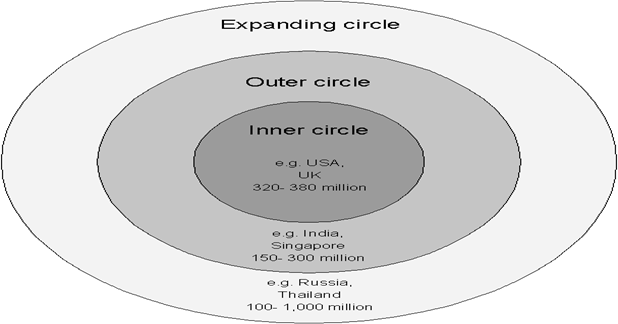
At the same time, the concept of global Englishes emphasizes communication and linguistic diversity, respectively, challenging traditional norms of Standard English. Standard English, traditionally associated with inner-circle countries, adheres to established rules of grammar, spelling, and pronunciation (Crystal, 2003). While the inner circle norms often serve as benchmarks for linguistic correctness, localized English varieties in the outer and expanding circles challenge this standardization. The outer- and expanding-circle varieties illustrate localized innovations that challenge these norms, underscoring the dynamic nature of English in global contexts. Critics argue that privileging native norms perpetuates linguistic inequality and undermines the creativity of non-native English speakers (Medgyes, 2017); however, in reality, and in many cases, inner circle varieties still set the norms, and there are some valid reasons for this. Therefore, despite some criticism regarding Kachru’s model for drawing geographic boundaries rather than linguistic ones, it appears that the model remains the norm in many cases, both within and outside language classes. Although ELF has gained a place in international communication and has a practical orientation, it often lacks the prestige and institutional support of Standard English, which can limit its applicability in formal or academic contexts (Jenkins, 2007).
English has emerged as a global language, and today, it functions as a primary medium of communication across diverse domains, including business, academia, international relations, and everyday interactions. However, the global dominance of English has sparked debates regarding its standardization, the legitimacy of linguistic diversity, and its practicality in language classes.
One perspective emphasizes English as a lingua franca (ELF), which prioritizes communicative effectiveness over strict adherence to native-speaker norms (Seidlhofer, 2011). This practical approach highlights the importance of intelligibility and communicative competence among speakers from diverse linguistic backgrounds. At the same time, and in line with ELF, WE being a sociolinguistic concept, rejects the notion of a single, correct standard language (Onysko, 2021) and instead celebrates the plurality of English varieties worldwide by focusing on its adaptation to local contexts cultures, and identities (Kirkpatrick, 2010). Together and despite their different perspectives, these concepts challenge traditional notions of linguistic hierarchy and raise questions about what constitutes "standard" English. In globalized settings of the modern world, English functions as a bridge language, facilitating interaction among speakers with diverse linguistic backgrounds. To complement these notions, in their book Global Englishes for Language Teaching, Rose and Galloway (2019) provide a detailed explanation of different terminology that is associated with the concept of WE and conclude that the umbrella word Global Englishes is a more inclusive terminology and creates “an inclusive paradigm of all shared ideologies” (p.13), which are ELF, English as an International Language and WE, not denying the importance of the multilingual term and translanguaging. They acknowledge that some other prominent scholars have used this term before them; however, their interpretations have not necessarily been as inclusive. They take a “curriculum perspective” and explore Global Englishes Language Teaching “by focusing on needs analysis, syllabus, methodology, assessment and curriculum evaluation” (p.29).
While proponents argue that global English empowers non-native speakers by validating their linguistic creativity and ownership of the language (Saraceni et al., 2021), its promotion is not without challenges. Critics caution that emphasizing localized varieties in educational contexts could hinder mutual intelligibility and limit learners' access to global opportunities (Khany & Beigi, 2024; Rojo, 2020). Balancing the celebration of diversity with the need for a shared standard remains a key challenge for educators and policymakers. These viewpoints eventually would have a direct impact on how a language class should be run. Lack of policies that support the concept of WE, as well as issues related to language and culture, language and identity, and the status of different dialects and accents within the inner circle and among English language speakers, are some of the concerns raised. Moreover, the pedagogical implications of WE are unclear to many language teachers.
Native vs. Non-Native English Language Teachers: A Balancing Act
Discussing issues related to WE and standard English has a direct impact on English language teachers and who is best qualified to teach the language. The debate surrounding native-speaker and non-native-speaker English teachers (NNSETs vs NSETs) is a complex one, with strong arguments on both sides. Traditionally, there was a clear preference for NS teachers, often based on assumptions about their innate language mastery and cultural understanding. However, recent years have seen a growing appreciation for the unique strengths of NNSETs, leading to a more nuanced understanding of teacher effectiveness.
On the one hand, native-speaker teachers are/were typically believed to possess a natural grasp of the language nuances, including slang, idioms, and subtle pronunciations, which they can readily share with students. Exposure to authentic speech patterns can be invaluable for learners seeking to achieve fluency. They can provide firsthand knowledge of the cultures associated with the language, enriching the learning experience beyond grammar and vocabulary. This cultural context can help students understand the complexities of language use in different social situations. Well-trained NNSETs, on the other hand, are thought to have more empathy and strong teaching methodology plus multicultural awareness, fostering a more inclusive and culturally sensitive learning environment. When it comes to teaching about language, many are believed to be competent (Mahboob, 2004; Medgyes, 2001).
Overall, with the emergence of concepts relating to Global Englishes, the binary juxtapositions, such as native and non-native language teachers, are also seen as problematic (Selvi et al., 2024). It is argued that these labels are not absolute indicators of teaching effectiveness. Ultimately, the best teachers, regardless of their native language background, share several key qualities. The most dominant characteristics are strong pedagogical skills, passion, enthusiasm, and willingness to continuously update their knowledge and skills.
Possessing pedagogic skills means having a strong understanding of language teaching methodologies and being able to adapt one's approach to diverse learning styles. As Dadvand and Behzadpoor’s (2020) study highlights nine main components of language teachers’ pedagogical skills: “knowledge of subject matter; knowledge of teaching; knowledge of students; knowledge of classroom management; knowledge of educational context; knowledge of democracy, equity and diversity; knowledge of assessment/testing; knowledge of learning; and knowledge of (professional) self” (p.122). Freeman et al. (2015) also believe that language teachers’ effectiveness should go beyond the level of the teachers’ general English proficiency and consider what type of classes the teachers are teaching. They argue that moving towards the concept of English-for-teaching, which refers to “the classroom language that teachers need to be able to use,” along with the skills that teachers should have to be effective, can reshape teacher training and development for most language classes taught by NNSETs. In another article, Freeman (2017) emphasizes the importance of teachers learning how to manage the classroom, understand and communicate lesson content, and assess and provide students with feedback.
Passion and enthusiasm are other essential qualities for all language teachers. Passionate teachers who genuinely enjoy sharing their knowledge can create a stimulating and motivating learning environment for students (Keller et al., 2013; Palmer, 2020).
Additionally, the best teachers are lifelong learners who actively seek out opportunities to enhance their knowledge and teaching skills. In Guskey’s (2002, p.383) words “the three major goals of professional development programs are change in the classroom practices of teachers, change in their attitudes and beliefs, and change in the learning outcomes of students”. In recent years, with the advancement of technology and online teaching, this area has become increasingly important and requires more attention. Teachers should be willing to learn how to leverage technology and develop their pedagogical skills and value systems in a way that aligns with the technological shifts.
Generally, it is essential to move beyond the simplistic "native vs. non-native" debate and focus on the individual qualities and capabilities of each teacher. The ideal learning environment should incorporate the advantages of both NS and NNSETs, focusing on providing students with a well-rounded and enriching educational experience.
Nevertheless, regardless of who teaches in the class and even the policies in place, teachers bring their own experiences and values to the class, both consciously and subconsciously. This is reflected in their use of language, body language, accent, life experiences, views of the world, views on education, and cultural values, background, work environment, as well as both collective and individual beliefs and decisions about learning (Opfer & Pedder, 2013). Being a native speaker does not make a language teacher a better teacher, nor does being a non-native speaker. Their priority should be considering the needs of the language learners. The same applies to anyone who uses English to convey a concept, an idea, or a piece of knowledge. Being a non-native speaker of English does not make their knowledge or the information they convey less valuable; however, the messages they try to convey should be intelligible and correctly understood by the listeners (Floris & Renandya, 2020). However, it is essential to learn the opinions of stakeholders and policymakers in order to make informed decisions that benefit all. Global Englishes is introducing new approaches for analyzing the concepts of native and non-native speakers, with a greater emphasis on the linguistic identities of teachers and contexts. A globalized mindset is seen as desirable. At the same time, in many cases, this is an ideal that is still not fully grasped by stakeholders and teachers, learners, and sometimes parents and school authorities may demand otherwise (Matikainen, 2018). The current study has taken a step towards understanding the views of the learners and teachers.
Method
Research Design
This study examines the perspectives of learners, teachers, and employers on Standard English and World English. Understanding their views can shed light on the obstacles to reforms (Ramanathan & Morgan, 2007) and provide the required support.
Theoretical Implications
The debates surrounding Global Englishes and Standard English highlight broader issues of linguistic equity and identity. While WE promotes inclusivity, it challenges traditional notions of correctness and prestige. ELF offers a pragmatic approach, but it risks being perceived as linguistically inferior. Standard English provides clarity and consistency but reinforces hegemonic norms. These theoretical tensions underscore the need for research that considers stakeholders’ practical needs and aspirations. Despite the argument that the dominance of standard English leads to the marginalization of non-native speakers and may reinforce linguistic hierarchies (Jenkins, 2007), the clarity, consistency, and perceived prestige (Crystal, 2003) that it provides still make it the preferred norm in many educational and non-educational contexts. As Hall et al. (2013, p. 5) put it, “practicing teachers, concerned as they are with the realities of the classroom, examination requirements, parents’ expectations, education department policies, etc.”, cannot fully embrace WE theories. These controversies and the clash between theories and practice were the initial drives for conducting the current study.
Research Questions
The main research question for the current study is:
Is there a consensus among stakeholders (language learners, teachers and employers) regarding the concept and learning of English as a global language?
To answer this question, the following three sub-questions had to be answered:
· What are the language learners’ preferences regarding learning what they consider standard vs non-standard English?
· What are the language teachers’ perceptions of Global Englishes in the classroom?
· What are the employers’ perceptions of Global Englishes for recruiting future employees?
Procedure
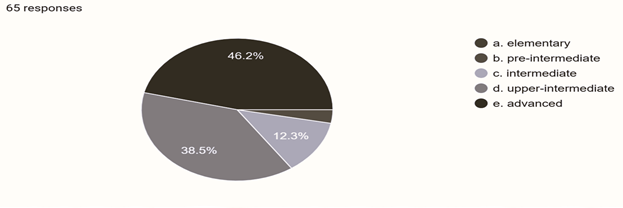
66 language adult learners from Uzbekistan and Iran, with the majority having intermediate and above English language proficiency (Figure 2), filled in a questionnaire regarding their viewpoints on the types of English they wished to learn. For all these learners, English was considered a foreign language.
Self-Reported English Language Proficiency Level
Twenty-nine language teachers and educators from diverse linguistic backgrounds working in Uzbekistan, Iran, Canada, Germany, and Australia also filled in another questionnaire that had been designed to clarify their viewpoints about Global English in their classrooms. Finally, two employers from international organizations who were required to hire candidates who were competent English language users took part in semi-structured interviews.
Learners and teachers completed structured questionnaires that were designed to capture their preferences and perceptions regarding English varieties, as well as their opinions on linguistic accuracy and acceptability. These questionnaires included Likert-scale items and open-ended questions, allowing participants to elaborate on their choices.
Semi-structured interviews were conducted with the two employers to collect qualitative data on recruitment procedures related to the use of English in their professional settings and organizational language policies. These interviews provided deeper insights into how English varieties are perceived and utilized in international workplace environments.
Participants were recruited through professional networks, academic institutions, and workplace contacts.
Quantitative data from the questionnaires were analyzed using descriptive statistics to identify trends in stakeholders’ attitudes. Qualitative data from open-ended responses and interviews were analyzed to uncover the respondents’ insights.
Ethical Considerations
Participants were informed about the purpose of the research, assured of their anonymity, and given the option to withdraw at any time. To ensure convenience and anonymity, questionnaires were distributed electronically. With the employers' consent, the interviews were recorded and later transcribed for analysis.
Results
Learners’ Perspectives
Learners completed a questionnaire regarding the type of English they preferred to learn and their justification for this preference. The questions directly and indirectly sought their opinions.
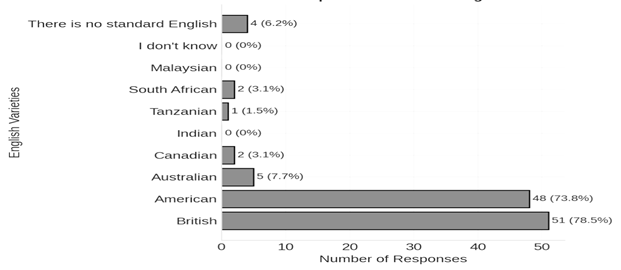
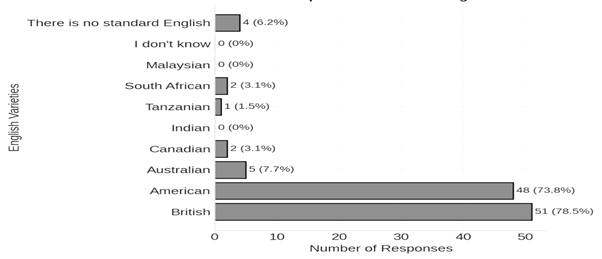
To begin with, when asked about what they considered to be Standard English, and if any, they would rather acquire, as Figures 3 and 4 demonstrate, the majority of the 66 respondents considered British and American English as standard and preferred to learn them. Only one had no preference and three admitted that they did not know what their preferences were. In the question regarding what they considered to be Standard English, they could select as many options as they wanted. In the other question, relating to the ones they would prefer to learn, they had the option of choosing up to three dialects.
Learners' Perceptions of Standard English
Learners' Preferred Dialect of English for Learning
To indirectly determine their understanding of the idea of WE another question was included. The question inquired about their opinions regarding learning English with an Indian accent if they were to live in India. In other words, the learners were asked if they would consider learning the Indian dialect of English if they were about to move and live in India.
Desire for Learning Indian Accent
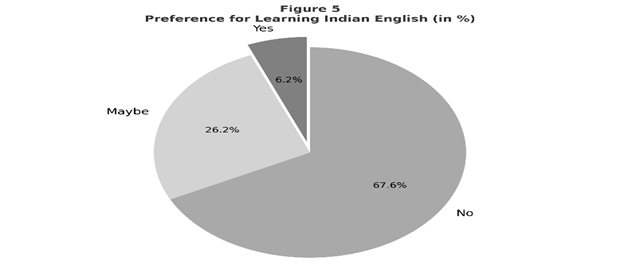
Figure 5 shows that a very small group would consider learning the Indian dialect of English. More than 67 percent would not even consider it.
Next, they were provided with a list of sentences to express their opinions about their preferences. As can be seen in Table 1, 96 percent prefer to have a native-like English accent, while the majority do not mind if their teachers have non-native-like accents. We had reasons for selecting Chinese, French, Persian, and Russian of all the other accents and dialects in the questions included. The reason for choosing Chinese in “Sentence d” was our understanding that there was some stereotyping around it and that some people may have difficulty understanding English with a strong Chinese accent. On the contrary, according to ChatGPT, having a French accent when speaking English sounds charming, pleasant, and even attractive to many native English speakers, who often associate it with sophistication and a touch of romanticism, probably due to cultural influences in the media and popular perception. We were curious to learn about the learners’ opinions and whether they would prefer it to have a Chinese accent. Persian was chosen since a group of respondents were Iranians, and Persian is their native language. Russian was also selected because it is a familiar accent to many Uzbekistanis who were among the respondents to the questionnaire.
Learners’ Views about Accents
|
Statement |
Agreement (%) |
|
a. It is fine if my English language teacher does not have a native-like English accent. |
70% |
|
b. I think I will have better job opportunities if I have a native-like English accent. |
65% |
|
c. I try to have a native-like English accent. |
96% |
|
d. It is fine if my English language teacher has a noticeable Chinese accent when speaking English. |
24% |
|
e. It is fine with me if my teacher has a noticeable Persian accent when speaking English. |
40% |
|
f. It is fine with me if my teacher has a noticeable Russian accent when speaking English. |
40% |
|
g. It is fine with me if my teacher has a noticeable French accent when speaking English. |
30% |
The findings of the questionnaire suggest that the majority of the respondents preferred Standard English (especially British and American varieties) due to the following assumptions:
- Opportunities: Standard English was seen as a gateway to academic and professional success.
- Prestige: Mastery of Standard English symbolized competence and social mobility.
- Concerns About WE: Learners worry that non-standard varieties might compromise their credibility and, once again, their opportunities.
Teachers’ Perspectives
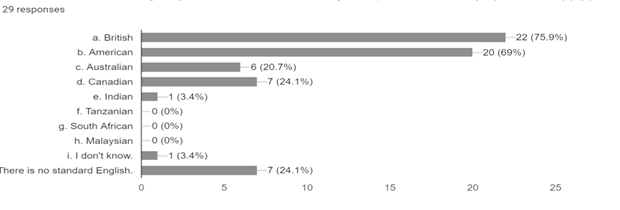
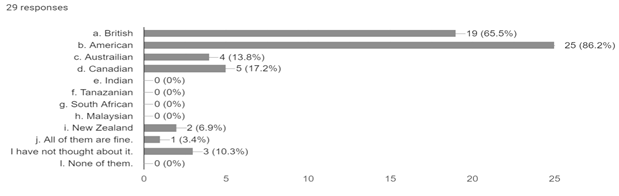
Twenty-nine English language teachers working in various contexts and countries agreed to complete the questionnaire. As Figure 6 shows, similar to the learners, the majority of the teachers considered British and American Englishes as the standard English. As Figure 7 suggests, again like the students, they preferred to follow these two dialects in their classes.
Teachers' Perceptions of Standard English Varieties
Teachers' Preferred Dialect of English for Teaching
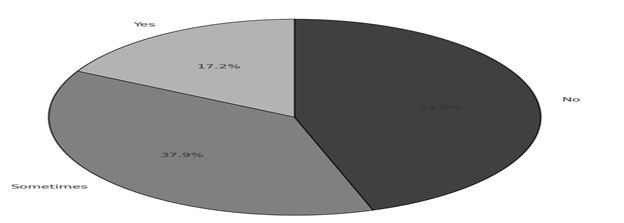
Interestingly, despite the fact that the majority preferred to use what they considered Standard English in their classes, 44 percent of the teachers believed that they did not encourage their students to follow a particular dialect of English (Figure 8).
Encouragement to Use Specific English Dialects
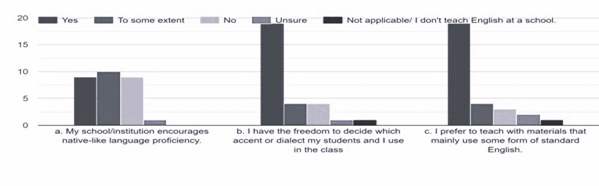
In addition, when asked about their school policies as presented in Figure 9, most of them (19 out of 29) reported that their workplace permitted the teachers to select the dialect they preferred to use in their classes.
Responses to Workplace Related Statement on Language Use and Policies
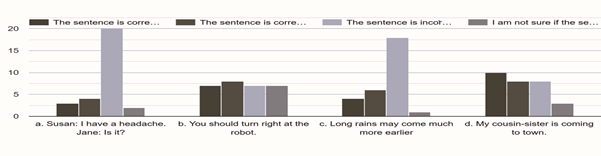
To gain a better understanding of the teachers’ practices, in another section of the questionnaire, the teachers were asked to comment on the accuracy of certain sentences. The sentences were all acceptable varieties of English in different contexts and were taken from the English used by what Kachru’s model considers as the English used by the outer circle English users. So, these sentences were not what is considered Standard English. The sentences are as follows:
· Sentence a: Susan: I have a headache.
Jane: Is it?
Using this type of question tag is common in South African English.
· Sentence b: You should turn right at the robot.
Robot means traffic light in South African English.
· Sentence c: Long rains may come much more earlier.
Using double comparatives is common in Tanzanian English.
· Sentence d: My cousin-sister is coming to town.
Cousin-sister is mainly used in Indian English.
The findings suggest that most teachers considered most of them unacceptable (Figure 10).
Responses to Sentence Correctness
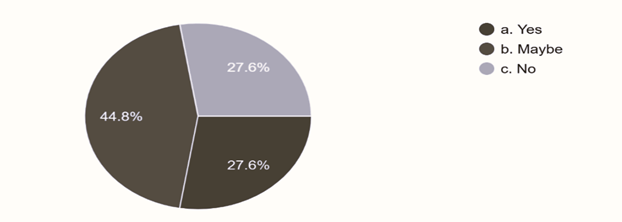
The final part of the questionnaire posed a more direct question to the teachers regarding Global Englishes. They were invited to express their opinions about varieties of English, such as Uzbek, Persian, Thai, Russian, and German, and whether these should be considered acceptable forms of English. The responses from the majority show that they are undecided or disagree, and only about 28 percent think they are acceptable (See Figure 11).
Opinions About Acceptable English Dialects
All in all, teachers highlighted the following concerns:
- Practicality: Standard English was prioritized for its utility in formal contexts. They were concerned that the learners might not be able to communicate effectively or might even fail their exams.
- Challenges with WE: Although they accept learners’ differences in terms of their accents and language use, incorporating WE into curricula poses difficulties in maintaining intelligibility and meeting learner expectations. They still prefer coursebooks designed in the UK or US Englishes and would still find certain varieties unacceptable in their classes.
- Cultural Influences: Teachers’ linguistic backgrounds shaped their views, with non-native teachers favoring Standard English for its reliability.
Employers’ Perspectives
Two employees who were involved in recruiting new staff members were also invited to highlight their organizations’ priorities and preferences in terms of English language proficiency when needed. One worked for a transnational university and the other one for an international organization. Both explained that their workplaces were quite flexible in terms of English language proficiency and accents. As soon as the intelligibility of the would-be employee when speaking English was established during the interviews, they would examine their expertise for the job they were to be hired for and would not require specific language exams.
Both admitted that non-standard accents and writing occasionally caused communication difficulties in academic settings. The university encourages academics to publish, and since they are mainly aiming for SCOPUS journals, the majority of publications are done in English journals that obviously have certain language criteria. In other organization for highly sensitive documents, they would hire a professional language editor to enhance the quality and make the documents closer to what they considered the standard English of their organization.
According to the interviewee who worked at the transnational university, the analysis of the end-of-term feedback provided by students about their lecturers who were non-native speakers of English suggested that, despite their expertise in the field, many students complained about the incomprehensibility of their accents.
To sum up, employers had no objection to employing non-native English speakers and emphasized that there was flexibility, with communicative competence taking precedence over strict adherence to Standard English norms. At the same time, in both organizations British spelling and standardized language, editing was prioritized in formal documents.
Comparing the Perspectives of the Three Groups
Overall, across all three groups, there is a shared recognition of English as a global language; yet, perspectives differ on how strictly English norms should be upheld. Teachers predominantly advocate for maintaining traditional English standards, with British and American English perceived as the most appropriate models. Some show openness toward dialectal variations but still emphasize pronunciation accuracy. Students demonstrate more flexibility, with many supporting World Englishes and recognizing non-native English varieties as valid linguistic expressions, though British and American English remain the preferred accents. Employers’ opinions align more closely with students’ perspectives, as they prioritize communicative competence over accent perfection and express no objection to hiring non-native English speakers. However, both organizations maintain British spelling and standardized editing in formal documents, reinforcing the importance of linguistic consistency in professional settings. This suggests that while spoken English accommodates flexibility, written English in business environments retains traditional norms, bridging global communication with standardized professionalism.
Discussion
Stakeholders largely favored Standard English for its clarity, prestige, and practicality. The majority of learners associated Standard English with opportunities for success and expressed reservations about learning non-standard varieties. They were unwilling to consider learning English dialects that deviate from the norm. This sentiment was echoed by teachers, who, despite being more open-minded about the concept of WE, still did not accept non-standard variations of English as correct. Teachers preferred coursebooks and curricula that adhered to Standard English rules. Similarly, employers prioritized communicative competence but maintained a preference for standard norms in formal documentation and professional communication, as demanded by their organizations.
These findings align with previous research indicating that learners prioritize Standard English for its perceived clarity, prestige, and utility (Crystal, 2003). Their apprehension toward WE suggests that their experiences or fears are shaped by what they believe occurs outside their classrooms and schools. Teachers and curriculum designers may need to balance the teaching of Standard English with an awareness of WE to prepare learners for diverse linguistic realities. Teachers’ preference for Standard English reflects their alignment with learner expectations and institutional demands. This finding is consistent with Medgyes’ (2017) assertion that Standard English serves as a practical teaching model.
Employers’ preferences underscore the dual role of English as a tool for communication and a marker of professionalism. While employers value functional language skills, their emphasis on standardization in specific contexts aligns with learners’ and teachers’ preferences for Standard English. The findings highlight the need for teacher training to address WE inclusively, enabling teachers to navigate the tensions between standardization and linguistic diversity. To achieve this, teachers require suitable training. However, unless schools, universities, and workplaces revise their policies and address public attitudes and stereotyping, teachers alone will be unable to enact major shifts. The washback effect of standardized tests remains a reality, compelling teachers to prepare students for these assessments (McKinley & Thompson, 2018).
All in all, the findings suggest that the globalization of the English language has sparked widespread debate regarding the appropriate approach to teaching it in educational settings. While the emergence of WE reflects the evolving dynamics of English use across diverse cultural and linguistic contexts, depriving language learners of access to standard English risks limiting their social, academic, and professional opportunities. Standard English—often associated with varieties such as American or British English—remains the dominant form in many global contexts. It serves as the linguistic currency in international business, academia, and diplomacy. By not equipping learners with a standardized form of English, educators may inadvertently restrict their ability to navigate global networks or pursue advanced studies. Many universities demand proficiency in a version of English that adheres to established norms, underscoring the practical necessity of teaching standardized English in classrooms.
The explicit teaching of WE in language classrooms introduces significant challenges. First, it can pose risks to mutual intelligibility, as learners may adopt localized pronunciations, grammar structures, or idiomatic expressions unfamiliar to speakers from other regions. This lack of uniformity could hinder effective communication in multicultural and international settings. In our study, almost all the teachers found at least some of the sentences that were not from the Inner-Circle model to be inaccurate. Second, learners who require a standardized form of English for specific purposes, such as academic writing or corporate communication, may find themselves disadvantaged. A focus on diverse English varieties might blur the boundaries between accurate and inaccurate usage, creating confusion about what constitutes correct grammar, syntax, and vocabulary in particular contexts. Third, emphasizing WE could lead to a loss of cultural identity for learners. Language acquisition often entails engaging with the cultures associated with that language. A focus on global varieties might dilute these connections, complicating learners’ efforts to integrate cultural context into their communication. For many, learning a standardized form of English is not merely a linguistic endeavor but also an entry point into global cultural norms (Crystal, 2003). Language, at its core, is a means of communication—a tool to foster understanding between people. Despite the forces of globalization and increased interactions between nations, culture remains an inherent part of communication (Hofstede, et al., 2010). Learners’ ability to communicate effectively depends not only on their linguistic proficiency but also on their cultural competence. Teaching English, therefore, involves more than imparting linguistic skills; it requires fostering awareness of the cultural nuances that shape communication.
The social, political, economic, and technological developments shaping the modern world have a profound impact on language use, including English. As noted by Rojo (2020), meaningful changes in language education cannot occur without corresponding social changes. For example, the global dominance of English is intricately tied to historical power structures, economic globalization, and the rise of digital communication platforms. However, while these forces drive linguistic evolution, the classroom must balance adapting to these changes with ensuring learners are equipped for current realities. Pedagogical practices that embrace WE must be implemented cautiously, ensuring that they do not compromise students’ access to opportunities that require standardized English.
All in all, as the findings of this study demonstrate, while WE reflects the reality of English as a global lingua franca, the practical advantages of mastering a standardized form of the language cannot be overlooked. Educators must navigate this complexity by balancing inclusivity with pragmatism, equipping learners with tools for effective global communication and the cultural competence needed in an interconnected world. The path forward requires an adaptive pedagogy that reflects linguistic diversity while maintaining clarity, accuracy, and accessibility. Changes in the classroom cannot occur without broader social changes (Rojo, 2020).
Implications for Language Education
Studies on Global Englishes, including the current study, have important implications. The findings highlight the need for balanced approaches to English language teaching. While Standard English remains the preferred benchmark, incorporating WE in curricula can help learners understand the global diversity of English use. Such integration must be approached carefully to maintain intelligibility and address stakeholders’ practical needs. Teacher training programs should focus on equipping educators with the skills to navigate the complexities of linguistic diversity. This includes fostering awareness of WE while retaining the clarity and consistency associated with Standard English. Employers can also promote inclusivity in professional communication to address challenges arising from non-standard accents and linguistic variation. Addressing biases against non-standard accents in recruitment and workplace communication is equally essential.
Even though teachers need to promote diversity, they face constraints, including preparing learners for standardized exams, meeting learner demands, and contending with their own experiences of discrimination. Therefore, encouraging policymakers and authorities in educational organizations to revisit their criteria is crucial. Preparing coursebooks that accommodate the needs of both the learners and their teachers can also contribute to paving the way for greater flexibility.
Future Directions
Teacher training programs should focus on equipping educators with skills to navigate the complexities of linguistic diversity. This includes fostering awareness of WE while retaining the clarity and consistency associated with Standard English. For employers, promoting inclusivity in professional communication can help address challenges arising from non-standard accents and linguistic variation. Tackling biases against non-standard accents in recruitment and workplace communication can also assist in improving the situation.
Given the dynamic nature of English and its role in globalization, further research is needed to explore:
- The concept of owning the English language by all regardless of their nationalities. Is it something that the stakeholders desire?
- How learners’ perceptions of WE evolve as they gain exposure to diverse English varieties.
- The long-term impacts of integrating WE into language education on learners’ communicative competence and confidence.
- The role of technological advancements, such as AI translation tools, in bridging linguistic gaps in professional and educational contexts.
Conclusion
There is no denying that WE is a reality. It is also impossible and undesirable to expect every non-native English teacher and every English language learner to become a native speaker of British or American English. Every teacher brings their own experience, culture, and background to the class, and so does every learner. English as a lingua franca is an undeniable means of communication at present, and the world uses English for communication. While Standard English continues to dominate as the preferred model for teaching and learning, acknowledging and integrating linguistic diversity is essential to reflect the realities of a globalized world. Striking this balance will empower educators and professionals to navigate the complexities of English as a truly international language.
Our small data suggests that the inner circle English is still considered Standard English among the stakeholders, and this is the main variety they demand to learn and teach. This is while the majority of the stakeholders seem to have some understanding of the concept of linguistic diversity. However, as it is, it seems that WE should not be promoted as a norm for teaching English for the time being. Depriving language learners of learning Standard English still deprives them of many opportunities. Explicit teaching of WE can pose challenges to mutual intelligibility, disadvantage learners who require a standardized form of English, blur the lines between accurate and inaccurate communication, and lead to a loss of cultural identity. Language is meant to be a means of communication through which people understand each other. Despite globalization and increased interactions between nations, culture remains an inherent part of communication.
Finally, the world’s social, political, economic, and technological developments affect language use, including the use of the English language. Changes in the classroom are only effective when changes take place outside of the classroom.
References
Crystal, D. (2003). English as a global language. Cambridge University Press. https://doi.org/10.1017/CBO9780511486999
Dadvand, B., & Behzadpoor, F. (2020). Pedagogical knowledge in English language teaching: A lifelong-learning, complex-system perspective. London Review of Education, 18(1), 107–125. https://doi.org/10.18546/LRE.18.1.08
Floris, F. D., & Renandya, W. A. (2020). Promoting the value of non-native English-speaking teachers. Pasaa, 59(1), 1–19. https://doi.org/10.58837/CHULA.PASAA.59.1.1
Freeman, D. (2017). The case for teachers’ classroom English proficiency. RELC Journal, 48(1), 31–52. https://doi.org/10.1177/0033688217691073
Freeman, D., Katz, A., Garcia Gomez, P., & Burns, A. (2015). English-for-teaching: Rethinking teacher proficiency in the classroom. ELT Journal, 69(2), 129–139. https://doi.org/10.1093/elt/ccu074
Guskey, T. R. (2002). Professional development and teacher change. Teachers and Teaching, 8(3), 381–391. https://doi.org/10.1080/135406002100000512
Hall, C. J., Wicaksono, R., Liu, S., Qian, Y., & Xiaoqing, X. (2013). English reconceived: Raising teachers’ awareness of English as a ‘plurilithic’ resource through an online course. ELT Research Papers, 13–05. https://www.teachingenglish.org.uk/sites/teacheng/files/D053%20Raising%20teachers%20awareness%20of%20English_ONLINE%20FINAL.pdf
Hofstede, G., Hofstede, G. J., & Minkov, M. (2010). Cultures and organizations: Software of the mind. McGraw-Hill.
Jenkins, J. (2007). English as a lingua franca: Attitude and identity. Oxford University Press.
Kachru, B. B. (1985). Standards, codification and sociolinguistic realism: The English language in the outer circle. In R. Quirk & H. Widdowson (Eds.), English in the world: Teaching and learning the language and literatures (pp. 11–30). The British Council.
Keller, M. M., Neumann, K., & Fischer, H. E. (2013). Teacher enthusiasm and student learning. https://www.researchgate.net/publication/277015929
Khany, R., & Beigi, M. (2024). A forty-year systematic review of WE: Implications for teaching, learning, and language policy. Teaching English as a Second Language Electronic Journal (TESL-EJ, 28)(2). https://doi.org/10.55593/ej.28110a1
Kirkpatrick, A. (2010). World Englishes: Implications for international communication and English language teaching. Cambridge University Press.
Mahboob, A. (2004). Native or non-native: What do the students think? In Learning and teaching from experience (pp. 121–147).
Matikainen, T. (2018). Beyond the native speaker fallacy: Internationalizing English-language teaching at Japanese universities. In P. Wadden & C. Hale (Eds.), Teaching English at Japanese universities (pp. 174–179). Routledge.
McKinley, J., & Thompson, G. (2018). Washback effect in teaching English as an international language. In J. I. Liontas (Ed.), The TESOL encyclopedia of English language teaching (pp. 1–12). Wiley-Blackwell.
Medgyes, P. (2001). When the teacher is a non-native speaker. In Teaching English as a second or foreign language. Heinle & Heinle.
Medgyes, P. (2017). The non-native teacher. In J. I. Liontas (Ed.), The TESOL encyclopedia of English language teaching (pp. 1–6). Wiley-Blackwell. https://doi.org/10.15639/teflinjournal.v29i2/149-154
Onysko, A. (2021). World Englishes. In K. Aijmer & C. Rühlemann (Eds.), The Cambridge handbook of English linguistics (pp. 257–274). Cambridge University Press.
Opfer, V. D., & Pedder, D. (2013). Teacher change and changing teachers via professional development. In Teachers learning: Professional development and education (pp. 93–117).
Palmer, D. (2020). Teacher enthusiasm and student motivation for learning. Global Journal of Educational Studies, 6(1), 40.
Ramanathan, V., & Morgan, B. (2007). TESOL and policy enactments: Perspectives from practice. TESOL Quarterly, 41(3), 447–463.
Rojo, M. (2020). Language and globalization: The tension between standard English and world Englishes in language education. Language, Culture and Curriculum, 33(2), 113–127. https://doi.org/10.1080/07908318.2020.1730664
Rose, H., & Galloway, N. (2019). Global Englishes for language teaching. Cambridge University Press.
Saraceni, M., & Moore, D. (2021). Global Englishes for language teaching. Routledge.
Seidlhofer, B. (2011). Understanding English as a lingua franca. Oxford University Press.
Selvi, A. F., Yazan, B., & Mahboob, A. (2024). Research on “native” and “non-native” English-speaking teachers: Past developments, current status, and future directions. Language Teaching, 57(1), 1–41.
Tupas, R. (2024). Unequal Englishes in the linguistic landscape: Tracing desires, ideologies, and class through public signs. University College London Journal of Education, Language, and Ideology, 2(1), 1–17. https://jelipub.com/wp-content/uploads/2024/10/Tupas_2024_Unequal_Englishes_In.pdf

Page 1 of
Download Count : 24
Visit Count : 131
Keywords
English as a Lingua Franca (ELF); World Englishes (WE); Global Englishes (GE); Stakeholders’ views; Native-speaker English teachers (NSET); Non-native speaker English teachers (NNSET)


Author(s) Information



How to cite this article
Arfa-Kaboodvand, M., & Akbarova, S. (2025). Stakeholders’ perspectives on teaching English as a global language. Studies in Educational Management, 17, 62-80. https://doi.org/10.32038/sem.2025.17.04
Acknowledgments
Not applicable.
Funding
Not applicable.
Conflict of Interests
No, there are no conflicting interests.
Open Access
This article is licensed under a Creative Commons Attribution 4.0 International License, which permits use, sharing, adaptation, distribution and reproduction in any medium or format, as long as you give appropriate credit to the original author(s) and the source, provide a link to the Creative Commons license, and indicate if changes were made. You may view a copy of Creative Commons Attribution 4.0 International License here: http://creativecommons.org/licenses/by/4.0/