







Original Research
An Empirical Study of UTAUT Model on the Adoption of AI Technologies in Vietnamese Higher Education


- Abstract
- Full text
- Metrics
In recent years, the development of AI-powered applications has sparked a wave of innovation across multiple disciplines, including education. In addition, Vietnam's education has been oriented to promote the development and study of AI applications towards specific targets for the year 2030, as set out in Decision No. 127/QD-TTg dated January 26, 2021, and Resolution 57-NQ/TW. However, this integration progress has stumbled over multiple challenges in the past few years due to many external and internal elements. In particular, Vo and Nguyen (2024) noted that although the reliability of answers from AI models like ChatGPT remains questionable, most surveyed Vietnamese university students found them approachable and easy to use. Another study by Maheshwari (2023) asserted that assessment methods, test instructions, and educators’ approaches also need appropriate adjustments to align with these technological advancements. Therefore, this paper aims to investigate the factors influencing the introduction of AI technologies into universities in Vietnam using an integrated model proposed by Sharma and Singh (2024). Built on renowned theories such as the Technology Acceptance Model (TAM), the Unified Theory of Acceptance and Use of Technology (UTAUT), and Perceived Organizational Support (POS), this model provided more comprehensive insights into the adoption of AI technologies in Vietnam. The results support the suggested hypotheses and recommend appropriate strategies for university students, academic staff, and policy makers for future use.
An Empirical Study of UTAUT Model on the Adoption of AI Technologies in Vietnamese Higher Education
Minh Nguyen-Dong
WESTERN SYDNEY UNIVERSITY, Australia
ABSTRACT
In recent years, the development of AI-powered applications has sparked a wave of innovation across multiple disciplines, including education. In addition, Vietnam's education has been oriented to promote the development and study of AI applications towards specific targets for the year 2030, as set out in Decision No. 127/QD-TTg dated January 26, 2021, and Resolution 57-NQ/TW. However, this integration progress has stumbled over multiple challenges in the past few years due to many external and internal elements. In particular, Vo and Nguyen (2024) noted that although the reliability of answers from AI models like ChatGPT remains questionable, most surveyed Vietnamese university students found them approachable and easy to use. Another study by Maheshwari (2023) asserted that assessment methods, test instructions, and educators’ approaches also need appropriate adjustments to align with these technological advancements. Therefore, this paper aims to investigate the factors influencing the introduction of AI technologies into universities in Vietnam using an integrated model proposed by Sharma and Singh (2024). Built on renowned theories such as the Technology Acceptance Model (TAM), the Unified Theory of Acceptance and Use of Technology (UTAUT), and Perceived Organizational Support (POS), this model provided more comprehensive insights into the adoption of AI technologies in Vietnam. The results support the suggested hypotheses and recommend appropriate strategies for university students, academic staff, and policy makers for future use.
Keywords: TAM, UTAUT, POS, Higher Education in Vietnam
The global bloom of Artificial Intelligence (AI) technologies has brought changes to education systems. AI’s “algorithmic power” supports learning across many fields through content delivery, feedback provision, and progress supervision (Chen et al., 2022). Using AI-supported education systems, teachers can make lectures more personalized, intriguing, and engaging for learners (Luckin & Holmes, 2016), addressing multiple problems in traditional classrooms.
In the higher education setting, AI can be used as an Intelligent Tutoring System (ITS) (AlShaikh & Hewahi, 2021), in e-learning platforms, in automated grading systems (Gobrecht et al., 2024), and chatbots (Rahim et al., 2022). Therefore, these applications not only contribute significantly to providing better learning environments, in which teaching deliverables, learning pace, and teaching methodologies can all be adjusted to meet students', lecturers', and institutions’ needs.
AI-supported learning platforms are capable of personalizing education by using the real-time data of learners (Nguyen & Hoang, 2024). This is possible because AI can continuously learn and adapt without the need for additional programming (Sharma & Singh, 2025). Moreover, because of its ability to continuously learn, individual flaws and difficulties can be analyzed and addressed immediately. Regarding lecturers, Huynh et al. (2024) stated that AI helps them brainstorm ideas, grade papers, improve their writing, and prepare teaching deliverables.
Previous studies have explored factors affecting AI adoption in universities in Vietnam using various types of models. A study by Phuoc (2022) found that, despite the insignificant impact of organization size on AI adoption, other factors in the technology–organization–environment (TOE) model were all important. Nguyen et al. (2025) implied that in Vietnam, 5 factors mainly affect the adoption of AI technologies: Institutional strategy and implementation support; Perceived usefulness; Perceived ease of use; Technological skill; and Perceived need to use. This statement also aligns with the Unified Theory of Acceptance and Use of Technology (UTAUT) model by Venkatesh et al. (2003). Dang et al. (2024) proposed an integrated framework for the assessment of AI adoption in Vietnam, incorporating the Technology Acceptance Model (TAM), the Technological Pedagogical Content Knowledge (TPACK) model, and the Unified Theory of Acceptance and Use of Technology (UTAUT) model, however, the framework has not yet been validated.
And although AI offers a wide range of benefits, shortcomings related to information quality, data privacy, work ethics, and more should not be overlooked. In a recent study, Sharma and Singh (2024) made adjustments to the original UTAUT model by Venkatesh et al. (2003) to test multiple hypotheses and specifically assess AI technology adoption in India. Moreover, this model also captured the effects of external and internal factors on the continuance intention to use AI of students and academic staff in universities. Based on empirical evidence, the models used in Vietnam left out specific challenges and risks, and their effects on AI adoption, user satisfaction, and continuance intention; therefore, this model is expected to provide a more comprehensive perspective for stakeholders in higher education settings.
Literature Review
In the current context, AI, especially generative AI, is emerging as a technology with potential in higher education. Generative AI tools such as ChatGPT, Gemini, and Sora have the potential to support lecturers and students in designing learning materials, personalizing teaching content, evaluating results, and conducting scientific research (Nguyen et al., 2025). Despite these benefits, the adoption and use of AI in higher education still face many challenges (Sharma & Singh, 2024). In Vietnam, these challenges are even more pronounced as many lecturers still struggle with digital literacy, infrastructure is not yet synchronized, and there is a lack of specific policies guiding the application of AI in teaching (Dang et al., 2024). Therefore, studying the factors influencing AI adoption in Vietnamese higher education is necessary to provide a scientific basis for education managers and policymakers in developing digital transformation strategies suitable to the domestic context.
When assessing the adoption of new technologies in the educational environment, many classic theories can be used, namely the Technology Acceptance Model (TAM), Diffusion of Innovation Theory (DOI), Technological Pedagogical Content Knowledge (TPACK), Unified Theory of Acceptance and Use of Technology (UTAUT), and many others (Dang et al., 2024).
In their paper, Dang et al. (2025) noted that the UTAUT model offers a comprehensive analysis of consumer behavior. While this is also confirmed by Sharma and Singh (2024), who stated that the UTAUT model has superior explanatory power compared to previous models, regarding the model's limitations, empirical evidence indicates that it fails to take human values , such as emotions, beliefs, and behaviors, into account.
Because of this characteristic of the UTAUT model, many studies have sought to apply other theoretical frameworks to supplement or adjust the survey variables to improve the model. It is noteworthy that among the references in Vietnam, none mention the Perceived Risk (PR) variable, whereas the international literature considers it an important factor influencing the adoption of new technologies. According to Sharma and Singh (2024), although further research is needed to better understand it, Perceived Risk (PR) influences Customer Satisfaction (SAT) and Continuance Intention (CI). For this reason, the UTAUT model proposed by Sharma and Singh (2024) has yielded results on future behavior regarding maintaining AI application use, in contrast to the opinion of Dang et al. (2024) that this model does not reflect customers' long-term usage intentions.
The Sharma and Singh (2024) model is adopted in this study because there is a strong similarity between the current educational context of Vietnam and India, as both governments are striving to improve the quality of education through the application of new technologies. However, in the same paper, the authors raise a concern that this model still needs to be validated and adjusted to suit different contexts to ensure its validity and suitability for the respective country.
Since this study builds upon the work of Sharma and Singh (2024), it will also apply eight theories, namely The motivational model, the TAM, the Theory of Planned Behavior (TPB), the Social Cognitive Theory, the Theory of Reasoned Action (TRA), the Innovation Diffusion Theory, the Model of PC Utilization, and the Task-Technology Fit.
Therefore, this study proposes an integrated research model in which Perceived Organizational Support (Pos), Perceived Ease of Use (PEU), Perceived Risk (PR), and Performance Expectancy (PE) are considered as antecedent factors influencing AI adoption in higher education. Furthermore, student and faculty satisfaction is considered to influence the adoption and use of AI tools, and satisfaction mediates the intention to continue using AI, or Continuance intention (CI). This research model not only draws on the theoretical foundations of TAM and UTAUT but also provides a new survey instrument, thereby reflecting the context of Vietnamese higher education in the digital transformation and AI application phase.
Perceived Organizational Support (POS)
The concept of POS, proposed by Eisenberger et al. (1986), describes the extent to which employees perceive that an organization values their contributions and cares about their well-being. This factor has been repeatedly confirmed to have a strong impact on an organization's attitude toward adopting new technologies (Soomro et al., 2026). A study of professionals in various fields, including the higher education sector, showed that this factor has the potential to reduce employees' AI anxiety (Elfar, 2025). Furthermore, a similarly defined factor, Institutional strategy and implementation support, in a study in Vietnam also showed high reliability and a positive influence on the adoption and use of AI tools in the educational environment (Nguyen et al., 2025). In a study on AI adoption in Indian higher education, Sharma and Singh (2024) found that POS positively influences AI adoption, highlighting the role of the organizational environment in developing countries. However, this relationship still needs to be re-examined in the context of Vietnamese education. Based on the theoretical arguments and empirical evidence presented above, this study proposes the following hypothesis:
H1: POS has a positive effect on AI adoption in higher education.
Perceived Ease of Use (PEU)
PEU was defined by Davis (1989) as the degree to which an individual believes that using a technology system will not require much effort in the TAM. In their study, Alshammari and Babu (2025) found that PEU and PU significantly influence user satisfaction with AI, thereby affecting the intention to continue using these tools. This was also confirmed by Hussain et al. (2025) in a survey of hospital healthcare workers. In higher education, AI tools are often perceived as highly complex technologies that require appropriate knowledge and teaching skills. Therefore, when instructors perceive AI tools as easy to learn, use, and integrate into teaching activities, the likelihood of AI adoption and application will increase significantly (Dang et al., 2024; Davis, 1989; Sharma & Singh, 2024). Based on the theoretical arguments and empirical evidence presented above, this study proposes the following hypothesis:
H2: PEU has a positive effect on AI adoption in higher education.
Perceived Risk (PR)
PR is defined by Li (2025) as the potential negative outcomes customers perceive when new technologies are introduced. Meanwhile, Alzaabi and Shuhaiber (2022) noted that perceived risks can negatively impact AI adoption in organizations, particularly in terms of “security, privacy, and technical risks.” Similarly, Kesharwani and Singh (2012) also made a similar observation that perceived risk negatively affects the intention to use technology in organizations. However, in addition to the listed risks, Sharma and Singh (2025) added financial risks to better reflect the survey reality in educational institutions. In the context of higher education in Vietnam, although numerous empirical studies have been presented, the models and studies have not been explored in depth. Based on that, this study proposes the following hypothesis:
H3: PR has a significant influence on the adoption of AI in higher education.
Performance Expectancy (PE)
Venkatesh et al. (2003) defined PR as the degree of increase in their work efficiency achieved by adopting a new technology. This definition is also applied in Venkatesh's (2022) study, which conducted surveys on AI applications in the modern era. Rahi et al. (2019) demonstrated that PE and EE are important factors with a statistically significant influence on the adoption of internet banking technology, while Abbad (2021) made the same claim among university students in Jordan. When technology users, specifically university students and faculty, perceive the benefits of AI, they tend to accept and be more open to using these new tools for educational purposes. Based on that, this study proposes the following hypothesis:
H4: PE positively and significantly influences the adoption of AI in higher education.
Adoption of Artificial Intelligence (AIA)
Besides the listed factors that affect the adoption of AI in educational institutions, namely POS, PEU, PR, PE; many other factors such as work experience, organizational supportive policies, users’ attitude towards its usability and cultural factors, were also proved to be significant (Sharma & Singh, 2025). Moreover, in the original study, the lack of evidence regarding the connection between adopting new technologies, specifically artificial intelligence in this context, was cited to justify the use of an AIA variable in the model. After thorough consideration, this issue also appears in studies in Vietnam and therefore requires further evaluation. Consequently, this study also proposes the following hypothesis:
H5: AIA in higher education leads to customer satisfaction (SAT).
Satisfaction (SAT)
As Sharma and Singh (2025) stated, in studies on technology acceptance, SAT was conceptualized as a three-dimensional construct comprising psychological, behavioral, and technical aspects. Among university students and lecturers, studies have pointed out variables that affect user satisfaction about new technologies as PU (Davis, 1989), ease of use (Venkatesh & Davis, 2000), and attitude towards technology, which influences customers’ satisfaction and intention to continue using it (Ajzen & Fishbein, 1980). The link between customers’ satisfaction and PEU was again confirmed by Calvo-Porral et al. (2017). Khan et al. (2023) also found that librarians with better leadership support develop greater productivity and an intention to use the technology. Besides, Sebetci (2018) mentioned that other variables, namely “information quality, system quality, support resources, and technologies’ compatibility” also contribute to user satisfaction. Furthermore, the degree of satisfaction closely connects with user competence (Al-Fraihat et al., 2020) and future usage intentions (Venkatesh et al., 2011). Therefore, this study also uses the following hypothesis:
H6: SAT obtained from using AI in higher education leads to CI.
Continuance Intention (CI)
CI represents the degree to which users intend to continue using the technology in the long term (Bhattacherjee, 2001). According to Sharma and Singh (2025), Bhattacharjee’s Expectation Confirmation Model (ECM) showed that the CI of technology users was highly affected by their level of satisfaction. Empirical evidence indicates that satisfaction affects users' continuance intention not only directly but also indirectly through their habits (Mouakket, 2015; Tam et al., 2020), affective commitment, hedonic values (Franque et al., 2021), and enjoyment (Joo et al., 2017). Al-Samarraie et al. (2018) suggested the need for further investigation into how satisfaction with technology use can affect the continuance intention of university institutions.
Method
Research Design
This study aims to analyze the factors influencing the adoption of artificial intelligence in higher education environments in Vietnam. To do this, a quantitative research method was used to identify correlations among variables under natural conditions, without external influences, thereby ensuring the validity of the data collected from the research subjects.
Due to the complexity of the UTAUT model and the required sample size, this study uses the Partial Least Squares Structural Equation Modeling (PLS-SEM) method as the primary method for data analysis. Hair et al. (2017, 2011) confirmed the effectiveness of this model in analyzing a complex model with a small sample size.
Data Collection
Primary data were collected through a structured online survey targeting two main groups at universities: students and faculty. These two groups of subjects can be considered the main stakeholders in the deployment of AI applications in higher education in Vietnam.
This study applied a random sampling method to both groups of subjects. Online surveys were randomly sent to Vietnamese students and lecturers (see Appendix 1). Specifically, after data cleaning by removing blank or incomplete responses, only 59 valid responses remained. The survey was completed by a total of 28 students and 31 lecturers at universities in Vietnam. While relatively small compared to an empirical study, this still yielded acceptable results for the PLS-SEM model, with the sample size being more than 10 times the number of structural relationships directed towards the dependent variable with the most paths in the model (Hair et al., 2017).
Instruments
The questionnaire was used as a data collection tool, with questions already used and validated in the study by Sharma and Singh (2024). The questions have been translated into Vietnamese to ensure relevance to the research context of this paper (see Appendix 2 and 3).
All observed variables were measured using a 5-point Likert scale, where 1 represents “Completely Disagree” and 5 represents “Completely Agree” (see Appendix 3). Before the questionnaire was officially distributed, the questions were reviewed to ensure clarity, comprehensibility, and relevance to the research subjects. The observed variables representing the concepts studied, namely Perceived Organization Support (POS), Perceived Ease of Use (PEU), Perceived Risk (PR), and Performance Expectancy (PE), are inherited from the study by Sharma and Singh (2024).
Data Analysis
The collected data were analyzed using SmartPLS software. The PLS-SEM analysis process was performed in two main stages: (1) assessing the reliability and validity of the measurement model and (2) evaluating the structural model using partial least squares structural equation modeling, also according to the original study by Sharma and Singh (2024). In addition, due to the nature of the sample in this study, the Bootstrapping technique was also applied to assess the path coefficients’ significance, heterotrait-heteromethod correlations, and statistical significance, as suggested by Hair et al. (2017, 2011).
Results
As shown in Table 1, among participants, only 1.7% held a doctoral degree, 54.2% a bachelor's degree, and 44.1% a master's degree. There were a total of 28 (47.5%) students and 31 (52.5%) university faculty members. This proportion ensures that the opinions of stakeholders are equally distributed among the two groups. Of the 59 survey participants, 19 were male, and 40 were female. Specifically, more than two-thirds (67.8%) of the participants were female, with the remainder being male. No ‘prefer not to say’ or ‘other’ options were recorded. Additionally, the total number of female faculty and students significantly exceeded their counterparts, 19 and 21, respectively, compared to 12 and 7. All 59 participants were aged 18-60, with none aged 61 or older. Of these, 69.5% were between 18 and 30, and only 27.1% were between 31 and 45. Additionally, only 3.4% were aged 46-60.
Demographic Characteristics
|
Characteristics |
Category |
Frequency |
Percentage |
|
Gender |
Male |
19 |
32.2 |
|
|
Female |
40 |
67.8 |
|
Highest education level (completed) |
Graduation |
32 |
54.2 |
|
|
Post-graduation |
26 |
44.1 |
|
|
Ph.D |
1 |
1.7 |
|
Role |
Student |
28 |
52.5 |
|
|
Lecturer |
31 |
47.5 |
|
Age |
18-30 |
41 |
69.5 |
|
|
31-45 |
16 |
27.1 |
|
|
46-60 |
2 |
3.4 |
Measurement Model
The measurement model was evaluated through internal consistency reliability, convergent validity, and discriminant validity as recommended by Hair et al. (2017, 2011) for PLS-SEM. The analysis results listed in Table 2, 3, and 4 showed that all latent variables achieved acceptable internal reliability. To be specific, Cronbach’s alpha ranged from .78 to .89, well above the minimum threshold of .70. In addition, the two Composite Reliability indices (rho_a and rho_c) for most variables were above .70, except for Perceived Risk (PR), indicating good internal consistency for the scale. Furthermore, the PR variable also had a rho_a value greater than 1, as noted by Hair et al. (2017, 2011), which they pointed out is a potential problem due to an excessively high reliability index, potentially reducing the reliability of the scale.
As suggested by Hair et al. (2017, 2011), convergent validity was assessed through the Average Variance Extracted (AVE) index. The results showed that most structures had AVE ≥ .50, indicating that the observed variables adequately explained the variance of their respective latent variables (see Table 4). However, the Perceived Risk (PR) variable had an AVE of .39, lower than the suggested threshold. Nevertheless, according to Fornell and Larcker (1981), if the Composite Reliability (CR) exceeds .7, convergent validity can still be accepted.
Correlation Matrix
|
AIA |
CI |
PE |
PEU |
POS |
PR |
SAT |
|
|
AIA |
1.00 |
|
|
|
|
|
|
|
CI |
.67 |
1.00 |
|
|
|
|
|
|
PE |
.69 |
.70 |
1.00 |
|
|
|
|
|
PEU |
.68 |
.45 |
.72 |
1.00 |
|
|
|
|
POS |
.65 |
.49 |
.55 |
.48 |
1.00 |
|
|
|
PR |
.31 |
.15 |
.19 |
.26 |
.26 |
1.00 |
|
|
SAT |
.78 |
.78 |
.68 |
.50 |
.71 |
.21 |
1.00 |
Factor Loadings
|
AIA |
CI |
PE |
PEU |
POS |
PR |
SAT |
|
|
AIA1 |
.62 |
||||||
|
AIA2 |
.71 |
||||||
|
AIA3 |
.73 |
||||||
|
AIA4 |
.85 |
||||||
|
AIA5 |
.73 |
||||||
|
AIA6 |
.77 |
||||||
|
CI1 |
.82 |
||||||
|
CI2 |
.86 |
||||||
|
CI3 |
.80 |
||||||
|
CI4 |
.87 |
||||||
|
CI5 |
.83 |
||||||
|
PE1 |
.81 |
||||||
|
PE2 |
.81 |
||||||
|
PE3 |
.85 |
||||||
|
PE4 |
.82 |
||||||
|
PE5 |
.85 |
||||||
|
PEU1 |
.84 |
||||||
|
PEU2 |
.86 |
||||||
|
PEU3 |
.75 |
||||||
|
PEU4 |
.57 |
||||||
|
PEU5 |
.76 |
||||||
|
POS1 |
.74 |
||||||
|
POS2 |
.82 |
||||||
|
POS3 |
.86 |
||||||
|
POS4 |
.84 |
||||||
|
POS5 |
.80 |
||||||
|
POS6 |
.79 |
||||||
|
PR1 |
.66 |
||||||
|
PR2 |
.45 |
||||||
|
PR3 |
.72 |
||||||
|
PR4 |
.93 |
||||||
|
PR5 |
.42 |
||||||
|
PR6 |
.39 |
||||||
|
SAT1 |
.74 |
||||||
|
SAT2 |
.73 |
||||||
|
SAT3 |
.74 |
||||||
|
SAT4 |
.85 |
||||||
|
SAT5 |
.80 |
Reliability & Validity
|
|
Cronbach’s alpha |
Composite reliability (rho_a) |
Composite reliability (rho_c) |
Average variance extracted (AVE) |
|
AIA |
.83 |
.85 |
.88 |
.55 |
|
CI |
.89 |
.90 |
.92 |
.70 |
|
PE |
.89 |
.90 |
.91 |
.69 |
|
PEU |
.81 |
.82 |
.87 |
.59 |
|
POS |
.89 |
.90 |
.92 |
.66 |
|
PR |
.78 |
1.00 |
.78 |
.39 |
|
SAT |
.83 |
.84 |
.88 |
.60 |
Discriminant validity was tested using two methods: the Fornell–Larker criterion and the Heterotrait–Monotrait ratio (HTMT). According to the Fornell–Larker criterion (Table 5), the square root of the AVE of each construct was greater than the correlation coefficient with other constructs, indicating that the latent variables were highly discriminant. However, Hair et al. (2017, 2011) also noted the limitations of the Fornell–Larker criterion for evaluating indicator loadings when the variables differ only slightly. Although the analysis results showed that indicator loadings differed relatively significantly (between .78 and 1.00), the HTMT analysis was also performed to examine the correlations.
The HTMT results (Table 5) further reinforced the above conclusion, as most values were below the conservative threshold of .85. Although some pairs of variables had relatively high HTMT values, they remained within acceptable limits for behavioral research models with closely related conceptual structures. In short, the above results show that the measurement model meets the reliability and validity requirements, qualifying it for further structural model evaluation.
Fornell-Larcker Criteria for Discriminant Validity
|
|
AIA |
CI |
PE |
PEU |
POS |
PR |
SAT |
|
AIA |
.74 |
|
|
|
|
|
|
|
CI |
.67 |
.84 |
|
|
|
|
|
|
PE |
.69 |
.70 |
.83 |
|
|
|
|
|
PEU |
.68 |
.45 |
.72 |
.76 |
|
|
|
|
POS |
.65 |
.49 |
.55 |
.48 |
.81 |
|
|
|
PR |
.31 |
.15 |
.19 |
.26 |
.26 |
.63 |
|
|
SAT |
.78 |
.78 |
.68 |
.50 |
.71 |
.21 |
.77 |
Structural Model
After confirming the suitability of the measurement model, the structural model is evaluated through path coefficients, t-value, p-value, and effect size (f²) (see Figure 1 and Table 6).
Hypothesis Testing
The hypothesis test results are presented in Table 6. The path from Artificial Intelligence Adoption (AIA) → Satisfaction (SAT) shows a strong and statistically significant impact, with β = .78, t = 16.29, and p-value < .001, indicating that AI application has a significant influence on student and faculty satisfaction in the context of higher education.
The factors Performance Expectancy (PE), Perceived Ease of Use (PEU), and Perceived Organizational Support (POS) all have a positive, statistically significant impact on the AIA index, with p-values of .05, .04, and .01, respectively. Meanwhile, Perceived Risk (PR) does not show a significant impact on AIA (p = .62), indicating that perceived risk is not a significant factor influencing AI application. Furthermore, Satisfaction (SAT) had a strong impact on Continuance Intention (CI) (β = .78, t = 15.05, p < .001), highlighting the central role of satisfaction in maintaining the intention to use AI technologies in education in the future.
Structural Model
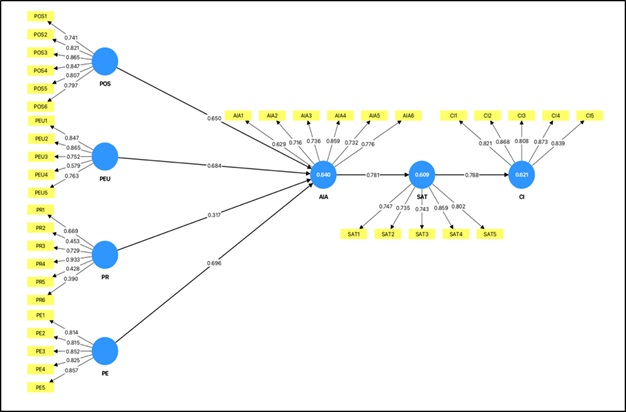
Structural Relationships and Results of Hypothesis Testing
|
|
Original sample (O) |
M |
t |
p |
Decision |
|
AIA ® SAT |
.78 |
.78 |
16.29 |
.000 |
Supported |
|
PE ® AIA |
.28 |
.28 |
1.88 |
.059 |
Supported |
|
PEU ® AIA |
.29 |
.27 |
2.03 |
.042 |
Supported |
|
POS ® AIA |
.32 |
.32 |
2.50 |
.012 |
Supported |
|
PR ® AIA |
.09 |
.05 |
0.48 |
.628 |
Unsupported |
|
SAT ® CI |
.78 |
.79 |
15.05 |
.000 |
Supported |
All of the R-squared (R2) and adjusted R-squared (Adjusted R2) values of each endogenous construct were higher than .5, signaling the explanatory power of this PLS-SEM model. Specifically, the SAT construct has an R-squared of .60, indicating that exogenous constructs in the model account for 60.9% of the SAT construct's variation. The adjusted R2 value showed that the model remained relatively small at .60. Similarly, the CI and AIA constructs had R2 values of .62 and .64, respectively, showing that the exogenous constructs can explain 62.1% and 64% of the corresponding variances.
The F-squared results show the extent to which each independent variable contributes to the explanatory variance of the dependent variable. According to Cohen's (1988) threshold (f² < .02 = negligible, .02–.15 = small, .15–.35 = medium, >.35 = large), the F-squared values for PE (f2 = .09), PEU (f2 = .11), POS (f2 = .19), and PR (f2 = .02) are all negligible, reflecting that these variables have small or negligible individual contributions to the variance in AIA. Conversely, the relationship between SAT → CI shows a very large influence (f2 = 1.64), confirming the crucial role of satisfaction in the research model.
Discussion
The introduction of AI technologies to higher education in Vietnam is still in its early stages, unfolding opportunities for teaching, learning, and school management. This paper inherited a model developed by Sharma and Singh (2024) and retested it in the context of Vietnam to assess the application of AI technologies in universities. The outcomes illustrated that all of the constructs had acceptable reliability and validity. The results also showed that perceived efficiency (PE), perceived ease of use (PEU), and perceived organizational support (POS) all have positive and significant influences on AI adoption (AIA), whereas perceived risk (PR) does not. Besides, user satisfaction (SAT) is seen to contribute to continuance intention (CI), implying its important role in future use of new technologies. These numbers again confirm the significance of users’ perceptions of technology adoption. Therefore, AI tools should be viewed as facilitators for students and academic staff, not potential substitutes. Another concern is that although the perceived risk proved to be insignificant in this study, this factor could become a barrier and require more attention for future implementation.
Conclusion
The original study by Sharma and Singh (2024) demonstrated that the adoption of artificial intelligence (AI) applications in higher education is influenced by both external and internal factors. The results show that, in addition to many similarities, there are significant differences in the level of influence of each factor, reflecting differences in the research context in Vietnam.
Firstly, in the original paper, Perceived Ease of Use (PEU) was proven to be the most significant variable in adopting AI into learning and teaching at universities, highlighting the importance of the user-friendliness of AI systems. However, the results from this study show that although PEU has a statistically significant influence on AI adoption, it is not the most influential factor. This may mean that the trend of adopting new technologies among Vietnamese students and faculty differs from that in India.
Furthermore, unlike the original study, in which Perceived Risk (PR) was identified as a significant factor influencing AI adoption, the results here show that PR has no statistically significant impact. This difference may stem from the fact that the risks involved in using AI in many aspects have not yet been widely publicized. This also means that many users have not yet developed a clear awareness of potential risks, a stark contrast to the context in India, where PR plays a major role in AI adoption in universities.
Thirdly, both studies indicate that Performance Expectancy (PE), reflecting the belief that AI can improve learning and teaching outcomes, has a positive impact on AI adoption. However, in the Vietnamese context, PE has been shown to be the most influential and statistically significant factor in AI adoption in higher education institutions. This may be evidence that Vietnamese students and faculty tend to have higher expectations for AI to improve the effectiveness of teaching and learning.
Consistent with the conclusions of the original study, Perceived Organizational Support (POS) continues to be affirmed as a strong and statistically significant factor influencing AI adoption in Vietnamese higher education. This result suggests that, similar to India, a supportive organizational environment, including policies, training, resources, and strategic direction, is a key condition for AI adoption and effective deployment.
Furthermore, the original study emphasizes that AI use has a positive impact on Satisfaction (SAT), thereby influencing Continuance Intention (CI). The results in Vietnam not only confirm this relationship but also show that SAT is the decisive mediating variable between AI adoption and the intention to continue using it. This implies that, in the Vietnamese context, real-world user experience and positive perceptions are more important than initial expectations of performance or technology.
Similar to the original paper's argument that education is inherently a humanistic activity, the current research shows that AI in Vietnamese higher education has not and should not be viewed as a replacement for humans. Instead, AI is only effective when deployed within an ecosystem with strong organizational support and designed to enhance the experience of learners and faculty.
Compared to the Indian context, where AI is expected to solve large-scale problems in the education system, the Vietnamese context shows a more cautious path, in which trust, satisfaction, and organizational support are the determining factors for the sustainability of AI adoption in higher education.
|
Funding No funding. Author Contributions The author confirms sole responsibility for the study conception and design, data collection, analysis and interpretation of results, and manuscript preparation. Conflict of Interest The authors declare that they have no known competing financial interests or personal relationships that could have appeared to influence the work reported in this paper. Generative AI Use Disclosure Statement During the preparation of this article, the author did not use any AI tools and take(s) full responsibility for the content of the publication. Data Availability Statement Data will be available on request from the authors. Acknowledgments Special thanks are extended to Vu Tran-Thanh, PhD for his mentorship and Ms. Dinh Do Anh Thu for her emotional support along this journey. |
References
Abbad, M. M. (2021). Using the UTAUT model to understand students’ usage of e-learning systems in developing countries. Education and Information Technologies, 26(6), 7205–7224. https://doi.org/10.1007/s10639-021-10573-5
Ajzen, I. (1980). Understanding attitudes and predicting social behavior. Prentice-Hall. https://catalog.nlm.nih.gov/permalink/01NLM_INST/1fua1rm/alma996273473406676
Al-Fraihat, D., Joy, M., Masa'deh, R. e., & Sinclair, J. (2020). Evaluating E-learning systems success: An empirical study. Computers in Human Behavior, 102, 67–86. https://www.sciencedirect.com/science/article/abs/pii/S0747563219302912
Al-Samarraie, H., Teng, B. K., Alzahrani, A. I., & Alalwan, N. (2018). E-learning continuance satisfaction in higher education: A unified perspective from instructors and students. Studies in Higher Education, 43(11), 2003–2019. https://doi.org/10.1080/03075079.2017.1298088
AlShaikh, F., & Hewahi, N. (2021, September). AI and machine learning techniques in the development of intelligent tutoring systems: A review. In Proceedings of the 2021 International Conference on Innovation and Intelligence for Informatics, Computing, and Technologies (3ICT) (pp. 403–410). IEEE. https://www.researchgate.net/publication/355919624
Alshammari, S. H., & Babu, E. (2025). The mediating role of satisfaction in the relationship between perceived usefulness, perceived ease of use and students’ behavioural intention to use ChatGPT. Scientific Reports, 15(1), 7169. https://doi.org/10.1038/s41598-025-91634-4
Alzaabi, M., & Shuhaiber, A. (2022). The role of AI availability and perceived risks on AI adoption and organizational values. In Intelligent Human Systems Integration (IHSI 2022). https://www.researchgate.net/publication/360028390
Bhattacherjee, A. (2001). Understanding information systems continuance: An expectation-confirmation model. MIS Quarterly, 25(3), 351–370. https://doi.org/10.2307/3250921
Calvo-Porral, C., Faíña-Medín, A., & Nieto-Mengotti, M. (2017). Exploring technology satisfaction: An approach through the flow experience. Computers in Human Behavior, 66, 400–408. https://doi.org/10.1016/J.CHB.2016.10.008
Chen, X., Zou, D., Xie, H., Cheng, G., & Liu, C. (2022). Two decades of artificial intelligence in education. Educational Technology & Society, 25(1), 28–47. https://www.jstor.org/stable/48647028
Cohen, J. (1988). Statistical power analysis for the behavioral sciences (2nd ed.). Routledge. https://doi.org/10.4324/9780203771587
Dang, T.-T.-N., Dao, T.-H. T., Nguyen, V.-H. T., & Ha, V.-D. (2024). Understanding the moderating role of trust on continuance intention towards smartphone banking services: empirical evidence from Vietnam. Journal for International Business and Entrepreneurship Development, 16(1), 4–33. https://www.researchgate.net/publication/380590598
Davis, F. D. (1989). Perceived usefulness, perceived ease of use, and user acceptance of information technology. MIS Quarterly, 13(3), 319–340. https://doi.org/10.2307/249008
Eisenberger, R., Huntington, R., Hutchison, S., & Sowa, D. (1986). Perceived organizational support. Journal of Applied Psychology, 71(3), 500. https://www.researchgate.net/publication/254734637
Elfar, E. E. (2025). Exploring the impact of AI awareness on AI anxiety: the moderating role of perceived organizational support. Management & Sustainability: An Arab Review. https://doi.org/10.1108/MSAR-01-2025-0008
Fornell, C., & Larcker, D. F. (1981). Evaluating structural equation models with unobservable variables and measurement error. Journal of Marketing Research, 18(1), 39–50. https://doi.org/10.2307/3151312
Franque, F. B., Oliveira, T., Tam, C., & Santini, F. D. O. (2021). A meta-analysis of quantitative studies on continuance intention to use an information system. Internet Research, 31(1), 123–158. https://doi.org/10.1108/INTR-03-2019-0103
Gobrecht, A., Tuma, F., Möller, M., Zöller, T., Zakhvatkin, M., Wuttig, A., … Schütt, S. (2024). Beyond human subjectivity and error: A novel AI grading system. arXiv. https://arxiv.org/abs/2405.04323
Hair, J. F., Matthews, L. M., Matthews, R. L., & Sarstedt, M. (2017). PLS-SEM or CB-SEM: Updated guidelines on which method to use. International Journal of Multivariate Data Analysis, 1(2), 107–123. https://doi.org/10.1504/IJMDA.2017.087624
Hair, J. F., Ringle, C. M., & Sarstedt, M. (2011). PLS-SEM: Indeed a silver bullet. Journal of Marketing Theory and Practice, 27(2), 139–152. https://doi.org/10.2753/MTP1069-6679190202
Hussain, A., Zhiqiang, M., Li, M., Jameel, A., Kanwel, S., Ahmad, S., & Ge, B. (2025). The mediating effects of perceived usefulness and perceived ease of use on nurses’ intentions to adopt advanced technology. BMC Nursing, 24(1), 33. https://openaccess.cms-conferences.org/#/publications/book/978-1-7923-8988-7
Huynh, N. Y. N., Nguyen, T. H. T., Luong, H. S., & Vu, V. N. (2024). Exploring the impact of AI tools on Vietnamese higher education: Perspectives from EFL lecturers in Dong Nai Province. Journal of Science and Technology, Dong Nai Technology University (Special Issue 334). https://jst.dntu.edu.vn/article/exploring_the_impact_of_ai_tools_on_vietnamese_higher_education:_perspectives_from_efl_lecturers_in_dong_nai_province-235
Joo, Y. J., Park, S., & Shin, E. K. (2017). Students’ expectation, satisfaction, and continuance intention to use digital textbooks. Computers in Human Behavior, 69, 83–90. https://www.researchgate.net/publication/311553920
Kesharwani, A., & Singh Bisht, S. (2012). The impact of trust and perceived risk on internet banking adoption in India: An extension of the technology acceptance model. International Journal of Bank Marketing, 30(4), 303–322. https://www.researchgate.net/publication/243459780
Khan, A. U., Rafi, M., Zhang, Z., & Khan, A. (2023). Determining the impact of technological modernization and management capabilities on user satisfaction and trust in library services. Global Knowledge, Memory and Communication, 72(6/7), 593–611. https://doi.org/10.1108/GKMC-06-2021-0095
Li, W. (2025). A study on factors influencing designers’ behavioral intention in using AI-generated content for assisted design: Perceived anxiety, perceived risk, and UTAUT. International Journal of Human–Computer Interaction, 41(2), 1064–1077. https://doi.org/10.1080/10447318.2024.2310354
Luckin, R., & Holmes, W. (2016). Intelligence unleashed: An argument for AI in education. Pearson. https://www.researchgate.net/publication/299561597
Maheshwari, G. (2023). Factors influencing students’ intention to adopt and use ChatGPT in higher education: A study in the Vietnamese context. Education and Information Technologies, 29(10), 12167–12195. https://doi.org/10.1007/s10639-023-12333-z
Mouakket, S. (2015). Factors influencing continuance intention to use social network sites: The Facebook case. Computers in Human Behavior, 53, 102–110. https://doi.org/10.1016/j.chb.2015.06.045
Nguyen, G. T. Q., & Hoang, T. T. D. (2024). Artificial intelligence in Vietnamese higher education: Challenges and opportunities. Industry and Trade Magazine. https://tapchicongthuong.vn/artificial-intelligence-in-vietnamese-higher-education-challenges-and-opportunities-124436.htm
Nguyen, N. T., Nguyen, K. P., & Nguyen, T. B. N. (2025). Factors affecting lecturers’ perceptions of the application of generative artificial intelligence in teaching. Vietnam Journal of Education, 59–64. https://tcgd.tapchigiaoduc.edu.vn/index.php/tapchi/article/view/3452
Phuoc, N. V. (2022). The critical factors impacting artificial intelligence application adoption in Vietnam: A structural equation modeling analysis. Economies, 10(6), 129. https://doi.org/10.3390/economies10060129
Rahi, S., Mansour, M. M. O., Alghizzawi, M., & Alnaser, F. M. (2019). Integration of UTAUT model in internet banking adoption context: The mediating role of performance expectancy and effort expectancy. Journal of Research in Interactive Marketing, 13(3), 411–435. https://doi.org/10.1108/JRIM-02-2018-0032
Rahim, N. I. M., Iahad, N. A., Yusof, A. F., & Al-Sharafi, M. A. (2022). AI-based chatbots adoption model for higher education institutions: A hybrid PLS-SEM–neural network modelling approach. Sustainability, 14(19), 12726. https://doi.org/10.3390/su141912726
Sebetci, Ö. (2018). Enhancing end-user satisfaction through technology compatibility: An assessment of health information systems. Health Policy and Technology, 7(3), 265–274. https://www.researchgate.net/publication/331950777
Sharma, S., & Singh, G. (2024). Adoption of artificial intelligence in higher education: An empirical study of the UTAUT model in Indian universities. International Journal of System Assurance Engineering and Management. https://doi.org/10.1007/s13198-024-02558-7
Soomro, S., Fan, M., Sohu, J. M., Soomro, S., & Shaikh, S. N. (2026). AI adoption: a bridge or a barrier? The moderating role of organizational support in the path toward employee well-being. Kybernetes, 55(2), 1059–1085. https://doi.org/10.1108/K-07-2024-1889
Tam, C., Santos, D., & Oliveira, T. (2020). Exploring the influential factors of continuance intention to use mobile apps: Extending the expectation-confirmation model. Information Systems Frontiers, 22(1), 243–257. https://doi.org/10.1007/s10796-018-9864-5
Venkatesh, V. (2022). Adoption and use of AI tools: A research agenda grounded in UTAUT. Annals of Operations Research, 308(1), 641–652. https://doi.org/10.1007/s10479-020-03918-9
Venkatesh, V., & Davis, F. D. (2000). A theoretical extension of the technology acceptance model: Four longitudinal field studies. Management Science, 46(2), 186–204. https://www.researchgate.net/publication/227447282
Venkatesh, V., Morris, M. G., Davis, G. B., & Davis, F. D. (2003). User acceptance of information technology: Toward a unified view. MIS Quarterly, 27(3), 425–478. https://doi.org/10.2307/30036540
Venkatesh, V., Thong, J. Y. L., & Xu, X. (2011). Consumer acceptance and use of information technology: Extending the unified theory of acceptance and use of technology. MIS Quarterly, 36(1), 157–178. https://doi.org/10.2307/41410412
Vo, T. K. A., & Nguyen, H. (2024). Generative Artificial Intelligence and ChatGPT in Language Learning: EFL Students’ Perceptions of Technology Acceptance. Journal of University Teaching and Learning Practice, 21(06). https://doi.org/10.53761/fr1rkj58
Appendices
Khảo sát về các yếu tố ảnh hưởng đến việc sử dụng AI trong công tác giảng dạy và học tập ở các trường đại học Việt Nam.
Kính gửi quý thầy/cô và các bạn sinh viên,
Em là Nguyễn Đông Minh, hiện em đang tiến hành một nghiên cứu khoa học nhằm phân tích các yếu tố ảnh hưởng đến sự chấp nhận và sử dụng Trí tuệ Nhân tạo (AI) của đội ngũ giảng viên và các bạn sinh viên đại học tại Việt Nam.
Nghiên cứu này có ý nghĩa quan trọng trong việc thực hiện Nghị quyết và Quyết định của Chính phủ về việc thúc đẩy ứng dụng AI đến năm 2030 (Quyết định 127/QĐ-TTg). Góc nhìn của anh/chị – người trực tiếp sử dụng công nghệ để học tập và làm việc – là cơ sở dữ liệu quý giá nhất để chúng tôi đưa ra các chính sách và kế hoạch phù hợp, giúp các trường xây dựng chiến lược hỗ trợ hiệu quả hơn.
Mọi phản hồi trong khảo sát này sẽ được thu thập ẩn danh, xử lý và trình bày dưới dạng thống kê tổng hợp. Thông tin cá nhân của anh/chị hoàn toàn được bảo mật và chỉ được sử dụng cho mục đích nghiên cứu khoa học, không công bố dưới bất kỳ hình thức nào.
Kính mời Anh/Chị tiếp tục trả lời các câu hỏi chi tiết ở phần dưới. Xin chân thành cảm ơn!
Trân trọng,
A survey on factors influencing the adoption of AI in teaching and learning at Vietnamese universities.
Dear Lecturers and Students,
My name is Nguyen Dong Minh, and I am currently conducting a scientific research study to analyze the factors influencing the acceptance and use of Artificial Intelligence (AI) among faculty and university students in Vietnam.
This research is of significant importance in implementing the Government's Resolution and Decision on promoting AI applications by 2030 (Decision 127/QD-TTg). Your perspective – as someone who directly uses the technology for learning and work – is the most valuable data for us to develop appropriate policies and plans, helping universities build more effective support strategies.
All responses in this survey will be collected anonymously, processed, and presented as aggregated statistics. Your personal information will be kept completely confidential and used only for scientific research purposes; it will not be published in any other form.
Please continue to answer the detailed questions below. Thank you very much!
Sincerely,
Vui lòng chọn đáp án phù hợp nhất (Please tick mark relevant option about you)
Thông tin nhân khẩu học (Demographic Information)
Chức danh (Role)
- Lecturer
- Student
Cấp bậc giáo dục cao nhất đã hoàn thành (Highest level of education completed)
- Đại học/Cao đẳng (Graduation)
- Thạc sĩ (Post-graduation)
- Tiến sĩ (PhD)
Nhóm tuổi (Age group)
- 18–30 tuổi (18-30 Years)
- 31–45 tuổi (31-45 Years)
- 46–60 tuổi (46-60 Years)
- Trên 61 tuổi (61 and Above)
Giới tính (Gender)
- Nam (Male)
- Nữ (Female)
- Khác (Other)
- Không muốn chia sẻ (Prefer not to say)
|
Anh/Chị vui lòng xếp hạng từ 1 đến 5 theo mức độ đồng ý của mình đối với từng phát biểu sau (áp dụng cho các công cụ AI mà Thầy/Cô đang sử dụng hoặc có ý định sử dụng). |
5 (Hoàn toàn đồng ý) |
4 (Đồng ý) |
3 (Trung lập) |
2 (Không đồng ý) |
1 (Hoàn toàn không đồng ý) |
|
Tôi cảm thấy tổ chức trân trọng ý kiến của tôi và có cân nhắc việc tích hợp AI vào giảng dạy. |
|
|
|
|
|
|
Tổ chức thể hiện sự quyết tâm cung cấp đủ nguồn tài nguyên và kiến thức cho giảng viên trong việc sử dụng AI để giảng dạy. |
|
|
|
|
|
|
Tôi tin rằng tổ chức thật sự có cân nhắc về trải nghiệm học tập và thành tựu của tôi trong việc sử dụng AI. |
|
|
|
|
|
|
Tổ chức khuyến khích và hỗ trợ việc tìm hiểu các phương pháp học tập với AI để cải thiện quá trình học tập của sinh viên. |
|
|
|
|
|
|
Tôi cho rằng tổ chức có xem trọng tiềm năng của AI trong việc cải thiện chất lượng giáo dục và chủ động trong việc tìm kiếm các giải pháp đến từ AI. |
|
|
|
|
|
|
Tôi tin rằng sự hỗ trợ của tổ chức trong việc tích hợp AI có ảnh hưởng tích cực đến việc ứng dụng AI trong giảng dạy của tôi. |
|
|
|
|
|
|
Tôi có thể dễ dàng hiểu cách tương tác với AI. |
|
|
|
|
|
|
AI cho tôi những chỉ dẫn hữu ích trong quá trình làm việc. |
|
|
|
|
|
|
AI giúp tôi làm việc tốt hơn. |
|
|
|
|
|
|
Việc trở nên thành thạo hơn trong công việc của mình thì dễ dàng với tôi hơn là trong việc sử dụng AI. |
|
|
|
|
|
|
Nhìn chung, tôi thấy AI dễ sử dụng. |
|
|
|
|
|
|
Tôi lo sợ rằng việc áp dụng AI sẽ làm tăng chi phí vận hành của tổ chức. |
|
|
|
|
|
|
Tôi lo sợ rằng những công cụ ứng dụng AI trong giáo dục có thể làm tăng chi phí của học sinh và gia đình. |
|
|
|
|
|
|
Tôi đắn đo về việc giáo dục tích hợp AI có thể dẫn đến việc suy giảm chất lượng học liệu so với các phương pháp truyền thống. |
|
|
|
|
|
|
Tôi đắn đo rằng những công cụ giáo dục tích hợp AI có thể không đáp ứng được các nhu cầu học hỏi của cá nhân một cách hiệu quả. |
|
|
|
|
|
|
Tôi lo lắng rằng giáo dục tích hợp AI có thể tiêu tốn nhiều thời gian hơn để chuẩn bị và sử dụng một cách hiệu quả. |
|
|
|
|
|
|
Tôi lo lắng rằng việc giáo dục dựa trên AI có thể ít thuận tiện hơn so với những phương pháp truyền thống bởi do các vấn đề hoặc sự phức tạp về mặt kĩ thuật. |
|
|
|
|
|
|
Sử dụng công nghệ AI sẽ giúp tôi hoàn thành các tác vụ hiệu quả hơn. |
|
|
|
|
|
|
Công nghệ AI sẽ giúp tăng cường năng lực của tôi trong việc thực hiện các công tác học thuật một cách hiệu quả. |
|
|
|
|
|
|
Tôi tin rằng công nghệ AI sẽ giúp cải thiện chất lượng học tập của tôi. |
|
|
|
|
|
|
Việc sử dụng công nghệ AI sẽ giúp cải thiện năng lực học thuật. |
|
|
|
|
|
|
Công nghệ AI sẽ đóng góp vào một trải nghiệm học tập hiệu quả và thành công hơn. |
|
|
|
|
|
|
Các tổ chức giáo dục đã sẵn sàng để sử dụng công nghệ AI trong các chương trình học của họ. |
|
|
|
|
|
|
Các tổ chức giáo dục đã sẵn sàng để hiện đại hoá các nền tảng học tập bằng cách sử dụng AI. |
|
|
|
|
|
|
Việc ứng dụng AI trong giáo dục đại học có thể khiến giáo dục có tính tương tác cao hơn. |
|
|
|
|
|
|
Việc ứng dụng AI trong giáo dục đại học có thể khiến hoạt động dạy - học trở nên thú vị hơn. |
|
|
|
|
|
|
Việc ứng dụng AI trong giáo dục đại học có thể làm giáo dục hiệu quả hơn về mặt chi phí. |
|
|
|
|
|
|
Việc ứng dụng AI trong giáo dục đại học có thể làm giáo dục hiệu quả hơn về mặt thời gian. |
|
|
|
|
|
|
Tôi tin rằng việc ứng dụng các công cụ AI để trợ giảng trong giáo dục đại học là một lựa chọn khôn ngoan. |
|
|
|
|
|
|
Tôi hài lòng với việc xem video và nội dung giáo dục sử dụng công cụ AI. |
|
|
|
|
|
|
Tôi hài lòng với các công cụ giáo dục ứng dụng AI. |
|
|
|
|
|
|
Tôi yêu thích việc sử dụng các công cụ và trợ lý AI. |
|
|
|
|
|
|
Nhìn chung, các công cụ giáo dục ứng dụng AI có đóng góp tích cực đối với trải nghiệm học tập của sinh viên. |
|
|
|
|
|
|
Tôi hứng thú trong việc tiếp tục xem những chương trình giáo dục có sự tham gia của các trợ giảng hoặc giảng viên AI. |
|
|
|
|
|
|
Tôi tự tin rằng tôi sẽ thường xuyên sử dụng các công cụ giáo dục ứng dụng AI cho việc học tập và làm việc trong tương lai. |
|
|
|
|
|
|
So với các phương pháp truyền thống, tôi ưu tiên việc học tập và làm việc trên những nền tảng có ứng dụng AI. |
|
|
|
|
|
|
Nếu được trao cơ hội, tôi sẽ gợi ý các công cụ giáo dục và nguồn học liệu ứng dụng AI cho các sinh viên và giảng viên khác. |
|
|
|
|
|
|
Tôi rất chào đón việc sử dụng công nghệ AI để cải thiện trải nghiệm học tập và làm việc của bản thân ở bậc đại học. |
|
|
|
|
|

Page 1 of
Download Count : 3
Visit Count : 15
Keywords
TAM; UTAUT; POS; Higher Education in Vietnam

Author(s) Information


How to cite this article:
Nguyen-Dong, M. (2026). An Empirical Study of UTAUT Model on the Adoption of AI Technologies in Vietnamese Higher Education. Studies in Educational Management, 19, 56-77. https://doi.org/10.32038/sem.2026.19.04
Funding
No funding.
Author Contributions
The author confirms sole responsibility for the study conception and design, data collection, analysis and interpretation of results, and manuscript preparation.
Conflict of Interest
The authors declare that they have no known competing financial interests or personal relationships that could have appeared to influence the work reported in this paper.
Generative AI Use Disclosure Statement
During the preparation of this article, the author did not use any AI tools and take(s) full responsibility for the content of the publication.
Data Availability Statement
Data will be available on request from the authors.
Acknowledgments
Special thanks are extended to Vu Tran-Thanh, PhD for his mentorship and Ms. Dinh Do Anh Thu for her emotional support along this journey.
Open Access
This article is licensed under a Creative Commons Attribution 4.0 International License, which permits use, sharing, adaptation, distribution and reproduction in any medium or format, as long as you give appropriate credit to the original author(s) and the source, provide a link to the Creative Commons license, and indicate if changes were made. You may view a copy of Creative Commons Attribution 4.0 International License here: http://creativecommons.org/licenses/by/4.0/