





Original Research
Exploring Media Narratives and National Identity through Corpus Linguistics: A Case Study of Moroccan Media Coverage of Alhawz Earthquake


- Abstract
- Full text
- Metrics
Television, newspapers, magazines, and other print and electronic media contribute to developing and preserving national and cultural identity by providing a platform for diverse voices, enabling different communities to share their narratives, traditions, and values. Media nurtures a sense of belonging and fosters a more unified and inclusive society by promoting cultural events and showcasing unity, harmony, and group spirit among citizens during times of crisis. Media narratives can shape the nation's perception, including national identity and political, social, and international relations narratives. However, the current paper focuses mainly on crisis narratives, another type of media narrative that can affect the perception of a nation. Those narratives focus mainly on events threatening a nation's stability, security, or well-being. Crisis narratives include natural disasters, economic slumps, and public health emergencies. Therefore, the current study attempts to analyse the Moroccan media narratives on the Alhawz earthquake, utilising a comprehensive analysis of 17 articles published between 10th September and 26th September 2023. The analysis is conducted within the framework of Critical Discourse Analysis and corpus linguistics to reveal how media narratives foster a sense of unity and nationalistic sentiments among citizens during the Alhawz earthquake. The findings indicated that Moroccan media narratives on the earthquake could shape how the public perceives the nation's ability to handle a crisis, the effectiveness of its leadership, and the resilience of its people, who were able to show a sense of unity and national pride during that natural disaster.
Rania Mjahad, Ahmed Boukranaa*
The Department of English, Faculty of Letters and Human Sciences, Sidi Mohamed Ben Abdellah University, Fes, Morocco
ABSTRACT:
Television, newspapers, magazines, and other print and electronic media contribute to developing and preserving national and cultural identity by providing a platform for diverse voices, enabling different communities to share their narratives, traditions, and values. Media nurtures a sense of belonging and fosters a more unified and inclusive society by promoting cultural events and showcasing unity, harmony, and group spirit among citizens during times of crisis. Media narratives can shape the nation's perception, including national identity and political, social, and international relations narratives. However, the current paper focuses mainly on crisis narratives, another type of media narrative that can affect the perception of a nation. Those narratives focus mainly on events threatening a nation's stability, security, or well-being. Crisis narratives include natural disasters, economic slumps, and public health emergencies. Therefore, the current study attempts to analyse the Moroccan media narratives on the Alhawz earthquake, utilising a comprehensive analysis of 17 articles published between 10th September and 26th September 2023. The analysis is conducted within the framework of Critical Discourse Analysis and corpus linguistics to reveal how media narratives foster a sense of unity and nationalistic sentiments among citizens during the Alhawz earthquake. The findings indicated that Moroccan media narratives on the earthquake could shape how the public perceives the nation's ability to handle a crisis, the effectiveness of its leadership, and the resilience of its people, who were able to show a sense of unity and national pride during that natural disaster.
Keywords: Critical Discourse Analysis (CDA), Corpus Linguistics, Earthquake, Morocco, Nationalism, National Identity
Media narratives refer to how the media creates and presents stories about a specific country or nation. These stories can affect international relations, national identity, and public opinion. National media narratives can be found in various media, including news articles, documentaries, movies, and social media posts. These stories might be positive, emphasising a nation's accomplishments, ideals, and culture, or negative, concentrating on its difficulties, disputes, and controversies. The framing and tone of media narratives can greatly influence how a country is seen at home and abroad.
Media narratives play a fundamental role in shaping national identity and fostering a sense of nationalism among citizens. People are exposed to stories that showcase their country's accomplishments, principles, and cultural legacy through various media platforms, including news sources, TV shows, and social media sites. These stories frequently inspire pride, allegiance, and camaraderie in the populace, which helps establish a solid national identity. By highlighting the commonalities among people, media narratives can encourage nationalism by fostering a sense of cohesion and belonging. The media can foster a feeling of collective identity that transcends individual differences by displaying shared history, customs, and values. Furthermore, media narratives frequently present the country in a favourable light, highlighting its achievements and encouraging a sense of patriotism.
By framing stories about nation and nationalism, the media can help citizens better understand their national identity and culture. Media narratives can also promote a sense of unity and belonging. Additionally, media narratives about nations and nationalism can influence public opinion on crucial political and social issues, such as immigration, trade, and foreign policy. For citizens, nationalism-related media narratives are crucial because they develop individual and group identities, affect public opinion, and impact cultural norms and values. For citizens to gain a comprehensive understanding of both their own country and the wider world, it is essential that they critically engage with media narratives surrounding nationalism.
Several media narratives about a nation can shape public attitudes and perceptions towards a specific country. However, the current paper focuses mainly on media narratives of crisis that promote a sense of collective responsibility and resilience. This study aims to scrutinise the role of Moroccan media during the Al-Hawz earthquake by analysing news reports to show how media can unite citizens in the face of a natural disaster by fostering a sense of solidarity and fuelling nationalistic sentiments.
This study examines reports from the Moroccan electronic press from 10th September to 26th September 2023, comprising 17 reports. This period was selected because it covered several actions and incidents related to the tragedy of the Al Hawz earthquake in September. The current study is significant not only because of its major contribution to enriching the literature with the framework of CDA and analytical methods of Corpus Linguistics (CL) but also because of its objectives of opening new insights into media narratives during crisis and how those mediated stories can shape national identity and foster a sense unity and solidarity among certain community. Most importantly, this study can help to understand the way media foster nationalism by analysing the linguistic features of Al Hawz Earthquake news coverage
Literature Review
Media and Nationalism
The development, contestation, and contextualisation of the idea of the nation throughout geography and time have been greatly influenced by the media and popular culture. The relationship between nationalism and the media has not attracted as much scholarly attention as it should, despite studies on nationalism being included in the political geography subfield (Adams, 2009; Burgess & Gold, 1985). Media geographers have long been interested in how the media shapes spatial imaginaries and identities. Initial work on nationalism, which is defined as "the territorial expression of identity: a sense of belonging to a group or community associated with a particular territory" (Mountz, 2009, p. 287), has required to identify the emergence of the "nation," more recent theorisations have set out to "explore the geographies of nationhood manifest in everyday life" (Edensor & Sumartojo, 2018, p. 553) and expressed through the media.
There have been several studies on nationalism and media. However, Anderson's work has been hugely influential within media studies, as it highlights the construction and circulation of a national imaginary via the popular press, which meant millions of people within a nation could read the same message simultaneously. As such, Anderson (1991) argues that nations are "imagined communities." This conceptualisation of the nation and its manifestation in the cultural practices of everyday life has proven to be significant work in tracing the relationship between nationalism and the world of media. Billig (1995) shows how the nation is “flagged” through the production, circulation, and consumption of symbols, representations, and routinised language located in print media, such as “we,” “us,” and “them,” which offer a spatial reference point and promote the “self–other” dichotomy that establishes national identification.
According to Kellner (1995), Media continues to affect notions of who 'we' are, "providing the models of what it means to be male or female, successful or a failure, powerful or powerless. Media culture also provides the materials out of which many people construct their sense of class, of ethnicity and race, of nationality, of sexuality, of 'us' and 'them'" (p.1). The media has this potential regardless of the nation they are created or intended for. The discourses vary among nations and evolve, reflecting the ongoing evolution of what it means to be "us." As a result, the construction of an "Other" is invariably a political and psychological instrument that directly contributes to the formation of a "Self" and its "national" identity, fostering a sense of inclusion for the one and alienation for the other. Since they may be held directly accountable for fostering this sense of an imagined community, the media play a significant role in this regard (Anderson 1991)
In her book Mediating the Nation, Mirca Madianou (2005) distinguished approaches that emphasise the power of the media in inculcating and sustaining a sense of national identity among the masses and those that focus attention on how culture shapes people's responses to media. Another scholar that emphasised the significance of the mass media in shaping one' national identity is Gellner’s much-cited reflection on ‘the facility of modern communications’ (Gellner, 1983, p. 126). He wrote:
The media do not transmit an idea that happens to have been fed into them. It matters precious little what has been fed into them: it is the media themselves, the pervasiveness and importance of abstract, centralised, standardised, one-to-many communication, which itself automatically engenders the core idea of nationalism’
In light of what scholars have confirmed, the media contributes significantly to dividing people into "us" and "them" by promoting national identity. Media outlets can foster a sense of otherness or difference toward people who do not share the national identity and a sense of belonging and unity among citizens by showcasing and promoting specific cultural symbols, narratives, and values specific to a given nation.
Nationalistic tales and symbols highlighting a specific nation's superiority or exceptionalism are one way the media produces this contradiction. The media can unintentionally foster a sense of superiority or exclusivity toward those who do not share the same national identity by promoting pride and allegiance to one's own country. This can create a dichotomy between the "us" and "them" mentality, where individuals within the national identity are seen as part of the in-group, while those outside are seen as part of the out-group.
The media plays a vital role in creating and maintaining national identity, as it influences how people perceive themselves and their nation. Media outlets can influence public opinion, advance cultural values, and foster a sense of unity among individuals through various communication channels, including radio, television, newspapers, and social media. Additionally, by influencing political and social attitudes and forming public debate, the media can also play a role in constructing national identity. Media sources can significantly influence how people perceive their country and its global standing by shaping public opinion on key issues and events through news reporting, opinion pieces, and entertainment programming. The media can foster a strong sense of purpose and direction among citizens by promoting specific values and ideas.
Media Narratives of Crisis and Nationalism
The Free and independent media must provide citizens with accurate, comprehensive, high-quality information. The media must perform this key function at all times, but it is still more important in times of crisis when they should be able to spark debate on the best ways to counter the reasons behind a crisis, its negative consequences, and how to get through it. The media should encourage public involvement in discussions about the long-term adjustments required to strengthen society's resilience against potential future disasters. In addition to serving as important conduits between the public and decision-makers, they should assume an instructional function, analysing and elucidating the new duties imposed in response to a crisis and the conduct the government expects of its citizens. Additionally, the media's role during a crisis is wider than informing people about the crisis. However, it also fosters a sense of unity and harmony and fuels nationalistic feelings among citizens.
In 1825, the Netherlands experienced one of the worst and hardest floods in history. The losses were high: a total number of 380 people were killed, and more than 16,700 cattle drowned (Buisman, 2019, pp. 797–840). All sorts of media reported on the disastrous event, including newspapers, pamphlets, songs, poems, and memorial books. Many authors encouraged Dutch citizens to help their fellow citizens, with effect. Paradoxically, this tragic event brought something good and generated strong communal bonds among Dutch people, leading to collective action. Thanks to the media, which played a significant role in shaping a communal sense of responsibility through songs, sermons, poems, and other writings, it was used to arouse sympathy for the victims and enhance empathy (Jensen, 2016)
Different scholars in cultural and media studies have demonstrated that media plays a crucial role in shaping our perception of disasters, as it disseminates information and interprets events primarily through narratives and images (Juneja & Schenk, 2014; Nünning, 2013). An example of a study on the relationship between media narratives on disasters and national identity is conducted by Zhang (2022). Zhang notes that Chinese social media narratives on COVID-19 reinforce and challenge established national identity, political legitimacy, and international geopolitical imaginary scripts. Zhang's study examines social media posts from official and private accounts around three emotional registers: enmity in narratives of power struggles and ideological competition between China and "the West," especially the United States. Additionally, the study confirms that by digitally reworking the long-standing repertoire of disaster nationalism, state media has attempted to turn the crisis into tools for bolstering national belonging and regime legitimacy. However, in the digital space, alternative expressions of grief, rage, and vernacular memory that defy integration into the "correct collective memory" of a nationalised tragedy have endured. The essay also explains how popular narratives effectively rewrite dominant ideas about the (inter)national community. Examples of these ideas include the historical imagination of a nation rising continuously from humiliation and disaster, positive energy, and a binary understanding of the international order characterised by Western hegemony and Chinese victimhood.
Method
The nature of this study dictates the use of Critical Discourse Analysis (CDA), which seeks to examine the interplay between language, power, and ideology; it is not only concerned with the meaning of discourse but also with the processes that lead to the production of meaning in discourse. It clarifies how ideology affects the text, how it responds to ideology, how these ideas come from the social structure, and how the relationship of power supports these ideas through the surface form of language (Fan, 2019, p. 1041). By concentrating on the connection between language and ideology, critical discourse analysis seeks to illuminate the hidden meanings in texts (Fairclough, 1989, p. 17). However, Discourse analysts are sometimes criticised for failing to prevent personal bias by selecting particular language traits randomly and then looking into them in a limited number of texts to support their assumptions (Hu & Kim, 2019, p.185). Therefore, the current study opts for a corpus-based approach as a new direction in discourse analysis to avoid subjectivity in analysing texts (Baker, 2006; Stubbs, 1996; Verschueren, 2001).
Jones and Waller (2015) define corpus linguistics as "an electronically stored, searchable collection of texts. These texts may be written or spoken and vary in length, but generally, they will be longer than a single speaking turn or written sentence. They are normally measured in terms of the number of words they contain or, to use a word common in most corpora, the number of tokens." (p. 5). Wodak and Meyer (2009) state that Corpus linguistics adds a quantitative methodology to CDA, wherein vast corpora are analysed using concordance software, yielding frequency lists and particular metrics of statistical significance. Thus, corpus linguistics employs a logical methodology when selecting specific terms relevant to the study. It also provides concordance lines for additional (qualitative) interpretation.
In short, corpus linguistics is an ideal research method for the current study as it allows the researcher to analyse as many news reports on the Alhawz earthquake as possible with extreme neutrality and objectivity. Put differently, the researchers rely on corpus-based discourse analysis to avoid bias during the analysis and interpretation of news reports. Additionally, the corpus can provide the freedom to analyse a huge amount of data using advanced software.
Design
Data Collection
The data included news articles published during the Al Hawz earthquake over a nearly one-month period, from October 9, 2023, to September 26, 2023. In terms of news article collection, this study utilized search keywords to gather reports from the official websites of the selected news sources. “Al Hawz earthquake” was used as the keyword to search for the news reports. A total of 17 articles were selected: thirteen articles from Hespress, two from Hebapress, and two from MAP, chosen to construct a self-built file corpus on news coverage of the Al-Hawz earthquake tragedy, comprising 11,524 tokens. The reason for choosing news reports from these specific electronic newspapers is their status as Morocco's most popular and authoritative electronic media platforms. Table 1 presents the selected articles.
Table 1
Articles Used in Building the Node Corpus
|
Article’s Name |
Name of the Journalist |
Date of Publication |
Name of the journal/magazine |
Country |
|
The earthquake of Al- Hawz: Moroccans provide a lesson in boundless solidarity. |
Unknown |
16-9-2024 |
Hebapress |
Morocco |
|
The Al-Harwz earthquake and the principle of solidarity... why not persist with each commemoration of the tragedy? |
Unknown |
19-9-2023 |
Hebapress |
Morocco |
|
The Al-Hawz earthquake and the Moroccan epic... international press exposes the shallowness of French platforms. |
Unknown |
26-6-2023 |
Hespress |
Morocco |
Article’s Name |
Name of the Journalist |
Date of Publication |
Name of the journal/magazine |
Country |
"The Al- Hawz earthquake" revives the values of solidarity and reminds us of the resilience of Moroccans in times of crisis. |
Unknown |
11-9-2023 |
Hespress |
Morocco |
The shock of the earthquake fails to "shake" the solidarity of Moroccans.. The spontaneity of volunteering stems from unity. |
Unknown |
17-9-2023 |
Hespress |
Morocco |
|
Sociologist: These are messages of solidarity from Moroccans. |
Unknown |
21-9-2023 |
Hespress |
Morocco |
|
A popular campaign to support the victims of "the Al- Hawz earthquake".. Solidarity takes root in the values of Moroccans. |
Unknown |
12-9-2023 |
Hespress |
Morocco |
Bousouf approaches "Tamghrabit" in "the Al- Hawz earthquake".. A collective love for goodness and solidarity. |
Unknown |
11-9-2023 |
Hespress |
Morocco |
|
"Al- Hawz earthquake" reveals Morocco's leading position on the global geopolitical map. |
Unknown |
12-9-2023 |
Hespress |
Morocco |
|
Morocco shakes the world. |
Unknown |
13-9-2023 |
Hespress |
Morocco |
Morocco appreciates the efforts of cooperation in "Al- Hawz earthquake" with royal messages to "the four countries". |
Youssef Yaakoubi |
20-9-2023 |
Hespress |
Morocco |
Another exceptional and impressive Moroccan solidarity. |
Ismail Halwati |
11-9-2023 |
Hespress |
Morocco |
|
Moroccans.. a united nation in the face of hardships. |
Youness Mlih |
14-9-2023 |
Hespress |
Morocco |
In the midst of international solidarity, Algeria expresses condolences to Morocco! |
Ismail Halwati |
10-9-2023 |
Hespress |
Morocco |
The solidarity of world celebrities persists through the announcement of initiatives to support the victims of the "Al Hawz earthquake". |
Manal Lotfi |
16-9-2023 |
Hespress |
Morocco |
Al-Hawz earthquake: A wave of broad international solidarity with Morocco. |
Unknown |
10-9-2023 |
MAP |
Morocco |
Al-Hawz earthquake: Bonds of solidarity among Moroccans worldwide extend towards the homeland. |
Unknown |
12-9-2023 |
MAP |
Morocco |
Corpus Tool
The current study employs corpus linguistics, a computer-based approach for analysing text using statistical tools. In other words, corpus linguistics studies large-scale language data analysis using computers to analyse enormous amounts of written texts or transcribed speech (Mcenery & Hardie, 2011)
Many software tools help researchers to maximise the use of computer corpora. However, this study opts for a sketch engine to construct lexical corpora. Word sketches automatically generate corpus-based one-page descriptions of a word's collocational and grammatical behaviour. They were first introduced at Euralex in 2002 and were used in the creation of the Macmillan English Dictionary. They were then exclusive to the English language. We have now created the Sketch Engine, a corpus tool that creates word sketches for words in any language given a corpus of that language and matching grammar patterns. Additionally, it produces "sketch differences"—a thesaurus that lists the distinctions and similarities between near-synonyms (Kilgarriff et al., 2004)
Results and Discussion
Analysis of Keywords
Moroccan newspapers use various discourse strategies in their news reports to propagate public opinion and gain public support. The keywords employed by Moroccan newspapers stimulate a sense of nationalism and solidarity among Moroccans.
A "keyword" is a word whose frequency is noticeably higher than a certain standard; the degree of this higher frequency is known as the keyword's "keyness." This definition states that the target corpus is compared to a reference corpus, and the words that appear frequently in the target corpus are considered its keywords. The reference corpus's statistics also determine the keyword's keyness. By extracting keywords from vast data, we can efficiently peel back the complex surface and find the issue's core. The news media frequently permits particular words to meld and affect the audience's impression of an issue by using them repeatedly. In this paper, we investigate the keywords to uncover the hidden agendas and ideologies propagated by Moroccan newspapers during the "Al-hawz Earthquake."
Using the Sketch engine tool (2304), keywords from Moroccan news reports were extracted by comparing the self-built corpus with Arabic Web 2024 (ar Ten Ten 24). However, this study focuses mainly on adjectives and nouns rather than linguistic features. This article examined keywords to reveal how Moroccan newspapers fostered solidarity and nationalism among Moroccan citizens during the "Al-Hawz Earthquake" natural disaster. This required an in-depth qualitative analysis of keywords, offering concordance lines to reveal why they appear in Moroccan news reports. The keyword analysis in this article will focus on more noteworthy nouns and adjectives, as listed in Figure 1.
Figure 1
Nouns Identified in the Corpus (Output from Sketch Software)
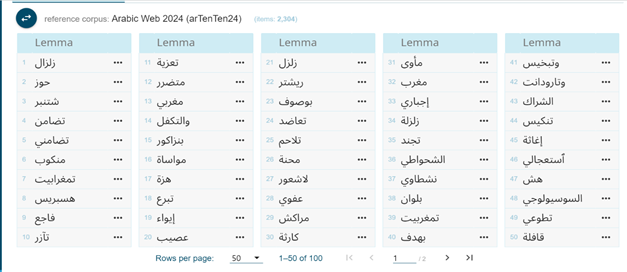
The first column of Figure 1 displays the nouns numbered in the order in which they are presented, based on keyword strength. The nouns mentioned in the news reports are listed in the second column. The frequencies of each noun as they appeared in the reference corpus are expressed in the third column.
As it looks in Figure 1, the top-ranked nouns that appear in the Moroccan news reports are (زلزال، حوز، شتنبر، تضامن، تضامني، منكوب، تضامني). Media outlets often play a crucial role in shaping public opinion and fostering a sense of nationalism among citizens. During times of crisis or national events, such as natural disasters or emergencies, the media may employ ingenious vocabulary and rhetoric to convey messages of unity, resilience, and national pride. By framing the narrative in a way that emphasises the strength and solidarity of the nation, media outlets can help instil a sense of patriotism and community spirit among citizens.
In the case of Morocco, the media would likely employ terminology emphasising the nation's ability to bounce back from hardships, the initiatives Moroccans took to assist one another, and the need to maintain national cohesion in surmounting obstacles. The media can encourage a sense of nationalism and togetherness among the populace amid trying times by using deft language and rhetoric that plays on national pride and identity, not only the adjectives and nouns that show how Moroccan news reports portrayed the solidarity among Moroccan citizens during the crisis. However, the compound or multiple-word nouns reveal the way Moroccan media foster a sense of unity among Moroccans, as shown in Figures 2 and 3:
Figure 2
Collocations Appeared in the Corpus 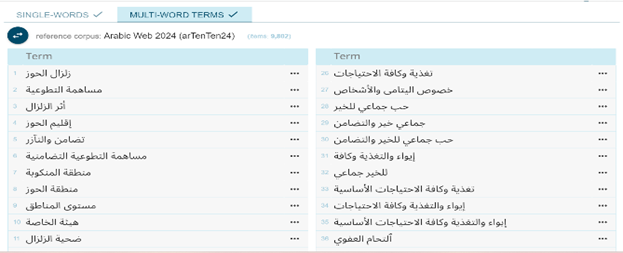
Figure 3
Collocations Appeared in the Corpus
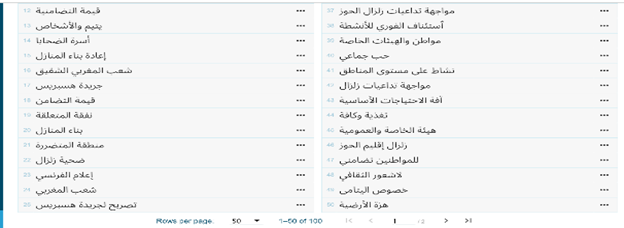
As appears in Figures 2 and 3, the top-ranked compound nouns used in the news reports are (قيمة التضامنية, قيمة التضامن, حب جماعي, شعب المغربي, حب جماعي للخير). These compound nouns appearing in the Moroccan news reports during the natural disaster of the Al Hawz Earthquake uncover that during the earthquake, Moroccans demonstrated incredible solidarity by assisting people affected by the disaster, organising resources, and giving up their time. Communities expressed great solidarity and compassion by coming together to give displaced people food, drink, and shelter. Local organisations and government agencies worked hand in hand with citizens to coordinate relief efforts and ensure that aid reached those most in need. In addition to easing the immediate suffering of earthquake victims, the community's sense of unity and resiliency was strengthened by the solidarity shown during this trying period. Moroccans overcame hardship and rebuilt stronger than before by banding together in unity.
Moroccan Media Narratives of the Nation
Nationalistic Sentiments and Collective Identity
During the tragic Alhawz earthquake, Moroccan media produced news reports on the incident, showing how Moroccans are one hand in crisis and how they helped each other financially and psychologically. News media, particularly the electronic ones, manage to unite the citizens in that natural disaster by fostering a sense of solidarity and fuelling nationalistic feelings. At that time, the media used strong language and attractive headlines to show the Moroccans' strong sense of nationality. Based on the self-designed corpus, we can observe that the keywords “solidarity” and “Tamghrabit” are employed frequently in Moroccan news reports, as clearly shown in Figures 4 and 5. the following graphs:
Figure 4
Distribution of “Solidarity” Hits in the News Reports
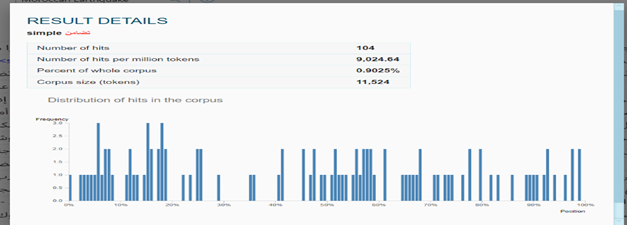
Figure 5
Distribution of “Tamghrabit” Hits in the News Reports 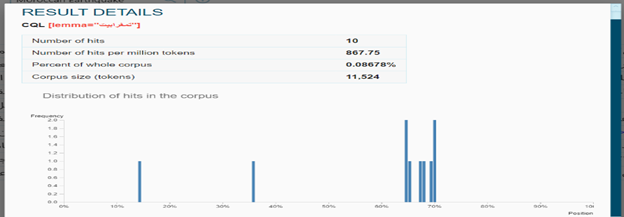
The earthquake can reignite solidarity, unite people, and emphasise the value of support and unity in trying times. Furthermore, mentioning Moroccans' crisis resilience suggests a spirit of fortitude and resolve in the face of difficulty. In summary, the research indicates that this incident has had a noteworthy effect on the community, highlighting the significance of uniting and supporting one another in hard times. Additionally, the term "Tamghrabit" likely refers to a sense of community or collective identity within the context of the "Al-Hawz Earthquake," which may be a specific event or situation. The reference to a shared love of goodness and solidarity highlights the significance of uniting to support one another and advance positive values, implying a close relationship among those impacted by or participated in this incident. According to this research, the community's reaction to «Al-Hawz Earthquake " is defined by a common dedication to kindness, solidarity, and support among one another when faced with difficulties, as the concordance lines of both keywords confirm, as presented in Figures 6 and 7:
Figure 6
The Concordance Analysis of the "Tamghrabit"
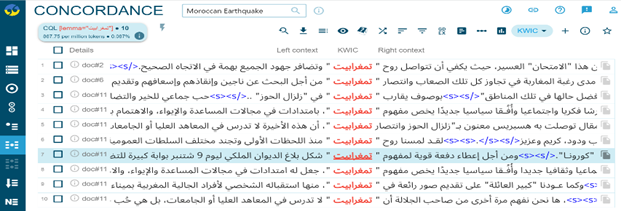
Figure 7
The Concordance Analysis of the "Solidarity." 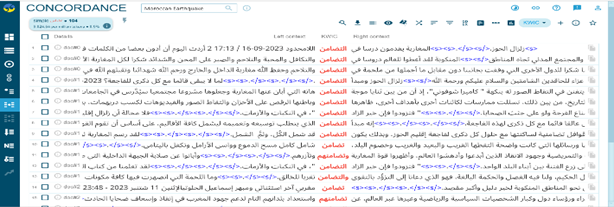
Based on the results retrieved from the self-developed corpus, one can deduce that Solidarity and Tamghrabit are important concepts in Moroccan culture, especially during times of crisis such as the Al Hawz earthquake. Solidarity refers to the unanimity and support that people and communities extend to those in need. Tamghrabit, on the other hand, is a term used to describe the sense of mutual aid and cooperation among people in Moroccan society.
These concepts were particularly important in uniting people to aid those afflicted by the Al Hawz earthquake in Morocco. The community came together to help those in need by offering resources, support, and emotional assistance. Tamghrabit and this spirit of unity contributed to the victims' pain being lessened and the damaged areas being rebuilt. In general, Tamghrabit and solidarity following the Al Hawz earthquake in Morocco emphasise the community's fortitude and resiliency in the face of hardship. It serves as a reminder of the importance of coming together and encouraging one another during challenging times.
Diplomatic Status of Morocco
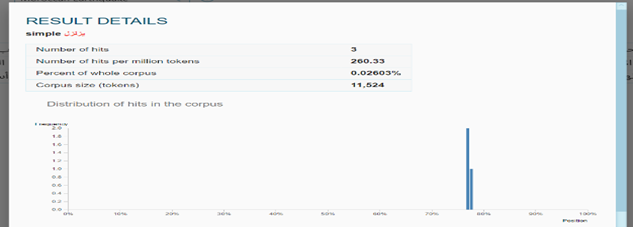
Through the analysis of the news reports, it has been noticed that the news narratives highlight the diplomatic status of Morocco among other nations as it received help and support from different countries, and the frequent usage of the word "يزلزل” “shake” confirms in Figures 8 and 9 and concordance lines:
Figure 8
The Concordance Analysis of the "Shake"
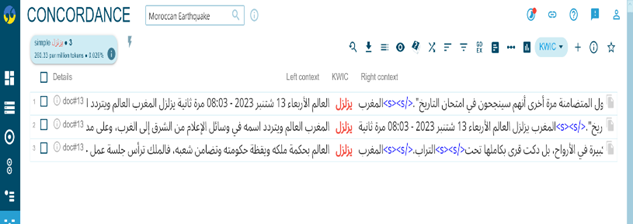
Figure 9
Distribution of “Shake” Hits in the News Reports
As we know, Morocco is a member of many international organisations, including the African Union, the Arab League, and the United Nations, and has diplomatic ties and collaborations with many other nations. The nation has been actively committed to promoting regional peace and stability and has taken a leading position in regional diplomacy. Moreover, Morocco has close relations with several nations, especially those in Europe, the Middle East, and Africa. It has also participated in several diplomatic initiatives to enhance international collaboration and alliances. The diplomatic status of Morocco plays a significant role in harvesting support from other countries during the tragic event of the "Al- Hawz Earthquake". Morocco's strong diplomatic ties and alliances with various nations have facilitated the mobilisation of international aid and assistance in the aftermath of the disaster. The international community has responded to the nation's diplomatic efforts, bringing attention to the urgent need for assistance and collaboration.
Additionally, Morocco's diplomatic efforts have improved its standing internationally by demonstrating the nation's persistence and resolve in confronting the obstacles presented by the earthquake. However, many countries worldwide insisted on providing the country with all means of help, either financially or logistically. However, Morocco has accepted the help of four major countries, as Dr Hassan Balwan, a researcher in international relations, states to Hespress:
The Moroccan state's response to the earthquake disaster in Al Hawz has been different and exceptional, reflecting the effectiveness and governance of the approach adopted since the beginning of the tragedy. He further argued: "The international relief operation was organised by limiting it to only four countries as an organisational necessity to accelerate the pace of action on the ground, especially given the extensive solidarity campaign that has impressed Moroccans worldwide." (Authors’ translation)
Balwan draws attention to the distinctive and effective strategy employed by the Moroccan government in the wake of the Al Hawz earthquake disaster. Words like "different and exceptional" infer that the government's reaction to the disaster varied from normal methods, demonstrating creativity and flexibility in their methodology. The emphasis on the efficacy and governance of the chosen strategy implies strong leadership and decision-making within the government structure. In addition, restricting international aid efforts to just four nations is a strategic requirement to speed operations, showing a measured and realistic attitude to handling the issue. This choice signifies a focus on efficiency and cooperation in providing resources and assistance to the impacted area.
Conclusion
Media narratives about the "Al-Hawz Earthquake" can shape national identity by influencing how citizens perceive their country, its values, and its strengths during challenging and critical times. The way Moroccan media portrayed the natural disaster of the Al-Hawz region could affect how Moroccans view their nation's response, leadership, and resilience, ultimately shaping their sense of national pride, unity, and solidarity. Media narratives highlight Moroccan's ability to overcome challenges, display heroism and unity, and emphasise that resilience can strengthen national identity by fostering a sense of citizen pride and solidarity. In general, media narratives significantly affect how the public views, feels and behaves toward the nation and its ideals, which helps shape national identity during times of crisis. To promote a robust and resilient national identity, media outlets must present truthful, impartial, and constructive coverage that emphasises a country's achievements and its problems during times of crisis.
Limitations and Recommendations
The limitation of the current study is that it only analyses a small number of selected news reports, particularly from electronic journals rather than printed ones. This can be a limitation, as it does not encompass all possible views and insights on the issue under examination. Another limitation is that this study does not include news reports published in French, focusing primarily on those written in Arabic. Future work should utilise a large sample of news reports in multiple languages to understand how the media fosters a national identity and a sense of nationality among citizens during a crisis.
References
Adams, P. C. (2009). Geographies of media and communication. John Wiley & Sons.
Anderson, B. (1991). Imagined communities: Reflections on the origin and spread of nationalism. Verso.
Baker, P. (2006). Using corpora in discourse analysis. Continuum.
Billig, M. (1995). Banal nationalism. Sage.
Buisman, J. (2019) Duizend jaar weer, wind en water in de Lage Landen [A thousand years of weather, wind and water in the Low Countries], vol 7. Uitgeverij Van Wijnen, Franeker, pp 1800–1825.
Burgess, J., & Gold, J. R. (1985). Geography, the media and popular culture. Croom Helm.
Edensor, T., & Sumartojo, S (2018). Geographies of everyday nationhood: experiencing multiculturalism in Melbourne. Nations and Nationalism, 24(3), 553–578.
Fairclough. N. (1989). Language and power. Longman
Fan, X. (2019). The research and application of critical discourse analysis. Journal of Language Teaching and Research. http://dx.doi.org/10.17507/jltr.1005.17
Gellner, E. (1983). Nations and nationalism. Cornell University Press. https://doi.org/10.1111/nana.12421
Hu, K, & Kim, K (Eds.). (2019). Corpus-based translation and interpreting studies in Chinese contexts. Springer International Publishing
Jensen, L. (Ed.) (2016). The roots of nationalism: national identity formation in early Modern Europe, 1600–1815. Amsterdam University Press, Amsterdam
Jones, C., & Waller, D. (2015). Corpus linguistics for grammar: A guide for research. Taylor & Francis
Juneja, M., & Schenk, G. J (Eds.). (2014). Disaster as image: iconographies and media strategies across Europe and Asia. Verlag Schnell & Steiner, Regensburg
Kellner, D. (1995). Media culture: Cultural studies, identity and politics between the modern and the postmodern. Routledge.
Kilgarriff, A., Rychlý, P., Smrz, P., & Tugwell, D. (2004). The Sketch Engine. Université de Bretagne-sud, Faculté des Lettres et des sciences Humaines [The Sketch Engine. University of Southern Brittany, Faculty of Arts and Humanities], ISBN (29-52245-70-31)
Madianou, M. (2005). Mediating the nation. Routledge. https://doi.org/10.4324/9780203058817
Mcenery, T., & Hardie, A. (2011). Corpus linguistics: Method, theory and practice. Cambridge University Press
Mountz, A. (2009). Nationalism. In C. Gallaher, C. T. Dahlman, M. Gilmartin, A. Mountz, & P. Shirlow (Eds.), Key concepts in political geography (pp. 277–287). Sage.
Nünning, A. (2013). Krise als Erzählung und Metaphor: Literaturwissenschaftlichte Bausteine für eine Metapholorlogie und Narratologie von Krisen [[Crisis as narrative and metaphor: Literary building blocks for a metaphorology and narratology of crises]. In C. Meyer, K. Patzel-Mattern, & GJ. Schenk (Eds.), Krisengeschichte(n), Krisengeschichte (n). “Krise” als Leitbegriff und Erzählmuster in Kultwissenschaftlichter [Crisis history(s), Crisis history(s). “Crisis” as a key concept and narrative pattern in cultural studies].
Stubbs, M. (1996). Text and corpus analysis: Computer-assisted studies of language and culture. Blackwell
Verschueren, J. (2001). Predicaments of criticism. Critique of Anthropology, 21(1), 59-81. https://doi.org/10.1177/0308275X0102100104
Wodak, R, & Meyer, M. (2009). Methods for critical discourse analysis. Sage
Zhang, C. (2022). Contested disaster nationalism in the digital age: Emotional registers and geopolitical imaginaries in COVID-19 narratives on Chinese social media. Review of International Studies, 48(2), 219–242. https://doi.org/10.1017/S0260210522000018

Page 1 of
Download Count : 61
Visit Count : 117
Keywords
Corpus Linguistics; Critical Discourse Analysis (CDA); Earthquake; Morocco; Nationalism; National Identity

Author(s) Information

How to cite this article
Mjahad, R, & Boukranaa, A. (2025). Exploring Media Narratives and National Identity through Corpus Linguistics: A Case Study of Moroccan Media Coverage of Alhawz Earthquake. Studies in Educational Management, 17, 1-16. https://doi.org/10.32038/sem.2025.17.01
Acknowledgments
Not applicable.
Funding
Not applicable.
Conflict of Interests
No, there are no conflicting interests.
Open Access
This article is licensed under a Creative Commons Attribution 4.0 International License, which permits use, sharing, adaptation, distribution and reproduction in any medium or format, as long as you give appropriate credit to the original author(s) and the source, provide a link to the Creative Commons license, and indicate if changes were made. You may view a copy of Creative Commons Attribution 4.0 International License here: http://creativecommons.org/licenses/by/4.0/