





Original Research
Job Engagement and Employee Voice among Nurses with the Mediating Role of Leadership Style


- Abstract
- Full text
- Metrics
Job engagement and employee voice are crucial factors in enhancing the quality of care, organizational productivity, and job satisfaction among nurses in high-stress healthcare environments, such as hospitals. In the present study, we aimed to investigate the relationship between job engagement and employee voice among nurses, with an emphasis on the mediating role of leadership style. The study was conducted within the framework of a causal model, and data were collected from 248 nurses working in public hospitals in Tehran using a quantitative method. The data collection tool consisted of three standard questionnaires: the Utrecht Work Engagement Scale for Students (UWES-9), Employee Voice Surveys (EVS), and Multifactor Leadership Questionnaire (MLQ). The data were analyzed using Structural Equation Modeling (SEM) and Smart-PLS software. The findings indicated that job engagement has a positive and significant effect on employee voice. Moreover, transformational leadership style, as a mediating variable, strengthens the relationship between job engagement and employee voice. In contrast, the transactional leadership style did not have a significant mediating effect. These results highlight the importance of nursing managers selecting appropriate leadership styles to encourage and enhance employee engagement and active participation in organizational decision-making. Hence, it is suggested that health policymakers design and employ educational programs to promote transformational leadership and provide opportunities for nurses to be creative, innovative, and active participants in the workplace.
Job Engagement and Employee Voice among Nurses with the Mediating Role of Leadership Style
Rashed Parastar
Department of Management, Ard. C, Islamic Azad University, Ardabil, Iran
Abstract:
Job engagement and employee voice are crucial factors in enhancing the quality of care, organizational productivity, and job satisfaction among nurses in high-stress healthcare environments, such as hospitals. In the present study, we aimed to investigate the relationship between job engagement and employee voice among nurses, with an emphasis on the mediating role of leadership style. The study was conducted within the framework of a causal model, and data were collected from 248 nurses working in public hospitals in Tehran using a quantitative method. The data collection tool consisted of three standard questionnaires: the Utrecht Work Engagement Scale for Students (UWES-9), Employee Voice Surveys (EVS), and Multifactor Leadership Questionnaire (MLQ). The data were analyzed using Structural Equation Modeling (SEM) and Smart-PLS software. The findings indicated that job engagement has a positive and significant effect on employee voice. Moreover, transformational leadership style, as a mediating variable, strengthens the relationship between job engagement and employee voice. In contrast, the transactional leadership style did not have a significant mediating effect. These results highlight the importance of nursing managers selecting appropriate leadership styles to encourage and enhance employee engagement and active participation in organizational decision-making. Hence, it is suggested that health policymakers design and employ educational programs to promote transformational leadership and provide opportunities for nurses to be creative, innovative, and active participants in the workplace.
Keywords: Job Engagement, Employee Voice, Leadership Style, Nurses, Transformational Leadership, Transactional Leadership
Most organizations strive to restructure and upgrade themselves in response to the latest developments in the global business world. In line with this strategy, these organizations should recognize and effectively utilize human resource factors. Several factors, such as employee job satisfaction, are assumed to be a combination of physiological and psychological states that lead employees to feel satisfied (Mehrad, 2015). Factors such as the type of work, colleagues, supervisors, subordinates, payments, incentives, and organizational communication play a significant role in organizational outcomes, which must be recognized (Eslami & Gharakhani, 2012). In recent years, one of the primary and crucial organizational factors that has received increased attention is employees’ job engagement, which has steadily gained recognition as a legitimate construct among academic researchers (Strom et al., 2014). Job engagement is probably the oldest and most common concept of well-being in the workplace (Wang et al., 2017). Recognizing the vital role of job engagement, Engelbrecht et al. (2017) noted that motivated employees are more creative and organized, and tend to enjoy their work. In contrast, Manning et al. (2016) reported that employees who are not motivated and empowered in their work are more likely to be dissatisfied with their jobs and have high job turnover. To represent the essential role of job engagement, Lu et al. (2018) argued that job engagement is considered a stable work state that can be transferred between employees in the workplace. The researchers also explained that, as an effective factor, it has a positive relationship with individual performance on tasks, appropriate presentation, observed behavior, personal work-family facilitation, job satisfaction, and mental well-being (Lu et al., 2018). Therefore, it is of utmost importance to understand the influencing factors that affect job engagement.
First, it is necessary to emphasize that nurses are a key and essential resource that must be considered in any health system (WHO, 2020). They form the largest group of healthcare professionals (Sekse et al., 2018), a fact that is similarly described and emphasized in the hospital setting by Baker and Alshehri (2020). In this study, job engagement was widespread among nurses across different hospital departments. Inadequate staffing is associated with lower nurse engagement, which contributes to higher burnout rates, reduced intention to remain in the profession, decreased job satisfaction, poorer patient outcomes, and increased adverse events (Chen et al., 2019; Dall’Ora et al., 2022; Hall et al., 2016). Therefore, the healthcare organization should provide adequate support to nurses that may lead to job engagement and high performance levels.
Furthermore, predictors of job engagement among nurses were mainly demographic data (such as gender, age, and work experience), job-related variables (such as job stress, role ambiguity, and organizational support), work environment variables (practical and dynamic environment) (Wan et al., 2018), and personal factors (such as personality, self-efficacy, and coping style) (Cao & Chen, 2020). Given the importance of nurses' job engagement in healthcare organizations, identifying factors affecting it may be of great value.
Leadership is a process through which an individual influences others to achieve common goals (Saleem, 2015). Moreover, leadership style is considered one of the key outcomes related to human resources and is perhaps one of the most studied topics in management and organizational psychology (Fiaz et al., 2017), with a direct relationship to employee responses and organizational behavior in the workplace (Mehrad et al., 2022). Transactional leadership style refers to a transactional relationship between a leader and an employee in which each party is involved to fulfill their own personal interests. The interests of each party are met by clarifying the employee's responsibilities, the leader's expectations, and the benefits of compliance (Strom et al., 2014). Transactional leadership is a dynamic exchange between leaders and subordinates (Keskes, 2014). In addition, transformational leadership style focuses on the ability of leaders to interact, understand, and support employees beyond the standard employment exchange. Depending on the situational circumstances, these leaders may assume roles such as facilitator, coach, and innovator, which may arise due to personal preferences. Generally, transformational leadership style includes behaviors that encourage employees to have different perspectives on their work and challenge them to try new approaches (Henker et al., 2015). A study by Lapeña et al. (2017) also indicated that transformational and transactional leadership styles significantly contribute to nurses’ satisfaction and high levels of performance.
Therefore, examining the mediating role of leadership style in the relationship between job engagement and employee voice can lead to a deeper understanding of nurses' motivational and behavioral mechanisms and provide valuable information for policymakers and health managers. Given the global health crises, including the COVID-19 pandemic, increased nurse workload, and increased burnout, the importance of addressing factors that can maintain and enhance job engagement is increasingly felt. Accordingly, the concept of employee voice has also become a strategic component in the context of promoting the quality of care and patient safety. Therefore, the present study aims to investigate whether leadership style can play a mediating role in the relationship between job engagement and employee voice among nurses, thereby providing practical solutions for enhancing organizational culture, promoting effective leadership, and optimizing human resource utilization within the health system.
Literature Review
Job Engagement
Job engagement is a widely used concept in positive organizational psychology, defined as a positive, encouraging, and work-related state. It consists of three key dimensions: vigor, dedication, and absorption, which refer to mental energy and resilience, a sense of meaning and inspiration, and complete focus on work, respectively. These three components make a fundamental distinction between job engagement and concepts such as job satisfaction and organizational commitment, representing a desirable psychological state. One of the prominent theoretical frameworks for examining job engagement is the Job Demands–Resources Model. According to this model, job resources such as social support, feedback, autonomy, and growth opportunities can enhance job engagement through a motivational process, even in dealing with high work demands. In the high-pressure healthcare environment, nurses are particularly vulnerable to intense job pressures, and supportive resources can play a crucial role in maintaining motivation and preventing burnout. In nursing, several studies have shown a positive relationship between leadership styles and job engagement. For example, a study by Mehrad and Fallahi (2014) examined the role of organizational support in mediating the relationship between leadership styles (transformational and transactional) and job engagement among nurses. The results showed that transformational and transactional leadership styles were positively correlated with Perceived Organizational Support (POS), and POS itself significantly predicted job engagement. The relationship between leadership style and job engagement was also mediated through POS (β = .58). In another study, the emphasis was on developing mission-oriented leadership behaviors or caring leadership among nursing managers. Zhang et al. (2024) found that caring leadership is positively related to nurses' job engagement, and this relationship is mediated through a sense of calling and affective organizational commitment in a chain manner. This model suggests that a supportive leadership style is not only directly effective, but also increases engagement in complex care environments by strengthening organizational meaning and sense of belonging. On the other hand, Hashemi et al. (2025) found in a sample of Iranian nurses that leader empowering behaviors are positively related to job engagement, with this relationship mediated by psychological empowerment (β = .24 for the direct relationship and β = .47 for the empowerment → engagement relationship). Moreover, in the ICU context, a study in China (Huang et al., 2025) showed that transformational leadership has a significant impact on the job performance of ICU nurses; this impact is mediated through psycho-empowerment and job satisfaction, and the contribution of the mediated effects was about 24.64% and 21.74% of the total effect, respectively. Overall, this research evidence represents that in the highly complex and stressful nursing environment, appropriate leadership styles (such as transformational, transactional, supportive, or empowering) increase job satisfaction by creating psychological resources such as POS or empowerment. Job satisfaction itself plays a crucial role in maintaining mental health, quality of patient care, and productivity.
Employee Voice
Employee voice is an emerging and important concept in the field of organizational behavior that refers to the expression of employees' views, ideas, suggestions, and concerns about organizational issues. This concept is recognized in the management literature as part of organizational citizenship behaviors and a key mechanism for enhancing organizational decision-making, promoting innovation, and mitigating systemic errors (Morrison, 2011). Employee voice means the ability and willingness of individuals to freely and constructively express work issues in a way that considers not only individual interests but also collective and organizational interests. The concept of employee voice has its roots in the theories of employee participation and industrial democracy; however, in recent decades, it has been developed from a behavioral-psychological perspective and has emerged as an independent construct. Morrison (2014) emphasizes that employee voice differs from mere complaints or protests, as its expression is typically made with the intention of improving organizational conditions, processes, or policies, and its goal is to increase effectiveness and efficiency. From this perspective, employee voice can be considered a mechanism for organizational learning and innovation. Two types of employee voice have been highlighted in research: promotive voice and defensive or prohibitive voice. Promotive voice refers to the expression of ideas, suggestions, and initiatives that lead to process improvements, increased efficiency, or the creation of new opportunities (Liang et al., 2012). In contrast, defensive voice refers to the warning against errors, inefficiencies, or potential problems that can prevent damage or failure. Both types of voice play an essential role in enhancing the quality of organizational performance, but their expression depends on several factors, including organizational culture, leadership style, and the level of trust among employees. One of the main factors that affects employee voice is the leadership style of managers. Transformational leaders create an environment that fosters employees' expression of ideas without fear of negative consequences by building trust, offering psychological support, and encouraging creativity (Detert & Burris, 2007). In contrast, authoritarian or controlling leadership styles may discourage employees from speaking up because employees feel that expressing their opinions could lead to punishment or neglect. This is particularly important in the nursing setting, as nurses’ voices can directly impact patient safety and quality of care (Tangirala & Ramanujam, 2008). Employee voice not only has positive outcomes for the organization, but is also valuable to the employees themselves. Research has shown that employees who feel their voices are heard experience higher levels of job satisfaction, organizational commitment, and job engagement (Mowbray et al., 2015). Also, expressing voice makes people feel more meaningful about their jobs and strengthens their work identity. On the other hand, the lack of opportunities to express one's voice can lead to frustration, apathy, and ultimately job abandonment. From a theoretical perspective, several approaches have been proposed to explain employee voice. Social Exchange Theory states that employees are more likely to express their opinion when they feel supported by the organization and managers and that there is a two-pronged relationship based on trust (Blau, 1964). Another important theory in this context is the Employee Silence Theory, which states that employee silence is often caused by fear, distrust, or a feeling of uselessness (Morrison & Milliken, 2000). Thus, employee voice and silence are two sides of the same coin, and it is the organizational environment that can determine whether employees speak up or remain silent. In the field of health and nursing, the importance of employee voice is even more important. Nurses, as frontline workers in healthcare, are often the first to identify problems in processes or patients' needs. If the work environment provides conditions in which nurses can express their problems and suggestions without fear of negative consequences, the quality of care and patient safety will increase significantly (Nembhard & Edmondson, 2006). On the contrary, nurses’ silence about errors or inefficiencies can have irreparable consequences for patients and healthcare organizations. One of the challenges to employee voice is the potential costs that individuals may incur if they express their views. For example, employees may worry that expressing critical opinions will damage their social image or reduce opportunities for promotion. These concerns are particularly serious in hierarchical and authoritarian environments. For this reason, creating an organizational culture that supports voice and participatory leadership is of great importance (Morrison, 2011).
Leadership Style
Leadership style is one of the key variables in the field of organizational behavior and human resource management, which refers to the way leaders guide, motivate, and interact with their subordinates. Leadership style not only affects employee performance but can also determine the level of job engagement, innovative behaviors, and employee voice (Shuck et al., 2020). Through different leadership styles, leaders shape organizational culture and influence the attitudes, feelings, and behaviors of their subordinates. Generally, leadership style is a set of behavioral patterns that a leader uses to influence others and guide them toward organizational goals. Leadership style not only reflects the leader's personality and beliefs, but is also influenced by environmental conditions, employee characteristics, and the nature of the work (Yukl, 2013). This concept has undergone numerous developments in management literature, ranging from classical theories to modern approaches. Theoretical approaches to leadership style:
Classical approaches: Early studies in the field of leadership style were devoted to distinguishing between task-oriented and relationship-oriented leaders. Research from the University of Ohio and the University of Michigan in the 1940s and 1950s showed that some leaders concentrate primarily on the structure of tasks and the achievement of goals (task-oriented), while others emphasize human relationships, support, and attention to the needs of employees (relationship-oriented) (Stogdill & Coons, 1957).
Contingent leadership: Over time, contingency theories emerged that stated that no single leadership style is best for all situations, but rather that leadership effectiveness depends on the fit between the leader's style and the environmental conditions. Important theories include Fiedler's contingency model (Fiedler, 1967) and the path-goal theory (House, 1971). These theories suggest that environmental conditions and follower characteristics can influence the preferred leadership style.
Transformational and transactional leadership: In recent decades, new leadership approaches such as transformational and transactional leadership have attracted much attention. Transformational leadership emphasizes inspiration, internal motivation, individualized attention to employees, and intellectual stimulation to foster innovation (Bass & Riggio, 2006). In contrast, transactional leadership is based on a reward and punishment system, and the leader’s interaction with employees is based more on contractual and tangible exchanges.
Servant leadership: Another new leadership style is servant leadership, which was introduced by Greenleaf (1977). In this style, the leader considers himself a servant to his followers; it emphasizes values such as humility, empowerment, and personal growth of employees. Research has shown that servant leadership can lead to increased trust, collaboration, and job engagement (Eva et al., 2019).
Authentic Leadership: Authentic leadership emphasizes transparency, self-awareness, ethics, and trusting relationships. This style makes employees feel that their leader is genuine and honest, which fosters mutual trust and encourages employees to express their voices (Walumbwa et al., 2008).
One important area in which leadership style plays a role is employee voice. Studies have shown that transformational and servant leaders increase the likelihood of employees expressing their opinions and concerns by creating a supportive and open environment (Detert & Burris, 2007). Conversely, authoritarian leadership may create organizational silence because employees worry about the possible consequences of expressing their opinions (Morrison & Milliken, 2000).
Leadership style is a major predictor of employee engagement. Transformational leaders increase employee energy and commitment levels by creating intrinsic motivation, meaning in work, and emotional support (Breevaart et al., 2014). Servant and authentic leaders also help increase employee engagement and job satisfaction by focusing on values and supporting individual growth. In healthcare settings, leadership style is of dual importance because the quality of leadership directly impacts patient safety and nurses’ job satisfaction. Research has shown that transformational leaders in hospital settings can promote a culture of safety, innovation in care, and open expression of concerns by nurses (Boamah et al., 2018). On the contrary, authoritarian or passive leadership can lead to burnout and reduced quality of care. Leadership style, as a key variable, is a bridge between leader behavior and employee outcomes. Modern leadership styles, such as transformational, servant, and authentic, have the greatest positive impact on variables including employee engagement and employee voice. This study, which examines the mediating role of leadership style between job engagement and the voice of nursing staff, can provide valuable insights for improving human resource management in the health sector.
Method
The present study is an applied research project, and, in terms of method, it is classified as a descriptive-survey study with a quantitative approach. Data collection was done through a standard questionnaire from a statistical population of 261 nurses who were selected by convenience sampling. The statistical software used for data analysis was SPSS 27 and Smart-PLS 3. Initially, the reliability of the research tool was examined using Cronbach's alpha coefficient. After removing some inappropriate items, the reliability of the questionnaires was reported at an acceptable level (more than .7). To examine the validity and reliability of the constructs, Cronbach's alpha, Composite Reliability (CR), Average Variance Extracted (AVE), and ROA coefficient were used. Additionally, the VIF index was used to assess the collinearity among the model variables. Next, to test the research hypotheses, Structural Equation Modeling (SEM) with a Partial Least Squares (PLS) approach was used. Accordingly, the measurement model was first assessed to measure the relationships between the manifest and latent variables. After confirming the validity of the model, the structural model was examined, and the relationships between the variables were analyzed. Indices such as factor loadings, external weights, and commonality index (CV.COM), and path coefficients were used to measure the model fit and test the hypotheses. In summary, the research method employed in this study was a combination of descriptive and inferential statistical techniques, relying on confirmatory factor analysis and structural equation modeling, which were carried out using specialized software.
Findings
Starting with the analysis of the research questionnaire data, the reliability was measured using Cronbach's alpha coefficient, as reported in Table 1. It is noticeable that to improve the reliability of the tool used, items 5, 12, 7, 27, 28, and 31 of the leadership style questionnaire were removed, and finally, after removing these items, the overall Cronbach's alpha and the components of the transactional and transformational leadership style were more than .7 and were assessed as appropriate. In addition, the reliability of the job engagement questionnaire and its components, as well as the reliability of the employee voice questions, was more than .7, which is acceptable.
Measuring the Reliability of the Research Instrument
|
Cronbach's alpha overall |
Deleted items |
Cronbach's alpha after deletion |
Initial Cronbach's alpha |
||
|
.82 |
5-7- |
.70 |
.59 |
Idealized influence |
Transformational leadership |
|
|
12 |
.71 |
.43 |
Inspirational motivation |
|
|
|
- |
- |
.77 |
Intellectual stimulation |
|
|
|
- |
- |
.72 |
Individual consideration |
|
|
.88 |
- |
- |
.71 |
Contingent reward |
Transactional leadership |
|
|
27-28 |
.71 |
.36 |
Active expectation management |
|
|
|
31 |
.71 |
.61 |
Passive expectation management |
|
|
|
- |
- |
.75 |
Unrestrained |
|
|
.90 |
- |
- |
.73 |
Energy |
Job engagement |
|
|
.73 |
Dedication |
|||
|
|
.76 |
Attraction |
|||
|
.70 |
5-7- |
.70 |
|
|
Employee voice |
Demographic Characteristics of the Participants
To provide a clearer understanding of the research outcomes and the applicability of the findings, it is important to consider the demographic attributes of the participants. Therefore, Table 2 illustrates the frequency distribution of these characteristics within the sample of 261 nurses involved in the study, which is summarized as follows. The majority of the subjects under study were men (73.6%) and married (70.1%). In terms of age, the highest frequency was observed in the 35-45 year old group (37.5%), followed by the 25-35 year old (28.4%), indicating a mix of experienced and younger nurses. In terms of education, nurses primarily held master's degrees (35.6%) and bachelor's degrees (35.2%), indicating a high academic level within the group. Insurance history is also relatively evenly distributed, with the largest shares falling within the ranges of 10-20 years (28.4%) and 1-5 years (24.5%). In terms of employment type, the share of contract workers (48.3%) and formal workers (31.8%) is the highest. In general, this sample represents nurses who are predominantly male, married, with intermediate experience, and hold high education levels; a significant portion of them work on a contract basis.
Frequency Distribution of Demographic Characteristics of the Nurses Under Study
|
N=261 |
|
|
|
|
Percentage |
frequency |
||
|
26.4 |
69 |
Female |
Gender |
|
73.6 |
192 |
Male |
|
|
70.1 |
183 |
Married |
Marital status |
|
29.9 |
78 |
Single |
|
|
6.5 |
17 |
18 -25 |
Age |
|
28.4 |
74 |
25-35 |
|
|
37.5 |
98 |
35-45 |
|
|
24.5 |
64 |
45-60 |
|
|
3.1 |
8 |
60 and older |
|
|
1.9 |
5 |
Undergraduate |
Education |
|
5.7 |
15 |
Diploma |
|
|
3.8 |
10 |
Associate |
|
|
35.2 |
92 |
Bachelor’s |
|
|
35.6 |
93 |
Master’s |
|
|
17.6 |
46 |
PhD and above |
|
|
24.5 |
64 |
1-5years |
Insurance history |
|
18.4 |
48 |
5-10 years |
|
|
28.4 |
74 |
10 -20 years |
|
|
23.4 |
61 |
20-30 years |
|
|
5.4 |
14 |
30 years and above |
|
|
3.4 |
9 |
Probationary |
Type of employment |
|
8.4 |
22 |
Term-based |
|
|
31.8 |
83 |
official |
|
|
8.0 |
21 |
Daily wage |
|
|
48.3 |
126 |
Contractual |
|
Descriptive Statistics of Variables
To evaluate the condition of the observed variables within the research model, Table 3 presents the descriptive statistics findings for them, which include the mean, standard deviation, minimum, maximum, skewness, and kurtosis, providing an initial understanding of the respondents' perspectives on each of these variables. It is noteworthy that in order to equalize the range of scores of the components related to each variable in this study, the averaging method was used to calculate the score of each variable. The results show that the nurses under study generally have a high level of job engagement, so that all three dimensions of "energy", "dedication", and "absorption" have averages above 4.6 (on a scale of 7) and low standard deviations (less than .83). The negative skewness of these dimensions indicates the tendency of the responses towards higher and more desirable values on the scale, which indicates relative satisfaction with this variable. Regarding employee voice, the items show a wider range of means (3.27 to 5.45) and higher standard deviations (1.22 to 1.73). This dispersion indicates significant individual differences in nurses' perceptions of opportunities and the extent to which they use their voice in the workplace. However, most items have negative skewness, indicating a general tendency towards a more positive evaluation, although with greater individual differences. Regarding transformational leadership, the means of its dimensions range from 2.88 to 3.49 (on a 5-point scale), indicating a moderate perception of the behaviors of this leadership style. Relatively low standard deviations (less than .87) indicate greater homogeneity in the responses. Negative skewness values in all transformational leadership dimensions indicate a tendency of responses towards higher values on the scale. This situation highlights the need to further strengthen this type of leadership within the organization. In the case of transactional leadership, the means range from 3.36 to 3.57 (on a scale of 5), which also indicates a moderate perception of this leadership style. Low standard deviations (less than .91) confirm the homogeneity of the responses. Similar to transformational leadership, negative skewness in these dimensions also indicates a tendency of responses towards higher values of the scale. Overall, these descriptive statistics provide a solid foundation for more advanced analyses and indicate that the data have an acceptable distribution for modeling.
Results of Descriptive Statistics for the Model’s Observed Variables
|
Skewness |
Kurtosis |
SD |
Maximum |
Minimum |
M |
|
|
Job engagement |
||||||
|
0.52- |
0.39 |
0.79 |
6.33 |
1.66 |
4.76 |
Energy |
|
0.07- |
0.04- |
0.82 |
7 |
2.4 |
4.63 |
Dedication |
|
0.50- |
0.18- |
0.81 |
7 |
2.83 |
4.98 |
Attraction |
|
Employee Voice |
||||||
|
0.86- |
0.86 |
1.29 |
7 |
1 |
5.45 |
Item One (EV1) |
|
0.61- |
0.33 |
1.42 |
7 |
1 |
4.92 |
Item Two (EV2) |
|
0.31- |
0.33- |
1.49 |
7 |
1 |
3.27 |
Item Three (EV3) |
|
0.78- |
1.13 |
1.22 |
7 |
1 |
5.26 |
Item Four (EV4) |
|
0.63- |
0.50- |
1.73 |
7 |
1 |
4.79 |
Item Five (EV5) |
|
0.55- |
0.26 |
1.34 |
7 |
1 |
5.18 |
Item Six (EV6) |
|
Transformational Leadership |
||||||
|
0.99- |
1.99 |
0.63 |
4.83 |
1 |
3.42 |
Idealized Influence |
|
0.86- |
0.90 |
0.79 |
5 |
1 |
3.34 |
Inspirational Motivation |
|
1.00- |
1.62 |
0.72 |
5 |
1 |
3.49 |
Rational Stimulation |
|
0.30- |
0.33- |
0.86 |
5 |
1 |
2.88 |
Individual Consideration |
|
Transactional Leadership |
||||||
|
1.16- |
2.51 |
0.67 |
5 |
1 |
3.57 |
Contingent Reward |
|
0.59- |
0.18- |
0.90 |
5 |
1 |
3.36 |
Active Expectation Management |
|
0.92- |
1.20 |
0.76 |
5 |
1 |
3.45 |
Passive Expectation Management |
|
0.95- |
1.35 |
0.73 |
5 |
1 |
3.51 |
Unrestrained |
Structural Equation Modeling
To examine the research hypotheses, structural equation modeling with a partial least squares approach has been used. In this approach, the results related to the measurement model fit are examined first, followed by the indicators related to the structural model fit. Finally, after confirming the overall quality of the model, the results of the conceptual model fit will be used to test the research hypotheses. In the framework of structural equation modeling, the measurement model refers to the part of the overall model that explains the relationships between a hidden construct (latent variable) and the observable indicators (manifest variables) associated with it. Figure 1 shows the outputs from the measurement model fit, which evaluates the degree of conformity of the model with the collected data.
Factor Loading of Items and Path Coefficients of the Model
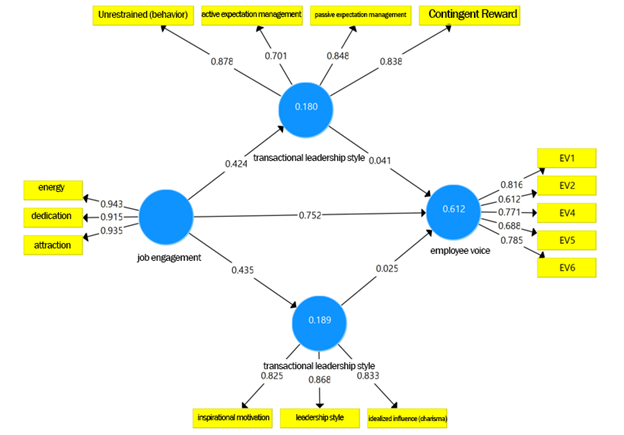
In fitting measurement models, examining the appropriateness of the factor loadings of the manifest variables is one of the key objectives. According to Chin (1998), factor loadings whose standardized estimate value is more than .5 are considered appropriate and indicate that the manifest variable under study has a significant and meaningful impact on the measurement of the corresponding latent variable. If the factor loading of the manifest variables is less than the acceptable level, they should be removed from the model. Table 4 shows that the factor loading of the third item of the Employee Voice (EV) and the individual consideration component related to the transactional leadership construct are estimated to be less than .5, and therefore, as represented in Figure 1, these two variables have been removed from the model. After removing the inappropriate variables, the factor loading of the other manifest variables of the model constructs is estimated to be appropriate and more than .5. Hence, it is concluded that the model is of confirmatory validity. In order to examine the degree of independence of the independent variables in the model, the “variance inflation factor” or VIF criterion has been used. Based on the results, all the observed variables in the model have VIFs of less than 5, and the analysis results will not be affected by collinearity. Moreover, the external weights of all the observed variables are statistically significant, indicating the validity and reliability of the measured constructs and confirming the model's reliability in explaining the relationships between variables. The reliability of the model constructs has been measured by two criteria: Cronbach's alpha and composite reliability, and it is observed that the Cronbach's alpha coefficient and the composite reliability coefficient for all three constructs of job engagement, transactional and transformational leadership, and employee voice are more than .8 and are evaluated at a good level according to DeVellis (2017) and Bagozzi and Yi (1988). The convergent validity of the constructs was also assessed by two criteria: AVE and ROA coefficient. The AVE coefficient for the model constructs was found to be greater than .5, while the ROA coefficient exceeded 0.8. Based on the guidelines set forth by Henseler et al. (2015) and Dijkstra and Henseler (2015), it can be concluded that the model constructs possess convergent validity. The quality of the model constructs was evaluated by the CV.COM index (commonality index). The results indicated that all the model constructs have a positive CV.COM coefficient. Therefore, based on Henseler et al. (2009), the model constructs have acceptable quality, which represents a good fit of the constructs and a positive correlation between them and the relevant variables.
Results of Factor Loading, External Weight, VIF of Items, Reliability, Convergent Validity and Commonality Index of Model Constructs
|
CV.COM |
AVE |
CR |
rho_A |
|
VIF |
External weight |
Final factor loading |
Initial factor loading |
|
|
|
.63 |
.86 |
.95 |
.92 |
.92 |
|
|
|
|
Job engagement |
|
|
|
4.11 |
.36** |
.94** |
.94** |
Energy |
|||||
|
2.97 |
.34** |
.91** |
.91** |
Dedication |
||||||
|
3.71 |
.36** |
.93** |
.93** |
Attraction |
||||||
|
.32 |
.54 |
.85 |
.81 |
.78 |
Employee Voice |
|||||
|
|
1.74 |
.34** |
.81** |
.81** |
Item One (EV1) |
|||||
|
1.30 |
.19** |
.61** |
.57** |
Item Two (EV2) |
||||||
|
Deleted |
Deleted |
Deleted |
.30 |
Item Three (EV3) |
||||||
|
1.64 |
.27** |
.77** |
.75** |
Item Four (EV4) |
||||||
|
1.41 |
.25** |
.68** |
.68** |
Item Five (EV5) |
||||||
|
.80 |
1.71 |
.27** |
.78** |
.78** |
Item Six (EV6) |
|||||
|
.39 |
.71 |
.88 |
.80 |
.79 |
Transformational Leadership |
|||||
|
1.83 |
.34** |
.83** |
.83** |
Ideal Influence |
||||||
|
1.51 |
.42** |
.82** |
.82** |
Inspirational Motivation |
||||||
|
1.88 |
.41** |
.86** |
.87** |
Rational Stimulation |
||||||
|
Deleted |
Deleted |
Deleted |
.10 |
Individual Consideration |
||||||
|
.44 |
.71 |
.89 |
.86 |
.83 |
Transactional Leadership |
|||||
|
1.96 |
.30** |
.83** |
.83** |
Contingent Reward |
||||||
|
1.48 |
.21** |
.70** |
.69** |
Active Expectation Management |
||||||
|
2.13 |
.30** |
.84** |
.84** |
Passive Expectation Management |
||||||
|
2.16 |
.38** |
.87** |
.88** |
Unrestrained |
||||||
Note. ** Indicates significance at the 1% error level.
The Fornell-Larcker (1981) matrix presented in Table 5 indicates that the model constructs interact more with their indicators than with each other, which confirms the appropriate divergent validity of the model (Henseler et al., 2015). Furthermore, the correlation between job engagement and employee voice is estimated to be .77, representing a positive relationship between these two variables. Henseler et al. (2015) suggest that, in addition to the Fornell-Larcker criterion, the HTMT criterion should also be used as a more powerful tool for assessing divergent validity in structural equation models with the PLS approach. Based on their suggestion, the HTMT value should be less than .85 to indicate appropriate divergent validity between the constructs. In cases where the constructs are more closely related (for example, on similar or very close scales), the HTMT value can be acceptable up to .90 or even .95, but it should be carefully examined. The estimated results for the HTMT criterion in Table 5 indicate that all values of this index are less than .9, and the appropriate divergent validity of the model based on this index is also confirmed.
Measuring the Divergent Validity of the Model Constructs
|
Constructs |
Fornell Larcker |
HTMT Indicator |
|||||||
|
1 |
2 |
3 |
4 |
1 |
2 |
3 |
4 |
|
|
|
Job Engagement |
.93 |
|
|
|
|
||||
|
Transactional Leadership Style |
.42 |
.81 |
|
.47 |
|
|
|
||
|
Transformational Leadership Style |
.43 |
.71 |
.84 |
|
.50 |
.86 |
|
|
|
|
Employee Voice |
.78 |
.37 |
.38 |
.73 |
.89 |
.45 |
.46 |
-- |
|
After confirming the suitability of the measurement models, structural model’s goodness-of-fit and that of the general model was assessed as presented in Table 6. In the structural section, only endogenous latent variables (dependent variables) are examined. In the research model, the variables of transformational leadership, transactional leadership, and employee voice have an endogenous role. The R2 index specifically measures the degree of influence of the predictor (independent) variables on the dependent variables. This index shows the predictability of the independent variables in relation to the dependent variable. Cohen (1998) suggests using values of .02, .15, and .33 as criteria for weak, medium, and strong R² values. Based on the results, the R-squared (R2) value for predicting transactional leadership was .18, and for predicting transformational leadership, it was also .18, which was considered medium. For predicting employee voice, the value was .61, which was considered strong. The index of redundancy, also called the CV Red or Q2 criterion, determines the predictive power of the model, and according to Henseler et al. (2009), if it is greater than zero for an endogenous construct, the predictive power of that construct is considered appropriate. In the present study, the Q2 index was estimated to be positive for all three endogenous constructs of the model, confirming the appropriateness of their predictive power. The GOF criterion is used to determine the overall quality of the model, and with this criterion, researchers can control the fit of the overall part after examining the fit of the measurement part and the structural part of their overall research model; the higher the GOF value, the more appropriate it is in describing the research sample. Wetzels et al. (2009) suggest three values of .01, .25, and .35 as criteria for weak, medium, and strong values of this index. The overall quality of the model “job engagement and employee voice among nurses: the mediating role of leadership style” is assessed .44 by the GOF criterion, which is considered strong. Thus, the quality of the measurement model, structural model, and overall model is confirmed, and the relationships within the model and the hypotheses can be examined.
Table 6
Goodness-of-Fit Indices of the Structural and General Model
|
Structure |
Goodness-of-fit in structural model |
Goodness-of-fit in general model |
||||
|
R2 |
Level |
SSO |
SSE |
Q2 |
GOF |
|
|
Transactional Leadership Style |
.18 |
Intermediate |
.10 |
.93 |
.10 |
.44 |
|
Transformational Leadership Style |
.18 |
Intermediate |
.78 |
.68 |
.12 |
|
|
Employee Voice |
.61 |
Strong |
.13 |
.90 |
.30 |
|
According to the findings, all instruments were confirmed to be valid and reliable, and the hypotheses were simultaneously evaluated using a structural equation model with the assistance of Smart-PLS 3 software. The significance levels associated with the direct path coefficients of the model are shown in Table 7.
Estimated Coefficients of the Direct Paths of the Model and Their Significance Test
|
|
Direct Path |
Standard coefficient |
Standard error |
Statistics |
p-value |
Effect size |
|
H1 |
Job engagement -> Employee Voice |
.75 |
.03 |
23.27 |
.000 |
1.14 |
|
H2A |
Job engagement -> Transactional Leadership Style |
.42 |
.06 |
6.39 |
.000 |
.21 |
|
H2B |
Job engagement -> Transformational Leadership Style |
.43 |
.06 |
6.96 |
.000 |
.23 |
|
H3A |
Transactional Leadership Style -> Employee Voice |
.04 |
.05 |
.82 |
.40 |
.00 |
|
H3B |
Transformational Leadership Style -> Employee Voice |
.02 |
.05 |
.44 |
.65 |
.00 |
Table 7 indicates that all paths in the model are significant (p < .05). The findings of the mediation analysis, according to the indirect path coefficient, are presented in Table 8.
Estimated Indirect Path Coefficients of the Model and Its Significance Test
|
|
Indirect Path |
Standard coefficient |
Standard error |
Statistics |
p-value |
|
H4A |
Job engagement -> Transactional Leadership Style -> Employee Voice |
.01 |
.02 |
.76 |
.44 |
|
H4B |
Job engagement -> Transformational Leadership Style -> Employee Voice |
.01 |
.02 |
.43 |
.66 |
Hypothesis 1: Job engagement has a positive and significant relationship with employee voice.
The test results indicate that job engagement and employee voice have a standard coefficient of .75, with a t-value of 23.27 and a p-value of less than .001. According to these results, it was concluded that job engagement has a positive and significant effect on employee voice, which aligns with the proposed hypothesis; therefore, the first hypothesis is accepted. The value of the effect of job engagement on employee voice is estimated to be 1.14, which is more than .33 and is at a significant level according to Cohen (1998).
Hypothesis 2: Job engagement has a positive and significant relationship with leadership style.
The test results indicate that job engagement in relation to transformational leadership has a standardized coefficient of .43, with a t-value of 6.96 and a p-value of less than .001. Moreover, job engagement in relation to transactional leadership has a standardized coefficient of .42. Based on these results, job engagement has a positive and significant effect on transformational and transactional leadership styles, which is in line with the proposed hypothesis, so the second hypothesis is also accepted. The value of the effect of job engagement on transformational leadership is estimated to be .23, and on transactional leadership is estimated to be .21, both of which are more than .15 and are at a moderate level according to Cohen (1998). However, the effect of job engagement on transformational leadership was slightly greater.
Hypothesis 3: Leadership style has a positive and significant relationship with employee voice.
The test results indicate that the transformational leadership style has a standard coefficient of .02 with a t-value of .44 and a P-value of .65, suggesting a minimal effect on employee voice. In addition, the transactional leadership style on employee voice has a standard coefficient of .04 with a t-value of .82 and a p-value of .40. Based on these results, leadership style does not have a significant effect on employee voice, which is not in line with the proposed hypothesis, so the third hypothesis is not accepted.
Hypothesis 4: Leadership style mediates the relationship between job engagement and employee voice.
Since the coefficient of the indirect effect of job engagement on employee voice through transformational leadership is estimated to be .01. The t-statistic value is .43, and the p-value is .66, and also, the coefficient of the indirect effect of job engagement on employee voice through transactional leadership is estimated to be 0.018. The t-statistic value is .76 and the p-value is .44; it can be said that the indirect path of job engagement on employee voice through leadership style is not significant, which is not in line with the proposed hypothesis. Therefore, the fourth hypothesis is not accepted, and it can be said that job engagement does not affect employee voice through transformational and transactional leadership styles.
Conclusion
The findings of the present study indicated that transactional and transformational leadership styles play a significant mediating role in the relationship between job engagement and employee voice. In other words, the presence of effective leadership in healthcare settings can play an important role in increasing the level of active participation of nurses and expressing their views. Transformational leadership also enhances the psychological sense of security, engagement, and willingness of employees to express their voices. On the other hand, descriptive data analysis revealed that job engagement among nurses is at a relatively high level. This can be related to several factors such as job meaningfulness, social support, and job self-efficacy.
They have emphasized that job engagement has a direct relationship with the occurrence of discretionary behaviors such as organizational voice. In the context of employee voice, the high dispersion in responses shows that the perception of voice opportunities and their use differ among nurses. Factors such as type of employment, age, and work experience may play a role in these differences. This finding may indicate the need for managers to focus more on empowering employees and creating a safe psychological environment for expressing opinions and criticisms. Furthermore, the elimination of some items due to low reliability or inappropriate factor loading reinforces the need to revise the instrument for measuring leadership styles in the cultural and occupational context of Iran. The “individual consideration” dimension in transformational leadership, in particular, did not appear to be very strong in this sample, which may be due to the common management styles in the country’s health sector. Finally, the results indicated that the structural model of the research has a good fit and the reliability, convergent validity, and model quality indicators are at an acceptable level. This represents the theoretical and empirical coherence of the conceptual model of the research.
According to recent research findings, leadership styles and job engagement play a crucial role in enhancing the performance and quality of health services in high-stress work environments, such as hospitals and primary care centers. Nurses, as the backbone of health systems, are more exposed than other professions to work pressures, high workloads, emotional demands, and increasing responsibilities; as a result, their level of job engagement can be strongly influenced by leadership styles in the workplace (Lee et al., 2025). Given the specific circumstances of the nursing profession, which require constant presence, interaction with patients in critical situations, and exposure to the human consequences of clinical decisions, health systems are expected to mitigate these pressures with strong organizational support. One of the most effective organizational tools for this purpose is the use of transformational, supportive, and participatory leadership styles, which can lead to increased work engagement, job satisfaction, and employee voice (Wang et al., 2025). Especially in primary health care settings, which often face a lack of human resources and infrastructure, the presence of leaders who are able to create a safe psychological environment, encourage open communication, and empower nurses not only improves the professional performance of nurses but can also have positive outcomes for the population’s health (Al-Otaibi et al., 2023). Therefore, it is emphasized at the global level that improving the performance of health systems will not be possible without investing in human resources, especially nurses, and without improving the level of organizational leadership.
Consequently, it is essential for health system managers to consider leadership style not just as a management component, but also as a key strategy in increasing nurses' motivation, commitment, and job engagement. Effective leadership style mediates between organizational structure and positive job behaviors such as employee engagement and voice, and can provide an environment in which nurses feel valued and are encouraged to actively participate in improving health services. The results of the present study emphasize the importance of leadership styles in explaining the relationship between employee engagement and voice in healthcare settings. The findings indicated that both transactional and transformational leadership styles play a significant mediating role; in such a way that, under conditions of effective leadership, nurses' job engagement can lead to increased voice and active participation in decision-making. These findings suggest that healthcare organizations should develop the leadership competencies of their managers and foster safe and supportive environments that encourage nurses to express their opinions and ideas. Moreover, promoting job engagement through meaningful design of occupations, creating growth opportunities, and social support is of great importance. At a theoretical level, the present study, by integrating three key constructs (job engagement, leadership style, and employee voice), contributes to a deeper understanding of psycho-organizational mechanisms in healthcare settings and suggests new directions for future research.
Thus, (1) it is crucial for managers to recognize and address the needs of nurses in order to enhance their job engagement within the healthcare system; (2) acquiring basic and necessary training on leadership styles and organizational behavior is important; (3) it is vital for health system management to encourage support for nurses and to acknowledge their requirements; (4) organizing informative sessions and practical workshops for managers, supervisors, leaders, and nurses to increase their understanding of organizational behavior and conflict resolution is necessary.
References
Al-Otaibi, S. M., Amin, M., Winterton, J., Bolt, E. E. T., & Cafferkey, K. (2023). The role of empowering leadership and psychological empowerment on nurses’ work engagement and affective commitment. International Journal of Organizational Analysis, 31(6), 2536–2560. https://doi.org/10.1108/IJOA-11-2021-3049
Bagozzi, R. P., Yi, Y. (1988). On the evaluation of structural equation models. JAMS, 16, 74–94. https://doi.org/10.1007/BF02723327
Baker, O. G., & Alshehri, B. D. (2020). The relationship between job stress and job satisfaction among Saudi nurses: A cross-sectional study. Nurse Media Journal of Nursing, 10(3), 292–305. https://doi.org/10.14710/nmjn.v10i3.32767
Bass, B. M., & Riggio, R. E. (2006). Transformational leadership (2nd ed.). Psychology Press. Google Scholar.
Blau, P. M. (1964). Exchange and power in social life. Wiley.
Boamah, S. A., Laschinger, H. K. S., Wong, C., & Clarke, S. (2018). Effect of transformational leadership on job satisfaction and patient safety outcomes. Nursing Outlook, 66(2), 180–189. https://doi.org/10.1016/j.outlook.2017.10.004
Breevaart, K., Bakker, A. B., Hetland, J., Demerouti, E., Olsen, O. K., & Espevik, R. (2014). Daily transactional and transformational leadership and daily employee engagement. Journal of Occupational and Organizational Psychology, 87(1), 138–157. https://doi.org/10.1111/joop.12041
Cao, X., & Chen, L. (2020). The impact of empathy on work engagement in hemodialysis nurses: The mediating role of resilience. Japan Journal of Nursing Science, 17(1), e12284. https://doi.org/10.1111/jjns.12284
Chen, Y.‑C., Guo, Y.‑L. L., Chin, W.‑S., Cheng, N.‑Y., Ho, J.‑J., & Shiao, J. S.‑C. (2019). Patient–nurse ratio is related to nurses’ intention to leave their job through mediating factors of burnout and job dissatisfaction. International Journal of Environmental Research and Public Health, 16(23), 4801. https://doi.org/10.3390/ijerph16234801
Chin, W. W. (1998). The partial least squares approach to structural equation modeling. Modern Methods for Business Research, 295(2), 295–33. Google Scholar
Cohen, J. (1988). Statistical power analysis for the behavioral sciences (2nd ed.). Hillsdale, NJ: Erlbaum.
Dall’Ora, C., Saville, C., Rubbo, B., Turner, L., Jones, J., & Griffiths, P. (2022). Nurse staffing levels and patient outcomes: A systematic review of longitudinal studies. International Journal of Nursing Studies, 134, 104311. https://doi.org/10.1016/j.ijnurstu.2022.104311
Detert, J. R., & Burris, E. R. (2007). Leadership behavior and employee voice: Is the door really open? Academy of Management Journal, 50(4), 869–884. https://doi.org/10.5465/amj.2007.26279183
DeVellis, R. F. (2017). Scale Development: Theory and Applications (4th ed.). SAGE Publications.
Dijkstra, T. K., & Henseler, J. (2015). Consistent partial least squares path modeling. MIS Quarterly, 39(2), 297–316. https://doi.org/10.25300/MISQ/2015/39.2.02
Engelbrecht, A. S., Heine, G., & Mahembe, B. (2017). Integrity, ethical leadership, trust and work engagement. Leadership & Organization Development Journal, 38(3), 368–379. https://doi.org/10.1108/lodj-11-2015-0237
Eslami, J., & Gharakhani, D. (2012). Organizational commitment and job satisfaction. ARPN Journal of Science and Technology, 2(2), 85–91.
Eva, N., Robin, M., Sendjaya, S., van Dierendonck, D., & Liden, R. C. (2019). Servant leadership: A systematic review and call for future research. The Leadership Quarterly, 30(1), 111–132. https://doi.org/10.1016/j.leaqua.2018.07.004
Fiaz, M., Su, Q., Amir, I., & Saqib, A. (2017). Leadership styles and employees' motivation: Perspective from an emerging economy. The Journal of Developing Areas, 51(4), 143–156. https://doi.org/10.1353/jda.2017.0093
Fiedler, F. E. (1967). A theory of leadership effectiveness. McGraw-Hill series in management.
Fornell, C., & Larcker, D. F. (1981). Evaluating structural equation models with unobservable variables and measurement error. Journal of Marketing Research, 18(1), 39–50. https://doi.org/10.1177/002224378101800104
Greenleaf, R. K. (1977). Servant leadership: A journey into the nature of legitimate power and greatness. Paulist Press.
Hall, L. H., Johnson, J., Watt, I., Tsipa, A., & O’Connor, D. B. (2016). Healthcare staff wellbeing, burnout, and patient safety: A systematic review. PLoS ONE, 11(7), e0159015. https://doi.org/10.1371/journal.pone.0159015
Hashemi, R., Sadeghi, A., Roshanaei, G., & Purfarzad, Z. (2025). The relationship between the leader empowering behaviors and work engagement: The role of psychological empowerment as a mediating variable. BMC Nursing, 24, Article 652. https://doi.org/10.1186/s12912-025-03321-4
Henker, N., Sonnentag, S., & Unger, D. (2015). Transformational leadership and employee creativity: The mediating role of promotion focus and creative process engagement. Journal of Business and Psychology, 30(2), 235–247. https://doi.org/10.1007/s10869-014-9348-7
Henseler, J., Ringle, C. M., & Sarstedt, M. (2015). A new criterion for assessing discriminant validity in variance-based structural equation modeling. Journal of the Academy of Marketing Science, 43(1), 115–135. https://doi.org/10.1007/s11747-014-0403-8
Henseler, J., Ringle, C. M., & Sinkovics, R. R. (2009). The use of partial least squares path modeling in international marketing. In New challenges to international marketing. Emerald Group Publishing Limited. https://doi.org/10.1108/S1474-7979(2009)0000020014
House, R. J. (1971). A path-goal theory of leader effectiveness. Administrative Science Quarterly, 16(3), 321–339
Huang, Q., Wang, L., Huang, H., Tang, H., Liu, J., & Chen, C. (2025). Transformational leadership, psychological empowerment, work engagement and intensive care nurses’ job performance: A cross-sectional study using structural equation modeling. BMC Nursing, 24, 215. https://doi.org/10.1186/s12912-025-03485-z
Keskes, I. (2014). Relationship between leadership styles and dimensions of employee organizational commitment: A critical review and discussion of future directions. Intangible Capital, 10(1), 26–51. https://doi.org/10.3926/ic.476
Lapeña, L. F. R., Tuppal, C. P., Loo, B. G. K., & Abe, K. H. C. (2017). Transformational and transactional leadership styles of nurse managers and job satisfaction among Filipino nurses: A pilot study. Nurse Media Journal of Nursing, 7(2), 65–78. https://doi.org/10.14710/nmjn.v7i2.15171
Liang, J., Farh, C. I. C., & Farh, J. L. (2012). Psychological antecedents of promotive and prohibitive voice: A two-wave examination. Academy of Management Journal, 55(1), 71–92. https://doi.org/10.5465/amj.2010.0176
Lee, S. E., Seo, J. K., & MacPhee, M. (2025). Individual and unit-level predictors of promotive voice in nursing: a multilevel analysis. BMC nursing, 24(1), 567. https://doi.org/10.1186/s12912-025-03217-3
Lu, X., Xie, B., & Guo, Y. (2018). The trickle-down of work engagement from leader to follower: The roles of optimism and self-efficacy. Journal of Business Research, 84, 186–195. https://doi.org/10.1016/j.jbusres.2017.11.014
Manning, J. (2016). The influence of nurse manager leadership style on staff nurse work engagement. Journal of Nursing. https://doi.org/10.1097/nna.0000000000000372
Mehrad, A., Fernández-Castro, J., González Gómez de Olmedo, M. P., & García-Sierra, R. (2022). Mediation role of perceived organizational support on nurses’ work engagement and leadership styles. Nurse Media Journal of Nursing, 12(2), 208–222. https://doi.org/10.14710/nmjn.v12i2.45872
Mehrad, A. (2015). Big five personality factors, emotional intelligence and job satisfaction among academic staff of public research universities in Kang Valley, Malaysia [Doctoral dissertation, Universiti Putra Malaysia]. http://psasir.upm.edu.my/id/eprint/64101
Mehrad, A. & Fallahi, B. (2014). The role of leadership styles on staff's job satisfaction in public organizations. Acta Universitaria, 24(5), 27–32. https://doi.org/10.15174/au.2014.597
Morrison, E. W. (2011). Employee voice behavior: Integration and directions for future research. Academy of Management Annals, 5(1), 373–412. https://doi.org/10.5465/19416520.2011.574506
Morrison, E. W. (2014). Employee voice and silence. Annual Review of Organizational Psychology and Organizational Behavior, 1(1), 173–197. https://doi.org/10.1146/annurev-orgpsych-031413-091328
Morrison, E. W., & Milliken, F. J. (2000). Organizational silence: A barrier to change and development in a pluralistic world. Academy of Management Review, 25(4), 706–725. https://doi.org/10.5465/amr.2000.3707697
Mowbray, P. K., Wilkinson, A., & Tse, H. H. M. (2015). An integrative review of employee voice: Identifying a common conceptualization and research agenda. International Journal of Management Reviews, 17(3), 382–400. https://doi.org/10.1111/ijmr.12045
Nembhard, I. M., & Edmondson, A. C. (2006). Making it safe: The effects of leader inclusiveness and professional status on psychological safety and improvement efforts in health care teams. Journal of Organizational Behavior, 27(7), 941–966. https://doi.org/10.1002/job.413
Saleem, H. (2015). The impact of leadership styles on job satisfaction and mediating role of perceived organizational politics. Procedia-Social and Behavioral Sciences, 172, 563–569. https://doi.org/10.1016/j.sbspro.2015.01.403
Shuck, B., Van Dyne, L., & Baker, S. (2020). Creating a positive climate for employee voice and innovation: The role of leadership and organizational culture. Journal of Leadership & Organizational Studies, 27(3), 274–287. https://doi.org/10.1177/1548051820915368
Sekse, R. J. T., Hunskår, I., & Ellingsen, S. (2018). The nurse's role in palliative care: A qualitative meta-synthesis. Journal of Clinical Nursing, 27(1-2), e21–e38. https://doi.org/10.1111/jocn.13912
Stogdill, R. M., & Coons, A. E. (1957). Leader behavior: Its description and measurement. Ohio State University, Bureau of Business Research.
Strom, D. L., Sears, K. L., & Kelly, K. M. (2014). Work engagement: The roles of organizational justice and leadership style in predicting engagement among employees. Journal of Leadership & Organizational Studies, 21(1), 71–82. https://doi.org/10.1177/1548051813485437
Tangirala, S., & Ramanujam, R. (2008). Employee silence on critical work issues: The cross-level effects of procedural justice climate. Personnel Psychology, 61(1), 37–68. https://doi.org/10.1111/j.1744-6570.2008.00105.x
Walumbwa, F. O., Avolio, B. J., Gardner, W. L., Wernsing, T. S., & Peterson, S. J. (2008). Authentic leadership: Development and validation of a theory-based measure. Journal of Management, 34(1), 89–126. https://doi.org/10.1177/0149206307308913
Wan, Q., Zhou, W., Li, Z., Shang, S., & Yu, F. (2018). Work engagement and its predictors in registered nurses: A cross‐sectional design. Nursing & Health Sciences, 20(4), 415–421. https://doi.org/10.1111/nhs.12424
Wang, Q., Zhang, H., Li, Y., & Wang, M. (2025). The relationship between affective leadership and the voice behavior of nurses: a cross-level moderated mediation model. BMC nursing, 24(1), 169.
Wang, Z., Li, C., & Li, X. (2017). Resilience, leadership and work engagement: The mediating role affect. Social. https://doi.org/10.1007/s11205-016-1306-5
Wetzels, M., Odekerken-Schröder, G., & Van Oppen, C. (2009). Using PLS path modeling for assessing hierarchical construct models: Guidelines and empirical illustration. MIS Quarterly, 177–195. https://doi.org/10.2307/20650284
World Health Organization (WHO). (2020). State of the world’s nursing 2020: Investing in education, jobs and leadership. Geneva: World Health Organization. https://www.who.int/publications/i/item/9789240003279
Yukl, G. (2013). Leadership in organizations (8th ed.). Pearson.
Zhang, F., Huang, L., Fei, Y., Peng, X., Liu, Y., Zhang, N., Chen, C., & Chen, J. (2024). Impact of caring leadership on nurses’ work engagement: Examining the chain mediating effect of calling and affective organizational commitment. BMC Nursing, 23, Article 716. https://doi.org/10.1186/s12912-024-02388-9

Page 1 of
Download Count : 14
Visit Count : 90
Keywords
Job Engagement; Employee Voice; Leadership Style; Nurses; Transformational Leadership; Transactional Leadership


Author(s) Information


How to cite this article
Parastar, R. (2025). Job engagement and employee voice among nurses with the mediating role of leadership style. Management Issues in Healthcare System, 11, 17-36. https://doi.org/10.32038/mihs.2025.11.02
Acknowledgments
Not applicable.
Funding
Not applicable.
Conflict of Interests
No, there are no conflicting interests.
Open Access
This article is licensed under a Creative Commons Attribution 4.0 International License, which permits use, sharing, adaptation, distribution and reproduction in any medium or format, as long as you give appropriate credit to the original author(s) and the source, provide a link to the Creative Commons license, and indicate if changes were made. You may view a copy of Creative Commons Attribution 4.0 International License here: http://creativecommons.org/licenses/by/4.0/