







Original Research
The AI–Ethics–Personalisation Nexus: How Ethical Deliberations Shape Personalised Banking Service in Ghana


- Abstract
- Full text
- Metrics
Artificial Intelligence (AI) is revolutionising banking by improving customer engagement and bank service personalisation. Yet, Ethical Deliberations (ED) on transparency, accountability, equity, and responsible data governance are crucial to the success of AI-powered personalisation. The present study explores the mediating effect of ED on the relationship between the adoption of AI and Personalised Banking Service (PBS) in the Ghanaian banking sector. Using a quantitative research design, data were collected from employees of five selected banks in Ghana. Of the 408 questionnaires distributed, 344 usable responses were obtained, representing an 84.3% response rate, and were analysed using Partial Least Squares Structural Equation Modelling (PLS-SEM). The results show that AI adoption is positively and significantly associated with PBS. Furthermore, ED plays a significant mediating role between AI adoption and PBS, suggesting that responsible AI governance enhances the effectiveness of investment in technology and the delivery of customer-focused banking services. The paper adds to the growing body of research on responsible AI and financial services, emphasising the role of ED as a key linkage between AI adoption and PBS in an emerging-market setting. Bank executives, regulators and policymakers interested in fostering innovation while remaining ethically responsible will find the findings of interest.
The AI–Ethics–Personalisation Nexus: How Ethical Deliberations Shape Personalised Banking Service in Ghana
KAAF University, Department of Business Administration and Education, Ghana
ABSTRACT:
Artificial Intelligence (AI) is revolutionising banking by improving customer engagement and bank service personalisation. Yet, Ethical Deliberations (ED) on transparency, accountability, equity, and responsible data governance are crucial to the success of AI-powered personalisation. The present study explores the mediating effect of ED on the relationship between the adoption of AI and Personalised Banking Service (PBS) in the Ghanaian banking sector. Using a quantitative research design, data were collected from employees of five selected banks in Ghana. Of the 408 questionnaires distributed, 344 usable responses were obtained, representing an 84.3% response rate, and were analysed using Partial Least Squares Structural Equation Modelling (PLS-SEM). The results show that AI adoption is positively and significantly associated with PBS. Furthermore, ED plays a significant mediating role between AI adoption and PBS, suggesting that responsible AI governance enhances the effectiveness of investment in technology and the delivery of customer-focused banking services. The paper adds to the growing body of research on responsible AI and financial services, emphasising the role of ED as a key linkage between AI adoption and PBS in an emerging-market setting. Bank executives, regulators and policymakers interested in fostering innovation while remaining ethically responsible will find the findings of interest.
KEYWORDS: Artificial Intelligence Adoption; Ethical Deliberations; Personalised Banking Services; Banking Sector; Ghana
In today's rapidly developing business environments, Artificial Intelligence (AI) has emerged as a crucial force in the digital transformation, influencing business models, decision-making, and service delivery across diverse industries (Kumar et al., 2024). In the financial sector, the integration of machine learning, predictive analytics, natural language processing, and intelligent automation is becoming more common as financial institutions seek to optimize operations, better manage risks, and improve customer experience (El Hajj & Hammoud, 2023). In the banking industry, AI tools help financial institutions to analyze customer data, forecast customer needs, suggest appropriate financial products, and provide PBS that meet evolving customer expectations (Peng et al., 2023). Over time, AI adoption has shifted from a mere investment in technology to a strategic tool that can enhance the customer experience within a banking service.
Nevertheless, the rise of AI in banking has spurred several ethical concerns. Customer profiling, credit assessment, product recommendation, and AI-driven customer interactions are some instances of AI-driven decisions that raise concerns about fairness, transparency, accountability, privacy, and responsible data governance (de Castro Vieira et al., 2025). In a banking context, the concern is greatest around the use of sensitive customer data and the significant role AI systems play in decisions that affect customer access, experiences, and financial outcomes. Thus, beyond technological competence, organisations need ethical governance mechanisms to ensure responsible and trustworthy AI deployment (Aldboush & Ferdous, 2023).
ED are the organisational processes by which organisations recognise ethical issues, assess potential outcomes and consider stakeholder perspectives in decision-making (Sleigh et al., 2024). In AI, ED concerns the design and implementation of AI systems that promote fairness, accountability, transparency, and human oversight throughout the AI system lifecycle (Biondi et al., 2023). In recent years, moral control has been suggested as a way to mitigate concerns related to algorithmic bias, privacy issues, and algorithmic explainability, ultimately fostering greater acceptance and legitimacy of AI-powered services (Machado et al., 2024). Although many concepts have been proposed, empirical evidence on how incorporating AI capabilities leads to customer-oriented outcomes remains limited.
Previous studies consistently associate AI with improvements in fraud detection, credit risk assessment, operational efficiency, customer engagement, and personalised recommendations (Doumpos et al., 2023; Hariguna & Ruangkanjanases, 2024; Maja & Letaba, 2022). However, the literature has focused more on technological and operational outcomes than on the governance mechanisms through which AI capabilities are translated into responsible personalised banking services (Ali et al., 2025; Magableh et al., 2024; Wamba-Taguimdje et al., 2020). This distinction suggests that AI capability alone may not explain customer-oriented outcomes and supports examining ED as an intermediary mechanism.
This creates an important theoretical and empirical gap. AI enables banks to collect, process, and interpret customer information, but technological capability alone may not ensure responsible or effective personalisation. The use of customer data and algorithmic decision-making requires attention to fairness, transparency, accountability, privacy, and stakeholder interests. ED may therefore provide an important mechanism through which banks translate AI capabilities into customer-oriented and responsible personalised services. Yet, empirical evidence on ED as an intermediary between AI adoption and Personalised Banking Services (PBS) remains limited, particularly in emerging-market banking contexts.
Ghana provides a relevant context for examining this relationship because its banking sector has experienced substantial growth in digital banking, fintech innovation, mobile payments, and technology-enabled financial services (Amankwah-Amoah & Lu, 2024). AI applications are increasingly relevant to fraud management, customer engagement, credit assessment, and process automation (Danso & Hanson, 2023). At the same time, concerns about data governance, cybersecurity, algorithmic accountability, and responsible AI adoption remain important. Examining ED as a mechanism linking AI adoption with PBS can therefore provide evidence on how technological capabilities are translated into responsible and customer-oriented banking outcomes.
The study addresses this gap by examining the relationship between AI adoption, ED, and PBS in Ghanaian banks. Specifically, it addresses three research questions:
RQ1: What is the relationship between AI adoption and PBS in Ghanaian banks?
RQ2: What is the relationship between ED and PBS in Ghanaian banks?
RQ3: Do ED mediate the relationship between AI adoption and PBS in Ghanaian banks?
This study makes three contributions. First, it extends research on AI-enabled banking by examining the governance conditions associated with customer-oriented outcomes. Second, it identifies ED as a mediating mechanism linking AI adoption with PBS. Third, it contributes evidence from Ghana, extending responsible AI research beyond developed-country contexts and highlighting the relevance of ethical governance in emerging banking environments.
Theoretical Foundation
The study is guided by two theories, which are the Stakeholder Theory and Institutional Theory, to see how Ethical Deliberations (ED) affect the relationship between Artificial Intelligence (AI) adoption and the implementation of Personalised Banking Services (PBS). These theories offer complementary explanations for why banks need to integrate technological innovation with ethical governance practices.
Based on Stakeholder Theory, proposed by Freeman (1984), organisations should consider the interests and expectations of stakeholders affected by their actions. In AI-powered banking, this means banks need to address issues of fairness, transparency, accountability, privacy, and responsible use of customer data. The organisational processes that banks undertake to consider the implications of AI applications and to ensure that technology is deployed in a way that meets stakeholder expectations are called ED. Responsible AI governance has been found to build trust in AI among stakeholders, as it helps to ensure accountability and mitigate risks related to algorithmic bias and misuse of data (Eskandarany, 2024; Owolabi et al., 2024). Thus, Stakeholder Theory offers a lens for understanding how ED can enable the adoption of AI to create better personalised banking experiences.
Another explanation for the implementation of ethical AI practices comes from Institutional Theory (DiMaggio & Powell, 1983). It is theorized that firms respond to regulatory, professional and social pressures with structures and practices to increase legitimacy. In banking, customers' demands for responsible AI, data security, and algorithmic accountability drive the adoption of ethical governance frameworks within financial institutions. In the banking industry, customer expectations for responsible AI, data security, and algorithmic accountability push financial institutions to institute ethical governance structures. These approaches allow banks to align responsible adoption with trust and regulatory acceptability (Vuković et al., 2025).
Stakeholder Theory and Institutional Theory together provide a strong theoretical basis for situating ED as a medium between AI adoption and PBS. Stakeholder Theory highlights the need to respond to stakeholder expectations when implementing an AI tool, while Institutional Theory highlights the external pressures that make it an incentive for banks to adopt ethical governance practices. Therefore, combining these perspectives suggests that AI adoption brings more value to customers when accompanied by ED and deliberation processes.
Empirical Review and Hypotheses Development
AI Adoption and PBS
In banking, AI is a key driver of digital transformation, enabling institutions to analyse customer data, predict behaviour and customise financial products and services to meet individual needs (Radenković et al., 2023). Machine learning, predictive analytics and intelligent automation enable banks to meet customers on their own terms and respond quickly to customer needs, which might not have been possible without automation (Roshni, 2024).
Previous studies demonstrate that AI adoption boosts operational efficiency, decision-making precision, fraud prevention, and customer engagement (Prabin et al., 2024; Mishra, 2025; Johora et al., 2024). Recent studies, in particular, highlight the importance of AI in personalisation, where it creates customer profiles and recommends products based on them (Sheth et al., 2022). However, much of the existing literature focuses on operational benefits, with relatively less attention to personalised banking services in emerging economies. By leveraging the principles of Stakeholder Theory, AI can illuminate and address consumer expectations by analysing their data and responding with personalised service. Taken together, the existing literature suggests that AI adoption provides banks with the technological capability to enhance customer-oriented services; however, the strength and nature of this relationship depend on how AI capabilities are deployed. While studies focusing on operational outcomes consistently associate AI with efficiency, decision accuracy, and fraud prevention (Johora et al., 2024; Mishra, 2025; Prabin et al., 2024), studies focusing on customer-facing applications emphasise the potential of AI to support profiling, recommendations, and customised interactions (Sheth et al., 2022). These streams of literature therefore converge on the potential of AI to improve service personalisation but leave limited empirical evidence on this relationship in emerging-market banking contexts. The present study addresses this gap by directly examining the association between AI adoption and PBS in Ghanaian banks. On that basis, we propose that:
H1: AI adoption has a positive and significant association with PBS in the Ghanaian banking industry.
AI Adoption and ED
AI has come a long way in financial services and is now used in various ways; however, the need for ethical governance, which involves fairness, transparency, accountability, and responsible use of data, is growing. Organisations are increasingly tasked with boosting ED as AI systems are used more in decision-making processes, to ensure automated decisions align with stakeholder and regulatory expectations (Biondi et al., 2023; Sleigh et al., 2024). Research findings indicate that responsible AI companies are more likely to embed ethical governance frameworks, such as algorithmic transparency, bias-reduction measures, and data protection, to foster public trust and organisational legitimacy (Aldoseri et al., 2023; Owolabi et al., 2024). From an Institutional Theory perspective, higher rates of AI use increase regulatory and normative scrutiny of the organisation, promoting the establishment of formal ethical governance mechanisms. Likewise, Stakeholder Theory states that banks implementing AI should consider customer expectations by incorporating ethics into AI deployment.
The literature therefore reveals an important distinction between AI capability and AI governance. On the one hand, AI adoption increases the scope and complexity of automated decision-making; on the other hand, this increased reliance on AI creates greater demands for transparency, accountability, fairness, and responsible data management. Existing studies on responsible AI emphasise these governance requirements (Aldoseri et al., 2023; Biondi et al., 2023; Owolabi et al., 2024), while Institutional Theory explains why regulatory and normative pressures may encourage organisations to formalise such practices. However, empirical evidence directly linking the extent of AI adoption with organisational ethical deliberation remains limited in the Ghanaian banking context. This study therefore examines whether greater AI adoption is associated with stronger ED. Therefore, we hypothesise that:
H2: AI adoption has a positive and significant association with ED in the Ghanaian banking industry
ED and PBS
ED surrounding AI adoption primarily revolves around fairness, transparency, accountability, and responsible data handling (Sleigh et al., 2024). This is more significant in banking than in many other industries because it relies heavily on customer information and automated decision-making to offer personalised service.
The previous studies indicate that the process of ethical governance establishes organizational trust, reputation, and stakeholder acceptance by fostering transparency and fairness perceptions (Hasan et al., 2024). In AI-powered banking, ethical considerations should help alleviate customer worries about privacy, algorithmic bias, and opaque decision-making processes. Based on this reasoning, banks that foster an ethical mindset in their AI adoption are more likely to have customers respond positively to personalised services.
In the spirit of Stakeholder Theory, ethical consideration allows banks to align their AI practices with the stakeholders' expectations and establishes a trust basis for service delivery. Overall, the literature suggests that ethical governance may influence personalised banking through two related pathways. First, fairness, transparency, and responsible data governance can address concerns associated with the use of personal information and automated decisions. Second, these practices can contribute to stakeholder acceptance and confidence in technology-enabled services. While existing studies have established the importance of ethical governance for trust, legitimacy, and responsible AI adoption (Hasan et al., 2024; Sleigh et al., 2024), relatively little attention has been given to its direct relationship with personalised banking services. The present study addresses this limitation by examining whether ED are associated with PBS in Ghanaian banks. Accordingly, we propose that:
H3: ED have a positive and significant association with PBS in the Ghanaian banking industry.
Mediating Role of ED
While AI equips banks with sophisticated analytical tools, its implementation does not necessarily lead to enhanced personalised results. Trust and acceptance of AI-driven services may depend on concerns regarding algorithmic bias, privacy, transparency, and accountability (Pasipamire & Muroyiwa, 2024).
Ethical deliberation provides banks with a governance process to directly tackle these concerns and apply AI responsibly. Fairness, transparency, and accountability will build customer trust and maximize the value derived from investment in AI (Owolabi et al., 2024; Ratzan & Rahman, 2024). In other words, ED can be the key to how AI capability translates into customer-centred service.
This shift in thinking, which could be summarized as banks addressing customer and societal needs for responsible AI adoption, is captured by the lens of Stakeholder Theory. Institutional Theory further notes that this governance pattern may arise when there is regulatory and/or normative pressure. Together, these perspectives point to ethical deliberation as a tool for understanding the link between AI adoption and personalised banking outcomes.
The combined evidence therefore suggests that AI adoption and ethical deliberations should not be viewed as independent sources of value. AI provides the technological capability to analyse customer information and deliver personalised services, whereas ED provides an organizational governance mechanism through which these capabilities can be deployed responsibly. Stakeholder Theory explains the need to align AI-enabled services with stakeholder expectations, while Institutional Theory explains how regulatory, professional, and social pressures can encourage banks to establish ethical governance practices. Despite these theoretical arguments, limited empirical research has directly tested ED as a mediating mechanism between AI adoption and PBS, particularly within emerging banking markets. The present study addresses this gap by testing whether AI adoption influences PBS indirectly through ED. Accordingly, we hypothesise that:
H4: ED mediates the relationship between AI adoption and PBS in the Ghanaian banking industry.
Conceptual Framework
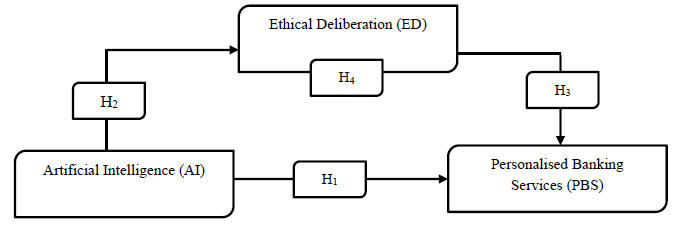
The conceptual framework provides a way to conceptualize the relationship between AI adoption, PBS, and ED. ED is also expected to positively influence PBS and mediate the influence of AI adoption on PBS, as seen in Figure 1. Thus, AI usage may contribute to service personalisation directly and indirectly via ED. The framework suggests that AI usage can complement PBS and ED by helping banks better understand customer data, respond to their needs, and provide personalized financial products and services (Sheth et al., 2022). However, the effectiveness of AI-driven personalisation depends on the ED processes surrounding AI implementation.
AI adoption in the banking sector is framed as the application of smart technologies to enhance customer interactions and services. Customer needs and preferences shape the level of customisation banks deliver, their communication and interactions with customers, and this is what PBS is about. In conceptualising ED, banks are seen as organisational processes that address ethical issues related to AI, such as fairness, transparency, accountability, and responsible data governance (Floridi et al., 2018; Jobin et al., 2019).
The framework suggests that ED mediates the relationship between AI adoption and PBS, helping banks convert technological capability into reliable, customer-centric services. Therefore, the model indicates that the value of AI adoption increases with ethical governance mechanisms that build customer confidence and organisational legitimacy as indicated in Figure 1.
Conceptual Framework Diagram
Method
A quantitative research approach was adopted to examine the relationship between AI adoption, ED, and PBS. The study adopted a quantitative, cross-sectional research design incorporating descriptive and explanatory elements. The descriptive design provides a general overview of AI use in banks in Ghana, and the explanatory design helps test the hypothesised relationships among the study variables.
The target population comprised 5 selected Commercial Banks in the Greater Accra Region with 920 employees. The branches were chosen for their size, extent of AI integration, and ease of reaching respondents. Participants ranged from branch managers and operations managers down to frontline staff who interacted with AI-driven banking systems.
The minimum sample size calculated using the Raosoft calculator was 272 respondents. Given the complexity of the proposed mediation model and the need to enhance statistical power while allowing for potential non-response, the study targeted 408 respondents. The study distributed 408 questionnaires to eligible employees across the five selected banks. After collection and screening for completeness, 344 usable questionnaires were retained for analysis, representing an effective response rate of 84.3%. The final sample therefore exceeded the minimum sample size requirement of 272 respondents and was considered adequate for the PLS-SEM analysis (Hair et al., 2021).
The two-stage sampling technique was employed. First, purposive sampling was used to select branches with AI-driven banking. Second, proportional stratified random sampling was used to represent the various managerial and non-managerial categories across branches.
A structured questionnaire was used to gather data on a five-point Likert scale (1 = Strongly Disagree to 5 = Strongly Agree) with closed-ended items. The five-point scale was used because of its simplicity, reliability, ease of use in organisational research, and its ability to reduce the burden on the respondent without compromising measurement consistency. The instrument consisted of three constructs: Artificial Intelligence Adoption (5 items), Ethical Deliberations (5 items), and Personalised Banking Services (5 items). The items measuring each variable were adapted from validated scales, ensuring content validity (Munoko et al., 2020; Osakwe, 2020; Sheth et al., 2022).
Before the main data collection, a pilot test was conducted with 30 employees drawn from different financial institutions that were not included in the final study sample. The pilot test aimed to assess the clarity, comprehension, and reliability of the survey instrument. Participants completed the questionnaire and identified any items that were ambiguous, difficult to understand, or repetitive. Based on the pilot results, minor wording modifications were made to selected items to improve respondent comprehension. The Cronbach's alpha values for all three constructs exceeded the 0.70 threshold during the pilot phase (AI = .84; ED = .76; PBS = .78), confirming the preliminary reliability of the measurement instrument before full-scale administration (Hair et al., 2021).
The internal consistency was verified by Cronbach’s alpha and Composite Reliability (CR). The reliability of all constructs was above the recommended level of .70. For convergent validity, indicator loadings and Average Variance Extracted (AVE) were measured. The loadings that exceed .70 and the AVE values that exceed .50 suggest good convergent validity (Hair et al., 2021). The HTMT ratio was used to evaluate discriminant validity, indicating that all constructs are empirically distinct. The overall measurement model has high reliability and validity.
Partial Least Squares Structural Equation Modelling (PLS-SEM) was employed to test the structural relationships formulated in the SmartPLS 4.0 software package. Standardized path coefficients (β) were used to assess the strength and direction of relationships. Cohen (2013) f² was used to evaluate the effect sizes and calculate the substantive impact of predictor variables on endogenous constructs: .02 = small effect, .15 = medium effect, and .35 = large effect. It adds to statistical significance by highlighting relevance for practice.
The impact of AI use on PBS was calculated as; Indirect Effect = β (AI → ED) × β (ED → PBS). Following PLS-SEM mediation guidance (Hair et al., 2021), the significance of the indirect effect was assessed using bootstrapping with 5,000 resamples. This was evaluated using the bootstrapped indirect effect and Variance Accounted For (VAF). The robustness of the results was ensured by using several tests:
VIF values below the recommended threshold indicated that multicollinearity was not a concern. Common method bias was assessed using full collinearity VIF and Harman's single factor test. The number of resamples to achieve path stability is 5,000. These tests verify the reliability and stability of the results.
Data were gathered physically and online through structured questionnaires from May to June 2026. Data collection commenced after permission had been obtained from the management of the selected banks. A total of 408 questionnaires were administered to eligible respondents. Respondents were informed of the academic purpose of the study, assured of anonymity and confidentiality, and informed that participation was voluntary. To minimise non-response, questionnaires were administered through both physical and online channels, and respondents were given sufficient opportunity to complete and return the instrument. Returned questionnaires were checked for completeness before coding and analysis. Following screening, 344 usable responses were retained, yielding an 84.3% response rate. The questionnaire was pre-tested to ensure that the items were clear and understandable to the target respondents before the main data collection.
Non-response bias was assessed following the extrapolation approach recommended by Armstrong and Overton (1977), which assumes that late respondents share characteristics with non-respondents. The sample was divided into two groups: early respondents, comprising the first 25% of returned questionnaires (n = 86), and late respondents, comprising the last 25% (n = 86). Independent-samples t-tests were conducted on the mean scores of all three study constructs (AI, ED, and PBS). The results indicated no statistically significant differences between the two groups at the 0.05 significance level (AI: t = .23, p = .81; ED: t = .26, p = .91; PBS: t = .24, p = .84), suggesting that non-response bias does not pose a substantive concern in this study. The high response rate of 84.3% further supports the representativeness of the collected data.
PLS-SEM was applied in SmartPLS 4.0 to analyse the data. The choice of PLS-SEM for this study was based on its ability to handle non-normal data distributions, complex mediation models, and prediction-oriented research (Hair et al., 2021).
The analysis included:
- Direct effects (AI → PBS; ED → PBS)
- Indirect effect (AI → ED → PBS)
- Total effect estimation
The structural model is specified as:
PBS = β₁AI + β₂ED + ε
ED = β₃AI + ε
Indirect effect:
AI → ED → PBS = β₃ × β₂
Total effect:
Direct effect + indirect effect
This specification enables the analysis of the relationship’s decomposition into direct and mediated relationships, as is done in mediation procedures in PLS-SEM.
Results
Measurement Model Assessment
As presented in Table 1, all indicator loadings exceeded the recommended .70 threshold, indicating strong indicator reliability and that each indicator represented its construct.
Factor Loadings for Measurement Model Constructs
|
Indicators |
Outer loadings |
|
AI 1 |
.88 |
|
AI 2 |
.81 |
|
AI 3 |
.87 |
|
AI 4 |
.86 |
|
AI 5 |
.84 |
|
ED 1 |
.88 |
|
ED 2 |
.89 |
|
ED 3 |
.90 |
|
ED 4 |
.91 |
|
ED 5 |
.87 |
|
PBS 1 |
.88 |
|
PBS 2 |
.90 |
|
PBS 3 |
.88 |
|
PBS 4 |
.88 |
|
PBS5 |
.87 |
Common Method Bias Results
Given that both the independent and dependent variables were collected from the same respondents using self-report measures, Common Method Bias (CMB) was assessed using two complementary approaches. First, Harman’s single-factor test was performed by loading all 15 measurement items into a single unrotated factor in exploratory factor analysis. The results showed that the first factor accounted for 25% of the total variance, below the 50% threshold recommended by Podsakoff et al. (2003), indicating that no single factor dominates the variance structure.
Second, the full collinearity variance inflation factor (VIF) approach recommended by Kock (2015) was employed. This method assesses CMB by examining whether all VIF values from a full collinearity test are equal to or lower than 3.3. The VIF values obtained for AI (1.97), ED (1.92), and PBS (1.93) were all substantially below this threshold. Taken together, both tests confirm that common method bias does not represent a significant threat to the validity of the study’s findings.
Construct Reliability and Validity
The psychometric properties of all the constructs are satisfactory. Internal consistency is supported by high Cronbach's alpha and composite reliability values, both greater than .70 for each as shown in Table 2. AVE values exceed .50, indicating acceptable convergent validity. Specifically, the convergence of ED (AVE = .79) and PBS (AVE = .78) is very high, indicating that these are very well-defined constructs. The validity of AI is also acceptable (AVE = .73), which will be included in the structural model.
Construct Reliability and Convergent Validity
|
Constructs |
Cronbach's alpha |
Composite reliability (rho_a) |
Composite reliability (rho_c) |
Average variance extracted (AVE) |
|
AI |
.91 |
.91 |
.93 |
.73 |
|
ED |
.93 |
.93 |
.95 |
.79 |
|
PBS |
.93 |
.93 |
.94 |
.78 |
Discriminant Validity
As demonstrated in Table 3, the Fornell–Larcker results indicate that the square root of the AVE exceeds the inter-construct correlations for AI (.85), ED (.89) and PBS (.88). This supports good discriminant validity and suggests that the constructs are empirically independent.
Discriminant Validity – Fornell-Larcker Criterion
|
Constructs |
AI |
ED |
PBS |
|
AI |
.85 |
|
|
|
ED |
.69 |
.89 |
|
|
PBS |
.73 |
.77 |
.88 |
Table 4 shows the range of Heterotrait–Monotrait Ratio (HTMT) values is .74 to .82, all below the conservative threshold of .85 indicated by Henseler et al. (2015). This supports the distinction between the constructs and indicates no commonality between AI adoption, ED, and PBSs.
Discriminant Validity – HTMT
|
Constructs |
HTMT Ratio |
|
ED <-> AI |
.74 |
|
PBS <-> AI |
.79 |
|
PBS <-> ED |
.82 |
Collinearity Assessment
As shown in Table 5, all constructs have Variance Inflation Factor (VIF) values less than 5, suggesting no multicollinearity among the constructs and stable model estimates.
Collinearity Statistics (VIF)
|
Construct |
VIF |
|
AI |
1.97 |
|
ED |
1.92 |
|
PBS |
1.93 |
Model Fit
Table 6 shows that the model fit is acceptable (SRMR = .03), with satisfactory d_ULS and d_G values. The NFI value of .93 is higher than the recommended value of .90.
Model Fit Indices
Fit Index |
Estimated Model |
Threshold / Reference |
SRMR |
0.03 |
< .08 (Hu & Bentler, 1999) |
d_ULS |
0.18 |
Acceptable (Henseler et al., 2015) |
d_G |
0.15 |
Acceptable (Henseler et al., 2015) |
Chi-Square |
506.17 |
Sensitive to sample size (Kline, 2023) |
NFI |
0.93 |
≥ .90 ideal (Bentler & Bonett, 1980) |
Coefficient of Determination (R²)
The structural model explains 67.1% of the variance in PBS (R² =.67) and 47.9% of the variance in ED (R² = .47). The R² value for PBS indicates substantial explanatory power, with AI adoption and ED together accounting for a significant proportion of variance in personalised banking services. The R² value for ED reflects that AI adoption alone explains approximately 47.9% of the variance in ethical deliberations, representing a moderate to substantial effect. Together, these values confirm that the model provides meaningful explanatory capacity for both endogenous constructs.
Predictive Relevance (Q²)
The predictive relevance of the structural model was evaluated using Stone–Geisser’s Q² values, obtained through the blindfolding procedure with an omission distance of 7 in SmartPLS 4.0 (Hair et al., 2021). The Q² values for PBS (.25) and ED (.26) were both greater than zero, confirming that the model has adequate predictive relevance for both endogenous constructs. According to Hair et al. (2021), Q² values above 0, .25, and .50 indicate small, medium, and large predictive relevance, respectively. The Q² value for PBS suggests medium predictive relevance, while the Q² value for ED indicates large predictive relevance.
Effect Size (f²)
Effect size (f²) was assessed to determine the magnitude of each predictor's contribution to the explained variance of the endogenous construct. Cohen (2013) guidelines were applied in interpreting the f² values, where values of .02, .15, and .35 represented small, medium, and large effects, respectively. Values below .02 indicated a negligible contribution. The f² assessment complemented the significance testing by indicating the practical magnitude of each predictor's contribution to the endogenous construct. The substantive influence of AI is medium (f² = .22), and ED is large (f² = .41).
Structural Model Analysis
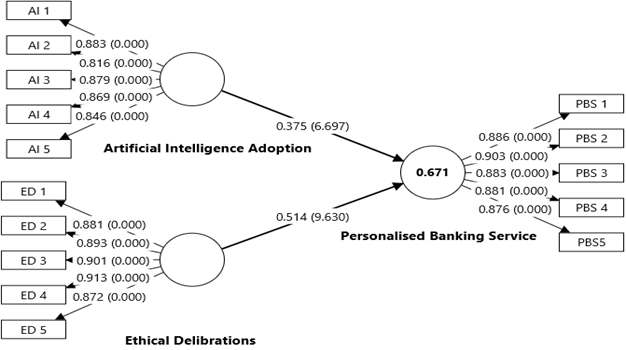
The results indicate that AI adoption is positively associated with PBS, suggesting that greater AI adoption is linked to more personalised banking services. AI adoption is also positively associated with ED, indicating that greater reliance on AI is accompanied by stronger ethical deliberation processes. In turn, ED is positively associated with PBS, suggesting that ethical considerations support the delivery of personalised banking services. These findings support H1, H2, and H3, respectively. Table 7 presents the detailed path coefficients and significance results.
Structural Path Coefficients and Hypothesis Testing
|
Hypothesis |
Path Relationship |
β |
Sample Mean |
STDEV |
t |
p |
Decision |
|
H1 |
AI → PBS |
.37 |
.37 |
.05 |
6.69 |
< .001 |
Supported |
|
H2 |
AI → ED |
.69 |
.69 |
.03 |
21.81 |
< .001 |
Supported |
|
H3 |
ED → PBS |
.51 |
.51 |
.05 |
9.63 |
< .001 |
Supported |
Substantively, the results suggest that AI adoption contributes to personalised banking both as a technological capability and through its association with ethical governance practices. The relationship between AI adoption and ED is particularly strong, indicating that greater reliance on AI may increase the importance of organisational processes related to fairness, transparency, accountability, and responsible data governance.
Figure 2 shows the structural model, AI Adoption and PBS. AI adoption has a significant positive association with both ED and PBS, lending support to the proposed theoretical relationships.
The Structural Model, AI Adoption and PBS
Mediation Analysis
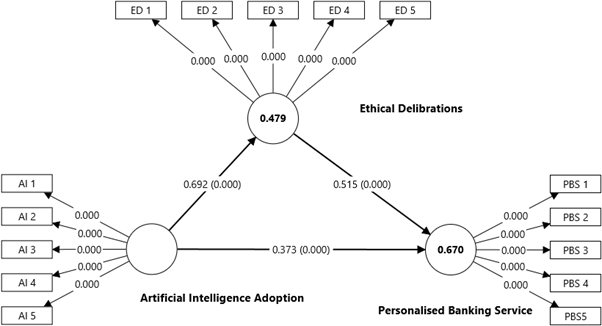
As shown in Table 8, the indirect relationship between AI adoption and PBS through ED was positive and significant (β = .35, t = 9.80, p < .001), indicating that ED partially mediates the relationship between AI adoption and PBS. Since both the direct and indirect relationships are significant, the findings support H4. The VAF of 48.7% further indicates partial mediation (Hair et al., 2021).
Mediation Effect of Ethical Deliberations
|
Hypothesis |
Mediator |
Indirect Path |
β |
STDEV |
t |
p |
Decision |
|
H4 |
ED |
AI → ED → PBS |
.35 |
.03 |
9.80 |
.000 |
Supported |
Figure 3 shows the direct and indirect paths between AI adoption and PBS. The VAF of 48.7% indicates that ED partially mediates the relationship between AI adoption and PBS (Hair et al., 2021).
Mediation Model Results
Discussion
This study investigated the relationship between ED and PBS in the banking industry in Ghana. The results indicate a positive effect of AI adoption on PBS, highlighting AI's ability to help banks use customer data, predict customer needs, and provide more personalized and proactive financial services. The results align with earlier studies (Kumar & Gupta, 2023; Sheth et al., 2022; Tayal et al., 2022), which suggest that AI can support better decision-making, improve operational efficiency, and deliver more personalised, customer-driven services. The evidence also indicates that AI is a strategic capability that banks can use to provide value to their customers in the new frontier of digital banking.
Additionally, the study revealed that AI adoption is positively associated with ED. This implies that banks are increasingly pressured to strengthen governance processes around transparency, fairness, accountability, and responsible data management as they embrace AI technologies. This finding aligns with responsible AI literature (Aldoseri et al., 2023; Biondi et al., 2023), which states that as organisations rely more on AI, they will need to implement ethical governance mechanisms to address stakeholders' concerns and regulatory expectations. The Institutional Theory approach indicates that integrating these ethical considerations into AI implementation challenges banks' ability to uphold ethical standards and retain customer trust.
In addition, ED has a strong positive association with PBS. This finding indicates that banks with well-established ED are more likely to provide personalised services that customers perceive as trustworthy, transparent, and fair. This aligns with Sleigh et al. (2024) and Biondi et al. (2023), who argue that ED is not just about regulatory adherence; it is also a strategic asset that contributes to customer trust and robust service delivery, supported by AI. The outcome also supports Stakeholder Theory, which focuses on stakeholders' expectations of responsible technology use as a way to create sustainable value for the organisation.
Most significantly, the findings show that ED partially mediates the relationship between AI adoption and PBS. This finding helps explain how technological capability translates into customer-oriented service outcomes. AI gives banks the capacity to analyse large volumes of customer information, identify behavioural patterns, and support personalised recommendations and interactions. However, these capabilities also increase the need for organisational processes to ensure customer information is used responsibly and that AI-supported decisions are fair, transparent, accountable, and appropriately supervised. ED therefore serves as an intermediary organisational mechanism through which banks can align AI adoption with stakeholder expectations and responsible service delivery.
From the perspective of Stakeholder Theory, this mediating role reflects the need for banks to consider the interests of customers, employees, regulators, and other stakeholders when deploying AI. Personalisation based solely on technological capability may not necessarily generate sustainable value if stakeholders perceive the underlying processes as opaque, unfair, or intrusive. ED can help banks reconcile AI's efficiency and analytical capabilities with stakeholder expectations for responsible technology use. Institutional Theory provides a complementary explanation: as AI becomes more embedded in banking operations, regulatory, professional, and societal pressures can encourage banks to formalise ethical governance arrangements. The significant indirect relationship observed in this study therefore suggests that ethical governance is not merely an external compliance requirement but an organisational mechanism linked to converting AI capabilities into personalised banking outcomes. This finding aligns with recent responsible AI research (Biondi et al., 2023; Machado et al., 2024), which has found that ethical deliberation facilitates the transformation of technological capability into trusted customer outcomes.
The study, therefore, adds to the current literature on AI by showing that the value of AI does not only stem from technological capabilities, but from the interplay between technological innovation and ED. However, a competitive advantage for banks in emerging markets like Ghana will not simply come from investing in AI. Rather, sustainable AI-enabled service innovation requires institutionalising ED that builds stakeholder confidence and organisational and customer acceptance of AI-oriented banking services.
Theoretical Implications
This research contributes to Stakeholder Theory and Institutional Theory by showing that ED is a vital organisational process associated with improved PBS through AI adoption. Although previous research has focused on the direct impact of AI adoption on ED, the present results reveal that AI also positively relates to ED, which subsequently has a positive association with personalised banking outcomes. The paper contributes to the responsible AI literature through the significant partial mediation effect, showing that ED is not just a compliance issue but also an explanatory mechanism between the technology's capabilities and service delivery to customers. The study provides evidence from an emerging economy and expands the geographical scope of AI governance research beyond mostly developed-country contexts.
Practical Implications
The findings indicate that investment in AI alone may not be sufficient to achieve effective personalised banking services. Banks should therefore integrate Ethical Deliberations (ED) into their AI governance frameworks as an ongoing organisational process rather than treating ethical considerations as a one-time compliance exercise. In practice, this can involve establishing clear procedures for algorithmic transparency, fairness assessment, bias monitoring, responsible customer-data management, explainability of AI-supported decisions, and human oversight throughout the AI system lifecycle. Such mechanisms can help banks identify and address ethical concerns before they undermine customer confidence in AI-enabled services.
For bank executives and technology managers, ED can be incorporated into AI governance through periodic ethical assessments of AI applications, cross-functional review committees involving technology, risk, compliance, legal, and customer-service personnel, and documented procedures for reviewing AI-generated recommendations and decisions. Employees who interact with AI-enabled systems should also receive regular training on responsible AI use, data protection, fairness, and escalation procedures when potentially harmful or inappropriate AI outcomes are identified. These practices can strengthen the reliability and perceived trustworthiness of personalised banking services and support more sustainable customer relationships.
The practical contribution of the study therefore lies in demonstrating that ethical governance should be considered part of the value-creation process surrounding AI adoption. When banks combine technological capabilities with appropriate ethical safeguards, they are better positioned to provide personalised services while addressing stakeholder concerns regarding fairness, transparency, accountability, and responsible data use. Although this study did not directly measure customer trust, the findings suggest that ethical governance provides an important organisational foundation that enables banks to build confidence in AI-enabled services and maintain service quality over time.
Policy Implications
The findings have implications for financial-sector regulators and policymakers seeking to promote AI innovation while protecting customers and maintaining confidence in digital banking. For regulators, the results support developing and enforcing clear responsible-AI governance expectations covering transparency, accountability, fairness, responsible data management, human oversight, and monitoring of AI-supported decisions. Regulatory guidance should also encourage banks to document how AI systems are developed, deployed, monitored, and reviewed, particularly where AI applications influence customer-facing decisions.
For policymakers, the findings highlight the need to balance technological innovation with appropriate ethical and institutional safeguards. Policies can support responsible AI adoption through capacity building, data-governance standards, digital infrastructure development, cybersecurity requirements, and professional training in AI governance. Policymakers should also encourage mechanisms that enable financial institutions to innovate without weakening customer protection or creating barriers to inclusive access to digital financial services. These measures can contribute to an institutional environment in which AI adoption and ethical governance develop together rather than as separate policy objectives.
Limitations and Future Research
The present study has a number of limitations. Firstly, the cross-sectional and self-reported research design restricts causal inferences and may be prone to common method bias; however, the results of the diagnostic tests suggest that this is a minor problem. Future studies could use longitudinal or experimental designs to investigate changes in AI adoption and ED over time.
Second, the study is limited to the Ghanaian banking sector, which might not make its findings easily transferable to other institutional and regulatory settings. Future studies should test the proposed model in other countries and in other digital financial services, such as fintech, insurance, and digital lending.
Lastly, this research regards ED as the only mediator between AI adoption and PBS. Future research might enhance the model by adding other mediators or moderators, such as organizational culture, leadership, digital maturity, regulatory intensity, or corporate governance, to gain a more complete understanding of responsible AI implementation.
Conclusion
This study investigated the relationship between AI adoption and PBS, with the mediating effect of ED. This study examined how AI adoption relates to PBS, with ED as the mediating factor, in Ghana's banking sector. The results show that AI adoption directly benefits PBS and substantially supports ED. In turn, ED positively affects PBS and partially mediates the relationship between AI adoption and service personalisation. The results demonstrate that the advantages of Artificial Intelligence are realized not only in technological terms but also in ethical governance.
The study highlights that ED is not only a regulatory protection or compliance measure but also a strategic organizational capability that can help banks use their investment in AI to deliver trusted, transparent, and customer-centric banking services. Incorporating principles of fairness, accountability, transparency, and responsible data governance into their approach to implementing AI will help banks build customer trust and ensure they deliver AI-powered services more effectively.
This study relies on the Stakeholder Theory and Institutional Theory, which have implications for the study of responsible AI and digital transformation by providing a mechanism that helps explain the relationship between the adoption of AI and PBS. Through the empirical evidence presented in this study from Ghana, it also contributes to the relatively small and growing body of literature focusing on AI adoption in emerging economies, while also identifying the need for sustainable competitive advantage to go beyond AI adoption alone to the use of technological innovation and strong ethical governance.
Author Contributions
Edward Annan and Mensah Marfo jointly conceived and designed the study. Mensah Marfo conducted the data analysis, while Edward Annan managed data collection and drafted the manuscript. Both authors reviewed, revised, and approved the final manuscript.
Conflict of Interest
The authors declare no known competing financial interests or personal relationships that could have appeared to influence the work reported in this paper.
Generative AI Use Disclosure Statement
No generative AI tools were used in the writing or analysis of this manuscript.
Data Availability Statement
Data will be available on request from the authors.
Acknowledgments
Not applicable.
References
Aldboush, H. H., & Ferdous, M. (2023). Building trust in fintech: an analysis of ethical and privacy considerations in the intersection of big data, AI, and customer trust. International Journal of Financial Studies, 11(3), 90. https://doi.org/10.3390/ijfs11030090
Aldoseri, A., Al-Khalifa, K. N., & Hamouda, A. M. (2023). Re-thinking data strategy and integration for artificial intelligence: concepts, opportunities, and challenges. Applied Sciences, 13(12), 7082. https://doi.org/10.3390/app13127082
Ali, M., Khan, T. I., & Şener, İ. (2025). Transforming hospitality: The dynamics of AI integration, customer satisfaction, and organizational readiness in enhancing firm performance. Journal of Hospitality and Tourism Technology, 16(5), 911–936. https://doi.org/10.1108/JHTT-04-2024-0261
Amankwah-Amoah, J., & Lu, Y. (2024). Harnessing AI for business development: a review of drivers and challenges in Africa. Production Planning & Control, 35(13), 1551–1560. https://doi.org/10.1080/09537287.2022.2069049
Armstrong, J. S., & Overton, T. S. (1977). Estimating nonresponse bias in mail surveys. Journal of Marketing Research, 14(3), 396-402. https://mpra.ub.uni-muenchen.de/81694/
Bentler, P. M., & Bonett, D. G. (1980). Significance tests and goodness of fit in the analysis of covariance structures. Psychological Bulletin, 88(3), 588. https://psycnet.apa.org/doi/10.1037/0033-2909.88.3.588
Biondi, G., Cagnoni, S., Capobianco, R., Franzoni, V., Lisi, F. A., Milani, A., & Vallverdú, J. (2023). Editorial: Ethical design of artificial intelligence-based systems for decision making. Frontiers in Artificial Intelligence, 6, 1250209. https://doi.org/10.3389/frai.2023.1250209
Cohen, J. (2013). Statistical power analysis for the behavioral sciences. routledge.
Danso, W. B., & Hanson, E. (2023). Artificial intelligence disruption and its impacts on future employment in Africa-a case of the banking and financial sector in Ghana. I-manager's Journal on Software Engineering, 18(1). https://doi.org/10.26634/jse.18.1.20082
de Castro Vieira, J. R., Barboza, F., Cajueiro, D., & Kimura, H. (2025). Towards fair AI: Mitigating bias in credit decisions—A systematic literature review. Journal of Risk and Financial Management, 18(5), 228. https://doi.org/10.3390/jrfm18050228
DiMaggio, P. J., & Powell, W. W. (1983). The iron cage revisited: Institutional isomorphism and collective rationality in organizational fields. American sociological review, 48(2), 147–160. https://www.academia.edu/download/62090212/1983_The_Iron_Cage_Revisited20200213-90456-fi8nk7.pdf
Doumpos, M., Zopounidis, C., Gounopoulos, D., Platanakis, E., & Zhang, W. (2023). Operational research and artificial intelligence methods in banking. European Journal of Operational Research, 306(1), 1–16. https://doi.org/10.1016/j.ejor.2022.04.027
El Hajj, M., & Hammoud, J. (2023). Unveiling the influence of artificial intelligence and machine learning on financial markets: A comprehensive analysis of AI applications in trading, risk management, and financial operations. Journal of Risk and Financial Management, 16(10), 434. https://doi.org/10.3390/jrfm16100434
Eskandarany, A. (2024). Adoption of artificial intelligence and machine learning in banking systems: a qualitative survey of board of directors. Frontiers in Artificial Intelligence, 7, 1440051. https://doi.org/10.3389/frai.2024.1440051
Floridi, L., Cowls, J., Beltrametti, M., Chatila, R., Chazerand, P., Dignum, V., ... & Vayena, E. (2018). AI4People—An ethical framework for a good AI society: Opportunities, risks, principles, and recommendations. Minds and Machines, 28(4), 689–707. https://doi.org/10.1007/s11023-018-9482-5
Freeman, R. E. (1984). Strategic management: A stokcholder approach. Pitman.
Hair, J. F., Astrachan, C. B., Moisescu, O. I., Radomir, L., Sarstedt, M., Vaithilingam, S., & Ringle, C. M. (2021). Executing and interpreting applications of PLS-SEM: Updates for family business researchers. Journal of Family Business Strategy, 12(3), 100392.
Hariguna, T., & Ruangkanjanases, A. (2024). Assessing the impact of artificial intelligence on customer performance: A quantitative study using partial least squares methodology. Data Science and Management, 7(3), 155–163. https://doi.org/10.1016/j.dsm.2024.01.001
Hasan, M. R., Hossain, I., & Islam, M. H. (2024). Examining the role of corporate governance practices in enhancing stakeholder trust: Insights from global case studies. International Journal of Science and Business, 42(1), 212–227. https://ijsab.com/wp-content/uploads/2493.pdf
Henseler, J., Ringle, C. M., & Sarstedt, M. (2015). A new criterion for assessing discriminant validity in variance-based structural equation modeling. Journal of the Academy of Marketing Science, 43(1), 115–135. https://doi.org/10.1007/s11747-014-0403-8
Hu, L. T., & Bentler, P. M. (1999). Cutoff criteria for fit indexes in covariance structure analysis: Conventional criteria versus new alternatives. Structural Equation Modeling: A Multidisciplinary Journal, 6(1), 1–55. https://doi.org/10.1080/10705519909540118
Jobin, A., Ienca, M., & Vayena, E. (2019). The global landscape of AI ethics guidelines. Nature Machine Intelligence, 1(9), 389–399. https://arxiv.org/pdf/1906.11668
Johora, F. T., Hasan, R., Farabi, S. F., Alam, M. Z., Sarkar, I., & Al Mahmud, A. (2024, June). AI advances: Enhancing banking security with fraud detection. In 2024 First International Conference on Technological Innovations and Advance Computing (TIACOMP) (pp. 289-294). IEEE. https://doi.org/10.1109/TIACOMP64125.2024.00055
Kline, R. B. (2023). Principles and practice of structural equation modeling. Guilford publications. https://psycnet.apa.org/doi/10.1037/0000308-034
Kock, N. (2015). Common method bias in PLS-SEM: a full collinearity assessment approach. International Journal of e-Collaboration, 11(4), 1–10. DOI: 10.4018/ijec.2015100101.
Kumar, J., & Gupta, S. S. (2023). Impact of Artificial Intelligence towards customer relationship in Indian banking industry. Gyan Management Journal, 17(1), 105–115. https://doi.org/10.48165/gmj.2022.17.1.12
Kumar, S., Verma, A. K., & Mirza, A. (2024). Digital transformation, artificial intelligence and society. Springer. https://link.springer.com/book/10.1007/978-981-97-5656-8
Machado, J., Sousa, R., Peixoto, H., & Abelha, A. (2024). Ethical decision-making in artificial intelligence: A logic programming approach. AI, 5(4), 2707–2724. https://doi.org/10.3390/ai5040130
Magableh, I. K., Mahrouq, M. H., Ta’Amnha, M. A., & Riyadh, H. A. (2024). The role of marketing artificial intelligence in enhancing sustainable financial performance of medium-sized enterprises through customer engagement and data-driven decision-making. Sustainability, 16(24), 11279. https://doi.org/10.3390/su162411279
Maja, M. M., & Letaba, P. (2022). Towards a data-driven technology roadmap for the bank of the future: Exploring big data analytics to support technology roadmapping. Social Sciences & Humanities Open, 6(1), 100270. https://doi.org/10.1016/j.ssaho.2022.100270
Mishra, B. R. (2025). The role of artificial intelligence in fraud detection and prevention in banking. Journal of Information Systems Engineering & Management, 10(49s), 1167–1173.
Munoko, I., Brown-Liburd, H. L., & Vasarhelyi, M. (2020). The ethical implications of using artificial intelligence in auditing. Journal of Business Ethics, 167(2), 209–234. https://doi.org/10.1007/s10551-019-04407-1
Osakwe, S. (2020). How can developing countries reduce financial exclusion? A critical review of Nigeria’s financial inclusion strategy. Comparative Political Economy: Social Welfare Policy eJournal. https://www.academia.edu/download/93203129/a_critical_review_of_nigerias_financial_inclusion_strategy.pdf
Owolabi, O. S., Uche, P. C., Adeniken, N. T., Ihejirika, C., Islam, R. B., Chhetri, B. J. T., & Jung, B. (2024). Ethical implication of artificial intelligence (AI) adoption in financial decision making. Computer and Information Science, 17(1), 1–49. https://doi.org/10.5539/cis.v17n1p49
Pasipamire, N., & Muroyiwa, A. (2024). Navigating algorithm bias in AI: ensuring fairness and trust in Africa. Frontiers in Research Metrics and Analytics, 9, 1486600. https://doi.org/10.3389/frma.2024.1486600
Peng, Y., Ahmad, S. F., Ahmad, A. Y. B., Al Shaikh, M. S., Daoud, M. K., & Alhamdi, F. M. H. (2023). Riding the waves of artificial intelligence in advancing accounting and its implications for sustainable development goals. Sustainability, 15(19), 14165. https://doi.org/10.3390/su151914165
Podsakoff, P. M., MacKenzie, S. B., Lee, J. Y., & Podsakoff, N. P. (2003). Common method biases in behavioral research: a critical review of the literature and recommended remedies. Journal of Applied Psychology, 88(5), 879–903. https://psycnet.apa.org/doi/10.1037/0021-9010.88.5.879
Prabin, A. D. H. I. K. A. R. I., Prashamsa, H. A. M. A. L., & Francis, B. J. (2024). Artificial Intelligence in fraud detection: Revolutionizing financial security. International Journal of Science and Research Archive, 13(1), 1457–1472. https://doi.org/10.30574/ijsra.2024.13.1.1860
Radenković, S. D., Hanić, H., & Bugarčić, M. (2023, March). Applying artificial intelligence in the digital transformation of banking sector. Proceedings, 85(1), 19. MDPI. https://doi.org/10.3390/proceedings2023085019
Ratzan, J., & Rahman, N. (2024). Measuring responsible artificial intelligence (RAI) in banking: a valid and reliable instrument. AI and Ethics, 4, 1279–1297. https://doi.org/10.1007/s43681-023-00321-5
Sheth, J. N., Jain, V., Roy, G., & Chakraborty, A. (2022). AI-driven banking services: the next frontier for a personalised experience in the emerging market. International Journal of Bank Marketing, 40(6), 1248–1271. https://doi.org/10.1108/IJBM-09-2021-0449
Sleigh, J., Hubbs, S., Blasimme, A., & Vayena, E. (2024). Can digital tools foster ethical deliberation? Humanities and Social Sciences Communications, 11, 117. https://doi.org/10.1057/s41599-024-02629-x
Tayal, R., Upadhyay, R. K., & Singh, R. (2022). Transformational leadership: an antecedent for organizational effectiveness in Indian banks. VINE Journal of Information and Knowledge Management Systems, 52(5), 718–739. https://doi.org/10.1108/VJIKMS-09-2020-0165
Vuković, D. B., Dekpo-Adza, S., & Matović, S. (2025). AI integration in financial services: A systematic review of trends and regulatory challenges. Humanities and Social Sciences Communications, 12(1), 1–29. https://doi.org/10.1057/s41599-025-04850-8
Wamba-Taguimdje, S. L., Fosso Wamba, S., Kala Kamdjoug, J. R., & Tchatchouang Wanko, C. E. (2020). Influence of artificial intelligence (AI) on firm performance: the business value of AI-based transformation projects. Business Process Management Journal, 26(7), 1893–1924. https://doi.org/10.1108/BPMJ-10-2019-0411

Page 1 of
Download Count : 4
Visit Count : 104
Keywords
Artificial Intelligence Adoption; Ethical Deliberations; Personalised Banking Services; Banking Sector; Ghana

Author(s) Information


How to cite this article
Annan, E., & Marfo, M. (2026). The AI–ethics–personalisation nexus: How ethical deliberations shape personalised banking service in Ghana. European Journal of Studies in Management and Business, 38, 26-46. https://doi.org/10.32038/mbrq.2026.38.02
Author Contributions
Edward Annan and Mensah Marfo jointly conceived and designed the study. Mensah Marfo conducted the data analysis, while Edward Annan managed data collection and drafted the manuscript. Both authors reviewed, revised, and approved the final manuscript.
Conflict of Interest
The authors declare no known competing financial interests or personal relationships that could have appeared to influence the work reported in this paper.
Generative AI Use Disclosure Statement
No generative AI tools were used in the writing or analysis of this manuscript.
Data Availability Statement
Data will be available on request from the authors.
Acknowledgments
Not applicable.
Open Access
This article is licensed under a Creative Commons Attribution 4.0 International License, which permits use, sharing, adaptation, distribution and reproduction in any medium or format, as long as you give appropriate credit to the original author(s) and the source, provide a link to the Creative Commons license, and indicate if changes were made. You may view a copy of Creative Commons Attribution 4.0 International License here: http://creativecommons.org/licenses/by/4.0/