







Original Research
Linking Ethical Leadership to Social Justice Outcomes: The Moderating Influence of Environmental Sustainability Practices


- Abstract
- Full text
- Metrics
Ethical Leadership (EL) is crucial for achieving Social Justice Outcomes (SJO) in environmentally vulnerable communities, yet the moderating role of Environmental Sustainability Practices (ESP) remains underexplored. This study examines the effect of EL on SJO and the moderating role of ESP in this relationship. The study sampled 452 respondents, including local government officials, traditional leaders, community opinion leaders, and residents from flood-prone coastal areas, informal settlements, and environmentally degraded communities. Data were collected through structured questionnaires and analyzed using Structural Equation Modelling (SEM) with SmartPLS 4 and bootstrapping techniques to assess direct and moderating effects. Results reveal that EL significantly promotes SJO through fairness, transparency, inclusion, accountability, and respect for rights. EL also positively influences ESP by encouraging conservation, efficiency, recycling, compliance, and innovation. Furthermore, ESP strengthens the relationship between EL and SJO, indicating that structured sustainability practices support ethical decision-making for equitable outcomes. Findings support Stakeholder Theory, emphasizing attention to diverse stakeholders, and Institutional Theory, highlighting formal structures for effective leadership. The study guides policymakers and community institutions in integrating ethical leadership with organized environmental practices to enhance justice and sustainability.
Linking Ethical Leadership to Social Justice Outcomes: The Moderating Influence of Environmental Sustainability Practices
Edward Annan*, Mensah Marfo
KAAF University, Department of Business Administration and Education, Ghana
ABSTRACT:
Ethical Leadership (EL) is crucial for achieving Social Justice Outcomes (SJO) in environmentally vulnerable communities, yet the moderating role of Environmental Sustainability Practices (ESP) remains underexplored. This study examines the effect of EL on SJO and the moderating role of ESP in this relationship. The study sampled 452 respondents, including local government officials, traditional leaders, community opinion leaders, and residents from flood-prone coastal areas, informal settlements, and environmentally degraded communities. Data were collected through structured questionnaires and analyzed using Structural Equation Modelling (SEM) with SmartPLS 4 and bootstrapping techniques to assess direct and moderating effects. Results reveal that EL significantly promotes SJO through fairness, transparency, inclusion, accountability, and respect for rights. EL also positively influences ESP by encouraging conservation, efficiency, recycling, compliance, and innovation. Furthermore, ESP strengthens the relationship between EL and SJO, indicating that structured sustainability practices support ethical decision-making for equitable outcomes. Findings support Stakeholder Theory, emphasizing attention to diverse stakeholders, and Institutional Theory, highlighting formal structures for effective leadership. The study guides policymakers and community institutions in integrating ethical leadership with organized environmental practices to enhance justice and sustainability.
KEYWORDS: Ethical Leadership, Social Justice Outcomes, Environmental Sustainability Practices, Stakeholder Theory, Institutional Theory, Ghana
JEL Clasification: M14, D63, Q56, M12
The concept of Social Justice Outcomes (SJO) has become increasingly popular in environmental governance, especially for communities that continue to face disproportionate exposure to environmental degradation and limited access to key resources (Buijs et al., 2024; Gosselin & Gauquelin, 2025). Social justice outcomes are defined as the equal distribution of environmental benefits and burdens, equal treatment in policymaking, and equal participation in decision-making processes that affect community well-being (Bennett et al., 2023). The most vulnerable groups, particularly those in the developing world, are often faced with environmental challenges such as pollution, resource depletion, and climate change that undermine their lives and health (UNEP, 2025). To address these issues, leadership strategies that emphasize fairness, responsibility, and ethical accountability are important for addressing environmental and social challenges.
Ethical Leadership (EL) has become an influential factor in shaping social justice outcomes, as it emphasizes integrity, transparency, and equity in organizational and institutional behavior (Alhaidan, 2025). Ethical leaders also behave in normatively appropriate ways, advocate ethical norms, and influence their followers to do so in a manner that supports justice and equity (Al Halbusi et al., 2021). These leaders are in a position to ensure that moral considerations guide decisions that affect communities, thereby limiting inequality and strengthening trust among stakeholders (Taamneh et al., 2024). EL promotes the fair use of environmental resources, proper waste management practices, and community participation in environmental management in environmentally vulnerable settings (Elkhweildi et al., 2025).
There is empirical evidence suggesting that EL is a primary factor in attaining social justice outcomes. As Páez Gabriunas (2023) found, ethical leaders enhance equity in organizational processes, which, when expanded to community-level interactions, is reflected in better societal outcomes. Crawford et al. (2025) also found that EL positively affects the trust of stakeholders and helps to make ethical decisions that favor marginalized groups. In the environmental context, ethical leaders ensure the responsible distribution of resources and prevent vulnerable groups from being overburdened by environmental hazards (Abraham et al., 2025). Leaders can impact institutions to be guided by the principles of justice and equality in their practices through ethical guidance and accountability (Limbore et al., 2025).
Environmental Sustainability Practices (ESP) are organizational and institutional efforts that are employed to preserve natural resources, reduce environmental degradation, and establish a long-term ecological balance (Gomes et al., 2024). These are waste minimization, energy savings, pollution reduction, and sustainable resource management. ESP can be a tool that helps disclose ethical standards as concrete environmental and social outcomes (Tennakoon et al., 2024). Companies that embrace high levels of sustainability not only help protect the environment but also enhance the future quality of life of communities exposed to environmental challenges (Chege & Wang, 2020).
ESP may moderate the relationship between EL and SJO by either reinforcing or diluting the impact of ethical leadership on community outcomes. When sustainability practices are long-standing, ethical leadership is more likely to yield positive social justice outcomes, as environmental efforts are implemented in ways that ensure all parties involved are treated equally (AlHares, 2025). Ethical leaders working in such systems can ensure that sustainability activities address the needs of vulnerable groups, thereby improving fairness and inclusiveness (Obasa, 2025). On the other hand, without an effective ESP, achieving the intended social justice might not be a complete success, as environmental initiatives might not be organized or consistent.
Environmental issues, including unauthorized mining, deforestation, and pollution, have also become a concern in environmentally susceptible communities in Africa, such as Ghana, with regard to the issue of justice and fairness in the allocation of resources (Hilson, 2017). Such challenges tend to have a disproportionate impact on rural and low-income groups of people and result in disparities in health, income, and access to clean environments. Fairness in environmental decision-making can be supported by ethical leadership in governmental and organizational institutions that develop policies that address the needs of marginalized groups (Dahiya et al., 2025). Nonetheless, the success of this kind of leadership depends on how sustainably environmental sustainability is entrenched in institutional structures.
This research has a theoretical basis on the Stakeholder Theory and the Institutional Theory. The Stakeholder Theory holds that organizations owe a broad set of stakeholders, such as communities impacted by environmental decisions, and that ethical leadership means these interests are taken into account when making decisions (Freeman, 2010). In this light, EL encourages equity and responsibility by balancing the interests of different stakeholder groups, hence improving social justice records. In contrast, the Institutional Theory describes how formal structures, norms, and practices shape organizational behavior (Scott, 2013). It indicates that the effectiveness of ethical leadership is reinforced by well-established environmental sustainability practices, which can provide a framework for executing ethical decisions.
The empirical research is in support of the combination of these theories in the explanation of the relationship between EL, ESP, and SJO. Kim and Thapa (2018) found that ethical leadership strengthens corporate social responsibility efforts, which, in turn, strengthen community welfare and equity. On the same note, Ahmad et al. (2024) and Testa et al. (2018) showed that organizations with excellent environmental sustainability practices achieve enhanced social outcomes through the systematic and consistent implementation of environmental policies. Besides, Al Halbusi et al. (2024) stated that ethical leaders can enhance society's welfare through responsible leadership practices that prioritize stakeholders' interests and justice.
The study contributes both theoretically and practically by demonstrating that Ethical Leadership (EL) positively influences Social Justice Outcomes (SJO) in environmentally vulnerable communities, while Environmental Sustainability Practices (ESP) strengthen this relationship. The study extends existing literature by showing how structured sustainability practices enhance the effectiveness of ethical leadership in promoting fairness, inclusion, and equity. Theoretically, the findings support Stakeholder Theory and Institutional Theory by illustrating that ethical leadership provides moral direction, whereas environmental sustainability practices facilitate the consistent implementation of ethical decisions and socially responsible actions. In practice, the study provides policymakers, community leaders, and environmental institutions with insights into integrating ethical leadership and sustainability initiatives to reduce inequalities, promote social justice, and improve community well-being.
Literature Review
Stakeholder Theory and Ethical Leadership (EL)
The Stakeholder Theory can be used to describe how ethical leadership facilitates the achievement of social justice by ensuring that the interests of all stakeholders, especially vulnerable communities, are taken into account in decision-making (AlHares, 2025). Ethical leadership focuses on fairness, accountability, and transparency, which promote equitable treatment of stakeholders by organizations and social and environmental inequalities (Alkhadra et al., 2023). By acting ethically, leaders gain the trust of communities and ensure that the impact of environmental decisions does not disproportionately affect disadvantaged groups (Hill, 2017). This practice helps in achieving the social justice outcomes through inclusive participation, equal distribution of resources, and responsible environmental governance.
In developing countries like Ghana, environmental issues disproportionately affect communities, underscoring the need for stakeholder-based leadership. According to Ahmed et al. (2024), ethical leadership enhances community involvement and makes environmental policies more responsive to the needs of affected communities. The principles of Stakeholder Theory are supported when sustainability practices are integrated into organizational systems, as they enhance ethical leaders' capacity to deliver fair and inclusive outcomes.
Institutional Theory and Leadership within Sustainability Structures
The Institutional Theory focuses on the idea that organizational behavior is determined by formal structures, policies, and norms that govern decision-making (Scott, 2013). In this understanding, environmental sustainability practices denote institutionalized structures that advance ethical leadership in realizing social justice outcomes (Tunji-Olayeni et al., 2025). Ethical leaders can work more efficiently when sustainability structures are in place that foster consistency, accountability, and compliance with environmental standards (Testa et al., 2018). These frameworks ensure that ethical principles are translated into actionable steps that can be used to support communities, especially those vulnerable to environmental impacts.
The sustainability practices of the environment are institutional processes that strengthen the effectiveness of ethical leadership. Companies that incorporate sustainability into their activities are better positioned to address challenges such as pollution, resource allocation, and environmental conservation in ways that foster fairness and equity (Galleli & Amaral, 2026). Ethical leaders in such institutions can help make environmental choices that reduce disparities and enhance community well-being. On the other hand, without well-established institutional frameworks, the impact of ethical leadership on social justice outcomes can be minimal due to inconsistent implementation and accountability.
The Institutional Theory is relevant in explaining the relationship between EL, ESP, and SJO with empirical evidence. Herold (2018) found that companies that have developed sustainability policies achieve superior social outcomes through organized environmental programs. In the same manner, Katou and Kafetzopoulos (2025) reported that leadership effectiveness in enhancing society's welfare is enhanced by institutional norms that emphasize responsibility and ethics. Tetteh et al. (2025) and Amoako et al. (2021) also found that, in Ghana, resource allocation inequalities are driven by weak institutional enforcement of environmental regulations, underscoring the need to introduce sustainability practices into governance systems.
Empirical Review and Hypotheses
EL and SJO
Empirical literature has shown that EL can play a significant role in SJO because of its fairness, justice, and ethical behavior in decision-making. Al Halbusi et al. (2020) found that EL increases employees' ethical conduct through the influence of organizational justice, suggesting that fairness and integrity at the top are translated into fairness and equity within and beyond the organization. Penney (2023) highlighted that ethical leadership enhances social justice because it is inclusive, accountable, and treats stakeholders equally, especially marginalized groups. The research, however, was more theoretical and not empirically validated in the environmentally vulnerable community. This relationship is further supported by empirical evidence. Al Halbusi et al. (2021) showed that EL affects employees' ethical behavior through their understanding of justice, although the research was conducted in organizational contexts and did not account for extensive societal consequences. Equally, She et al. (2023) found that EL minimizes organizational silence by promoting fairness and open communication, thereby fostering participation and voice, which are critical to the realization of SJO. Although these contributions have been made, studies that have been done have mainly focused on internal organizational impacts and little on justice implications in the community. These results indicate that EL improves SJO through fostering equity, openness, and stakeholder engagement.
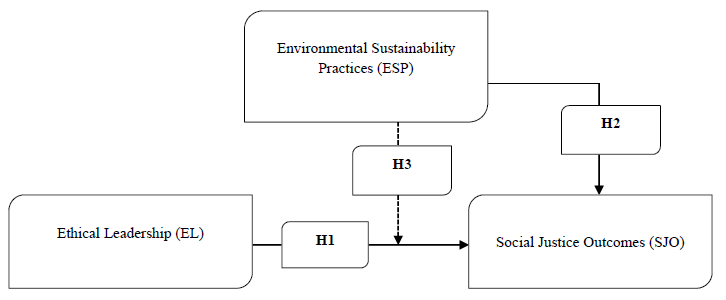
H1: EL has a significant effect on SJO.
ESP and SJO
Studies have shown that ESP contributes to SJO by promoting environmentally friendly actions and fostering sustainability. Hameed et al. (2023) found that EL enhances environmental performance through green technology innovation and green IT capital, suggesting that ethical leaders promote investments that respect the environment. Nevertheless, the research was conducted with the technological aspect in mind and did not examine the broader sustainability issues across various sectors. As stated by Rihal et al. (2025), EL enhances environmental performance through green organizational identity and culture, indicating that environmental practices are driven by ethical values; however, the study was restricted to particular organizational settings.
Other investigations support such results. As noted by Boeske (2023), leadership strategies grounded in ethics promote sustainability through their advocacy of responsible environmental practices, but the research was a review rather than empirical. According to the study by Ogaga et al. (2023), EL improves sustainability in agro-allied companies, especially in environments with uncertainty, though the researchers did not identify specific sustainability practices. The report by Fatoki (2020) also revealed that ESP enhances sustainable performance in SMEs, but it was not specifically focused on ESP. These results suggest that the ESP facilitates SJO through ethical direction, organizational culture, and innovation in environmental practices.
H2: ESP has a significant effect on SJO.
ESP as a Moderator Between EL and SJO
There is empirical evidence suggesting that ESP can reinforce the connection between EL and SJO by offering a model through which ethical values can be translated into societal outcomes. The study by Saleem et al. (2020) supported the idea that EL improves employee green performance through mechanisms that foster environmental responsibility, meaning that sustainability practices reinforce ethical leadership performance. However, the authors studied employee-level performance rather than social justice outcomes at a larger level. It was shown that EL affects social sustainability through ethical climate, and the strength of this effect is moderated by mediating factors, but environmental sustainability practices were not directly tested (Santiago-Torner et al., 2025). Additional support is given in further studies. Environmentally oriented EL has been demonstrated to enhance employee performance through engagement and communication (Elkhweildi et al., 2025); hence, it is possible to suggest that sustainability-oriented practices enhance the effectiveness of leadership. Rihal et al. (2025) also found that EL encourages environmental performance through organizational culture, which can lead to better societal outcomes when aligned with societal needs. Although this has been identified, there is a paucity of research that directly examines the moderating effect of ESP on the EL-SJO relationship, especially in environmentally susceptible communities. These findings suggest that ESP has the potential to complement the role of EL in SJO by ensuring that ethical choices are made through systematic, consistent environmental practices.
H3: ESP significantly moderates the relationship between EL and SJO.
Conceptual Framework
The study’s conceptual framework centres around three primary constructs: EL (the dependent variable), ESP (the moderating variable), and SJO (the independent variable). A literature review informed the refinement of these constructs in Figure 1.
Conceptual Framework Diagram
 Research Design and Research Approach
The research design used in this study is a quantitative, cross-sectional explanatory research design to test the impact of EL on SJO within environmentally vulnerable groups with ESP as a moderating variable. The explanatory design assists in testing the direct and moderating effects through statistical estimation, and the study can ascertain how EL affects SJO across different levels of ESP. The research adheres to the positivist paradigm, which prioritizes objectivity, empirical measurement, and the extrapolation of results from quantitative data. Data analysis was performed using SmartPLS 4 to determine the direct effect of EL on SJO and the moderating role of ESP.
Population, Sampling Method, and Sample Size
The target population for this study consisted of environmentally vulnerable groups and key stakeholders in Ghanaian communities affected by environmental challenges such as flooding, pollution, coastal erosion, deforestation, and poor waste management systems. These communities included flood-prone areas, informal settlements, coastal communities, and environmentally degraded regions affected by both natural and human activities. The study population further comprised local government officials, assembly members, traditional leaders, community opinion leaders, personnel from environmental protection agencies, non-governmental organisations (NGOs), community-based organisations (CBOs), household heads, youth representatives, and small business operators whose livelihoods are directly affected by environmental conditions and leadership practices.
The study employed a stratified random sampling technique to ensure proportional representation of the various stakeholder categories within the selected communities. The strata were developed based on stakeholder classifications, including government representatives, environmental organizations, community leaders, and residents. Respondents within each stratum were selected randomly to minimize sampling bias and improve representativeness.
The minimum required sample size was determined using the Raosoft sample size calculator at a 99% confidence level and a 5% margin of error, which produced a minimum sample size of 363 respondents. To enhance the reliability and robustness of the study findings and to account for possible non-response or incomplete questionnaires, the sample size was increased by approximately 40%, following the recommendation of Israel (1992). Consequently, a total of 508 questionnaires were distributed to respondents across the selected communities.
Of the 508 questionnaires distributed, 471 were successfully retrieved. After data screening and removal of incomplete responses, 452 valid questionnaires were retained for the final analysis, representing an effective response rate of 88.98%. This response rate was considered adequate for Structural Equation Modeling (SEM) analysis. Before the main survey, a pilot study involving 51 respondents was conducted to assess the clarity, reliability, and validity of the research instrument. Primary data were subsequently collected over three months using both online and field-based questionnaire administration methods.
Measures
A structured questionnaire was used as the primary instrument for data collection. The questionnaire was developed based on the study's main constructs: Ethical Leadership (EL), Social Justice Outcomes (SJO), and Environmental Sustainability Practices (ESP).
Ethical Leadership (EL) was measured using five indicators: integrity (EL1), fairness (EL2), accountability (EL3), transparency (EL4), and honesty (EL5). These items were adapted from the works of Yukl et al. (2013) and Kalshoven et al. (2011). The indicators capture the moral values and ethical behaviors of leaders that influence trust, fairness, and responsible governance within communities.
Social Justice Outcomes (SJO) were measured using equity (SJO1), inclusion (SJO2), equality (SJO3), rights (SJO4), and fairness (SJO5). These measures were adapted from Rawls (1971). The indicators assess the extent to which communities experience fair, inclusive, and equitable social and environmental outcomes.
Environmental Sustainability Practices (ESP) were measured using conservation (ESP1), efficiency (ESP2), recycling (ESP3), compliance (ESP4), and innovation (ESP5). These indicators were adapted from Tennakoon et al. (2024) and Cowan et al. (2010). The measures reflect organized environmental practices that support sustainability, environmental protection, and long-term community well-being.
All items were measured using a five-point Likert scale ranging from 1 = Strongly Disagree to 5 = Strongly Agree to indicate the degree of respondents’ agreement with each statement. To ensure content validity and contextual appropriateness, the questionnaire was reviewed by academic experts in environmental management and public policy, as well as practitioners involved in sustainability and community development. Their feedback helped improve the clarity, relevance, and suitability of the measurement items for the study context.
Data Analysis Technique
SmartPLS 4 was used to perform data analysis. Descriptive statistics, correlation analysis, and measures of construct reliability and validity were involved in the analysis. The impact of EL on SJO and the moderating effect of ESP were estimated using SEM and tested with the help of bootstrapping with 5,000 resamples. The review aimed to establish the effects of EL on SJO and the reinforcing or weakening effects of ESP on SJO in environmentally vulnerable communities.
Results
This section presents the results of the data analysis. Descriptive statistics and SEM using SmartPLS 4 were employed to test the proposed hypotheses. Of the 508 questionnaires distributed, 471 were retrieved and usable, yielding a response rate of 92.7% and an adequate sample for SEM analysis.
Demographic Characteristics of Respondents
As displayed in Table 1, a total of 471 valid responses were obtained, with 268 (56.9%) males and 203 (43.1%) females, indicating a fairly balanced gender distribution. The majority of respondents were within the 26–35 years (33.5%) and 36–45 years (28.0%) age groups, showing that participants are largely economically active. In terms of education, most respondents held a bachelor’s degree (40.8%), followed by a diploma (22.9%) and postgraduate qualifications (18.3%), indicating an adequate educational background. Regarding the respondent category, residents/household heads (27.4%) and community leaders (17.2%) formed the largest groups, reflecting diverse stakeholder representation. For experience or residence, 37.6% had over 10 years, 37.4% had 6–10 years, and 25.1% had less than 5 years, suggesting strong familiarity with community conditions.
Demographic Characteristics of Respondents
|
Demographic Variable |
Category |
Frequency |
Percentage (%) |
|
Gender |
Male |
268 |
56.9 |
|
|
Female |
203 |
43.1 |
|
Age Group |
18–25 years |
72 |
15.3 |
|
|
26–35 years |
158 |
33.5 |
|
|
36–45 years |
132 |
28.0 |
|
|
46–55 years |
74 |
15.7 |
|
|
Above 55 years |
35 |
7.4 |
|
Educational Level |
Basic/Secondary |
64 |
13.6 |
|
|
Diploma |
108 |
22.9 |
|
|
Bachelor’s Degree |
192 |
40.8 |
|
|
Postgraduate |
86 |
18.3 |
|
|
Professional/Other |
21 |
4.5 |
|
Category of Respondents |
Local Government Officials |
74 |
15.7 |
|
|
Traditional Leaders |
52 |
11.0 |
|
|
NGO/Environmental Officers |
69 |
14.6 |
|
|
Community Leaders |
81 |
17.2 |
|
|
Residents/Household Heads |
129 |
27.4 |
|
|
Youth/Small Business Operators |
66 |
14.0 |
|
Years of Experience / Residence |
Less than 5 years |
118 |
25.1 |
|
|
6–10 years |
176 |
37.4 |
|
|
Above 10 years |
177 |
37.6 |
Factor Loadings
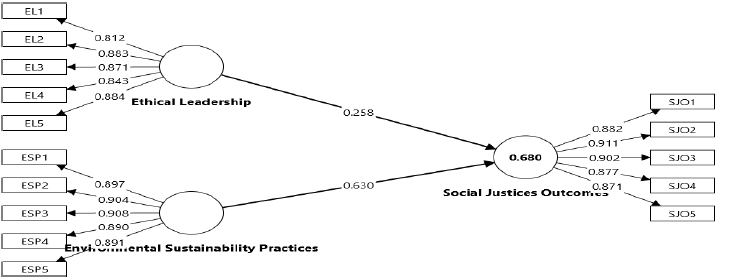
As shown in Table 2, all indicators loaded strongly on their constructs, ranging from 0.812 to 0.911, exceeding the .70 threshold (Hair et al., 2021). This confirms that EL, ESP, and SJO are well measured.
Construct Reliability and Validity
The reliability and validity of the measurement model were assessed using Cronbach’s alpha, composite reliability, outer loadings, and Average Variance Extracted (AVE). The results presented in Table 2 indicate that all constructs satisfied the recommended thresholds for internal consistency reliability and convergent validity.
The Cronbach’s alpha (α) values for Ethical Leadership (.94), Environmental Sustainability Practices (.91), and Social Justice Outcomes (.93) were all above the acceptable threshold of 0.70 recommended by Bagozzi and Yi (1988), indicating high internal consistency among the measurement items. Similarly, the composite reliability values (rho_c) for all constructs ranged from .93 to .95, exceeding the recommended minimum value of .70, thereby confirming construct reliability.
In addition, the outer loadings of all indicators were above .80, demonstrating that the observed variables adequately represented their respective latent constructs (See Figure 2). The AVE values for Ethical Leadership (.80), Environmental Sustainability Practices (.73), and Social Justice Outcomes (.79) also exceeded the recommended threshold of .50, confirming convergent validity. These findings suggest that the measurement model possesses adequate reliability and validity for subsequent structural model analysis.
Construct Reliability and Validity
|
Indicators |
Outer loadings |
α |
(rho_a) |
(rho_c) |
AVE |
|
Ethical Leadership |
.94 |
.94 |
.95 |
.80 |
|
|
EL1 |
.81 |
|
|
|
|
|
EL2 |
.88 |
|
|
|
|
|
EL3 |
.87 |
|
|
|
|
|
EL4 |
.84 |
|
|
|
|
|
EL5 |
.88 |
|
|
|
|
|
Environmental Sustainability Practices |
.91 |
.91 |
.93 |
.73 |
|
|
ESP1 |
.89 |
|
|
|
|
|
ESP2 |
.90 |
|
|
|
|
|
ESP3 |
.90 |
|
|
|
|
|
ESP4 |
.89 |
|
|
|
|
|
ESP5 |
.89 |
|
|
|
|
|
Social Justices Outcomes |
.93 |
.93 |
.95 |
.79 |
|
|
SJO1 |
.88 |
|
|
|
|
|
SJO2 |
.91 |
|
|
|
|
|
SJO3 |
.90 |
|
|
|
|
|
SJO4 |
.87 |
|
|
|
|
|
SJO5 |
.87 |
|
|
|
|
Measurement Model Diagram
Multicollinearity
As shown in Table 3, the VIF values range from 2.02 to 2.99, which are below the 5.0 threshold recommended by Diamantopoulos and Siguaw (2006), indicating the absence of multicollinearity. This further confirms construct independence and supports stable model estimation (Kock & Lynn, 2012).
Multicollinearity (VIF Values)
|
Indicators |
VIF |
|
EL1 |
2.06 |
|
EL2 |
2.04 |
|
EL3 |
2.66 |
|
EL4 |
2.36 |
|
EL5 |
2.16 |
|
ESP1 |
2.32 |
|
ESP2 |
2.71 |
|
ESP3 |
2.82 |
|
ESP4 |
2.16 |
|
ESP5 |
2.21 |
|
SJO1 |
2.16 |
|
SJO2 |
2.02 |
|
SJO3 |
2.66 |
|
SJO4 |
2.05 |
|
SJO5 |
2.99 |
Discriminant Validity (Fornell–Larcker Criterion) and HTMT Ratio
Discriminant validity was assessed using both the Fornell–Larcker criterion and the Heterotrait–Monotrait (HTMT) ratio. As presented in Table 4, the square roots of the AVE values, shown along the diagonal of the Fornell–Larcker matrix, were greater than the inter-construct correlations, indicating adequate discriminant validity (Fornell & Larcker, 1981). In addition, all HTMT ratios were below the recommended threshold of .90, further confirming that the constructs were empirically distinct from one another.
Discriminant Validity Assessment (Fornell–Larcker Criterion and HTMT Ratios
|
Constructs |
ESP |
EL |
SJO |
HTMT Ratio |
|
ESP |
.89 |
|||
|
EL |
.66 |
.88 |
.72 |
|
|
SJO |
.80 |
.67 |
.85 |
.81 (SJO–ESP) / .73 (SJO–EL) |
Model Fit Analysis
As shown in Table 5, model fit is acceptable with SRMR = .03 (< .08) (Hu & Bentler, 1999) and NFI = .93 (> .90), indicating good fit. The d_ULS (.17) and d_G (.15) values further support model adequacy (Dijkstra & Henseler, 2015; Hair et al., 2019).
Model Fit Analysis
|
Fit summary |
Saturated model |
Estimated model |
|
SRMR |
0.03 |
0.03 |
|
d_ULS |
0.17 |
0.17 |
|
d_G |
0.15 |
0.15 |
|
Chi-square |
500.31 |
500.31 |
|
NFI |
0.93 |
0.93 |
Coefficient of Determination (R²) and Effect Size (f²)
As presented in Table 6, the coefficient of determination (R²) results indicate that Ethical Leadership and Environmental Sustainability Practices jointly explained 68.0% of the variance in Social Justice Outcomes, with an adjusted R² value of .67. This suggests that the model possesses substantial explanatory power in predicting social justice outcomes within environmentally vulnerable communities.
The effect size (f²) results further show the individual contribution of each predictor construct to Social Justice Outcomes. Environmental Sustainability Practices recorded a large effect size (f² = .69), indicating a strong contribution to variations in Social Justice Outcomes. Ethical Leadership also demonstrated a considerable effect size (f² = .41), suggesting that it significantly influences Social Justice Outcomes. According to Cohen’s (2013) guidelines, f² values of .02, .15, and .35 represent small, medium, and large effect sizes, respectively. Since the obtained effect sizes for ESP → SJO (.69) and EL → SJO (.41) exceed the .35 threshold, both relationships demonstrate large effect sizes, confirming the practical significance of the predictor variables in the structural model.
Coefficient of Determination (R²) and Effect Size (f²)
|
Relationship / Construct |
R2 |
Adjusted R2 |
f² |
|
Social Justice Outcomes (SJO) |
.68 |
.67 |
|
|
Environmental Sustainability Practices (ESP) → SJO |
.69 |
||
|
Ethical Leadership (EL) → SJO |
.41 |
Structural Hypothesis Testing Results
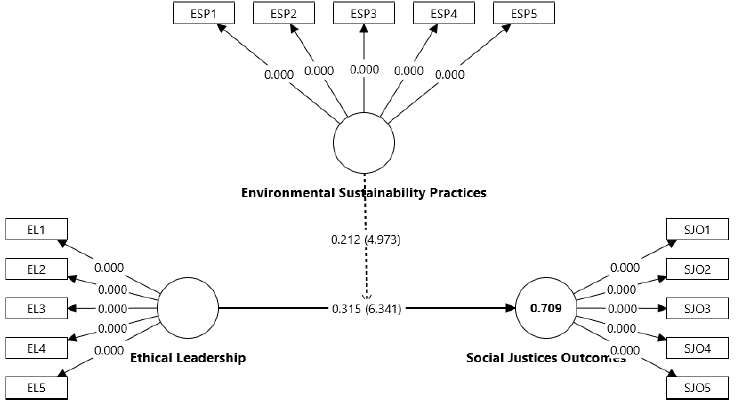
The structural model results presented in Table 7 indicate that Ethical Leadership (EL) has a positive and significant effect on Social Justice Outcomes (SJO) (β = .25, t = 5.24, p < .001). This finding suggests that ethical leadership practices contribute to improving fairness, inclusion, and equity within environmentally vulnerable communities. Environmental Sustainability Practices (ESP) also demonstrated a positive and statistically significant influence on Social Justice Outcomes (β = .63, t = 12.56, p < .001), indicating that stronger sustainability practices substantially enhance social justice outcomes.
Furthermore, as shown in Figure 3, the moderating analysis revealed that Environmental Sustainability Practices significantly moderate the relationship between Ethical Leadership and Social Justice Outcomes (β = .21, t = 4.97, p < .001). This implies that the positive influence of ethical leadership on social justice outcomes becomes stronger in contexts where environmental sustainability practices are effectively implemented. Therefore, hypotheses H1, H2, and H3 were all supported.
Structural and Moderating Hypothesis Testing Results
|
Hypothesis |
Relationship |
β |
SD |
t |
p |
Decision |
|
H1 |
EL → SJO |
0.25 |
.04 |
5.24 |
.000 |
Supported |
|
H2 |
ESP) → SJO |
0.63 |
.05 |
12.56 |
.000 |
Supported |
|
H3 |
(ESP × EL) → SJO |
0.21 |
.04 |
4.97 |
.000 |
Supported |
Moderating Structural Hypothesis Testing Results Diagram
Discussion
The findings of this study revealed that Ethical Leadership (EL) has a significant positive effect on Social Justice Outcomes (SJO) among environmentally vulnerable communities. This suggests that leaders who demonstrate honesty, fairness, accountability, transparency, and concern for community welfare are more likely to promote equitable access to opportunities, inclusive participation in decision-making, and protection of community rights. One possible explanation for this finding is that ethical leaders tend to establish trust-based relationships with community members, which encourages openness, participation, and collective engagement in governance processes. In environmentally vulnerable settings where communities often experience marginalization and unequal access to resources, ethical leadership becomes essential in ensuring fairness in environmental governance and resource allocation.
The finding also indicates that ethical leadership contributes to reducing perceptions of exclusion and discrimination because ethical leaders are more likely to involve diverse stakeholders in decisions affecting their welfare. This creates a sense of belonging and procedural justice within communities. In the context of environmental vulnerability, such leadership practices may further strengthen social cohesion and improve cooperation between local authorities, environmental institutions, and community members. These findings align with Al Halbusi et al. (2020), who found that ethical leadership reinforces ethical conduct through organizational justice, and with Penney (2023), who asserted that ethically grounded leadership enhances fairness and inclusion in governance procedures. Similarly, Al Halbusi et al. (2021) and She et al. (2023) observed that ethical behavior reduces silence and encourages voice, thereby promoting inclusive decision-making processes. Therefore, the findings imply that ethical leadership improves fairness in environmental management, access to resources, and representation in decisions affecting vulnerable populations.
However, despite the strong positive relationship observed in this study, some prior research has reported mixed or weaker effects of ethical leadership on justice-related outcomes. For example, Eisenbeiss et al. (2015) and Mayer et al. (2012) found that ethical leadership does not always translate directly into perceived fairness when organizational systems and enforcement mechanisms are weak. Similarly, De Hoogh and Den Hartog (2008) argue that the impact of ethical leadership may be constrained by contextual and structural factors within the environment. These findings suggest that ethical leadership alone may not be sufficient unless supported by strong institutional frameworks and participatory governance structures.
The study further found that Ethical Leadership positively and significantly influences Environmental Sustainability Practices (ESP). This implies that leaders who uphold ethical principles are more likely to support environmentally responsible actions, such as conservation initiatives, recycling, efficient resource use, environmental compliance, and sustainability-oriented innovation. A possible reason for this relationship is that ethical leaders often prioritize long-term societal welfare over short-term personal or institutional gains. Consequently, they are more willing to promote environmental policies and practices that protect natural resources and support sustainable community development.
In addition, ethical leadership may shape organizational and community culture by encouraging environmentally responsible behavior among stakeholders. Ethical leaders often serve as role models whose values influence collective attitudes toward environmental protection and sustainability. This is particularly important in environmentally vulnerable communities where poor environmental management can intensify poverty, health risks, and social inequalities. The findings therefore suggest that ethical leadership not only improves governance outcomes but also strengthens environmental responsibility and resilience within communities. These results are consistent with Hameed et al. (2023), who reported that ethical leadership enhances environmental performance through green innovation, and Rihal et al. (2025), who found that ethical values strengthen environmental practices through organizational culture and identity. Similar conclusions were reported by Boeske (2023), Ogaga et al. (2023), and Fatoki (2020), who argued that ethics-based leadership improves sustainability outcomes across different contexts.
Although the present study confirms a positive relationship between ethical leadership and environmental sustainability practices, some studies have reported less consistent or indirect effects. For instance, Newman et al. (2017) and Norton et al. (2015) found that ethical or pro-environmental leadership does not always lead to significant environmental performance unless supported by organizational commitment and environmental systems. In addition, Sundarasen et al (2024) noted that sustainability outcomes may depend more on institutional enforcement and employee environmental engagement than leadership ethics alone. These inconsistencies indicate that ethical leadership may require complementary environmental structures to fully translate into effective sustainability practices.
Furthermore, the moderating analysis demonstrated that Environmental Sustainability Practices strengthen the positive relationship between Ethical Leadership and Social Justice Outcomes. This indicates that the effectiveness of ethical leadership in promoting fairness, inclusion, and equity becomes stronger when sustainability practices are deeply embedded within community or institutional systems. One explanation for this finding is that sustainability practices provide practical structures and mechanisms for translating ethical principles into measurable social outcomes. In communities where environmental sustainability initiatives are effectively implemented, ethical leadership is more likely to produce transparent, participatory, and socially inclusive outcomes because environmental programs often require stakeholder collaboration, accountability, and shared responsibility.
The result also suggests that sustainability practices create an enabling environment that supports ethical decision-making and reinforces public confidence in leadership processes. In environmentally vulnerable communities, sustainability initiatives such as waste management programs, conservation projects, and environmental awareness campaigns may improve community participation and social inclusion, thereby amplifying the impact of ethical leadership on justice-related outcomes. These findings are consistent with Saleem et al. (2020), who found that sustainability practices enhance the effectiveness of ethical leadership, and Santiago-Torner et al. (2025), who emphasized that contextual sustainability factors influence social sustainability outcomes. Similarly, Elkhweildi et al. (2025) and Rihal et al. (2025) concluded that sustainability-oriented leadership improves engagement and performance when sustainability practices are institutionalized. Therefore, the findings imply that environmental sustainability practices enhance the capacity of ethical leadership to promote social justice outcomes by ensuring that ethical decisions are implemented through clear environmental structures and sustainable practices.
While this study finds that environmental sustainability practices strengthen the relationship between ethical leadership and social justice outcomes, some studies have reported weaker or context-dependent moderating effects. For example, Boiral et al. (2018) and López-Gamero et al. (2016) observed that sustainability practices do not always enhance leadership outcomes when organizational integration and stakeholder participation are low. Similarly, Pellegrini and Gerlagh (2006) found that environmental initiatives may yield limited social outcomes in contexts with weak governance systems. These mixed findings suggest that the moderating role of environmental sustainability practices may depend on the level of implementation effectiveness and institutional support.
Implications of Study
The findings support Stakeholder Theory by showing that EL positively affects SJO, ensuring the interests of vulnerable groups are considered. Institutional Theory is also reinforced, as ESP provides structures that consistently implement ethical principles. Together, EL promotes fairness and accountability, while ESP ensures these principles produce practical benefits for communities.
The study highlights that ethical leadership and structured sustainability initiatives improve living standards in environmentally vulnerable communities. Fair and accountable leadership, combined with ESP, ensures equitable access to environmental resources, supports community health, and reduces inequalities, promoting environmental justice.
Policymakers and practitioners should promote EL through training in integrity, transparency, and accountability. ESP should guide environmental initiatives to ensure consistency and fairness, while community engagement should be strengthened to include residents in decision-making. Aligning EL with structured sustainability practices enhances SJO and stakeholder confidence in vulnerable communities.
Conclusion, Limitations, and Future Research
This study examined the effects of Ethical Leadership (EL) on Social Justice Outcomes (SJO) and the moderating role of Environmental Sustainability Practices (ESP) in environmentally vulnerable communities. Findings show that EL significantly enhances SJO by promoting equity, inclusion, and accountability, and positively influences ESP, indicating that ethical leaders encourage responsible environmental behaviour. ESP further strengthens EL’s effect on SJO, suggesting that structured sustainability practices support ethical decision-making and just outcomes. These results confirm that EL and ESP complement each other in improving SJO.
Theoretically, the study contributes to Stakeholder Theory and Institutional Theory by demonstrating that ethical leadership and well-structured environmental practices are critical for achieving SJO. EL ensures fair representation of stakeholder interests, while ESP provides institutional support for the effective implementation of ethical decisions. Practically, the findings highlight that enhancing leadership ethics and sustainability practices can improve justice and equity in environmental governance.
Limitations include the cross-sectional design, reliance on self-reported data, and focus on Ghana, which may restrict generalizability. Future research should adopt longitudinal designs, include other regions, and explore additional moderators or mediators such as institutional trust and community involvement.
Funding
This study received no external funding and was fully self-funded by the authors.
Author Contributions
The authors declare no conflicts of interest
Conflict of Interest
The authors declare that they have no known competing financial interests or personal relationships that could have appeared to influence the work reported in this paper.
Generative AI Use Disclosure Statement
No generative AI tools were used in the writing or analysis of this manuscript.
Data Availability Statement
Data will be available on request from the authors.
Acknowledgments
Not applicable.
Ethics Approval and Consent to Participate
Ethical clearance was obtained from the Research Committee of KAAF University in accordance with the 1964 Declaration of Helsinki. Participation was voluntary, informed consent was secured, and confidentiality and anonymity were maintained. Participants had the freedom to withdraw at any point.
References
Abraham, E. M., Ganyaglo, F. K., Andoh, J. A., Asamoah, E., & Koomson, S. (2025). The ethics of climate justice in emerging economies: exploring the intersection of development and environmental responsibility. International Journal of Ethics and Systems. https://doi.org/10.1108/IJOES-07-2025-0385
Ahmad, H., Yaqub, M., & Lee, S. H. (2024). Environmental-, social-, and governance-related factors for business investment and sustainability: A scientometric review of global trends. Environment, development and Sustainability, 26(2), 2965–2987. https://doi.org/10.1007/s10668-023-02921-x
Ahmed, I. A., Anaman, P. D., Cudjoe, M. A., Akyen, B., & Donkor, C. (2024). Exploring the factors that mediate the relationship between accounting ethics and financial reporting quality among MSMEs. The Indonesian Accounting Review, 14(2), 253–271. https://doi.org/10.14414/tiar.v14i2.4711
Al Halbusi, H., Ruiz-Palomino, P., Jimenez-Estevez, P., & Gutiérrez-Broncano, S. (2021). How upper/middle managers' ethical leadership activates employee ethical behavior? The role of organizational justice perceptions among employees. Frontiers in Psychology, 12, 652471. https://doi.org/10.3389/fpsyg.2021.652471
Al Halbusi, H., Tang, T. L. P., Williams, K. A., & Ramayah, T. (2024). Do ethical leaders enhance employee ethical behaviors? Organizational justice and ethical climate as dual mediators and leader moral attentiveness as a moderator: Empirical support from Iraq’s emerging market. In Monetary wisdom (pp. 317-337). Academic Press. https://doi.org/10.1016/B978-0-443-15453-9.00018-8
Al Halbusi, H., Williams, K. A., Mansoor, H. O., Hassan, M. S., & Hamid, F. A. H. (2020). Examining the impact of ethical leadership and organizational justice on employees’ ethical behavior: does person–organization fit play a role?. Ethics & Behavior, 30(7), 514–532. https://doi.org/10.1080/10508422.2019.1694024
Alhaidan, H. (2025). Ethical leadership in action: Understanding the mechanism of organizational justice and leaders’ moral identity. Human Systems Management, 44(3), 477–489. https://doi.org/10.1177/01672533241295609
AlHares, A. (2025). Ethical Leadership and Its Impact on Corporate Sustainability and Financial Performance: The Role of Alignment with the Sustainable Development Goals. Sustainability, 17(15), 6682. https://doi.org/10.3390/su17156682
Alkhadra, W. A., Khawaldeh, S., & Aldehayyat, J. (2023). Relationship of ethical leadership, organizational culture, corporate social responsibility and organizational performance: a test of two mediation models. International Journal of Ethics and Systems, 39(4), 737–760. https://doi.org/10.1108/IJOES-05-2022-0092
Amoako, G. K., Adam, A. M., Arthur, C. L., & Tackie, G. (2021). Institutional isomorphism, environmental management accounting and environmental accountability: a review. Environment, Development and Sustainability, 23(8), 11201–11216. https://doi.org/10.1007/s10668-020-01140-y
Bagozzi, R. P., & Yi, Y. (1988). On the evaluation of structural equation models. Journal of the Academy of Marketing Science, 16(1), 74–94. https://doi.org/10.1007/BF02723327
Bennett, N. J., Alava, J. J., Ferguson, C. E., Blythe, J., Morgera, E., Boyd, D., & Côté, I. M. (2023). Environmental (in) justice in the Anthropocene ocean. Marine policy, 147, 105383. https://doi.org/10.1016/j.marpol.2022.105383
Boeske, J. (2023). Leadership towards sustainability: a review of sustainable, sustainability, and environmental leadership. Sustainability, 15(16), 12626. https://doi.org/10.3390/su151612626
Boiral, O., Raineri, N., & Talbot, D. (2018). Managers’ citizenship behaviors for the environment: a developmental perspective. Journal of business ethics, 149(2), 395–409. https://doi.org/10.1007/s10551-016-3098-6
Buijs, A. E., Gulsrud, N. M., Rodela, R., Diduck, A. P., van der Jagt, A. P., & Raymond, C. M. (2024). Advancing environmental justice in cities through the Mosaic Governance of nature-based solutions. Cities, 147, 104799. https://doi.org/10.1016/j.cities.2024.104799
Chege, S. M., & Wang, D. (2020). The influence of technology innovation on SME performance through environmental sustainability practices in Kenya. Technology in Society, 60, 101210. https://doi.org/10.1016/j.techsoc.2019.101210
Cohen, J. (2013). Statistical power analysis for the behavioral sciences. Routledge.
Cowan, D. M., Dopart, P., Ferracini, T., Sahmel, J., Merryman, K., Gaffney, S., & Paustenbach, D. J. (2010). A cross-sectional analysis of reported corporate environmental sustainability practices. Regulatory Toxicology and Pharmacology, 58(3), 524–538. https://doi.org/10.1016/j.yrtph.2010.09.004
Crawford, W., Taylor, N., Miles, J., Andrews, M. C., & Kacmar, M. (2025). Internals vs. externals: Who is impacted by ethical leadership?. Leadership & Organization Development Journal, 46(5), 774–795. https://doi.org/10.1108/LODJ-10-2024-0694
Dahiya, R., Selvakumar, P., Ahluwalia, G. K., Manjunath, T. C., & Anute, N. (2025). Ethical Leadership and Decision Making. In Advances in Ethical Work Climate and Employee Well-Being (pp. 45-66). IGI Global Scientific Publishing. https://doi.org/10.4018/979-8-3693-8819-8.ch003
De Hoogh, A. H., & Den Hartog, D. N. (2008). Ethical and despotic leadership, relationships with leader's social responsibility, top management team effectiveness and subordinates' optimism: A multi-method study. The leadership quarterly, 19(3), 297–311. https://doi.org/10.1016/j.leaqua.2008.03.002
Diamantopoulos, A., & Siguaw, J. A. (2006). Formative versus reflective indicators. British Journal of Management, 17(4), 263–282. https://doi.org/10.1111/j.1467-8551.2006.00500.x
Dijkstra, T. K., & Henseler, J. (2015). Consistent partial least squares path modeling. MIS Quarterly, 39(2), 297–316. https://doi.org/10.25300/MISQ/2015/39.2.02
Eisenbeiss, S. A., Van Knippenberg, D., & Fahrbach, C. M. (2015). Doing well by doing good? Analyzing the relationship between CEO ethical leadership and firm performance. Journal of Business Ethics, 128(3), 635–651. https://doi.org/10.1007/s10551-014-2124-9
Elkhweildi, M., Vetbuje, B., Alzubi, A. B., & Aljuhmani, H. Y. (2025). Leading with green ethics: How environmentally specific ethical leadership enhances employee job performance through communication and engagement. Sustainability, 17(17), 7923. https://doi.org/10.3390/su17177923
Fatoki, O. (2020). Ethical leadership and sustainable performance of small and medium enterprises in South Africa. Journal of Global Business and Technology, 16(1), 62–79. https://www.proquest.com/docview/2438198894?pq-origsite=gscholar&fromopenview=true&sourcetype=Scholarly%20Journals
Fornell, C., & Larcker, D. F. (1981). Evaluating structural equation models with unobservable variables. Journal of Marketing Research, 18(1), 39–50. https://doi.org/10.1177/002224378101800104
Freeman, R. E. (2010). Strategic management: A stakeholder approach. Cambridge university press.
Galleli, B., & Amaral, L. (2026). Bridging institutional theory and social and environmental efforts in management: A review and research agenda. Journal of Management, 52(1), 42–93. https://doi.org/10.1177/01492063251322429
Gomes, S., Pinho, M., & Lopes, J. M. (2024). From environmental sustainability practices to green innovations: Evidence from small and medium‐sized manufacturing companies. Corporate Social Responsibility and Environmental Management, 31(3), 1677–1687. https://doi.org/10.1002/csr.2657
Gosselin, L., & Gauquelin, M. (2025). Rethinking knowledge cumulation: foregrounding epistemic justice in environmental governance research. Environmental Policy and Governance, 35(4), 729–743. https://doi.org/10.1002/eet.2168
Hair Jr, J. F., Hult, G. T. M., Ringle, C. M., Sarstedt, M., Danks, N. P., & Ray, S. (2021). An introduction to structural equation modeling. In Partial least squares structural equation modeling (PLS-SEM) using R: a workbook (pp. 1-29). Cham: Springer International Publishing. https://doi.org/10.1007/978-3-030-80519-7_1
Hair, J. F., Risher, J. J., Sarstedt, M., & Ringle, C. M. (2019). When to use and how to report the results of PLS-SEM. European Business Review, 31(1), 2–24. https://doi.org/10.1108/EBR-11-2018-0203
Hameed, Z., Naeem, R. M., Misra, P., Chotia, V., & Malibari, A. (2023). Ethical leadership and environmental performance: The role of green IT capital, green technology innovation, and technological orientation. Technological Forecasting and Social Change, 194, 122739. https://doi.org/10.1016/j.techfore.2023.122739
Herold, D. M. (2018). Demystifying the link between institutional theory and stakeholder theory in sustainability reporting. Economics, Management and Sustainability, 3(2), 6–19. https://www.ceeol.com/search/article-detail?id=780463
Hill, R. P. (2017). Failure of ethical leadership: Implications for stakeholder theory and “anti‐stakeholders”. Business and Society Review, 122(2), 165–190. https://doi.org/10.1111/basr.12114
Hilson, G. (2017). Shootings and burning excavators: Some rapid reflections on the Government of Ghana's handling of the informal Galamsey mining ‘menace’. Resources Policy, 54, 109–116. https://doi.org/10.1016/j.resourpol.2017.09.009
Hu, L. T., & Bentler, P. M. (1999). Cutoff criteria for fit indexes in covariance structure analysis. Structural Equation Modeling, 6(1), 1–55. https://doi.org/10.1080/10705519909540118
Israel, G. D. (1992). Determining sample size. University of Florida Cooperative Extension Service, Institute of Food and Agriculture Sciences, EDIS, Florida.
Kalshoven, K., Den Hartog, D. N., & De Hoogh, A. H. (2011). Ethical leadership at work questionnaire (ELW): Development and validation of a multidimensional measure. The leadership quarterly, 22(1), 51–69. https://doi.org/10.1016/j.leaqua.2010.12.007
Katou, A., & Kafetzopoulos, D. (2025). Disruptive sustainability and its impact on organizations through the lens of institutional theory. Journal of Strategy and Management, 18(4), 873–893. https://doi.org/10.1108/JSMA-07-2025-0269
Kim, M. S., & Thapa, B. (2018). Relationship of ethical leadership, corporate social responsibility and organizational performance. Sustainability, 10(2), 447. https://doi.org/10.3390/su10020447
Kock, N., & Lynn, G. S. (2012). Lateral collinearity and misleading results in SEM. Journal of the Association for Information Systems, 13(7), 546–580. https://doi.org/10.17705/1jais.00302
Limbore, N. V., Anute, N., Ahluwalia, G. K., Chordiya, P. B., Kalshetti, P., & Selvakumar, P. (2025). Ethical leadership and corporate responsibility. In Innovative approaches to managing conflict and change in diverse work environments (pp. 193-218). IGI Global Scientific Publishing. https://doi.org/10.4018/979-8-3693-9556-1.ch009
López-Gamero, M. D., & Molina-Azorín, J. F. (2016). Environmental management and firm competitiveness: the joint analysis of external and internal elements. Long range planning, 49(6), 746–763. https://doi.org/10.1016/j.lrp.2015.12.002
Mayer, D. M., Aquino, K., Greenbaum, R. L., & Kuenzi, M. (2012). Who displays ethical leadership, and why does it matter? An examination of antecedents and consequences of ethical leadership. Academy of Management Journal, 55(1), 151–171. https://doi.org/10.5465/amj.2008.0276
Newman, A., Round, H., Bhattacharya, S., & Roy, A. (2017). Ethical climates in organizations: A review and research agenda. Business Ethics Quarterly, 27(4), 475–512. https://doi.org/10.1017/beq.2017.23
Norton, T. A., Parker, S. L., Zacher, H., & Ashkanasy, N. M. (2015). Employee green behavior: A theoretical framework, multilevel review, and future research agenda. Organization & Environment, 28(1), 103–125. https://doi.org/10.1177/1086026615575773
Obasa, A. E. (2025). Navigating the storm: Ethical consideration to climate justice and sustainable health equity in Africa. The Journal of Climate Change and Health, 25, 100465. https://doi.org/10.1016/j.joclim.2025.100465
Ogaga, I. A., Ezenwakwelu, C. A., Isichei, E. E., & Olabosinde, T. S. (2023). Ethical leadership and sustainability of agro-allied firms: moderating role of environmental dynamism. International Journal of Ethics and Systems, 39(1), 36–53. https://doi.org/10.1108/IJOES-12-2021-0226
Páez Gabriunas, I. (2023). Ethical leadership. In Encyclopedia of business and professional ethics (pp. 760-765). Cham: Springer International Publishing. https://doi.org/10.1007/978-3-030-22767-8_55
Pellegrini, L., & Gerlagh, R. (2006). Corruption, democracy, and environmental policy: an empirical contribution to the debate. The Journal of Environment & Development, 15(3), 332–354. https://doi.org/10.1177/1070496506290960
Penney, S. (2023). Leadership and social justice. In Global encyclopedia of public administration, public policy, and governance (pp. 7386-7391). Cham: Springer International Publishing. https://doi.org/10.1007/978-3-030-66252-3_2174
Rawls, J. (1971). An egalitarian theory of justice. Philosophical Ethics: An Introduction to Moral Philosophy, 365–370. https://usdglobal.wordpress.com/wp-content/uploads/2015/05/02-an-egalitarian-theory-of-justice-by-rawls.pdf
Rihal, J., Alzubi, A., Aljuhmani, H. Y., & Berberoğlu, A. (2025). From ethics to ecology: How ethical leadership drives environmental performance through green organizational identity and culture. PloS one, 20(11), e0336608. https://doi.org/10.1371/journal.pone.0336608
Saleem, M., Qadeer, F., Mahmood, F., Ariza-Montes, A., & Han, H. (2020). Ethical leadership and employee green behavior: A multilevel moderated mediation analysis. Sustainability, 12(8), 3314. https://doi.org/10.3390/su12083314
Santiago-Torner, C., Jiménez-Pérez, Y., & Tarrats-Pons, E. (2025). Interaction between ethical leadership, affective commitment and social sustainability in transition economies: A model mediated by ethical climate and moderated by psychological empowerment in the Colombian electricity sector. Sustainability, 17(13), 6068. https://doi.org/10.3390/su17136068
Scott, W. R. (2013). Institutions and organizations: Ideas, interests, and identities. Sage publications.
She, J., Zhang, R., Li, Y., Mei, Y., & Li, H. (2023). Effect of ethical leadership on nurses’ organizational silence: the mediating role of organizational justice. Journal of Nursing Management, 2023(1), 9929435. https://doi.org/10.1155/2023/9929435
Sundarasen, S., Zyznarska-Dworczak, B., & Goel, S. (2024). Sustainability reporting and greenwashing: A bibliometrics assessment in G7 and non-G7 nations. Cogent Business & Management, 11(1), 2320812. https://doi.org/10.1080/23311975.2024.2320812
Taamneh, M., Aljawarneh, N., Al-Okaily, M., Taamneh, A., & Al-Oqaily, A. (2024). The impact of ethical leadership on organizational citizenship behavior in higher education: the contingent role of organizational justice. Cogent Business & Management, 11(1), 2294834. https://doi.org/10.1080/23311975.2023.2294834
Tennakoon, W. D. N. M. S., Janadari, M. P. N., & Wattuhewa, I. D. (2024). Environmental sustainability practices: A systematic literature review. European Journal of Sustainable Development Research, 8(3), 18. https://doi.org/10.29333/ejosdr/14604
Testa, F., Boiral, O., & Iraldo, F. (2018). Internalization of environmental practices and institutional complexity: can stakeholders pressures encourage greenwashing?. Journal of Business Ethics, 147(2), 287–307. https://doi.org/10.1007/s10551-015-2960-2
Tetteh, F. K., Owusu Kwateng, K., & Obiri-Yeboah, H. (2025). Understanding green building practices adoption in the construction industry: an extension of institutional theory. Property Management, 43(5), 806–831. https://doi.org/10.1108/PM-09-2024-0096
Tunji-Olayeni, P., Kajimo-Shakantu, K., Ayodele, T. O., & Babalola, O. (2025). Promoting construction for sustainability transformation: the perspective of institutional theory. International Journal of Building Pathology and Adaptation, 43(5), 933–950. https://doi.org/10.1108/IJBPA-07-2022-0104
United Nations Environment Programme (UNEP). (2023). Global environment outlook. UNEP. https://wedocs.unep.org/items/bba44efd-7715-4054-8432-92b270ee9d67
Yukl, G., Mahsud, R., Hassan, S., & Prussia, G. E. (2013). An improved measure of ethical leadership. Journal of leadership & Organizational Studies, 20(1), 38–48. https://journals.sagepub.com/doi/abs/10.1177/1548051811429352#con4

Page 1 of
Download Count : 4
Visit Count : 105
Keywords
Ethical Leadership; Social Justice Outcomes; Environmental Sustainability Practices; Stakeholder Theory; Institutional Theory; Ghana

Author(s) Information


How to cite this article:
Annan, E., & Marfo, M. (2026). Linking ethical leadership to social justice outcomes: The moderating influence of environmental sustainability practices. European Journal of Studies in Management and Business, 37, 23-43. https://doi.org/10.32038/mbrq.2026.37.02
Funding
This study received no external funding and was fully self-funded by the authors.
Author Contributions
The authors declare no conflicts of interest
Conflict of Interest
The authors declare that they have no known competing financial interests or personal relationships that could have appeared to influence the work reported in this paper.
Generative AI Use Disclosure Statement
No generative AI tools were used in the writing or analysis of this manuscript.
Data Availability Statement
Data will be available on request from the authors.
Acknowledgments
Not applicable.
Ethics Approval and Consent to Participate
Ethical clearance was obtained from the Research Committee of KAAF University in accordance with the 1964 Declaration of Helsinki. Participation was voluntary, informed consent was secured, and confidentiality and anonymity were maintained. Participants had the freedom to withdraw at any point.
Open Access
This article is licensed under a Creative Commons Attribution 4.0 International License, which permits use, sharing, adaptation, distribution and reproduction in any medium or format, as long as you give appropriate credit to the original author(s) and the source, provide a link to the Creative Commons license, and indicate if changes were made. You may view a copy of Creative Commons Attribution 4.0 International License here: http://creativecommons.org/licenses/by/4.0/