






Original Research
Analysis of the use of Large-Scale Language Models (LLMs) in SMEs in the Guadalajara Metropolitan Area: Tools, Tasks, and Perceived Benefits


- Abstract
- Full text
- Metrics
This research examines how Small and Medium-sized Enterprises (SMEs) in Guadalajara’s Metropolitan Area are incorporating Large Language Models (LLMs) into their operations. Beyond simply mapping adoption, it explores the specific tools in use, the tasks they support, the organizational areas they influence, and the benefits companies perceive from their implementation. Adopting a quantitative design, the study will draw on data collected through a questionnaire administered to a representative sample of SMEs across diverse sectors. Key variables, namely frequency of use, user profiles, functional areas involved, types of tasks performed, perceived advantages, and decision-making factors, will be systematically analyzed. Statistical techniques, including descriptive, comparative, and correlational analyses, will be applied to reveal usage patterns and relationships among variables. The resulting evidence will provide a nuanced picture of how LLMs are transforming the local business landscape. These insights aim to inform public policy and guide technological adoption strategies, fostering broader and more effective integration of Artificial Intelligence tools within SMEs in Jalisco.
Analysis of the use of Large-Scale Language Models (LLMs) in SMEs in the Guadalajara Metropolitan Area: Tools, Tasks, and Perceived Benefits
Luis Roberto Castro-Hernández *, Ricardo Arechavala-Vargas,
Marlon Israel Nuño-Rodríguez
Universidad de Guadalajara, Zapopan, Mexico
ABSTRACT:
This research examines how Small and Medium-sized Enterprises (SMEs) in Guadalajara’s Metropolitan Area are incorporating Large Language Models (LLMs) into their operations. Beyond simply mapping adoption, it explores the specific tools in use, the tasks they support, the organizational areas they influence, and the benefits companies perceive from their implementation. Adopting a quantitative design, the study will draw on data collected through a questionnaire administered to a representative sample of SMEs across diverse sectors. Key variables, namely frequency of use, user profiles, functional areas involved, types of tasks performed, perceived advantages, and decision-making factors, will be systematically analyzed. Statistical techniques, including descriptive, comparative, and correlational analyses, will be applied to reveal usage patterns and relationships among variables. The resulting evidence will provide a nuanced picture of how LLMs are transforming the local business landscape. These insights aim to inform public policy and guide technological adoption strategies, fostering broader and more effective integration of Artificial Intelligence tools within SMEs in Jalisco.
KEYWORDS: Large Language Models, SMEs, Generative Artificial Intelligence, Productivity, Technological Adoption
Small and medium-sized businesses in emerging markets face persistent structural barriers to adopting technology. For artificial intelligence, the barriers are shortages in technical human capital, shortages in available funds, and underdeveloped information systems. Here, Large Language Models (LLMs) represent a disruptive and complex frontier. Given that prior studies have scoped adoption in large businesses and mature economies, much less is known about how SMEs, particularly in emerging markets, incorporate LLMs strategically and transform adoption into organizational payoffs.
This work enlarges upon a systematic literature review and incorporates a composite theoretical framework that unites the Technology–Organization–Environment (TOE) model, the Technology Acceptance Model (TAM), the Resource-Based View (RBV), Dynamic Capabilities theory, as well as the Perceived Performance approach. The integration of these perspectives provides a multi-dimensional description of adoption by relating contextual, perceptual, as well as resource-based antecedents. The framework also outlines how adoption and integration of LLMs in SMEs can provide economic, operational, as well as strategic advantages under the constraints that are characteristic of emerging economies. By integrating these methodologies, the framework contributes not only to scholarly discourses, but also to practical knowledge for managers, consultants, as well as policymakers in Latin America as well as other emerging economies.
SME operating environments in Latin American countries are remarkably different from those in high-income economies. There is acute underinvestment in digital backbones, restricted access to finance, as well as scarce specialized human capital. Against these frequent challenges, SMEs remain the primary creator of jobs, as OECD (2023a) data show. Fixed internet access in Mexico in 2023 reached 89.4% as available to SMEs, yet application of advanced digital tools is still inconsistent in deployment: those in sales through the internet were lagging in the period at 66.9%, which reinforces the large digital and AI adoption gap (Instituto Federal de Telecomunicaciones, 2024). This gap is more than symptomatic of finance and technology limitations, institutional shortcomings, as well as cultures resistant to change.
These Mexican patterns are consistent with broader digital divides evidence from the OECD (2023b). Global studies have concurred that divergent adoption trends among SMEs are worldwide trends (Schwaeke et al., 2024). Similar studies also show that institutional settings are adoption pattern determinants (Gunduz et al., 2023). Similar trends are also observed in Latin American nations, where, for example, SMEs in Ecuador have adopted AI as part of their market positioning strategy and among their tools to become more competitive (Cordovilla et al., 2024).
An Integrated Framework to Understand LLM Adoption in SMEs
Here, the integrated theory framework is particularly relevant to emerging economies. The Technology–Organization–Environment (TOE) theory outlines how environmentally induced pressures such as customer needs and competition, in conjunction with organizational readiness, preconditions adoption. The Technology Acceptance Model (TAM) is sensitive to the role played by perceptions in situations where managers themselves are deficient in technical knowledge. The Resource-Based View (RBV) and Dynamic Capabilities theory address the scarcity of resources as much as the ongoing imperative that businesses must redefine them to extricate themselves partially intact from environments that are constantly changing. Finally, the Perceived Performance perspective enables one to capture value added other than in monetary terms through the inclusion of operational efficiency as much as in strategic positioning—the latter dimension often proving the decisive criterion in SMEs operating in uncertain marketplaces.
The use of this combined framework is germane to the claims made by Benbya et al. (2020), who underline that digital adoption in developing markets is conditioned by the interaction between technological, organizational, and institutional systems. AI adoption handbooks currently in use observe in a similar vein their importance when considering SMEs (Khosrow-Pour et al., 2024). Bibliometric analyses similarly show a marked increase in research attention at the AI-business practice boundary (García Peñaloza et al., 2024), in favoring the use of broad-based frameworks like that utilized in this study.
External validation from outside Latin American contexts also shows the value added from consolidated theory to understanding innovation and technological integration among SMEs. Companies in countries like India face the same challenges as Mexican SMEs, including limited sources and inconsistent funding data. Here, Vij and Bedi (2016) cross-verified subjective and objective performance measures, supporting the value of perceived performance metrics in understanding organizational output in restricted-resource contexts.
The TOE framework (Tornatzky & Fleischer, 1990) provides a structural explanation of adoption, illustrating how technological, organizational, and environmental contexts shape decision-making about new technologies. When we zoom into SMEs in emerging economies, these dimensions become particularly pressing. Technological considerations include how advantageous LLMs appear compared to existing tools, whether they fit into current workflows, and how complex or intimidating they seem. Organizational readiness is not just about infrastructure—it is also about leadership commitment and whether employees have the digital skills to make the leap. Then there is the external environment: market competition, customer expectations, and regulatory pressures—all of which push (or sometimes stall) adoption decisions.
Meanwhile, the Technology Acceptance Model (TAM) (Davis, 1989) adds a psychological layer to the equation. Here, it is not the hardware or systems that matter most—it is what people believe about them. Are these tools useful? Are they easy to use? Do they inspire trust? These questions weigh heavily, especially in SMEs where managers may not have technical backgrounds. Recent studies remind us that without trust in the system’s outputs—especially with the risks of bias, hallucinations, or opaque responses—LLM adoption simply does not gain traction (Chatterjee et al., 2023; Kshetri & Voas, 2023). And it is not just theory: empirical research continues to affirm TAM as a solid framework for understanding AI adoption in SMEs, particularly when usefulness and ease of use drive the decision (Gündüzyeli, 2024).
But perceptions alone do not make adoption sustainable. That is where the Resource-Based View (RBV) (Barney, 1991) becomes essential. This theory argues that lasting competitive advantage comes from having and using resources that are valuable, rare, hard to imitate, and difficult to substitute. Think of things like high-performing IT systems, sharp managerial insight, or a team that can learn quickly. For SMEs in low-resource environments, the challenge lies in making the most of what they have got—both tangible and intangible—and figuring out how to stretch those limited resources to support LLM integration. The RBV framework helps us understand why some SMEs move forward while others lag behind: it is not just about what they have, but how they use it.
Expanding on this idea, Dynamic Capabilities theory (Teece, 1997) focuses on firms’ ability to adapt and reconfigure resources in turbulent environments. In plain terms: can the firm spot opportunities, grab them fast, and shift its internal processes to take advantage of change? When applied to LLMs, this means SMEs need more than a good AI tool—they need agility. Whether through continuous upskilling, agile redesign of workflows, or reallocating tech investments, it is the firms with strong dynamic capabilities that go beyond basic experimentation and achieve deeper, lasting integration. Not surprisingly, firms that excel in this area report significantly better outcomes with generative AI (Csaszar et al., 2024).
Now, how do we know adoption is working? Traditionally, people would say: “Show me the financial results.” But as Venkatraman and Ramanujam (1986) argued decades ago, performance is more than profit margins. It is about operational improvements, strategic positioning, and long-term resilience. That is where the Perceived Performance perspective comes into play. It recognizes that financial metrics can be misleading—especially in SMEs where data might be missing, inconsistent, or distorted by external shocks. Instead, performance is understood through what managers experience: smoother operations, faster delivery, fewer mistakes, stronger innovation, and improved competitiveness. In other words, outcomes you can feel—even if they do not yet show up on the balance sheet.
Recent research in Latin America validates this multidimensional lens. Santos and Brito (2012), working with Brazilian firms, confirmed that subjective measures across economic, operational, and strategic domains offer meaningful insights in emerging markets. Heredia-Pérez et al. (2019) went further, exploring the links between innovation and performance in manufacturing SMEs in Chile and Peru, and underscoring that perceived impact—not just hard data—matters in complex environments. In Mexico, Jiménez-Castañeda et al. (2019) found that when SMEs embrace innovation and take proactive steps toward environmental adaptation, their perceived performance rises—regardless of what traditional accounting might say.
Taken together, these frameworks build a robust, integrated model that captures the multifaceted nature of LLM adoption in SMEs. They offer a lens not just for academics but also for managers and policymakers trying to navigate the messy, uncertain terrain of digital transformation in resource-constrained settings. Figure 1 presents conceptual framework for LLM adoption in SMEs.
Conceptual Framework for LLM Adoption in SMEs
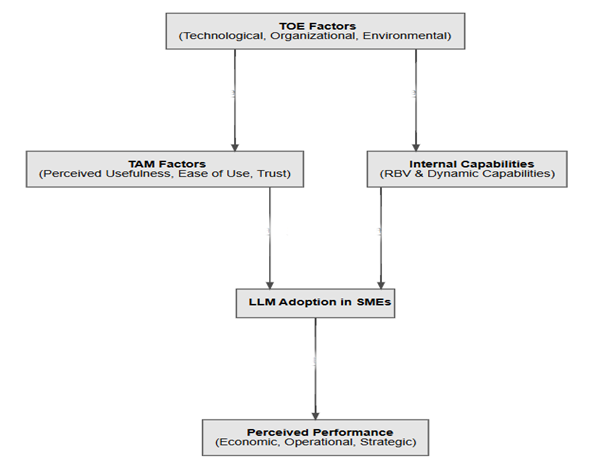
Note. Developed by the authors based on Tornatzky and Fleischer (1990), Davis (1989), Barney (1991), Teece (1997), and Venkatraman and Ramanujam (1986)
From Conceptual Framework to Testable Hypotheses
Having laid out an integrated framework, this study moves from theory to testing. The goal? To connect the dots—between what drives adoption, how it plays out inside organizations, and what results come from it. That is where the hypotheses come in. They are not just statements to verify—they act as bridges between ideas, capturing how different layers of this framework relate to one another.
The hypotheses fall into four major themes. First, there are the contextual and perceptual drivers of adoption—things like technological fit, organizational readiness, and what managers believe about LLMs (TOE and TAM). Next, we explore internal resources and dynamic capabilities—the tools and flexibilities that allow firms to actually integrate these technologies. Third, we look at outcomes, especially how SMEs perceive their own performance—economically, operationally, and strategically. Finally, we explore how these relationships are shaped or strengthened by mediating or moderating effects. Here is a summary of what the study sets out to test:
H1: Perceptions matter. The more useful, easy-to-use, and trustworthy LLMs seem, the more likely they are to be adopted by SMEs.
H2: TOE factors—relative advantage, compatibility with current systems, and complexity—are significant influences on whether or not firms adopt LLMs.
H3: Firms with stronger dynamic capabilities—those that can pivot quickly and adapt—are more likely to integrate LLMs deeply into their operations.
H4: It is not just about external pressures; the effect of TOE factors on adoption is filtered through perceived usefulness, echoing TAM logic.
H5: Adoption and integration of LLMs are linked to perceived performance improvements across the board: economic (like cost savings), operational (like efficiency gains), and strategic (like improved competitiveness).
H6: Dynamic capabilities do not just help with adoption—they strengthen the link between adoption and performance. Firms with higher capability levels see bigger payoffs.
To make these hypotheses more tangible, Table 1 lays them out clearly. It maps each one to its theoretical foundation, outlines the expected relationship, and shows the anticipated direction of the effect. This is not just academic rigor—it is a roadmap for how AI adoption might unfold in the real world of SMEs.
Study Hypotheses
|
Hypothesis |
Theoretical Base |
Expected Effect |
|
H1 |
TAM (Davis, 1989) |
Usefulness, ease of use, trust → Adoption (+) |
|
H2 |
Advantage, compatibility (+); complexity (–) → Adoption |
|
|
H3 |
Dynamic Capabilities (Csaszar et al., 2024; Teece, 1997) |
Capabilities → Integration depth (+) |
|
H4 |
TOE + TAM |
Usefulness mediates TOE → Adoption |
|
H5 |
Perceived Performance (Venkatraman & Ramanujam, 1986) |
Adoption → Performance (economic, operational, strategic) (+) |
|
H6 |
Dynamic Capabilities |
Adoption × Capabilities → Stronger Performance |
Note. Hypotheses integrate TOE, TAM, RBV, Dynamic Capabilities, and Perceived Performance frameworks.
Method
To examine the adoption and impact of Large Language Models (LLMs) in small and medium-sized enterprises (SMEs), this study applies a quantitative, cross-sectional design focused on firms located in the Guadalajara Metropolitan Area—one of Mexico’s most dynamic regional economies, where opportunities for digital transformation coexist with persistent structural barriers. In the absence of a comprehensive sampling frame and considering the novelty of the phenomenon, purposive non-probability sampling was chosen. This strategy enables the inclusion of SMEs across various sectors, allowing for a more nuanced understanding of how LLMs are being integrated into organizational routines.
Data are being collected through a structured survey administered to SME decision-makers operating in diverse industries. This approach ensures that the data reflect lived experiences and perceptions directly related to the use of LLMs—capturing not just technical implementation, but the human and strategic dimensions of adoption.
The survey instrument is organized into thematic blocks aligned with the theoretical frameworks employed in this study: technological, organizational, and environmental factors (TOE); perceived usefulness, ease of use, and trust in outcomes (TAM); resource-based capabilities (RBV); and dynamic capabilities (sensing, seizing, and reconfiguring).
LLM adoption and integration are evaluated using the ILLM-P maturity index, which considers multiple dimensions: usage intensity, diversity of tasks supported, level of process integration, and presence of governance mechanisms. This index allows the study to distinguish between superficial experimentation and substantive adoption.
Perceived performance outcomes are measured along three core dimensions: 1) Economic, including cost reduction and revenue growth. 2) Operational, such as improvements in efficiency and reduction in errors. 3) Strategic, including innovation capacity and competitive positioning.
All items in the instrument are rated using 5-point Likert scales (1 = strongly disagree, 5 = strongly agree), providing a standardized method for capturing variation in perception.
To ensure both clarity and validity, the questionnaire underwent several layers of refinement. These included expert review, cognitive interviews, and a pilot test conducted with selected SMEs prior to deployment. This rigorous process ensured that the instrument was both theoretically grounded and accessible to respondents from diverse organizational backgrounds. Table 2 provides an overview of the constructs, definitions, and primary sources used in the development of the survey instrument.
Key Constructs and Sources
|
Construct |
Main Sources |
|
Technological Factors |
|
|
Organizational Factors |
|
|
Environmental Factors |
|
|
Perceived Usefulness |
|
|
Ease of Use |
|
|
Trust in Outputs |
|
|
IT Resources |
|
|
Dynamic Capabilities |
|
|
Adoption & Integration |
|
|
Performance – Economic |
|
|
Performance – Operational |
|
|
Performance – Strategic |
Note. All items measured on 5-point Likert scales (1 = strongly disagree, 5 = strongly agree).
The data analysis strategy is structured in three stages. First, descriptive statistics provide an overview of adoption patterns, user profiles, and task distribution. Second, the measurement models are validated through tests of internal consistency (Cronbach’s α, composite reliability), convergent and discriminant validity (AVE, HTMT), and procedures to address common method bias. Finally, the structural model is estimated using Partial Least Squares Structural Equation Modeling (PLS-SEM), a technique well-suited for small and medium-sized samples. This analysis explores direct relationships, including mediation effects (TOE → TAM → Adoption) and moderation effects (Dynamic Capabilities → Performance), while controlling for variables such as industry type and firm size. Robustness checks are incorporated to reinforce the credibility and reliability of the findings.
Findings, Contributions, and Future Directions
Although empirical data collection is still underway, some patterns are already beginning to emerge—and they are not random. In fact, what is taking shape lines up with findings from other parts of the world. The framework and hypotheses developed in this study give us a head start in understanding what is really going on. What is interesting—and worth paying attention to—is how adoption of Large Language Models (LLMs) in SMEs is not just about installing a tool. It is about the context around it: the environment in which the company operates, the beliefs and perceptions of its managers, and the resources that shape what is or is not possible inside the organization. When those three elements come together, that is when adoption happens—and more importantly, when it starts generating results across multiple fronts, from operations to strategy.
It turns out that when SMEs believe LLMs are actually useful, easy to use, and reliable in what they deliver, they are far more likely to adopt them with real commitment—this directly supports hypotheses H1 and H2. In plain terms, perception matters. These psychological factors are not just side notes; they are core drivers. And that is exactly what the Technology Acceptance Model (TAM) has been arguing all along. In settings where technical know-how is limited—and let’s be honest, that is often the case in smaller firms—what managers think and feel about a new tool can tip the scales one way or the other (Chatterjee et al., 2021; Chatterjee et al., 2023; Gündüzyeli, 2024).
Technology–Organization–Environment (TOE) factors also carry serious weight when it comes to adoption. Think about it: when a company sees a clear advantage in using LLMs—something that really fits with how they already operate—it makes sense they would lean in more confidently. On the flip side, when the tech feels too complex or incompatible, that enthusiasm drops. Adoption becomes slower and more cautious. Internally, the readiness of the organization plays a key role too. Are managers backing the change? Is the IT infrastructure solid? Do employees have the skills to make it work? Externally, the pressure builds—from competitors moving ahead or customers demanding faster, smarter service. All these elements tend to push adoption forward. So yes, hypothesis H2 finds a strong footing here. And what is striking is how these TOE dimensions do not replace perceptual factors—they build on them, complementing how managers interpret and respond to new technologies.
When you look at the full picture, the message is clear: both TAM and TOE still hold up as solid explanations for how SMEs in emerging markets adopt new technologies—even when resources are tight. It’s not just theory. Studies on European SMEs reveal adoption patterns that echo Rogers’ diffusion model (Gastón & Rammer, 2023). And when you zoom out to the broader landscape, systematic reviews keep pointing to the same culprits: lack of resources and know-how are two of the biggest reasons why AI still hasn’t reached its full potential in many small firms (Mathagu, 2024).
But the story does not stop there. Enter dynamic capabilities—the quiet powerhouses that shape how far adoption really goes. As suggested by hypotheses H3 and H6, these capabilities pull double duty. First, they help drive integration. SMEs that know how to spot emerging opportunities, act on them quickly, and shuffle their resources effectively are the ones embedding LLMs deeply into different parts of the business. Second, they act as a kind of amplifier. If adoption is the engine, dynamic capabilities are the turbocharger—helping firms unlock bigger gains in performance. Without that adaptability, LLM use risks staying stuck in one-off projects or disconnected use cases (Csaszar et al., 2024; Teece, 1997).
And here is where it gets even more interesting. Hypothesis H4 puts the spotlight on perceived usefulness—not just as a factor, but as a bridge between potential and action. It does not matter if the market is pressuring a company or if new tech is sitting right there waiting to be picked up. Unless managers believe LLMs can genuinely help, adoption isn’t likely to happen. In fact, those external forces alone rarely do the trick. It’s what happens inside the mind of the decision-maker that really counts. This is especially true in environments filled with uncertainty and technical blind spots—where gut feeling and judgment carry more weight than dashboards or data.
When hypothesis H5 enters the picture, it brings with it an encouraging perspective: adopting and integrating LLMs does not just tick a tech box—it tends to generate real, measurable improvements across multiple fronts. On the economic side, automation leads to lower costs, while better services and new business models open up fresh streams of revenue. Operationally, SMEs begin to notice a difference too—faster workflows, fewer mistakes, and a boost in overall efficiency. And let’s not forget the strategic level, where firms report stronger innovation capabilities, sharper competitive positioning, and customers who are not just satisfied but impressed. These are not just hopes—they are outcomes already showing up in recent studies, from AI-driven productivity boosts (Brynjolfsson et al., 2023), to enhanced innovation and growth (Kopka & Fornahl, 2024), and marked gains from using generative AI (Czarnitzki et al., 2023).
So what is really driving all of this? The first group of hypotheses lays it out clearly: it is the mix of contextual enablers, managerial perceptions, and organizational resources that together shape adoption decisions. But whether that adoption translates into performance gains? That depends on how deeply the technology is embedded and whether the firm has the dynamic capabilities to make it count. These early findings give strong support to the framework proposed in this study, positioning it as a solid lens to understand how LLM adoption unfolds in SMEs across emerging economies.
This leads us to one of the study’s key contributions: offering a more complete, more grounded way to explain how SMEs adopt LLMs. Past research has often looked through a single lens—either the Technology Acceptance Model (TAM) or the Technology–Organization–Environment (TOE) framework. Both models have added a lot to the conversation, but let’s be honest: they each tell only part of the story. TAM zeroes in on how people perceive usefulness and ease of use, but leaves out crucial elements like organizational dynamics or strategic thinking. TOE, on the other hand, frames adoption in terms of technology and context but misses the human and resource-based drivers that are especially relevant for SMEs.
What happens when you stop looking at adoption through a single lens? You get something more real, more useful. By weaving together TAM, TOE, the Resource-Based View (RBV), Dynamic Capabilities theory, and the Perceived Performance approach, this study delivers a framework that does not just skim the surface—it digs deep. It helps explain what drives adoption, how far LLMs are actually integrated, and what kind of impact they create across economic, operational, and strategic dimensions. It is the kind of comprehensive model researchers have been calling for—one that does not just focus on isolated factors, but truly reflects the messy, multidimensional reality of how digital technologies take root in business (Benbya et al., 2020; Khosrow-Pour et al., 2024).
This matters even more for SMEs in emerging economies. Unlike their counterparts in the Global North, these firms do not have the luxury of scale or easy access to capital to cushion the risks that come with tech adoption. They are often navigating a storm of constraints—scarce resources, volatile institutions, cutthroat competition—and those forces shape not only whether they can adopt LLMs, but also whether that adoption actually pays off. That is why a one-size-fits-all explanation will not work here. You need a multidimensional framework to understand why some SMEs find success with LLMs, while others struggle to move beyond experimentation.
Dynamic Capabilities theory adds a crucial piece to that puzzle. It centers on something we do not talk about enough: the firm’s ability to sense opportunities, seize them quickly, and reconfigure internal resources to stay competitive in unpredictable environments (Teece, 1997). Whether an SME ends up using LLMs just for basic tasks—or instead integrates them into core operations that transform how the business runs—depends a lot on those capabilities. Bringing this lens into the conversation bridges two important worlds: the logic of information systems and the strategic thinking behind long-term survival. In doing so, it connects today’s tech decisions to tomorrow’s resilience.
The Perceived Performance approach brings something refreshing to the table—it broadens how we define success. Too often, adoption studies have reduced performance to one thing: financial returns. But for SMEs, especially in unpredictable markets, that’s only part of the picture. As Venkatraman and Ramanujam (1986) argued decades ago, performance should also include operational and strategic dimensions. And this isn’t just theory. Empirical work in Latin America—like the studies by Santos and Brito (2012) in Brazil and Heredia-Pérez et al. (2019) in Chile and Peru—has shown that this multidimensional view of performance truly fits the context of emerging economies. Our framework takes this seriously. It treats cost savings and efficiency as important, yes, but also recognizes that things like innovation and competitive edge can make the difference between surviving and thriving in the long run.
Stepping back, the core theoretical contribution of this research is about building bridges. It brings together fragmented theories of adoption and turns them into a cohesive model that actually reflects the messy reality faced by SMEs. This model clarifies the what (adoption determinants), the how (mechanisms of integration), and the so what (performance outcomes). It challenges the idea that adoption happens just because someone perceives a benefit or reacts to market pressure. Instead, it shows that adoption decisions and integration depth emerge from a dynamic mix of perceptions, organizational conditions, and internal capabilities. In doing so, it pushes the conversation on digital transformation well beyond the limited scope of any one theoretical lens.
Still, the framework does not paint an overly rosy picture. It acknowledges something fundamental: results will vary. Not every SME will benefit equally from adopting LLMs. Some may have the right mix of conditions to turn technology into transformation, while others might not move the needle much at all. And that is okay. What matters is recognizing this variability instead of assuming every firm will magically thrive just by implementing AI. By resisting that kind of technological determinism, the framework reminds us of something essential—success depends as much on organizational muscle and local context as on the tools themselves.
SMEs that have built up strong absorptive capacity and dynamic capabilities tend to come out ahead—across the board. They are the ones seeing real, multidimensional benefits: cutting costs, running operations more smoothly, pushing innovation forward, and carving out a stronger place in the market. What sets them apart? They do not stop at pilot tests or surface-level uses. They embed LLMs into the heart of their operations, turning adoption into long-term value. Evidence from SMEs in Europe and Asia backs this up—adoption often pays off when it is backed by the right support systems and resources (Brynjolfsson et al., 2023; Czarnitzki et al., 2023; Kopka & Fornahl, 2024).
Now, contrast that with firms that lack these capabilities or operate with limited resources. In these cases, adoption tends to stay at the shallow end. Maybe they use LLMs to draft social media posts or automate basic customer support—but that is it. Integration does not really happen. As a result, the gains are minimal or even non-existent. Researchers have started calling this the “AI adoption trap”—where companies invest in generative AI tools but see little return because they were not ready to put them to work in meaningful ways (Kshetri & Voas, 2023).
This kind of outcome gap is especially visible in emerging economies, where structural hurdles run deep. Studies focusing on Latin American SMEs paint a familiar picture: persistent challenges in infrastructure, financing, and access to skilled labor all shape what is possible—and what is not—when it comes to adopting AI (Cordovilla et al., 2024; Escárraga & Hernández, 2024). Take Mexico, for instance. Recent evidence shows that SMEs are both excited and hesitant about generative AI. For some, it looks like a strategic breakthrough. For others, the lack of technical knowledge and fear of the unknown hold them back. It is a classic case of digital transformation being both a huge opportunity and a serious challenge (Porras Sandoval et al., 2025).
These contrasting scenarios leave no room for oversimplification. The outcomes of adopting LLMs do not follow a neat, upward curve. Instead, they depend on how prepared the organization is, how managers perceive the technology, and how flexibly the firm can redirect its resources when needed. It is a dynamic equation, not a one-size-fits-all recipe. This complexity mirrors what is been observed in a range of industries. For example, in healthcare SMEs in both Germany and China, results varied widely—not because of the technology itself, but because of differences in organizational capabilities and the specific constraints they were operating under (Dumbach et al., 2021).
By laying out both the success stories and the more limited use cases, the framework avoids idealism. It gives us a grounded, practical way to understand what is really happening with LLM adoption in SMEs. Yes, the potential for transformation is real. But it does not land the same way in every company or every sector. That unevenness—this heterogeneity—makes it clear: we cannot analyze digital transformation in emerging markets without paying attention to how ready a firm is, how its managers think, and how much effort is being put into building internal capabilities.
For SME managers, this framework is not just theoretical—it is a tool. A way to assess whether jumping into LLM adoption makes sense for their specific context. It is not just about buying or licensing a tool. It is about aligning that move with where the company actually stands. Are the employees trained? Is the infrastructure in place? Does the organizational culture support change? These are the questions that need answers before any resources are committed. And yes, small steps matter. Training sessions, low-risk pilot projects—these can boost perceived usefulness and ease of use, which still sit at the heart of adoption decisions (Chatterjee et al., 2021; Gündüzyeli, 2024). But let’s not stop there. Building dynamic capabilities—knowing how to spot opportunities, act on them fast, and reconfigure resources—is what will truly make the difference (Teece, 1997).
For consultants working with SMEs, this framework offers more than just theory—it is a practical guide for crafting tailored solutions. One-size-fits-all will not cut it here. Every SME brings a different mix of technological readiness, organizational maturity, and leadership mindset. That is why the first step is diagnosis: understanding where the firm stands before recommending how to integrate LLMs. If the tech is in place but trust in the system is low, the focus should be on building managerial confidence. On the other hand, if leadership is eager but the IT backbone is fragile, a step-by-step rollout makes more sense (Fuhrman & Mooney, 2021; Rajaram & Tinguely, 2024).
Consultants also play a key role as translators between global tech providers and local realities. That means customizing LLMs for Spanish-speaking markets, adapting customer chatbots to cultural norms, ensuring compliance with local laws, or fine-tuning analytics for sectors like tourism, retail, or healthcare. And by spotting early signs of potential failure—before money and time are wasted—consultants can help SMEs avoid common “AI traps” and focus instead on building the capabilities that actually unlock long-term value (Kshetri & Voas, 2023).
For policymakers, the message is urgent: SMEs cannot be left behind in the digital transformation push. Too often, policy is built around the needs of big corporations, forgetting that SMEs are the engine of employment and innovation—especially in emerging markets (OECD, 2023b; OECD, 2024, 2025). What is needed are targeted interventions in three key areas. First, offer training that helps managers overcome fear and resistance to AI. Second, lower the cost barrier through smart incentives—subsidies, tax breaks, or low-interest loans. Third, create trustworthy regulatory environments around data use, privacy, and IP rights. But do not stop there.
Governments can also act as connectors, promoting collaboration between universities, tech firms, and SMEs. This kind of ecosystem support has worked elsewhere, and it could work in places like Guadalajara—Mexico’s own innovation hub. There, coordinated public–private partnerships could help SMEs clear long-standing hurdles like funding gaps, poor infrastructure, and talent shortages. If those systemic barriers are addressed, LLM adoption will not just expand—it will become more inclusive, spreading benefits across sectors and businesses of all sizes.
As with any academic work, this study comes with its share of limitations—though each one also opens the door to deeper exploration. Let’s start with the design: since the data was gathered through a cross-sectional survey, we are limited in how much we can say about cause and effect. The framework does a solid job identifying relationships between context, perception, and organizational capabilities, but to truly understand how LLM adoption evolves over time, we will need longitudinal studies. Following firms over months or even years could show whether early trials lead to full integration—or whether progress stalls due to limited resources or shifting managerial perceptions. This kind of approach would be especially valuable in a fast-moving tech landscape, where the promises and pitfalls of generative AI can change rapidly.
Another limitation lies in how performance was measured. The study leaned on perceptual indicators—what managers feel or believe about outcomes. That makes sense, especially in emerging markets where financial data can be scarce or unreliable (Heredia-Pérez et al., 2019; Santos & Brito, 2012; Venkatraman & Ramanujam, 1986). Still, future research could strengthen the findings by blending these perceptions with hard numbers—like revenue growth, cost savings, or innovation metrics. And why stop at surveys? A mixed-methods approach—pairing questionnaires with in-depth interviews or case studies—could shed light on those subtle dynamics of learning and decision-making that numbers alone cannot capture (Kraus et al., 2024).
Lastly, the sampling strategy reflects both the context and the challenges of studying SMEs in Guadalajara. Because there is no complete database of firms, a purposive, non-random sample was used. That approach ensures diversity across sectors and firm types, but it does limit how broadly we can generalize the results. Future studies should aim to build larger and more representative samples, perhaps using probabilistic methods to enhance external validity. Cross-country comparisons would also be a welcome addition. How do institutional contexts or cultural norms shape LLM adoption? How do Mexican SMEs compare to their peers in Asia or Europe? Answering those questions could give us a richer, more global understanding of what digital transformation really looks like for small and medium-sized firms (Dumbach et al., 2021).
As LLM technologies continue to evolve, they bring along a fresh wave of tough questions—ones that go beyond algorithms and productivity. We are talking about ethics, governance, and the messy, very human side of working alongside AI. How transparent are these tools? Who is accountable when things go wrong? These are not abstract concerns—especially for SMEs, which often lack the resources to build robust oversight systems. Future research needs to tackle how these firms can develop ethical governance practices that allow them to innovate confidently, without falling into risky grey zones (Kshetri & Voas, 2023; OECD, 2025). But the conversation doesn’t stop there. The human side of adoption deserves center stage. How do employees react when AI tools are introduced? Do they embrace, adapt—or resist? These interactions will shape not just productivity, but the very culture of the organization and its long-term trust in digital transformation.
By surfacing these unanswered questions—and laying out clear directions for future inquiry—this study goes beyond a single research effort. It positions itself as part of a broader agenda: not just asking whether SMEs are adopting LLMs, but probing into the how, under what conditions, and with what consequences. The answers to these questions will deepen both academic debates and the real-world strategies shaping digital transformation across emerging markets.
To wrap up, this research helps clarify how small and medium-sized enterprises (SMEs) in emerging economies are navigating the adoption and integration of Large Language Models (LLMs). By weaving together the Technology–Organization–Environment (TOE) framework, the Technology Acceptance Model (TAM), the Resource-Based View (RBV), Dynamic Capabilities theory, and the Perceived Performance approach, it offers a genuinely multidimensional model. One that does not just explain why firms adopt, but also how deeply they integrate these tools and what outcomes follow. This kind of synthesis enriches the academic landscape, building a bridge between information systems and strategic management thinking. And it reminds us of that LLM adoption isn’t just about tools or pressure—it is about how perception, context, and internal capabilities work together to determine whether a firm simply experiments… or truly transforms.
References
Barney, J. (1991). Firm resources and sustained competitive advantage. Journal of Management, 17(1), 99–120. https://doi.org/10.1177/014920639101700108
Bass, F. M. (1969). A new product growth model for consumer durables. Management Science, 15(5), 215–227. https://doi.org/10.1287/mnsc.15.5.215
Benbya, H., Nan, N., Tanriverdi, H., & Yoo, Y. (2020). Complexity and information systems research in the emerging digital world. MIS Quarterly, 44(1), 1–17. https://doi.org/10.25300/MISQ/2020/13371
Brynjolfsson, E., Li, D., & Raymond, L. R. (2023). Generative AI at work (NBER Working Paper No. 31161). National Bureau of Economic Research. https://doi.org/10.3386/w31161
Chatterjee, S., Rana, N. P., & Sharma, A. (2023). Adoption of generative artificial intelligence by SMEs: Opportunities and challenges. Journal of Business Research, 158, 113701. https://doi.org/10.1016/j.jbusres.2023.113701
Chatterjee, S., Rana, N. P., Tamilmani, K., & Sharma, A. (2021). Exploring the impact of artificial intelligence on SMEs: Empirical evidence using the TAM model. Information Systems Frontiers, 23(5), 1247–1265. https://doi.org/10.1007/s10796-020-10022-9
Cordovilla Cordovilla, J., Delgado Riofrío, Z. N., Murillo Valverde, R., Calle López, L. V., Sinchiguano Lucas, K. G., & Soto Montoya, C. L. (2024). Optimización del posicionamiento de las microempresas en la parroquia Ximena, Guayaquil 2024, mediante el uso estratégico de inteligencia artificial [Optimizing the positioning of microenterprises in the Ximena parish, Guayaquil 2024, through the strategic use of artificial intelligence]. Ciencia Latina: Revista Científica Multidisciplinar, 8(4), 10315–10332. https://doi.org/10.37811/cl_rcm.v8i4.13171
Csaszar, F. A., Garonne, C., & Lechler, T. (2024). Dynamic capabilities in the age of generative AI: Evidence from SMEs. Strategic Management Journal, 45(2), 325–347. https://doi.org/10.1002/smj.3608
Czarnitzki, D., Fernández, C., & Rammer, C. (2023). Artificial intelligence and firm-level productivity. Journal of Economic Behavior & Organization, 214, 631–650. https://doi.org/10.1016/j.jebo.2023.08.016
Davis, F. D. (1989). Perceived usefulness, perceived ease of use, and user acceptance of information technology. MIS Quarterly, 13(3), 319–340. https://doi.org/10.2307/249008
Dumbach, M., Pütz, L., & Weeger, A. (2021). Artificial intelligence adoption in SMEs: Evidence from healthcare industries in Germany and China. Journal of Small Business Management, 59(5), 819–842. https://doi.org/10.1080/00472778.2021.1883037
Escárraga, J., & Hernández, P. (2024). Adopción de inteligencia artificial generativa en PyMEs mexicanas: Retos y beneficios percibidos [Adoption of generative artificial intelligence in Mexican SMEs: Challenges and perceived benefits]. Revista Latinoamericana de Innovación Empresarial, 12(1), 55–74.
Fuhrman, P., & Mooney, J. (2021). Business adoption of artificial intelligence. Graziadio Business Review, 24. https://www.researchgate.net/publication/349989412_Business_Adoption_of_Artificial_Intelligence
García Peñaloza, J. E., Loaiza Vera, J. L., & Rivera Montes, J. E. (2024). La inteligencia artificial en el campo de los negocios: Un análisis bibliométrico en Scopus [Artificial intelligence in the field of business: A bibliometric analysis in Scopus]. FACE: Revista de la Facultad de Ciencias Económicas y Empresariales, 24(3), 185–194. https://doi.org/10.24054/face.v24i3.3463
Gastón, S., & Rammer, C. (2023). Diffusion of artificial intelligence in European SMEs: An empirical test of Rogers’ theory. Technological Forecasting and Social Change, 193, 122581. https://doi.org/10.1016/j.techfore.2023.122581
Gunduz, M., Kaya, E., & Polat, A. (2023). Institutional perspectives on AI adoption in SMEs: Evidence from cross-country analysis. Journal of Enterprise Information Management, 36(7), 1743–1764. https://doi.org/10.1108/JEIM-03-2022-0132
Gündüzyeli, A. (2024). Understanding SME adoption of AI-based tools: A technology acceptance model perspective. International Journal of Innovation Management, 28(1), 2450007. https://doi.org/10.1142/S1363919624500072
Heredia Pérez, J. A., Geldes, C., Kunc, M. H., & Flores, A. (2019). New approach to the innovation process in emerging economies: The manufacturing sector case in Chile and Peru. Technovation, 79, 35–55. https://doi.org/10.1016/j.technovation.2018.02.012
Instituto Federal de Telecomunicaciones. (2024). Aumenta el uso de los servicios de telecomunicaciones y las TIC en MiPymes (2018–2023) [Increased use of telecommunications and ICT services in micro, small, and medium-sized enterprises (2018–2023)]. IFT. https://www.ift.org.mx/comunicacion-y-medios/comunicados-ift/es/aumenta-el-uso-de-los-servicios-de-telecomunicaciones-y-las-tic-en-mipymes-comunicado-1082024-24-de
Jiménez-Castañeda, J. C., Granados-Echegoyen, H., & Nieto-Delgado, M. L. (2019). Performance and environmental proactivity in small mezcal businesses in Oaxaca, México. Investigación Administrativa, 48(123).
Khosrow-Pour, M., Clarke, S., & Dwivedi, Y. K. (2024). Handbook of research on AI adoption, digital transformation, and SMEs. IGI Global.
Kopka, A., & Fornahl, D. (2024). Artificial intelligence and firm growth: Catch-up processes of SMEs through integrating AI into their knowledge bases. Small Business Economics, 62(1), 63–85. https://doi.org/10.1007/s11187-023-00754-6
Kraus, S., Palmer, C., & Kailer, N. (2024). Artificial intelligence in SMEs: A systematic literature review and future research agenda. Journal of Small Business Management, 62(1), 23–49. https://doi.org/10.1080/00472778.2022.2141339
Kshetri, N., & Voas, J. (2023). The economics of generative AI adoption in small firms. Computer, 56(9), 74–82. https://doi.org/10.1109/MC.2023.3282450
Mathagu, R. (2024). Barriers to adoption of AI in SMEs in emerging economies: A systematic review. International Journal of Information Management, 74, 102679. https://doi.org/10.1016/j.ijinfomgt.2023.102679
Moore, G. A. (1991). Crossing the chasm: Marketing and selling high-tech products to mainstream customers. Harper Business.
OECD. (2023a). The digital transformation of SMEs. OECD Publishing. https://doi.org/10.1787/bdb9256a-en
OECD. (2023b). SME and entrepreneurship outlook 2023. OECD Publishing. https://doi.org/10.1787/342b8564-en
OECD. (2024). AI diffusion in small and medium enterprises: Policy perspectives. OECD Publishing.
OECD. (2025). Emerging divides in firm-level AI adoption: Evidence from linked data. OECD Publishing. https://doi.org/10.1787/7376c776-en
Porras Sandoval, M. I., Solano Rosales, G. F., Rincón Montero, R. I., Rodríguez Zúñiga, M. A., & Pérez Esparza, E. (2025). Transformación digital en las PyMEs mexicanas: Un paradigma emergente de la inteligencia artificial para la competitividad empresarial [Digital transformation in Mexican SMEs: An emerging paradigm of artificial intelligence for business competitiveness]. Ciencia Latina: Revista Científica Multidisciplinar, 9(2), 389–406. https://doi.org/10.37811/cl_rcm.v9i2.16847
Rajaram, K., & Tinguely, E. (2024). Generative artificial intelligence in small and medium enterprises. Business Horizons. https://doi.org/10.1016/j.bushor.2024.05.008
Rogers, E. M. (2003). Diffusion of innovations (5th ed.). Free Press.
Santos, J. B., & Brito, L. A. L. (2012). Toward a subjective measurement model for firm performance. BAR - Brazilian Administration Review, 9(Spe), 95–117. https://doi.org/10.1590/s1807-76922012000500007
Schwaeke, J., Peters, A., Kanbach, D. K., Kraus, S., & Jones, P. (2024). The new normal: The status quo of AI adoption in SMEs. The Service Industries Journal. https://doi.org/10.1080/00472778.2024.2379999
Teece, D. J. (1997). Dynamic capabilities and strategic management. Strategic Management Journal, 18(7), 509–533. https://doi.org/10.1002/(SICI)1097-0266(199708)18:7<509::AID-SMJ882>3.0.CO;2-Z
Tornatzky, L. G., & Fleischer, M. (1990). The processes of technological innovation. Lexington Books.
Venkatraman, N., & Ramanujam, V. (1986). Measurement of business performance in strategy research: A comparison of approaches. Academy of Management Review, 11(4), 801–814. https://doi.org/10.5465/amr.1986.4283976
Vij, S., & Bedi, H. S. (2016). Are subjective business performance measures justified? International Journal of Productivity and Performance Management, 65(5), 603–621. https://doi.org/10.1108/ijppm-12-2014-0196

Page 1 of
Download Count : 51
Visit Count : 216
Keywords
Large Language Models; SMEs; Generative Artificial Intelligence; Productivity; Technological Adoption


Author(s) Information


How to cite this article
Castro-Hernández, L. R., Arechavala-Vargas, R., & Nuño-Rodríguez, M. I. (2025). Analysis of the use of large-scale language models (LLMs) in SMEs in the Guadalajara metropolitan area: Tools, tasks, and perceived benefits. European Journal of Studies in Management and Business, 35, 18-33. https://doi.org/10.32038/mbrq.2025.35.33
Acknowledgments
Not applicable.
Funding
Not applicable.
Conflict of Interests
No, there are no conflicting interests.
Open Access
This article is licensed under a Creative Commons Attribution 4.0 International License, which permits use, sharing, adaptation, distribution and reproduction in any medium or format, as long as you give appropriate credit to the original author(s) and the source, provide a link to the Creative Commons license, and indicate if changes were made. You may view a copy of Creative Commons Attribution 4.0 International License here: http://creativecommons.org/licenses/by/4.0/