








Original Research
The Effect of Consumer Innovation, Service Innovation and Customer Brand Identification on Customer Participation Behaviors and Customer Citizenship Behaviors


- Abstract
- Full text
- Metrics
In recent years, marketing research has shifted from viewing customers as passive buyers to recognizing them as active participants in value creation, making the study of customer behaviors in this process increasingly important. This study aims to analyze the relationships among customer engagement, consumer innovativeness, organizational innovativeness, and brand identification, and how these factors influence customer participatory and citizenship behaviors. Data were collected from 384 residents of three-, four-, and five-star hotels in Isfahan, Shiraz, and Mashhad using a questionnaire. The results indicate that customer engagement, consumer innovativeness, organizational innovativeness, and brand identification from the customer’s perspective have a significant impact on customer citizenship and participation behaviors in hotels. This study demonstrates that innovativeness, customer identification, and engagement significantly enhance participation and citizenship behaviors, establishing an integrated behavioral model for the Iranian hotel industry. Hotel managers should strengthen customer identification, engagement, and innovation capabilities to effectively increase customer co-creation and supportive behaviors.
The Effect of Consumer Innovation, Service Innovation and Customer Brand Identification on Customer Participation Behaviors and Customer Citizenship Behaviors
Fateme Ramezanirad, Ebrahim Zarepour Nasirabadi*
Department of Business Management, Shahed University, Tehran, Iran
Abstract:
In recent years, marketing research has shifted from viewing customers as passive buyers to recognizing them as active participants in value creation, making the study of customer behaviors in this process increasingly important. This study aims to analyze the relationships among customer engagement, consumer innovativeness, organizational innovativeness, and brand identification, and how these factors influence customer participatory and citizenship behaviors. Data were collected from 384 residents of three-, four-, and five-star hotels in Isfahan, Shiraz, and Mashhad using a questionnaire. The results indicate that customer engagement, consumer innovativeness, organizational innovativeness, and brand identification from the customer’s perspective have a significant impact on customer citizenship and participation behaviors in hotels. This study demonstrates that innovativeness, customer identification, and engagement significantly enhance participation and citizenship behaviors, establishing an integrated behavioral model for the Iranian hotel industry. Hotel managers should strengthen customer identification, engagement, and innovation capabilities to effectively increase customer co-creation and supportive behaviors.
KEYWORDS: Consumer Engagement, Consumer Innovation, Customer Brand Identification, Firm Innovation, Customer Participation Behaviors, Customer Citizenship Behaviors
Scholarly interest in the Service-Dominant (S-D) logic paradigm in marketing theory has grown substantially over the preceding decade. While traditional consumer behavior research has predominantly focused on customer decision-making processes in purchase transactions, contemporary theoretical perspectives recognize that consumers transcend passive recipient roles and actively engage as co-participants in value-creation processes. This paradigm shift necessitates greater scholarly attention to customer behavioral manifestations in value co-creation contexts (Yi & Gong, 2013).
Within the hospitality services domain, the dynamic interaction between customers and service organizations in facilitating customer value co-creation encompasses multifaceted dimensions of strategic importance. This value co-creation phenomenon, manifested through customer participatory behaviors and customer citizenship behaviors, generates collaborative service experiences that fundamentally transform traditional service delivery paradigms. The service provision process possesses the capacity to create distinctive and memorable customer experiences while exerting significant influence on customer-perceived value propositions (Prahalad & Ramaswamy, 2004).
Furthermore, customer value co-creation processes enhance customers' subjective value perceptions, satisfaction levels, and loyalty intentions while simultaneously improving employee performance outcomes and organizational satisfaction metrics. Scholars have systematically investigated the antecedents of customer value co-creation processes through multiple theoretical lenses, encompassing customer-centric, organizational, and service environment perspectives (Junaid et al., 2020; Kim et al., 2019).
Given that innovative methodologies and organizational environments serve as catalysts for customer interaction and participatory engagement (Shamim et al., 2016), innovation capabilities emerge as critical determinants in creating collaborative service experiences with customers. Researchers have approached innovation studies through diverse conceptual frameworks and theoretical orientations. Although innovation capacity can be examined across multiple stakeholder dimensions, including consumers (Roy et al., 2020), organizations, products, and services (Im & Qu, 2017), consumer innovation propensity and organizational innovation capabilities represent the predominant research foci within this domain.
Consumer innovation propensity constitutes an intrinsic motivational resource that facilitates customer value co-creation, whereas organizational innovation capabilities represent extrinsic motivational stimuli for such behavioral manifestations. Consumer innovation propensity refers to consumers' predisposition toward adopting novel products or services, representing an inherent individual difference characteristic manifested in new product adoption behaviors (Keiningham et al., 2019).
Consumer innovation propensity provides explanatory power for understanding consumers' inclinations toward utilizing innovative products, services, and technological solutions (Lam et al., 2013). Empirical research has established consumer innovation propensity as a fundamental determinant influencing consumers' new product adoption decisions and engagement behaviors.
Organizational innovation capabilities encompass enterprises' capacity to develop and introduce novel technologies, conceptual frameworks, or operational processes while commercializing distinctive service offerings ahead of competitive market players (Tajeddini & Trueman, 2014). Innovation represents a multi-stage organizational process through which enterprises transform conceptual ideas into tangible products and services, thereby achieving competitive differentiation within their respective markets (Demary, 2017).
Martínez and Bosque (2013) conceptualized brand identification as a robust psychological attachment formation between customers and brand entities. The theoretical construct of customer brand identification derives from social identity theory, which elucidates how individuals develop perceptions of belonging to specific social groups and utilize these affiliations to construct their self-concept frameworks (Tajfel & Turner, 2004). Customer brand identification represents a specialized form of social identity encompassing cognitive, affective, and evaluative dimensions (So et al., 2018). When brands assume meaningful social category significance for customers and facilitate identity formation processes, customers express their social identity through brand-related behavioral manifestations. Empirical research by So et al. (2013) demonstrated that hotel brand identification positively influences perceived value, service quality perceptions, and brand trust, thereby enhancing brand loyalty.
Extensive empirical research has substantiated the significant influence of customer brand identification on various consumer behavioral outcomes within service contexts. Alnawas and Altarifi (2016) established that customer brand identification exerts positive effects on brand love formation, demonstrating the emotional dimensions of brand-consumer relationships. Rather (2019) provided comprehensive evidence indicating that customer brand identification positively influences multiple relationship quality indicators, including customer satisfaction, trust, commitment, and loyalty constructs. Zhang et al. (2021) demonstrated that restaurant customers with strong brand identification are more likely to engage in positive word-of-mouth communication about their restaurant experiences across both digital and traditional communication channels. Furthermore, Nyamekye et al. (2023) established that restaurant brand identification positively affects brand passion, brand love, and brand pride, thereby confirming the multifaceted nature of brand identification outcomes within hospitality contexts.
Customer brand identification assumes particular strategic importance within hospitality industry customer relationship management frameworks. Given the intensifying competitive landscape and evolving market dynamics characteristic of contemporary hospitality environments, systematic examination of customer value co-creation behaviors within this industry has acquired heightened theoretical and practical significance for both academic researchers and industry practitioners. This necessitates a comprehensive understanding of how brand identification processes interface with innovation-driven value co-creation mechanisms to generate sustainable competitive advantages and enhance customer engagement.
Literature Review
Contemporary scholarly discourse has increasingly examined the complex interrelationships among innovation, customer participatory behaviors, and customer citizenship behaviors, providing a robust theoretical foundation for advancing current research paradigms. This literature review synthesizes key empirical findings that illuminate the mechanisms through which innovation influences customer value co-creation processes within service contexts.
Innovation and Customer Engagement in Hospitality Services
Fakharian et al. (2024) conducted a comprehensive investigation into the role of service innovation in the hospitality industry, empirically validating its positive influence on customer engagement and value co-creation behaviors. Their findings demonstrate that service innovation is a critical determinant of customer engagement and participatory behaviors, which, in turn, facilitate the development of customer citizenship behaviors. These results underscore the strategic imperative for hospitality organizations to develop innovative service strategies that attract customers and strengthen their participation in value creation processes.
In a parallel investigation within healthcare contexts, Golzarfar et al. (2023) examined the impact of service innovation on customer satisfaction and loyalty among hospital patients during the COVID-19 pandemic. Their empirical analysis revealed that service innovation positively affects patient satisfaction and loyalty. These findings illuminate the critical importance of innovation in generating positive customer experiences, which, in turn, reinforce loyalty and participatory behavior across diverse service sectors.
Customer Citizenship Behaviors and Value Creation
Bahrami et al. (2023) provided significant insights through their analysis of the impacts of customer citizenship behavior on perceived value and customer satisfaction in the restaurant industry. Their empirical results demonstrated that customer citizenship behaviors exert positive, statistically significant effects on both perceived value and customer satisfaction. This research emphasizes the pivotal role of citizenship behaviors in enhancing customer value perceptions and experiential outcomes, thereby directly contributing to elevated customer satisfaction.
Technology-Mediated Value Co-Creation
Afshoun et al. (2023) explored the emerging role of chatbot anthropomorphism in facilitating value co-creation from tourists' perspectives. Their findings established that chatbot use is associated with tourists' hedonic and utilitarian motivations and contributes significantly to value co-creation in the tourism sector. This research highlights how technological innovations, such as anthropomorphic chatbots, can enhance customer participation and strengthen customer experiential outcomes through digital service interfaces.
Innovation, Brand Identification, and Customer Behaviors
Yen’s (2023) empirical investigation examined the multifaceted factors influencing customer value-creation behaviors in the hospitality industry, specifically consumer innovation propensity, organizational innovation capabilities, and the mediating role of brand identification. The study demonstrated that both consumer and organizational innovation dimensions positively influence customer brand identification, which, in turn, strengthens customer engagement and citizenship behaviors. Furthermore, brand identification was identified as a significant mediator in the relationship between innovation constructs and customer value-creation behaviors.
Building upon this foundation, Yen et al. (2020) investigated the mediating role of customer engagement in the relationship between innovation and customer value co-creation behaviors. Their survey-based empirical analysis revealed that both innovation and customer engagement positively affect behavioral outcomes of value creation. This research contributes to theoretical advancement in customer value creation literature by clarifying the linkages among innovation, customer engagement, and value co-creation behaviors.
Individual Differences and Value Co-Creation
Uslu and Tosun (2024) examined the influence of tourist personality characteristics on value co-creation and emotional well-being outcomes. Their research demonstrated that customers' personality traits, specifically extraversion and agreeableness, facilitate positive value co-creation, satisfaction, and emotional well-being through enhanced customer-employee relational dynamics. The results indicate that customers characterized by extraversion and agreeableness engage in more positive interactions with service employees and demonstrate greater participation in value-creation processes, ultimately resulting in enhanced satisfaction and emotional well-being. This research contributes to the scientific literature by confirming the direct role of value co-creation in enhancing tourists' emotional well-being.
Consumer Participation and Brand Identification
Vilkaitis et al. (2022) proposed a conceptual framework examining customer engagement in consumer brand identification processes. While consumer participation in new product development represents an established concept, its application has gained renewed prominence within gaming industry contexts. Their conceptual model focuses on understanding the impact of consumer participation on customer brand identification through brand appeal as a mediating mechanism and brand innovation as a moderating factor. The authors constructed a comprehensive research model incorporating potential hypotheses and research design considerations, while identifying future research opportunities and limitations for investigating the impacts of consumer participation on customer brand identification across diverse cultural contexts.
Research Gap Identification and Theoretical Contribution
The synthesis of the existing literature reveals that service innovation positively influences customer engagement and participation while simultaneously strengthening customer citizenship behaviors. However, despite these theoretical advances, significant gaps remain in the extant literature, particularly within hospitality and tourism service contexts. Specifically, there exists
insufficient empirical examination of the direct and indirect roles of service innovation and its impacts on customer participatory and citizenship behaviors across varied contextual settings.
The present research endeavors to address these theoretical and empirical lacunae by proposing and testing a comprehensive theoretical model that examines innovation's role in enhancing customer participatory and citizenship behaviors within the hospitality industry. This investigation contributes to both theoretical advancement and practical understanding of how innovation mechanisms facilitate customer value co-creation processes in contemporary service environments.
Theoretical Foundations
In recent years, researchers have examined issues related to customer engagement in the hospitality context. Hollebeek et al. (2019) argued that customer engagement is a multidimensional concept that encompasses various aspects such as affection, cognition, and behavior. Customer engagement is the degree of commitment and deep interest customers have in their relationships with a company.
The concept of innovativeness is derived from the diffusion of innovation theory presented by Rogers (1995), which describes how individuals and groups adopt new ideas. Innovativeness is an inherent characteristic of consumers (Lam et al., 2013). In marketing, consumer innovativeness is the degree of a consumer's willingness to purchase new products or brands.
Firm innovativeness is a company's ability to generate new ideas, services, and promotional methods. Hospitality companies can demonstrate their innovativeness by proposing innovative service concepts, improving service delivery systems, introducing new service technologies, and promoting interactive technological services (Tajeddini & Trueman, 2014).
Nysveen et al. (2018) showed that innovativeness positively affects green image and brand experience. Kim et al. (2019) indicated that firm innovativeness strengthens value creation behaviors and increases customer satisfaction and loyalty. Kallmuenzer et al (2020) and Tajeddini and Trueman (2014) demonstrated that innovativeness improves the financial performance of hospitality companies.
Martínez and del Bosque (2013) defined brand identification as a strong psychological attachment between customers and a brand. The construct of customer brand identification is derived from social identity theory, which describes how individuals often believe they belong to a particular social group and use it to define their self-concept. Customer brand identification is a type of social identity that includes cognitive, emotional, and evaluative characteristics. When a brand belongs to a meaningful social category for customers and creates a sense of identity, customers express their social identity with the brand through practical actions. Therefore, hotel brand identification positively affects perceived value, service quality, and brand trust, consequently enhancing brand loyalty. Alnawas and Altarifi (2016) discovered that customer brand identification positively affects brand love and positively influences customer satisfaction, trust, commitment, and loyalty.
Customer value creation in the hospitality context has been extensively studied (Junaid et al., 2020). Customer value-creation behaviors involve increasing customer value through participation in service processes. Yi and Gong (2013) explained how customers demonstrate engagement and citizenship behaviors during value creation. Customer citizenship behaviors refer to customers who provide suggestions to companies to improve their services, disseminate positive marketing communications, and help other customers. This is a voluntary and extra-role behavior that facilitates value creation (Yi & Gong, 2013, p. 1281). Customer citizenship behaviors include providing feedback, helping, advocating, and tolerating (Revilla-Camacho et al., 2015).
Kallmuenzer et al. (2020) suggested that reciprocal relationships between customers and hospitality companies can increase information exchange, service creation, and value creation. Therefore, social interaction between companies and customers is a vital source of social capital that enables customers to create services that can be beneficial for both companies and customers.
Method
Sample and Procedure
The present research is applied in purpose and descriptive-analytical in method and nature. Both library and field methods were used to collect the required information. In this study, hotel guests constitute the statistical population. Data were collected through sampling of guests staying in three-, four-, and five-star hotels in Isfahan, Shiraz, and Mashhad who had stayed at least one night in each hotel. Since the statistical population is very large, and it was not possible to access all hotel customers, simple random sampling was used. The sample size was determined using Cochran’s formula for an infinite population, resulting in 384 participants. The collected data were analyzed using SPSS and SmartPLS software.
Measures
The research questionnaire consists of two main sections. The first section includes descriptive statistics, where the data are summarized using measures of central tendency and dispersion. The second section covers inferential statistics.
In total, 67 items were developed using a five-point Likert scale (ranging from “strongly disagree” to “strongly agree”). Specifically, 11 items measured customer engagement, four measured consumer innovativeness, five measured customer brand identification, 18 measured firm innovativeness, 16 measured customer participation behaviors, and 13 measured customer citizenship behaviors.
The convergent validity and reliability results for the constructs were satisfactory. The Average Variance Extracted (AVE) values ranged from .44 to .58, exceeding the acceptable threshold of .40 for exploratory research. The Cronbach’s alpha coefficients ranged from .75 to .93, indicating good internal consistency for all constructs. Specifically, the AVE values were .46 for customer engagement, .58 for consumer innovativeness, .44 for corporate innovativeness, .56 for customer identification, .44 for customer citizenship behaviors, and .51 for customer participatory behaviors.
Reliability and Validity
To assess convergent validity, the AVE was used. Discriminant validity was examined through the HTMT method and factor loading coefficients. The reliability of constructs was evaluated using Cronbach’s alpha and composite reliability. Finally, Structural Equation Modeling (SEM) was employed to test the relationships among variables and to examine the conceptual model of the research.
Results
In the descriptive section of this research, the demographic characteristics of the statistical sample, including gender, age, education, and field of study, have been examined. The results from 384
respondents who answered the questionnaire are presented in Table 1, broken down by demographic characteristics.
Demographic Characteristics of the Participants (N = 384) Characteristic
|
Variable |
Category |
Percentage |
|
Gender |
Male |
60.7 |
|
Female |
39.3 |
|
|
Age |
Less than 20 years |
3.6 |
|
20–30 years |
24 |
|
|
31–40 years |
24.5 |
|
|
41–50 years |
32.6 |
|
|
Over 50 years |
15.4 |
|
|
Field of Study |
Humanities |
16.7 |
|
Experimental Sciences |
49.7 |
|
|
Mathematics |
26.6 |
|
|
Other |
7.0 |
|
|
Education |
Diploma |
3.1 |
|
Associate degree |
17.2 |
|
|
Bachelor’s degree |
48.4 |
|
|
Master’s degree |
23.2 |
|
|
|
PhD |
8.1 |
For a deeper understanding of the population under study and obtaining more accurate information about the research variables, data description must first be addressed. Before conducting statistical analyses and testing hypotheses, it is essential to examine the concept and characteristics of each variable carefully. In this research, the mean has been used as one of the central indices. This index indicates the midpoint of the data distribution; that is, if all observations were replaced, the total sum of the data would not change. The results related to descriptive statistics are presented in detail in Table 2.
Frequency and Standard Deviation of Model Variables
|
Research Variables |
f |
M |
SD |
Variance |
p |
Error Value |
|
Customer Engagement |
384 |
2.44 |
.76 |
.58 |
.636 |
.05 |
|
Consumer Innovativeness |
384 |
3.74 |
.86 |
.74 |
.000 |
.05 |
|
Firm Innovativeness |
384 |
3.64 |
.74 |
.55 |
.226 |
.05 |
|
Customer Brand Identification |
384 |
3.68 |
.82 |
.68 |
.009 |
.05 |
|
Customer Participation Behaviors |
384 |
3.53 |
.73 |
.53 |
.000 |
.05 |
|
Customer Citizenship Behaviors |
384 |
3.52 |
.64 |
.41 |
.006 |
.05 |
The Kolmogorov-Smirnov method was used to test the normality of data distribution. The obtained significance levels for the research variables, except for customer engagement and firm innovativeness, are less than .05. Consequently, research variables in the examined sample, except for customer engagement and firm innovativeness, do not have a normal distribution. SmartPLS software is among the software that is not sensitive to normal and non-normal data. For this reason, structural equation modeling using the partial least squares approach in SmartPLS is used for hypothesis testing.
The construct validity of the present investigation was systematically evaluated across three fundamental dimensions. Convergent validity was employed to assess the accuracy and statistical significance of the designated measurement indicators. The analytical findings substantiate that the selected indicators exhibited robust factorial structures, thereby demonstrating their appropriateness for operationalizing and measuring the theoretical constructs embedded within the proposed research framework. This validation process ensures the methodological rigor and theoretical coherence of the measurement model utilized in this empirical study.
Empirical Validation of Research Hypotheses
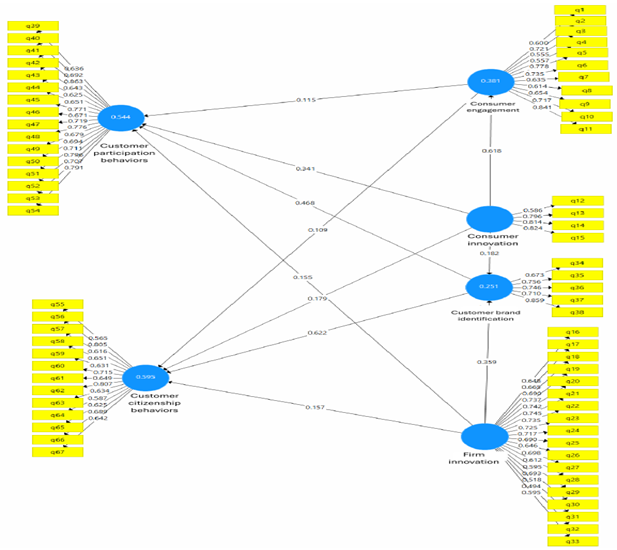
The parameter estimates illustrated in the structural equation modeling diagrams are systematically classified into two fundamental taxonomies. The primary classification encompasses the associations between latent constructs (represented by elliptical nodes) and their corresponding observed indicators (rectangular nodes), formally designated as factor loadings or measurement model parameters. These factor loadings serve as quantitative indices of the extent to which each observed variable contributes to the operationalization of its respective latent construct. Specifically, indicators with higher factor loadings demonstrate greater explanatory power in measuring the underlying theoretical construct, whereas those with lower loadings contribute less substantially to construct measurement and interpretation.
The secondary classification comprises the structural relationships between latent constructs themselves, denoted as path coefficients or structural model parameters, which constitute the empirical foundation for hypothesis evaluation. These path coefficients quantify the magnitude and direction of hypothesized relationships within the theoretical framework. The statistical significance of all parameter estimates is rigorously assessed through t-statistic analysis, employing conventional significance thresholds to determine the empirical support for the proposed theoretical relationships.
Figure 1, which depicts path coefficients and factor loadings, provides a comprehensive visualization of the relative influence of the model's constituent variables. The acceptability and interpretive validity of any given path coefficient are contingent upon the attainment of statistical significance for the corresponding test statistic associated with the hypothesized relationship. In this analytical framework, the absolute magnitude of path coefficients serves as a quantitative indicator of effect size, with coefficients of greater absolute value indicating stronger, more substantive relationships between constructs. Furthermore, the algebraic sign of each path coefficient provides critical information about the direction of the observed association: positive coefficients indicate direct or positive relationships, and negative coefficients denote inverse or negative relationships between the respective latent variables.
Path Coefficients and Factor Loadings Values
As presented in Figure 2, the numerical parameters displayed along the directional arrows connecting the circular nodes (representing theoretical constructs) constitute the calculated t-statistics for the respective structural relationships within the empirical model. These t-statistics serve as inferential test statistics employed to evaluate the statistical significance of the hypothesized associations between latent variables, utilizing a Type I error probability threshold of α = .05. In accordance with established statistical conventions for significance testing, structural relationships are deemed statistically significant when the absolute magnitude of the corresponding t-statistic exceeds the critical value of 1.96. This threshold serves as the standard criterion for rejecting the null hypothesis of no relationship at the 95% confidence level, thereby providing empirical support for the theoretical propositions embedded in the research framework. Consequently, path coefficients associated with t-statistics surpassing this critical threshold are interpreted as statistically reliable indicators of meaningful relationships between the examined constructs.
t-Statistic Values
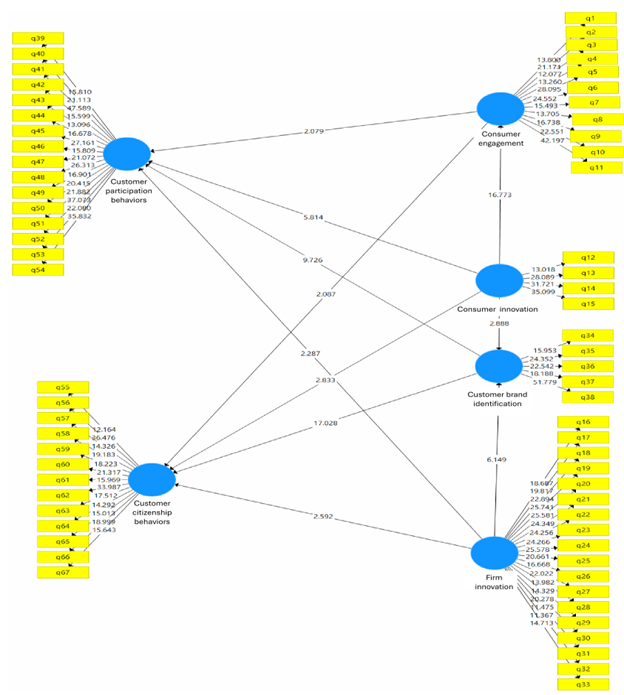
In the examination of hypotheses, as observed in the previous figures, the path coefficients and t-statistics for each hypothesis were analyzed, and the results are presented in Table 3.
Path Coefficients and t-Statistics of Research Hypotheses
|
Number |
Hypothesis |
Path Coefficient |
t-Statistic |
Result |
|
1 |
Consumer innovation influences customer participatory behaviors. |
0.34 |
5.81 |
Supported |
|
2 |
Consumer innovation influences customer citizenship behaviors. |
0.17 |
2.83 |
Supported |
|
3 |
Corporate innovation influences customer participatory behaviors. |
0.15 |
2.28 |
Supported |
|
4 |
Corporate innovation influences customer citizenship behaviors. |
0.15 |
2.59 |
Supported |
|
5 |
Customer identification influences customer participatory behaviors. |
0.46 |
9.72 |
Supported |
|
6 |
Customer identification influences customer citizenship behaviors. |
0.62 |
17.02 |
Supported |
|
7 |
Customer engagement influences customer participatory behaviors. |
0.11 |
2.07 |
Supported |
|
8 |
Customer engagement influences customer citizenship behaviors. |
0.10 |
2.08 |
Supported |
|
9 |
Consumer innovation influences customer engagement. |
0.61 |
16.77 |
Supported |
|
10 |
Consumer innovation influences customer identification. |
0.18 |
2.88 |
Supported |
|
11 |
Corporate innovation influences customer identification. |
0.35 |
6.14 |
Supported |
Discussion
The findings of this study indicate that consumer innovation, corporate innovation, customer–brand identification, and customer engagement each have a significant and positive effect on customers’ participation and citizenship behaviors in hotels located in Isfahan, Shiraz, and Mashhad. These results suggest that customer behavior in the hospitality industry is not merely driven by satisfaction or service quality; rather, it is deeply influenced by the level of innovation and the extent of the psychological and emotional connection customers feel toward the brand.
The results revealed that consumer innovation has a positive and significant effect on customer participation behavior (β = .341, t = 5.81) and customer citizenship behavior (β = .17, t = 2.83). This implies that customers who are more open to new experiences, technologies, and innovative ideas are more likely to actively participate in service processes and co-create value. These findings are consistent with those of Yen (2023), Bakhshi and Shahreki (2023), and Yen et al. (2020), who demonstrated that consumer innovation positively affects customer participation and value co-creation behaviors. In the hotel context, innovative customers tend to engage more actively in providing feedback, recommending services to others, and supporting improvements in service delivery.
Corporate innovation was also found to have a positive and significant impact on both customer participation (β = .15, t = 2.28) and citizenship behaviors (β = .15, t = 2.59). This finding highlights that organizational innovation—such as implementing new technologies, introducing new service designs, and responding to emerging customer needs—encourages customers to participate more actively in service interactions and display voluntary citizenship behaviors, such as advocacy and brand support. These findings align with those of Yen (2023) and Yen et al. (2020), emphasizing that customers’ perception of an organization as innovative strengthens their motivation to engage and contribute to service improvement.
Customer–brand identification showed the strongest influence among all relationships, significantly affecting both participation (β = .46, t = 9.72) and citizenship behaviors (β = .62, t = 17.02). This demonstrates that the more customers identify themselves with the brand and perceive it as part of their self-concept, the more likely they are to engage in behaviors that support and promote the brand. This finding is consistent with Yen (2023) and Vilkaitis et al. (2022), who confirmed that brand identification is a key psychological mechanism driving customers’ voluntary and participative behaviors. In the hospitality sector, such identification may lead to behaviors such as positive word of mouth, defending the brand against criticism, and participating in loyalty programs.
The results also indicated that customer engagement positively affects both participation (β = .11, t = 2.07) and citizenship behaviors (β = .15, t = 2.59). This means that when customers feel emotionally or cognitively involved in the service process, their sense of belonging and willingness to cooperate increase. The findings are in line with Bakhshi and Shahreki (2023), who emphasized that customer engagement enhances collaboration and relationship-building between customers and organizations.
Further analysis showed that consumer innovation positively affects customer engagement (β = .61, t = 16.77) and brand identification (β = .18, t = 2.88). Similarly, corporate innovation has a positive and significant impact on brand identification (β = .35, t = 6.14). These results suggest that both individual and organizational innovation strengthen customers’ emotional and cognitive attachment to the brand, which, in turn, promotes participative and citizenship behaviors. These findings are consistent with those of Yin (2023) and Vilkaitis et al. (2022), who demonstrated that brand identification serves as a mediating mechanism between innovation and customer behavior.
Limitations and Future Research Directions
Several methodological and theoretical limitations warrant acknowledgment. The study employed a cross-sectional research design, which may have constrained causal inference. Future investigations should use longitudinal designs to enhance the validity of causal inference. Additionally, the research scope should be extended to other tourism sectors, including the airline industry and broader service contexts.
The study did not incorporate control variables, potentially allowing confounding variables to influence the proposed relationships within the research model. Related studies suggest that customer innovation perception, consumer behavioral patterns, and customer typologies may affect value co-creation behaviors. Future studies should control these variables within multi-mediator models to accurately capture mediating effects in innovation-value co-creation relationships.
The present investigation focused exclusively on positive customer interactions through participatory and citizenship behaviors. Future research should examine relationships between innovation and dysfunctional or destructive customer behaviors. Both customers and employees play vital roles in service value creation, suggesting the need for investigating relationships between innovation and employee value creation behaviors.
While this study examined the effects of consumer and organizational innovation on customer behaviors through brand identification, situational factors such as generational differences and customer engagement levels were not considered. Future investigations should examine whether relationships between these variables are influenced by demographic and contextual variables.
Finally, although this study focused on how innovation indirectly affects customer value co-creation behaviors through customer engagement, moderating factors such as hospitality duration were not considered. Future researchers should investigate whether innovation, customer engagement, and value co-creation behaviors are influenced by moderating variables to provide more comprehensive theoretical understanding.
References
Afshoun, A., Etebari, M., & Ahmadzadeh, S. (2023). The anthropomorphic role of chatbots in co-creating value from the perspective of tourists' hedonic and utilitarian motivations (Case study: Tourism industry). Journal of Human Information Interaction, 10(2), 93–117.
Alnawas, I., & Altarifi, S. (2016). Exploring the role of brand identification and brand love in generating higher levels of brand loyalty. Journal of Vacation Marketing, 22(2), 111–128. https://doi.org/10.1177/1356766715604663
Bahrami, R., Taherpour Kalantari, H., Rastinpour, F., & Razavi Khabir, H. (2023). Analyzing the role of perceived value in the relationship between citizenship behavior and customer satisfaction. Essays in Management, 2(1). https://doi.org/10.22034/jsm.2023.407232.1015
Bakhshi, F., & Shahreki, A. (2023). Examining the effect of innovation on customer participation and citizenship behaviors. Journal of Development and Transformation Management, 15(53).
Demary, V. (2017). Stepping up the game—The role of innovation in the sharing economy. Innovation in the Sharing Economy (No. 11/2017). IW-Report. https://doi.org/10.13140/RG.2.2.28679.19365
Fakharian, M., Hosseinzadeh, A., & Bastam, H. (2024). Explaining the role of service innovation in customer value co-creation behaviors with the mediation of customer engagement in the hotel industry (Case study: Three, four and five-star hotels in Mashhad). Commercial Management, 16(1). https://doi.org/10.22059/jibm.2023.357834.4561
Golzarfar, H., Shir Solimian, F., & Noorani Azad, S. (2023). The relationship between service innovation and its quality on patient satisfaction and loyalty during the COVID pandemic. Journal of Shahid Sadoughi University of Medical Sciences. https://doi.org/10.18502/ssu.v31i12.14977
Hollebeek, L. D., Srivastava, R. K., & Chen, T. (2019). S-D logic–informed customer engagement: Integrative framework, revised fundamental propositions, and application to CRM. Journal of the Academy of Marketing Science, 47(1), 161–185. https://doi.org/10.1007/s11747-016-0494-5
Im, S., & Qu, W. G. (2017). Drivers and outcomes of innovation in hospitality and tourism firms: A meta‑analytic approach. Tourism Management, 61, 258–273. https://doi.org/10.1016/j.tourman.2017.02.003
Junaid, M., Hussain, K., Asghar, M. M., Javed, M., Hou, F., & Liutiantian. (2020). An investigation of the diners’ brand love in the value co-creation process. Journal of Hospitality and Tourism Management, 45, 172–181. https://doi.org/10.1016/j.jhtm.2020.08.008
Kallmuenzer, A., Peters, M., & Buhalis, D. (2020). The role of family firm image perception in host-guest value co-creation of hospitality firms. Current Issues in Tourism, 23(19), 2410–2427. https://doi.org/10.1080/13683500.2019.1611746
Keiningham, T. L., He, Z., Hillebrand, B., Jang, J., Suess, C., & Wu, L. (2019). Creating innovation that drives authenticity. Journal of Service Management, 30(3), 369–391. https://doi.org/10.1108/JOSM-12-2018-0383
Kim, E., Tang, L., & Bosselman, R. (2019). Customer perceptions of innovativeness: An accelerator for value co-creation. Journal of Hospitality & Tourism Research, 43(6), 807–838. https://doi.org/10.1177/109634801983627
Lam, S. K., Ahearne, M., Mullins, R., Hayati, B., & Schillewaert, N. (2013). Exploring the dynamics of antecedents to consumer-brand identification with a new brand. Journal of the Academy of Marketing Science, 41(2), 234–252.
Martínez, P., & Rodríguez Del Bosque, I. (2013). CSR and customer loyalty: The roles of trust, customer identification with the company and satisfaction. International Journal of Hospitality Management, 35, 89–99. https://doi.org/10.1016/j.ijhm.2013.05.009
Nyamekye, M. B., Adam, D. R., Boateng, H., & Kosiba, J. P. (2023). Place attachment and brand loyalty: The moderating role of customer experience in the restaurant setting. International Hospitality Review, 37(1), 48–70. https://doi.org/10.1108/IHR-02-2021-0013
Nysveen, H., Oklevik, O., & Pedersen, P. E. (2018). Brand satisfaction: Exploring the role of innovativeness, green image and experience in the hotel sector. International Journal of Contemporary Hospitality Management, 30(9), 2908–2924. https://doi.org/10.1108/IJCHM-05-2017-0280
Prahalad, C. K., & Ramaswamy, V. (2004). Co-creating unique value with customers. Strategy & Leadership, 32(3), 4–9.
Rather, R. A. (2019). Consequences of consumer engagement in service marketing: An empirical exploration. Journal of Global Marketing, 32(2), 116–135. https://doi.org/10.1080/08911762.2018.1454995
Revilla-Camacho, M. Á., Vega-Vázquez, M., & Cossío-Silva, F. J. (2015). Customer participation and citizenship behavior effects on turnover intention. Journal of Business Research, 68(7), 1607–1611. https://doi.org/10.1016/j.jbusres.2015.02.004
Rogers, E. M. (1995). Diffusion of innovations (4th ed.). Free Press.
Roy, S. K., Balaji, M. S., Soutar, G., & Jiang, Y. (2020). The antecedents and consequences of value co-creation behaviors in a hotel setting: A two-country study. Cornell Hospitality Quarterly, 61(3), 353–368. https://doi.org/10.1177/1938965519890572
Shamim, A., Ghazali, Z., & Albinsson, P. A. (2016). An integrated model of corporate brand experience and customer value co-creation behaviour. International Journal of Retail & Distribution Management, 44(2), 139–158. https://doi.org/10.1108/IJRDM-06-2015-0079
So, K. K. F., King, C., Sparks, B. A., & Wang, Y. (2013). The influence of customer brand identification on hotel brand evaluation and loyalty development. International Journal of Hospitality Management, 34, 31–41. https://doi.org/10.1016/j.ijhm.2013.02.002
So, K. K. F., Wu, L., Xiong, L., & King, C. (2018). Brand management in the era of social media: Social visibility of consumption and customer brand identification. Journal of Travel Research, 57(6), 727–742. https://doi.org/10.1177/0047287517718354
Tajeddini, K., & Trueman, M. (2014). Perceptions of innovativeness among Iranian hotel managers. Journal of Hospitality and Tourism Technology, 5(1), 62–77. https://doi.org/10.1108/JHTT-12-2012-0036
Tajfel, H., & Turner, J. C. (2004). The social identity theory of intergroup behavior. In J. T. Jost & J. Sidanius (Eds.), Political psychology (pp. 276–293). Psychology Press. https://doi.org/10.4324/9780203505984-16
Uslu, A., & Tosun, P. (2024). Tourist personality, value co‐creation, and emotional well‐being. International Journal of Consumer Studies, 48(1), e12995. https://doi.org/10.1111/ijcs.12995
Vilkaitis, K., Jakutis, L., & Correia, R. (2022). Gaming times four: How does customer participation shape consumer brand identification during the new product creation process? A conceptual model proposal. Procedia Computer Science, 204, 370–377. https://doi.org/10.1016/j.procs.2022.08.045
Yen, C.-H. (2023). Customer value cocreation behaviors in hospitality: Antecedents and mediators. International Journal of Hospitality Management, 110, 103456. https://doi.org/10.1016/j.ijhm.2023.103456
Yen, C.-H., Teng, H.-Y., & Tzeng, J.-C. (2020). Innovativeness and customer value co-creation behaviors: Mediating role of customer engagement. International Journal of Hospitality Management, 88, 102514. https://doi.org/10.1016/j.ijhm.2020.102514
Yi, Y., & Gong, T. (2013). Customer value co-creation behavior: Scale development and validation. Journal of Business Research, 66(9), 1279–1284. https://doi.org/10.1016/j.jbusres.2012.02.026
Yin, H. (2023). Innovation orientation, brand identification, and customer participation behavior in service contexts. Journal of Business Research, 156, 113506. https://doi.org/10.1016/j.jbusres.2022.113506
Zhang, S.-N., Li, Y.-Q., Liu, C.-H., & Ruan, W.-Q. (2021). Reconstruction of the relationship between traditional and emerging restaurant brand and customer WOM. International Journal of Hospitality Management, 94, 102879. https://doi.org/10.1016/j.ijhm.2021.102879

Page 1 of
Download Count : 27
Visit Count : 64
Keywords
Consumer Engagement; Consumer Innovation; Customer Brand Identification; Firm Innovation; Customer Participation Behaviors; Customer Citizenship Behaviors

Author(s) Information


How to cite this article
Remezanirad, F., & Zarepoor Nasirabadi, E. (2025). The effect of consumer innovation, service innovation and customer brand identification on customer participation behaviors and customer citizenship behaviors. Marketing and Branding Research, 11(1), 74-89. https://doi.org/10.32038/mbr.2025.12.01.04
Acknowledgments
Not applicable.
Funding
Not applicable.
Conflict of Interests
No, there are no conflicting interests.
Open Access
This article is licensed under a Creative Commons Attribution 4.0 International License, which permits use, sharing, adaptation, distribution and reproduction in any medium or format, as long as you give appropriate credit to the original author(s) and the source, provide a link to the Creative Commons license, and indicate if changes were made. You may view a copy of Creative Commons Attribution 4.0 International License here: http://creativecommons.org/licenses/by/4.0/