







Original Research
Knocking on the Doors of Perception: Neuroacoustics in Marketing and Tourism. A Comparative Systematic Literature Review and Bibliometric Analyses


- Abstract
- Full text
- Metrics
This research is the first comprehensive analysis to thoroughly examine the emerging discipline of neuroacoustics in marketing and tourism marketing. Neuroacoustics combines neuroscience and acoustics to fully understand the effect of these signals on humans' behavior and decision-making processes. Employing two systematic literature reviews and bibliometric analyses, this study provides a comparative examination of the neuroacoustics discipline within the marketing and tourism marketing domains. By bridging the existing gaps, such as the recognition of neuroacoustics as a discipline, tracing its academic evolution, and identifying emerging trends, this research underscores the interdisciplinary nature of neuroacoustics and its relevance in shaping managerial capabilities and strategic decision-making processes.
Nuria Recuero Virto*, Manuel Recuero López
Marketing Department, Faculty of Commerce and Tourism, Universidad Complutense de Madrid, Madrid, Spain
ABSTRACT
This research is the first comprehensive analysis to thoroughly examine the emerging discipline of neuroacoustics in marketing and tourism marketing. Neuroacoustics combines neuroscience and acoustics to fully understand the effect of these signals on humans' behavior and decision-making processes. Employing two systematic literature reviews and bibliometric analyses, this study provides a comparative examination of the neuroacoustics discipline within the marketing and tourism marketing domains. By bridging the existing gaps, such as the recognition of neuroacoustics as a discipline, tracing its academic evolution, and identifying emerging trends, this research underscores the interdisciplinary nature of neuroacoustics and its relevance in shaping managerial capabilities and strategic decision-making processes.
KEYWORDS: Sound, Sonic Branding, Acoustic Signals, Music, Sensory Marketing
The impact of sound on human physiology has been acknowledged across history and applied innovatively in diverse contexts. This influence is evident in wartime situations, such as during the Gulf War, where high-volume acoustic signals were used to extract confessions, or in Kinmen during the conclusion of the Chinese Civil War, where traditional warfare methods gave way to strategic placement of speakers emitting speeches and music (Lekner, 2022). Additionally, music therapy in field hospitals and veteran rehabilitation emerged during these conflicts (Gilliland, 1945). However, armies also discovered less therapeutic aspects of music over time, such as its use in torture practices, exemplified when the US Army utilized songs like Metallica’s “Enter Sandman” during the interrogation of Iraqi detainees, repeatedly played at high volume (Cusick, 2020). Besides these applications, contemporary research continues to reveal the multidimensional influence of acoustic signals, with studies indicating its positive effects on cows, suggesting that playing music to cows can lead to an increase in milk production (Kochewad et al., 2022).
In the fields of tourism and marketing, the term “acoustics” has been scarcely used (Barnes, 2024; Lowe & Haws, 2017), in contrast to its extensive examination in engineering, encompassing diverse topics ranging from architectural soundproofing to environmental noise control (Arjunan et al., 2024; Barrigón Morillas et al., 2002). The integration of neuroscience and acoustics has mainly been observed in medical research, particularly in studies exploring the therapeutic effects of acoustic signals’ stimulation for conditions such as tinnitus, Parkinson’s disease, and Alzheimer’s disease (Bastos et al., 2021; Gálvez et al., 2018; Kroener-Herwig et al., 2000).
Based on other interdisciplinary neuroscience research disciplines definitions (Bhardwaj et al., 2023; Juárez-Varón et al., 2024; Kaur, 2024), neuroacoustics can be described as the study of how the brain interprets and processes acoustic signals. This entails understanding the transmission of these acoustic signals in a physical space and their brain interpretation.
Despite the considerable body of research in sensory marketing that has examined the significance of acoustics signals’ stimuli (Biswas et al., 2019; Fan et al., 2023; Spence, 2012), which include concepts like sonic branding, music, sound, and phonetic symbolism, a universally accepted terminology for this area of research is lacking, posing the question of whether there is a need to establish neuroacoustics as an emerging discipline in business and tourism domains.
Against this backdrop, this research aims to undertake a comparative examination through conducting two systematic literature reviews and two bibliometric analyses to examine the body of research concerning neuroscience and acoustics, and to address the deficiencies hindering the discipline, such as (1) the recognition of neuroacoustics as a discipline; (2) the identification of the interest in neuroacoustics within marketing and tourism marketing, (3) the specific themes and areas of focus within neuroacoustics related to marketing and tourism marketing; and (4) the publication patterns and distribution within the domain of neuroacoustics. Accordingly, this study seeks to explore the following research questions (RQs):
(RQ1) Is there a recognized discipline within the field of neuroacoustics?
(RQ2) Is there a growing interest in neuroacoustics within marketing and tourism marketing?
(RQ3) What topics does neuroacoustics encompass within marketing and tourism marketing?
(RQ4) Are there identifiable publication trends?
This research offers academic and managerial contributions by establishing robust foundations for neuroacoustics. It proposes a comprehensive and comparative analysis of research conducted concerning neuroscience and acoustics in marketing and tourism marketing.
Method
To address the research gaps and questions, two systematic literature reviews (SLRs) were conducted, followed by two bibliometric analyses, regarding neuroacoustics in the fields of marketing and tourism marketing. SLR and bibliometric analysis stand as cornerstones of literature review methods in scientific research (Cano-Marin et al., 2023).
Following Chaudhuri et al.’s (2023) recommendations SLR was selected within different objectives: (1) to ensure quality in the literature review and the findings of the analyses; (2) to review a wide range of articles; (3) to minimize potential biases and errors; (4) to ensure validity and transparency by facilitating the replicability of the analyses; (5) to synthesize current literature and organize search data within the research domains; and (6) to provide theoretical and managerial. Moreover, SLR is necessary when the topic under research is delimited, facilitating comprehension of the current state of the topic and ensuring the application of the study within its context (Deepa et al., 2024).
In this study, the SLR process was developed through five sequential steps, adapted from the PRISMA methodology, which comprises four main stages: identification, screening, eligibility, and inclusion (Moreno-Lobato et al., 2023).
Step 1: Question formulation
The five-stage process, which begins with the first step of question formulation, inspired by Beloskar et al.’s (2024) study.
Step 2: Identification
The second step, identification, is the phase where specific databases are selected and the Boolean operators are defined to identify relevant articles (Deepa et al., 2024; Moreno-Lobato et al., 2023). The bibliometric analyses were conducted using the Web of Science (WoS) and Scopus databases.
The decision criteria used for both bibliometric analyses developed was based on prior studies (Beloskar et al., 2024; Liu & Avello, 2021; Kaur, 2024; Novitzky et al., 2023). Table 1 illustrates the Boolean criteria strategy utilized for each of the two bibliometric analyses conducted, i.e., neuroacoustics within the domains of marketing and tourism marketing. These searches were conducted on the 26th of February 2024. The primary keywords employed were silence, noise, music, sound, and jingle. Additionally, for the bibliometric study in marketing, the keywords “consumer, user, marketing, brand, or advertisement” were included. For the analysis in the tourism marketing domain, the keyword “tourism” was also incorporated.
For both bibliometric studies, the inclusion criteria were defined based on the document type, which was limited to articles, and the language, which was English. The inclusion criteria regarding WoS categories and Scopus subject areas are shown in Table 1 for both bibliometric analyses. The difference between the two analyses regarding this inclusion criterion lies in the bibliometric study focusing on neuroacoustics in tourism marketing, which included an additional WoS category, namely hospitality, leisure, sport, and tourism (Moreno-Lobato et al., 2023).
Table 2 presents the number of records obtained after conducting searches using the five primary keywords (i.e., silence, noise, music, sound, and jingle) in both the marketing and tourism marketing domains. This process resulted in the creation of ten databases, each dedicated to one of the five search criteria.
Decision Criteria
|
|
neuroacoustics in marketing |
|
neuroacoustics in tourism marketing |
|||||||
|
Criteria |
Web of Science Core Collection |
Scopus Elsevier |
|
Web of Science Core Collection |
Scopus Elsevier |
|||||
|
Meta Search |
Topic: |
Title, abstract, keywords: |
|
Topic: |
Title, abstract, keywords: |
|||||
|
|
The following words were used in the searches: |
|
The following words were used in the searches: |
|||||||
|
|
(1) silence AND consumer* OR user* OR marketing* OR brand* OR advertisement* |
|
(1) silence AND tourism |
|||||||
|
|
(2) noise AND consumer* OR user* OR marketing* OR brand* OR advertisement* |
|
(2) noise AND tourism |
|||||||
|
|
(3) music AND consumer* OR user* OR marketing* OR brand* OR advertisement* |
|
(3) music AND tourism |
|||||||
|
|
(4) sound AND consumer* OR user* OR marketing* OR brand* OR advertisement* |
|
(4) sound AND tourism |
|||||||
|
|
(5) jingle AND consumer* OR user* OR marketing* OR brand* OR advertisement* |
|
(5) jingle AND tourism |
|||||||
|
Inclusion Criteria |
Document Type: Article |
Document Type: Article |
|
Document Type: Article |
Document Type: Article |
|||||
|
|
Language: English |
Language: English |
|
Language: English |
Language: English |
|||||
|
|
Web of Science Categories: Behavioural Science; Business; Communication; Management; Social sciences, interdisciplinary |
Subject area: Business, Management and Accounting; Social Sciences; Economics, Econometrics and Finance |
|
Web of Science Categories: Behavioural Science; Business; Communication; Hospitality, Leisure, Sport & Tourism; Management; Social sciences, interdisciplinary |
Subject area: Business, Management and Accounting; Social Sciences; Economics, Econometrics and Finance |
|||||
|
Number of Articles Within Databases Scope (Without Filtering): Distribution Per Source |
||||||||||
|
Database in neuroacoustics marketing |
sound |
silence |
noise |
music |
jingle |
|||||
|
Web of Science Core Collection |
1094 |
208 |
606 |
1670 |
26 |
|||||
|
Scopus Elsevier |
3143 |
300 |
1967 |
3105 |
31 |
|||||
|
Total |
4237 |
508 |
2573 |
4775 |
57 |
|||||
|
Web of Science Core Collection |
192 |
65 |
58 |
334 |
1 |
|||||
|
Scopus Elsevier |
360 |
63 |
140 |
403 |
2 |
|||||
|
Total |
552 |
128 |
198 |
737 |
3 |
|||||
Step 3: Screening
The third step involved removing duplicate articles present in each of the databases, which were independently cleaned. This involved employing Biblioshiny for processing and deleting duplicate DOI and SR values, no author keywords, and entries lacking DOI or SR values (Cano-Marin et al., 2023; Kaur, 2024). Tables 3 and 4 show the results after these two procedures.
|
Articles Within Databases Scope: After Processing in Biblioshiny |
|||||
|
Database in neuroacoustics marketing |
sound |
silence |
noise |
music |
jingle |
|
Web of Science Core Collection |
1093 |
208 |
606 |
1670 |
26 |
|
Scopus Elsevier |
3112 |
298 |
1948 |
3074 |
31 |
|
Total |
4205 |
506 |
2554 |
4744 |
57 |
|
Web of Science Core Collection |
192 |
65 |
58 |
334 |
1 |
|
Scopus Elsevier |
360 |
63 |
140 |
403 |
2 |
|
Table 4 |
||||
|
Articles Within Databases Scope: After Deleteing Missing DOI Values, Duplicates DOI Values, Duplicates or no SR Values and no Author Keywords |
||||
|
Merged database: Web of Science Core Collection and Scopus Elsevier |
sound |
silence |
noise |
music |
|
Database in neuroacoustics marketing |
2449 |
298 |
1957 |
2761 |
|
Database in neuroacoustics tourism marketing |
331 |
85 |
131 |
469 |
Step 4: Eligibility
During this phase, each database underwent independent cleaning, excluding records lacking relevance after abstract, title, and keyword review (Cano-Marin et al., 2023).
Step 5: Included
A new revision of duplicate DOI and SR values was performed in the merged databases. Following this process, a total sample of 286 records was obtained for neuroacoustics in marketing, while 39 records were collected for neuroacoustics in tourism marketing, as explained in Table 5. The sample sizes used in this study were considered appropriate, as they were similar to those used in recent related studies (Chaudhuri et al., 2023; Moreno-Lobato et al., 2023).
|
Articles Within Databases Scope: After Excluding Records Lacking Relevance After Abstract, Title, and Keyword Review and After Deleting Duplicates in the Merged Database |
||||||
|
Databases: Web of Science Core Collection and Scopus Elsevier |
sound |
silence |
noise |
music |
jingle |
Total |
|
|
|
|
|
|
|
|
|
Database in neuroacoustics marketing |
159 |
2 |
4 |
119 |
2 |
286 |
|
|
||||||
|
Database in neuroacoustics in tourism marketing |
7 |
2 |
3 |
27 |
0 |
39 |
The next and final step involved conducting bibliometric analyses within the software tools. These included Biblioshiny (a graphical interface of Bibliometrix R package), which is widely used in current bibliometric studies (Beloskar et al., 2024; Makaya et al., 2023; Oludapo et al., 2024), as well as Tableau and Microsoft Excel (Alhashmi et al., 2024; Del Gesso et al., 2024), for analysis and visualization purposes.
Table 6 offers an overview of significant bibliometric metrics. For the marketing domain, the articles included in the study sample were published from 1993 to 2024, presenting an annual growth rate of 5.33%. In comparison, the analyzed articles for the tourism marketing domain were published between 2001 and 2024. The average number of citations per document in the marketing field is 16.99, while in the tourism marketing area, it is 12.18.
|
|
|
|
|
|
Study Sample Technical Characteristics |
|
|
|
|
Description |
Results: neuroacoustics marketing |
|
Results: neuroacoustics tourism marketing |
|
Timespan |
1993:2024 |
|
2001:2024 |
|
Documents |
286 |
|
39 |
|
Annual Growth Rate % |
5.33 |
|
0 |
|
Document Average Age |
7.06 |
|
5.64 |
|
Average citations per doc |
16.99 |
|
12.18 |
|
References |
8637 |
|
1516 |
|
Authors |
663 |
|
97 |
|
Authors of single-authored docs |
45 |
|
6 |
|
Co-Authors per Doc |
2.67 |
|
3.13 |
|
International co-authorships % |
7.692 |
|
17.95 |
Descriptive Review of the Literature
Articles Per Year and Country Location
Since the first neuroacoustics article was published in 1993, research activity in the marketing domain remained low until 2009, and was almost non-existent in the tourism marketing field (Table 7). In the field of marketing, 92.66% of the papers were published after 2009, while 94.87% were in the field of tourism marketing.
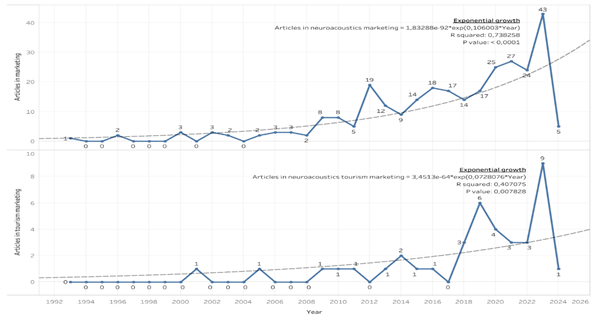
Price’s Index indicates the percentage of references that are less than five years old (Gong, 2023; Price, 1970). Until February 2024, the findings offer a Price’s Index of 49.3% in the marketing field and 66.7% in the tourism marketing domain. As the Price Index’s values are reasonably high (Liu & Avello, 2021), neuroacoustics is considered an innovative and robust research field. It has been stated that normally the development of a scientific discipline undergoes exponential growth, doubling in size every 10 to 15 years (Price, 1963). The evolution of the scientific field typically encompasses four stages: the precursor phase, the exponential growth period, the consolidation of knowledge, and the decline in production stage.
Figure 1 reveals that research in both domains is still in its precursor phase (Liu & Avello, 2021). However, it remains to be seen the evolution of neuroacoustics, considering the substantial growth observed in 2023 with 43 articles published in marketing and 9 in tourism marketing.
|
Frequency of Publication of Articles Related to Neuroacoustics in Marketing and in Tourism Marketing Per Year |
||||||
|
Year |
Frequency in marketing |
Percentage in marketing |
Cumulative relative frequency in marketing |
Frequency in tourism marketing |
Percentage in tourism marketing |
Cumulative relative frequency in tourism marketing |
|
1993 |
1 |
0.3% |
0.35% |
0 |
0% |
0 |
|
1994 |
0 |
0% |
0.35% |
0 |
0% |
0 |
|
1995 |
0 |
0% |
0.35% |
0 |
0% |
0 |
|
1996 |
2 |
0.7% |
1.05% |
0 |
0% |
0 |
|
1997 |
0 |
0% |
1.05% |
0 |
0% |
0 |
|
1998 |
0 |
0% |
1.05% |
0 |
0% |
0 |
|
1999 |
0 |
0% |
1.05% |
0 |
0% |
0 |
|
2000 |
3 |
1% |
2.10% |
0 |
0% |
0 |
|
2001 |
0 |
0% |
2.10% |
1 |
3% |
2.56% |
|
2002 |
3 |
1% |
3.15% |
0 |
0% |
2.56% |
|
2003 |
2 |
0.7% |
3.85% |
0 |
0% |
2.56% |
|
2004 |
0 |
0% |
3.85% |
0 |
0% |
2.56% |
|
2005 |
2 |
0.7% |
4.55% |
1 |
3% |
5.13% |
|
2006 |
3 |
1% |
5.59% |
0 |
0% |
5.13% |
|
2007 |
3 |
1% |
6.64% |
0 |
0% |
5.13% |
|
2008 |
2 |
0.7% |
7.34% |
0 |
0% |
5.13% |
|
2009 |
8 |
2.8% |
10.14% |
1 |
3% |
7.69% |
|
2010 |
8 |
2.8% |
12.94% |
1 |
3% |
10.26% |
|
2011 |
5 |
1.7% |
14.69% |
1 |
3% |
12.82% |
|
2012 |
19 |
6.6% |
21.33% |
0 |
0% |
12.82% |
|
2013 |
12 |
4.2% |
25.52% |
1 |
3% |
15.38% |
|
2014 |
9 |
3.1% |
28.67% |
2 |
5% |
20.51% |
|
2015 |
14 |
4.9% |
33.57% |
1 |
3% |
23.08% |
|
2016 |
18 |
6.3% |
39.86% |
1 |
3% |
25.64% |
|
2017 |
17 |
5.9% |
45.80% |
0 |
0% |
25.64% |
|
2018 |
14 |
4.9% |
50.70% |
3 |
8% |
33.33% |
|
2019 |
17 |
5.9% |
56.64% |
6 |
15% |
48.72% |
|
2020 |
25 |
8.7% |
65.38% |
4 |
10% |
58.97% |
|
2021 |
27 |
9.4% |
74.83% |
3 |
8% |
66.67% |
|
2022 |
24 |
8.4% |
83% |
3 |
8% |
74.36% |
|
2023 |
43 |
15.0% |
98% |
9 |
23% |
97.44% |
|
2024 |
5 |
1.7% |
100% |
1 |
3% |
100.00% |
Growth of Scientific Production
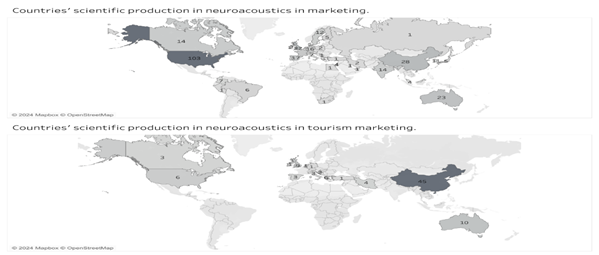
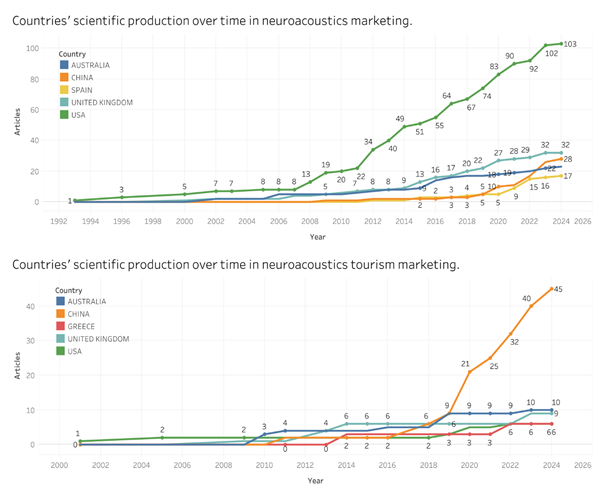
The neuroacoustics discipline is primarily located in the United States, United Kingdom, China, and Australia, as illustrated in Figures 2 and 3. In the marketing field, the leading countries are the United States of America (103), followed by the United Kingdom (32), China (28), Australia (23), and Spain (17). Meanwhile, in the tourism marketing domain, the top countries include China (45), Australia (10), United Kingdom (9), United States (6), and Greece (6). Figure 2 also highlights evidence of neuroacoustics research in emerging economies within both fields, underscoring the need for more studies in developing countries, as suggested in prior research (Albahari et al., 2022).
Figure 2
Countries’ Scientific Production in Neuroacoustics in Marketing and in Tourism Marketing
Countries’ Scientific Production Over Time
Main Topics Analysed and Research Lines
Keywords
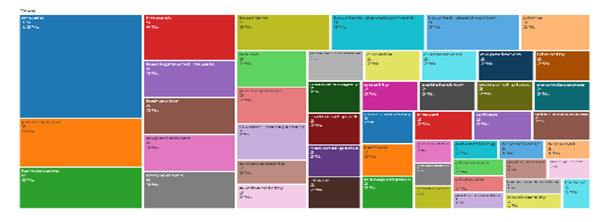
Analysing the frequency of keyword appearances offers insights into the main topics covered (Chaudhuri et al., 2023; Kaur, 2024; Liu & Avello, 2021). As presented in Tables 8 and 9, terms such as “background music,” “perception,” and “impact” appear as the top five most frequently mentioned concepts across both domains. Additionally, in the marketing field, keywords like “behaviour” and “sound” are highly mentioned, whereas in the tourism area, “music” and “landscape” also rank among the top five most mentioned.
As observed in the word clouds presented in Figures 4 and 6, most of these terms are associated with the acoustic signals' influence on consumers’ or visitors’ attitudes, except for “landscape”, which is connected to the concept “soundscape” (refer to Figure 7). The tree maps shown in Figures 5 and 7 visually represent the data from Tables 8 and 9, highlighting additional topics explored in neuroacoustics disciplines that vary between the marketing and tourism marketing domains. For instance, in the marketing field, keywords such as “memory”, “phonetic symbolism”, as well as those related to target segmentation, have emerged. Conversely, in tourism marketing, other relevant keywords include “tourism development”, “tourism management”, “authenticity” and “identity”.
|
Frequency of Occurrence of Neuroacoustics in Marketing Keywords (>9 Times) |
||||
|
|
Keywords |
Frequency |
Percentage |
|
|
|
background music |
44 |
8.91% |
|
|
|
Behavior |
38 |
7.69% |
|
|
|
Impact |
34 |
6.88% |
|
|
|
Sound |
30 |
6.07% |
|
|
|
Perception |
28 |
5.67% |
|
|
|
Music |
26 |
5.26% |
|
|
|
Memory |
21 |
4.25% |
|
|
|
phonetic symbolism |
21 |
4.25% |
|
|
|
Responses |
19 |
3.85% |
|
|
|
Mood |
18 |
3.64% |
|
|
|
Information |
15 |
3.04% |
|
|
|
Female |
14 |
2.83% |
|
|
|
Involvement |
14 |
2.83% |
|
|
|
Male |
14 |
2.83% |
|
|
|
Adult |
13 |
2.63% |
|
|
|
Model |
13 |
2.63% |
|
|
|
Consumers |
12 |
2.43% |
|
|
|
Consumption |
12 |
2.43% |
|
|
|
Perceptions |
12 |
2.43% |
|
|
|
Personality |
12 |
2.43% |
|
|
|
Taste |
12 |
2.43% |
|
|
|
Attitude |
11 |
2.23% |
|
|
|
Human |
11 |
2.23% |
|
|
|
Article |
10 |
2.02% |
|
|
|
Attention |
10 |
2.02% |
|
|
|
in-store music |
10 |
2.02% |
|
|
|
Pitch |
10 |
2.02% |
|
|
|
Tempo |
10 |
2.02% |
|
|
Frequency of Occurrence of Neuroacoustics in Tourism Marketing Keywords (>3times) |
||
|
Keywords |
Frequency |
Percentage |
|
Music |
15 |
24.59% |
|
perception |
7 |
11.48% |
|
landscape |
6 |
9.84% |
|
Impact |
5 |
8.20% |
|
background music |
4 |
6.56% |
|
behaviour |
4 |
6.56% |
|
experiences |
4 |
6.56% |
|
responses |
4 |
6.56% |
|
Tourism |
4 |
6.56% |
|
tourism development |
4 |
6.56% |
Neuroacoustics in Marketing Keywords Co-Occurrence Network in Word Cloud Format
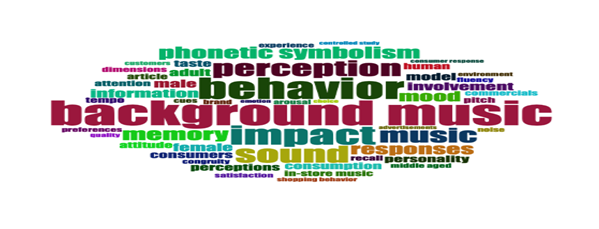
Figure 5
Neuroacoustics in Marketing Keywords Co-Occurrence Network in Tree Map Format
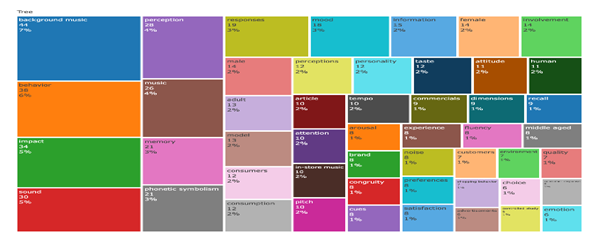
Figure 6
Neuroacoustics in Tourism Marketing Keywords Co-Occurrence Network in Word Cloud Format
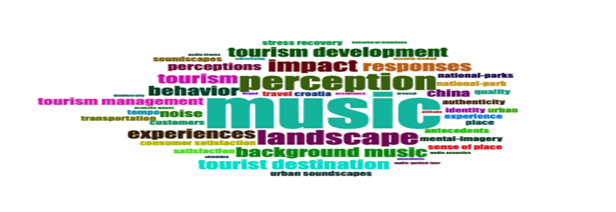
Figure 7
Neuroacoustics in Tourism Marketing Keywords Co-Occurrence Network in Tree Map Form
Co-word analyses
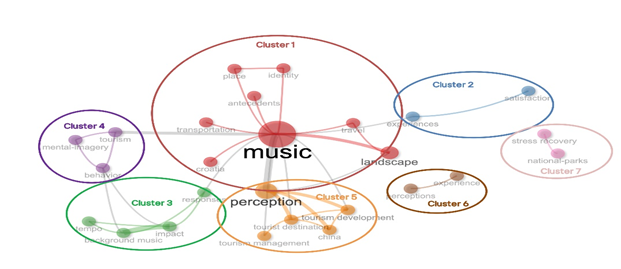
Biblioshiny created the correlation network maps in both fields, as presented in Figures 8 and 9. Figure 8 indicates that the marketing domain is represented by four clusters, whereas Figure 10 outlines that the tourism marketing field is categorized into seven clusters. To understand the correlation network maps between keywords presented in Figures 8 and 9, nodes of the same colour form a cluster, and the closer proximity between nodes within the same cluster indicates a stronger relationship (Haba et al., 2023; Kaur, 2024; Liu & Avello, 2021).
In the marketing domain (Figure 8), Cluster 1, represented by the red network titled “Background music behaviour”, focuses on the relationship between background music and consumer behaviour, including aspects such as memory, in-store music, shopping behaviour, choice, experience, and preferences. Cluster 2, shown by the green network labelled “Sound perceptions”, encompasses themes related to sound and perception. Cluster 3, represented by the blue network and titled “Consumers’ segmentation”, covers topics related to target segmentation, such as gender and age, as well as connections to noise, music, and satisfaction. Cluster 4, the purple network, and named “Responses to symbolic sounds”, comprises themes related to phonetic symbolism, personality, perception, fluency, and quality.
In the tourism marketing field (Figure 9), Cluster 1, red network, entitled “Music influence on tourism”, includes concepts such as music, identity, place, travel, and transportation. Cluster 2, represented by the blue network and named “Satisfactory experiences” is related to the terms satisfaction and experience. Cluster 3, green network and titled “Background music effects on tourism”, encompasses concepts such as tempo, background music, and impact. Cluster 4, purple network, labelled “Mental-tourism-imagery”, mainly relates to mental imagery and behaviour. Cluster 5, orange network, named “Tourism development”, is associated with concepts of tourism management. Cluster 6, brown network, named “Experience perceptions”, focuses on these two terms. Cluster 7, pink network, titled “Nature stress relief”, is related to national parks and stress recovery.
Neuroacoustics In Marketing Correlation Map Between Keywords
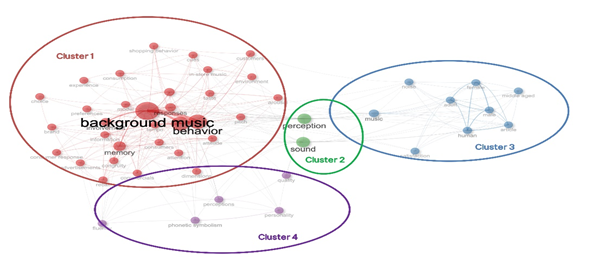
Figure 9
Neuroacoustics In Tourism Marketing Correlation Map Between Keywords
Thematic Maps
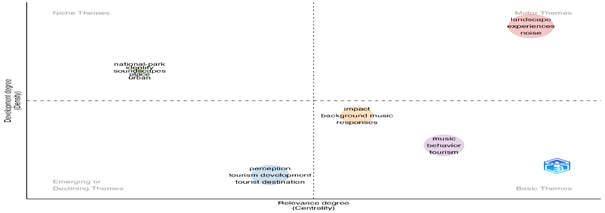
Biblioshiny generates a thematic map for each bibliometric analysis, using authors’ keywords as the units of analysis to reveal critical themes (Oludapo et al., 2024). These thematic maps are interpreted based on their centrality, which reveals their significance, and density, which represents their growth, in relation to various research themes (Kaur, 2024).
Figure 10 presents a neuroacoustics thematic map within the marketing domain, highlighting themes such as “art” and “landscape” as fundamental topics relevant to general research. Themes such as “behavioural research”, “crowdsourcing”, “music preferences”; “audio acoustics”, “audio” and “computer applications”, and “public attitude” and “noise pollution” are showing a declining trend. In contrast, “computer music”, “electronic music” and “generation” represent are emerging themes with limited representation but rapid growth. Finally, “background music”, “behaviour”, “impact”, and “perception”, “sound” and “music” represent the motor themes driving research in the field.
Likewise, Figure 11 shows a neuroacoustics thematic map within the tourism marketing field, underscoring themes as “music”, “behaviour” and “tourism” and “impact”, “background music” and “responses” as key themes. Topics such as “tourism development”, “tourist destination”, and “perception” are displaying a decreasing development. Conversely, “national park”, “identity”, “soundscapes”, “place” and “urban” denote emergent themes with reduced representation but fast development. Lastly, “landscapes,” “experiences,” and “noise” are the key themes that enhance research in the area.
Hence, scholars are encouraged to further develop the motor themes in both domains (i.e., marketing and tourism marketing), given their significance and potential for future research in neuroacoustics.
Thematic Strategic Map For Neuroacoustics In Marketing
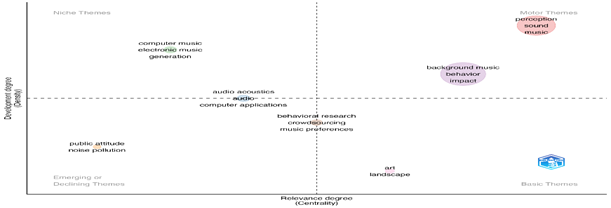
Figure 11
Thematic Strategic Map for Neuroacustics in Tourism Marketing
Scientific scope
Most productive and influential journals
The significance of journals was evaluated based on the number of articles they published and their citation computations (Liu & Avello, 2021). Table 10 details the 25 most influential journals in neuroacoustics within marketing, based on a sample of 286 records. Table 11 provides information on all the journals that have published articles on neuroacoustics in tourism marketing, as it is based on a smaller sample of 39 records.
In relation to neuroacoustics within marketing, the journals that have published the highest number of neuroacoustics articles include the Journal of Business Research (17 articles), Psychology & Marketing (13 articles), Journal of Retailing and Consumer Services (12 articles), and Marketing Letters (12 articles), all with a strong focus on business marketing (refer to Table 11). However, it is noteworthy that the most cited journals differ from those with the highest number of publications in neuroacoustics (Liu & Avello, 2021). For instance, the top four most cited journals are the Journal of Business Research (68.574 citations and 17 neuroacoustics articles), Journal of Retailing and Consumer Services (20.489 citations and 12 neuroacoustics articles), European Journal of Marketing (10.334 citations and seven neuroacoustics articles), and Psychology & Marketing (10.243 citations and 13 neuroacoustics articles).
Table 12 provides insights into journals that publish articles on neuroacoustics in tourism marketing. The journals that have published the highest number of neuroacoustics articles are Current Issues In Tourism (4 articles), Asia Pacific Journal of Tourism Research (3 articles), Annals of Tourism Research (2 articles), International Journal of Tourism Policy (2 articles), Journal of Destination Marketing and Management (2 articles), Tourism Management Perspectives (2 articles), and Tourist Studies (2 articles), all emphasizing a strong orientation towards tourism management. Among the most cited journals are Sustainability (187.953 citations and one neuroacoustics article), Journal of Business Research (68.574 citations and one neuroacoustics article), Annals of Tourism Research (19.874 citations and two neuroacoustics articles), and Journal of Travel Research (13.84 citations and one neuroacoustics article).
|
Top 25 Journals Regarding the Number of Articles Published in Neuroacoustics Marketing |
||||||||
|
Sources |
NA Feb. 2024 |
TC 2022 |
TCA 2022 |
JCR 2022 |
JCR edition |
JCR category |
JIF quartile 2022 |
JIF rank 2022 |
|
Journal of Business Research |
17 |
68.574 |
6 |
11.3 |
SSCI |
BUSINESS - SSCI |
Q1 |
14/154 |
|
Psychology & Marketing |
13 |
10.243 |
5 |
6.7 |
SSCI |
BUSINESS - SSCI; PSYCHOLOGY. APPLIED - SSCI |
Q2; Q1 |
47/154; 11/83 |
|
Journal of Retailing and Consumer Services |
12 |
20.489 |
7 |
10.4 |
SSCI |
BUSINESS - SSCI |
Q1 |
19/154 |
|
Marketing Letters |
12 |
3.544 |
2 |
3.6 |
SSCI |
BUSINESS - SSCI |
Q3 |
105/154 |
|
Journal of Product and Brand Management |
8 |
4.73 |
4 |
5.6 |
SSCI |
BUSINESS - SSCI; MANAGEMENT - SSCI |
Q2; Q2 |
63/154; 84/227 |
|
European Journal of Marketing |
7 |
10.334 |
3 |
4.4 |
SSCI |
BUSINESS - SSCI |
Q3 |
88/154 |
|
Journal of Consumer Psychology |
7 |
8.525 |
3 |
4.8 |
SSCI |
BUSINESS - SSCI; PSYCHOLOGY. APPLIED - SSCI |
Q3; Q1 |
78/154; 20/83 |
|
Indian Journal of Marketing1 |
5 |
* |
* |
* |
* |
* |
* |
* |
|
International Journal of Advertising |
5 |
4.345 |
3 |
6.7 |
SSCI |
COMMUNICATION - SSCI; BUSINESS - SSCI |
Q2; Q1 |
47/154; 6/96 |
|
Journal of Brand Management |
5 |
3.344 |
3 |
4.1 |
SSCI |
BUSINESS - SSCI; MANAGEMENT - SSCI |
Q3; Q3 |
95/154; 127/227 |
|
Journal of Retailing |
5 |
10.611 |
5 |
10 |
SSCI |
BUSINESS - SSCI |
Q1 |
22/154 |
|
Appetite |
4 |
25.778 |
3 |
5.4 |
SSCI |
NUTRITION & DIETETICS - SCIE; BEHAVIORAL SCIENCES - SCIE |
Q2; Q1 |
24/88; 4/52 |
|
Asia Pacific Journal of Marketing and Logistics |
4 |
3.095 |
2 |
3.7 |
SSCI |
BUSINESS - SSCI |
Q3 |
103/154 |
|
International Journal of Industrial Ergonomics |
4 |
5.114 |
2 |
3.1 |
SSCI |
ERGONOMICS - SSCI |
Q3 |
9/16 |
|
International Journal of Research in Marketing |
4 |
6.466 |
3 |
7 |
SSCI |
BUSINESS - SSCI |
Q2 |
44/154 |
|
Journal of Marketing Research |
4 |
31.359 |
4 |
6.1 |
SSCI |
BUSINESS - SSCI |
Q2 |
52/154 |
|
Personal and Ubiquitous Computing |
4 |
2.505 |
* |
1.924 |
SCIE |
TELECOMMUNICATIONS - SCIE; COMPUTER SCIENCE. INFORMATION SYSTEMS - SCIE |
Q2; Q2 |
33/89; 48/146 |
|
Sources |
NA Feb. 2024 |
TC 2022 |
TCA 2022 |
JCR 2022 |
JCR edition |
JCR category |
JIF quartile 2022 |
JIF rank 2022 |
|
Behavioural Sciences |
3 |
3.166 |
1 |
2.6 |
SSCI |
PSYCHOLOGY. MULTIDISCIPLINARY - SSCI |
Q2 |
61/147 |
|
Expert Systems with Applications |
3 |
76.302 |
4 |
8.5 |
SCIE |
OPERATIONS RESEARCH & MANAGEMENT SCIENCE - SCIE; COMPUTER SCIENCE. ARTIFICIAL INTELLIGENCE - SCIE; ENGINEERING. ELECTRICAL & ELECTRONIC - SCIE |
Q1; Q1; Q1 |
6/86; 22/145; 23/275 |
|
International Journal of Gastronomy and Food Science |
3 |
1.646 |
2 |
3.8 |
SCIE |
FOOD SCIENCE & TECHNOLOGY - SCIE |
Q2 |
54/142 |
|
International Journal of Retail & Distribution Management |
3 |
4.413 |
3 |
4.4 |
SSCI |
BUSINESS - SSCI; MANAGEMENT - SSCI |
Q3; Q3 |
88/154; 121/227 |
|
International Review of Retail Distribution and Consumer Research |
3 |
1.180 |
2 |
3.6 |
ESCI |
BUSINESS - ESCI |
Q3 |
172/306 |
|
Journal of Consumer Marketing |
3 |
4.818 |
2 |
2.8 |
ESCI |
BUSINESS - ESCI |
Q3 |
172/306 |
|
Journal of International Consumer Marketing |
3 |
1.467 |
1 |
3.3 |
ESCI |
BUSINESS - ESCI |
Q3 |
168/306 |
|
Journal of Marketing |
3 |
30.960 |
8 |
12.9 |
BUSINESS - SSCI |
Q1 |
8/154 |
|
|
Note. NA number of articles. TC total cites. TCA total cites per article, JCR Journal Citation Reports Impact, JIF Journal Impact Factor, |
||||||||
|
* These journals lack impact in the JCR 2022. |
||||||||
|
1 Indian Journal of Marketing is indexed in the Scimago Journal & Country Rank under the subject area of Business, Management, and Accounting, specifically in the Marketing category, with an h-index of 12 and placed in the Q3 tier.
|
||||||||
Journals that Have Published Articles Regarding Neuroacoustics in Tourism Marketing
|
Sources |
NA Feb. 2024 |
TC 2022 |
TCA 2022 |
JCR 2022 |
JCR edition |
JCR category |
JIF quartile 2022 |
JIF rank 2022 |
|
Current Issues in Tourism |
4 |
11.548 |
4 |
8 |
SSCI |
HOSPITALITY, LEISURE, SPORT & TOURISM - SSCI |
Q1 |
14/58 |
|
Asia Pacific Journal of Tourism Research |
3 |
3.674 |
3.5 |
5 |
SSCI |
HOSPITALITY, LEISURE. SPORT & TOURISM - SSCI |
Q2 |
19/58 |
|
Annals of Tourism Research |
2 |
19.874 |
6 |
13.2 |
SSCI |
HOSPITALITY, LEISURE, SPORT & TOURISM - SSCI; SOCIOLOGY - SSCI |
Q1; Q1 |
1/58; 1/149 |
|
International Journal of Tourism Policy2 |
2 |
* |
* |
* |
* |
* |
* |
* |
|
Journal of Destination Marketing and Management |
2 |
4.848 |
5 |
8.4 |
SSCI |
HOSPITALITY, LEISURE, SPORT & TOURISM - SSCI; MANAGEMENT - SSCI |
Q1; Q1 |
12/58: 36/227 |
|
Tourism Management Perspectives |
2 |
6.336 |
6 |
8.7 |
SSCI |
HOSPITALITY, LEISURE, SPORT & TOURISM - SSCI; MANAGEMENT - SSCI |
Q1; Q1 |
11/58; 33/227 |
|
Tourist Studies |
2 |
890 |
2 |
2.4 |
SSCI |
HOSPITALITY, LEISURE, SPORT & TOURISM - SSCI |
Q3 |
40/58 |
|
Consumer Behavior in Tourism and Hospitality1 |
1 |
* |
* |
* |
* |
* |
* |
* |
|
Cultural Management: Science and Education3 |
1 |
* |
* |
* |
* |
* |
* |
* |
|
European Countryside |
1 |
520 |
1 |
1.6 |
ESCI |
GEOGRAPHY - ESCI |
Q2 |
74/169 |
|
Geojournal |
1 |
5.326 |
1 |
2.7 |
ESCI |
GEOGRAPHY - ESCI |
Q1 |
40/169 |
|
International Journal of Tourism Cities |
1 |
875 |
1 |
2.6 |
ESCI |
HOSPITALITY, LEISURE, SPORT & TOURISM - ESCI |
Q2 |
50/136 |
|
International Journal of Tourism Research |
1 |
4.715 |
3 |
4.6 |
SSCI |
HOSPITALITY, LEISURE. SPORT & TOURISM - SSCI |
Q2 |
22/58 |
|
Journal of Business Research |
1 |
68.574 |
6 |
11.3 |
SSCI |
BUSINESS - SSCI |
Q1 |
14/154 |
|
Journal of Heritage Tourism |
1 |
1.28 |
1 |
2.7 |
ESCI |
HOSPITALITY. LEISURE. SPORT & TOURISM - ESCI |
Q2 |
56/136 |
|
Journal of Hospitality and Leisure Marketing1 |
1 |
* |
* |
* |
* |
* |
* |
* |
|
Sources |
NA Feb. 2024 |
TC 2022 |
TCA 2022 |
JCR 2022 |
JCR edition |
JCR category |
JIF quartile 2022 |
JIF rank 2022 |
|
Journal of Hospitality and Tourism Management |
1 |
5.691 |
6 |
8.3 |
SSCI |
HOSPITALITY, LEISURE. SPORT & TOURISM - SSCI; MANAGEMENT - SSCI |
Q1; Q1 |
13/58; 37/227 |
|
Journal of Nonprofit and Public Sector Marketing |
1 |
657 |
1 |
1.4 |
ESCI |
BUSINESS - ESCI |
Q4 |
241/306 |
|
Journal of Quality Assurance in Hospitality and Tourism |
1 |
1.251 |
2 |
3.3 |
ESCI |
HOSPITALITY, LEISURE. SPORT & TOURISM - ESCI |
Q2 |
57/136 |
|
Journal of Tourism Sustainability and Well-Being1 |
1 |
* |
* |
* |
* |
* |
* |
* |
|
Journal of Travel Research |
1 |
13.84 |
6 |
8.9 |
SSCI |
HOSPITALITY, LEISURE, SPORT & TOURISM - SSCI |
Q1 |
10/58 |
|
Journal of Travel and Tourism Marketing |
1 |
6.552 |
5 |
7.2 |
SSCI |
HOSPITALITY. LEISURE. SPORT & TOURISM - SSCI |
Q2 |
16/58 |
|
Journal of Vacation Marketing |
1 |
2.047 |
3 |
5.1 |
SSCI |
BUSINESS - SSCI; HOSPITALITY, LEISURE, SPORT & TOURISM - SSCI |
Q2; Q2 |
72/154; 18/58 |
|
Service Industries Journal |
1 |
4.695 |
4.5 |
9.4 |
SSCI |
MANAGEMENT - SSCI |
Q1 |
29/227 |
|
Sustainability (Switzerland) |
1 |
187.953 |
2 |
3.9 |
SSCI |
ENVIRONMENTAL STUDIES - SSCI; GREEN & SUSTAINABLE SCIENCE & TECHNOLOGY - SSCI |
Q2; Q2 |
48/128; 5/9 |
|
Tourism in Marine Environments4 |
1 |
* |
* |
* |
* |
* |
* |
* |
|
Tourism Recreation Research |
1 |
2.461 |
2.5 |
4.2 |
ESCI |
HOSPITALITY, LEISURE, SPORT & TOURISM - ESCI |
Q1 |
31/136 |
|
Tourism Review |
1 |
3.275 |
4 |
7.8 |
SSCI |
HOSPITALITY, LEISURE, SPORT & TOURISM - SSCI |
Q2 |
15/58 |
|
Turyzm/Tourism5 |
1 |
* |
* |
* |
* |
* |
* |
* |
|
Note. NA number of articles, TC total cites, TCA total cites per article, JCR Journal Citation Reports Impact, JIF Journal Impact Factor. |
||||||||
|
* These journals lack impact in the JCR 2022. |
||||||||
|
1 Consumer Behavior in Tourism and Hospitality, Journal of Hospitality and Leisure Marketing and Journal of Tourism Sustainability and Well-Being are not indexed in either JCR or Scopus. |
||||||||
|
2 International Journal of Tourism Policy is indexed in the Scimago Journal & Country Rank under the subject area of Business, Management, and Accounting, specifically in the Tourism, Leisure, and Hospitality Management category, with an h-index of 17 and placed in the Q4 tier. |
||||||||
|
3 Cultural Management: Science and Education is indexed in the Scimago Journal & Country Rank within the subject area of Arts and Humanities (Arts and Humanities (miscellaneous)), Business, Management and Accounting (Business and International Management and Strategy and Management) and Social Science (Education). It boasts an h-index of 5 and is positioned in the Q2 tier for the Arts and Humanities category, while being placed in the Q3 tier for the other categories. |
||||||||
|
4 Tourism in Marine Environments is indexed in the Scimago Journal & Country Rank falls under the categories of Business and International Management Strategy, Management (Tourism, Leisure, and Hospitality Management) and Social Sciences (Geography, Planning and Development). It boasts an h-index of 23 and is positioned in the Q3 tier in all the categories. |
||||||||
|
5 Turyzm/Tourism s is indexed in the Scimago Journal & Country Rank falls under the categories of Economics, Econometrics and Finance (Economics, Econometrics and Finance (miscellaneous) and Social Sciences (Geography, Planning and Development, Social Sciences (miscellaneous) and Sociology and Political Science). It boasts an h-index of 10 and is positioned in the Q4 tier in all the categories. |
||||||||
Most cited articles
Analysing the most cited articles within a discipline offers valuable insights into the literature considered most significant by the research community. The number of citations is a key indicator of both influence and attention within the scientific community. It is essential to note that the articles mentioned in Tables 13 and 13 were retrieved on February 26, 2024. Although the articles remain the same upon repeated searches, the number of citations may vary as new citations accumulate over time (Bengoa et al., 2023; Liu & Avello, 2021).
Table 12 presents the 25 most influential articles on neuroacoustics in marketing, with their citation counts and the percentage of citations per year. Precisely, a total of 19 articles acquired more than 60 citations, a relatively modest number of citations compared to more established fields of research. The most cited article, with 267 citations, is related to phonetic symbolism (Klink, 2000), representing one of the earliest contributions to the field. Following closely behind is the research by Berns and Morre (2011), which has 175 citations. Similarly, Table 13 reveals that only one article received over 60 citations, specifically the research by Waitt and Duffy (2010) on sonic knowledge of listening, with a total of 80 citations.
|
Table 12 Articles Published Concerning Neuroacoustics in Marketing |
|||||||
|
Authors |
Year |
Title |
Journal |
TC |
TC per year |
Normalized TC |
DOI |
|
Klink, R. R. |
2000 |
Creating brand names with meaning: The use of sound symbolism. |
Journal of Global Marketing |
267 |
10.68 |
2.21 |
10.1023/A:1008184423824 |
|
Berns, G. S., & Moore, S. E. |
2011 |
A neural predictor of cultural popularity. |
Journal of Consumer Psychology |
175 |
13.46 |
4.80 |
10.1016/j.jcps.2011.05.001 |
|
Garlin, F. V., & Owen, K. |
2006 |
Setting the tone with the tune: A meta-analytic review of the effects of background music in retail settings. |
Journal of Business Research |
144 |
7.58 |
1.45 |
10.1016/j.jbusres.2006.01.013 |
|
Sweeney, J., & Wyber, F. |
2002 |
The role of cognitions and emotions in the music‐approach‐avoidance behaviour relationship. |
Journal of Services Marketing |
144 |
6.26 |
2.23 |
10.1108/08876040210419415 |
|
Herrington, J. D. |
1996 |
Effects of music in service environments: a field study. |
Journal of Services Marketing |
133 |
4.59 |
1.97 |
10.1108/08876049610114249 |
|
Biswas, D., Lund, K., & Szocs, C. |
2019 |
Sounds like a healthy retail atmospheric strategy: Effects of ambient music and background noise on food sales. |
Journal of the Academy of Marketing Science |
121 |
20.17 |
6.79 |
10.1007/s11747-018-0583-8 |
|
Oakes, S. |
2000 |
The influence of the musicscape within service environments. |
Journal of Services Marketing |
92 |
3.68 |
0.76 |
10.1108/08876040010352673 |
|
Beverland, M., Lim, E.A., Morrison, M., & Terziovski, M. |
2006 |
In-store music and consumer–brand relationships: Relational transformation following experiences of (mis)fit. |
Journal of Business Research |
82 |
4.32 |
0.83 |
10.1016/j.jbusres.2006.07.001 |
|
Spence, C. |
2012 |
Auditory contributions to flavour perception and feeding behaviour. |
Physiology & Behavior |
78 |
6.00 |
2.14 |
10.1016/j.physbeh.2012.04.022 |
|
Authors |
Year |
Title |
Journal |
TC |
TC per year |
Normalized TC |
DOI |
|
Alpert, J. I., Alpert, M. I., & Maltz, E. N. |
2005 |
Purchase occasion influence on the role of music in advertising.
|
Journal of Business Research |
75 |
3.75 |
1.90 |
10.1016/S0148-2963(03)00101-2 |
|
Kim, J., Kim, M., & Lennon, S. J. |
2016 |
Effects of web site atmospherics on consumer responses: music and product presentation. |
Direct Marketing: An International Journal |
75 |
4.69 |
2.21 |
10.1108/17505930910945705 |
|
Aljanaki, A., Wiering, F., & Veltkamp, R. C. |
2016 |
Studying emotion induced by music through a crowdsourcing game. |
Information Processing and Management |
74 |
8.22 |
3.36 |
10.1016/j.ipm.2015.03.004 |
|
Bailey, N., & Areni, C. S. |
2006 |
When a few minutes sound like a lifetime: Does atmospheric music expand or contract perceived time? |
Journal of Retailing |
71 |
3.74 |
0.72 |
10.1016/j.jretai.2006.05.003 |
|
Hagtvedt, H., & Brasel, S. A. |
2016 |
Cross-modal communication: Sound frequency influences consumer responses to color lightness. |
Journal of Marketing Research |
70 |
7.78 |
3.18 |
10.1509/jmr.14.0414 |
|
Shrum, L.J., Lowrey, T. M., Luna, D. Lerman, D.B., & Liu, M. |
2012 |
Sound symbolism effects across languages: Implications for global brand names. |
International Journal of Research in Marketing |
70 |
5.38 |
1.92 |
10.1016/j.ijresmar.2012.03.002 |
|
Demoulin, N. |
2011 |
Music congruency in a service setting: The mediating role of emotional and cognitive responses. |
Journal of Retailing and Consumer Services |
64 |
4.57 |
2.35 |
10.1016/j.jretconser.2010.08.007 |
|
North, A. C., Sheridan, L., & Areni, C. S. |
2016 |
Music congruity effects on product memory, perception, and choice. |
Journal of Retailing |
64 |
7.11 |
2.91 |
10.1016/j.jretai.2015.06.001 |
|
Argo, J. J., Popa, M., & Smith, M. C. |
2010 |
The sound of brands. |
Journal of Marketing |
61 |
4.07 |
2.45 |
10.1509/jmkg.74.4.97 |
|
Authors |
Year |
Title |
Journal |
TC |
TC per year |
Normalized TC |
DOI |
|
Lowe, M. L., & Haws, K. L. |
2017 |
Sounds big: The effects of acoustic pitch on product perceptions. |
Journal of Marketing Research |
61 |
7.63 |
4.08 |
10.1509/jmr.14.0300 |
|
Andersson, P., Kristensson, P., Wästlund, E., & Gustafsson, A. |
2012 |
Let the music play or not: The influence of background music on consumer behaviour. |
Journal of Retailing and Consumer Services |
59 |
4.54 |
1.62 |
10.1016/j.jretconser.2012.06.010 |
|
Knöferle, K., Spangenberg, E. R., Herrmann, A., & Landwehr, J. R. |
2012 |
It is all in the mix: The interactive effect of music tempo and mode on in-store sales. |
Marketing Letters |
57 |
4.38 |
1.56 |
10.1007/s11002-011-9156-z |
|
Klink, R. R., & Athaide, G. A. |
2012 |
Creating brand personality with brand names. |
Marketing Letters |
54 |
4.15 |
1.48 |
10.1007/s11002-011-9140-7 |
|
Lageat, T., Czellar, S., & Laurent, G. |
2003 |
Engineering hedonic attributes to generate perceptions of luxury: Consumer perception of an everyday sound. |
Marketing Letters |
47 |
2.14 |
1.00 |
10.1023/A:1025462901401 |
|
Nijland, H., Van Kempen, E., Van Wee, G., & Jabben, J. |
2003 |
Costs and benefits of noise abatement measures. |
Transport Policy |
47 |
2.14 |
1.00 |
10.1016/S0967-070X (02)00064-1 |
|
Bijsterveld, K. |
2010 |
Acoustic cocooning. |
The Senses and Society |
45 |
3.00 |
1.81 |
10.2752/174589210X12668381452809 |
|
Magnini, V. P., & Parker, E. E. |
2009 |
The psychological effects of music: Implications for hotel firms. |
Journal of Vacation Marketing |
44 |
2.75 |
1.29 |
10.1177/1356766708098171 |
|
Sullivan, M. |
2002 |
The impact of pitch, volume, and tempo on the atmospheric effects of music. |
International Journal of Retail & Distribution Management |
43 |
1.87 |
0.66 |
10.1108/09590550210429531 |
|
Cocron, P., & Krems, J. F. |
2013 |
Driver perceptions of the safety implications of quiet electric vehicles. |
Accident Analysis & Prevention |
41 |
3.42 |
4.35 |
10.1016/j.aap.2013.04.028 |
|
Authors |
Year |
Title |
Journal |
TC |
TC per year |
Normalized TC |
DOI |
|
Sayın, E., Krishna, A., Ardelet, C., Decré, G. B., & Goudey, A. |
2015 |
“Sound and safe”: The effect of ambient sound on the perceived safety of public spaces. |
International Journal of Research in Marketing |
40 |
4.00 |
2.73 |
10.1016/j.ijresmar.2015.06.002 |
|
Ding, C. G., & Lin, C. |
2012 |
How does background music tempo work for online shopping? |
Electronic Commerce Research and Applications |
39 |
3.00 |
1.07 |
10.1016/j.elerap.2011.10.002 |
|
Shan, M. K., Kuo, F. F., Chiang, M. F., & Lee, S. Y. |
2009 |
Emotion-based music recommendation by affinity discovery from film music. |
Expert Systems with Applications |
39 |
2.44 |
1.15 |
10.1016/j.eswa.2008.09.042 |
|
Klink, R. R., & Lan, W. |
2014 |
The role of position, type, and combination of sound symbolism imbeds in brand names. |
Marketing Letters |
38 |
3.45 |
2.24 |
10.1007/s11002-013-9236-3 |
|
Vida, I., Obadia, C., & Kunz, M. |
2007 |
The effects of background music on consumer responses in a high-end supermarket. |
The International Review of Retail, Distribution and Consumer Research |
38 |
2.11 |
1.97 |
10.1080/09593960701631532 |
|
Cuny, C., Fornerino, M., & Helme-Guizon, A. |
2015 |
Can music improve e-behavioural intentions by enhancing consumers’ immersion and experience? |
Information & Management |
37 |
3.70 |
2.53 |
10.1016/j.im.2015.07.009 |
|
Lu, W., & Petiot, J. F. |
2014 |
Affective design of products using an audio-based protocol: Application to eyeglass frame. |
International Journal of Industrial Ergonomics |
37 |
3.36 |
2.18 |
10.1016/j.ergon.2014.01.004 |
|
Abel, G. A., & Glinert, L. |
2008 |
Chemotherapy as language: Sound symbolism in cancer medication names. |
Social Science & Medicine |
36 |
2.12 |
1.06 |
10.1016/j.socscimed.2007.12.016 |
|
Imschloß, M., & Kuehnl, C. |
2019 |
Feel the music! Exploring the cross-modal correspondence between music and haptic perceptions of softness. |
Journal of Retailing |
35 |
5.83 |
1.96 |
10.1016/j.jretai.2019.10.004 |
|
Styvén, M. E. |
2010 |
The need to touch: Exploring the link between music involvement and tangibility preference. |
Journal of Business Research |
35 |
2.33 |
1.41 |
10.1016/j.jbusres.2008.11.010 |
|
Authors |
Year |
Title |
Journal |
TC |
TC per year |
Normalized TC |
DOI |
|
Craton, L. G., & Lantos, G. P. |
2011 |
Attitude toward the advertising music: an overlooked potential pitfall in commercials. |
Journal of Consumer Marketing |
34 |
2.43 |
1.25 |
10.1108/07363761111165912 |
|
Hwang, A.H.-C., Oh, J., & Scheinbaum, A.C. |
2020 |
Interactive music for multisensory e-commerce: The moderating role of online consumer involvement in experiential value, cognitive value, and purchase intention. |
Psychology & Marketing |
32 |
6.40 |
2.35 |
10.1002/mar.21338 |
|
Articles Published Concerning Neuroacoustics in Tourism Marketing |
|||||||
|
Authors |
Year |
Title |
Journal |
TC |
TC per year |
Normalized TC |
DOI |
|
Waitt, G, & Duffy, M. |
2010 |
Listening and tourism studies. |
Annals of Tourism Research |
80 |
5.33 |
1,00 |
10.1016/j.annals.2009.10.017 |
|
Liu, A., & Wang, X. L., Liu, F., Yao, C., & Deng, Z. |
2017 |
Soundscape and its influence on tourist satisfaction. |
Service Industries Journal |
35 |
5.00 |
1,84 |
10.1080/02642069.2017.1382479 |
|
Votsi, N.-E. P., Mazaris, A. D., Kallimanis, A. S., & Pantis, J. D. |
2014 |
Natural quiet: An additional feature reflecting green tourism development in conservation areas of Greece. |
Tourism Management Perspectives |
33 |
3.00 |
1,35 |
10.1016/j.tmp.2014.02.001 |
|
Hadinejad, A., Moyle, B. D., Kralj, A., & Scott, N. |
2019 |
Physiological and self-report methods to the measurement of emotion in tourism. |
Tourism Recreation Research |
30 |
5.00 |
1,71 |
10.1080/02508281.2019.1604937 |
|
He, M., Li, J., Li, J., & Chen, H. |
2018 |
A comparative study on the effect of soundscape and landscape on tourism experience. |
International Journal of Tourism Research |
29 |
4.83 |
1,66 |
10.1002/jtr.2237 |
|
Authors |
Year |
Title |
Journal |
TC |
TC per year |
Normalized TC |
DOI |
|
Min, Z., Jie, Z., Xiao, X., Mengyuan, Q., Youhai, L., Hui, Z., … Meng, H. |
2019 |
How destination music affects tourists’ behaviours: travel with music in Lijiang, China. |
Asia Pacific Journal of Tourism Research |
26 |
5.20 |
1,33 |
10.1080/10941665.2019.1683046 |
|
Lu, Y.-H., Zhang, J., Zhang, H., Xiao, X., Liu, P., Zhuang, M., & Hu, M. |
2021 |
Flow in soundscape: the conceptualization of soundscape flow experience and its relationship with soundscape perception and behaviour intention in tourism destinations. |
Current Issues in Tourism |
26 |
8.67 |
1,95 |
10.1080/13683500.2021.1922363 |
|
Qiu, M., Zhang, J., & Zheng, C. |
2018 |
Exploring tourists’ soundscape emotion and its impact on sustainable tourism development. |
Asia Pacific Journal of Tourism Research |
20 |
2.86 |
1,05 |
10.1080/10941665.2018.1494614 |
|
Jiang, J., Zhang, J., Zheng, C., Zhang, H., & Zhang, J. |
2018 |
Natural soundscapes in nature-based tourism: leisure participation and perceived constraints. |
Current Issues in Tourism |
20 |
4.00 |
1,03 |
10.1080/13683500.2018.1540559 |
|
Henke, L. L. |
2005 |
Music induced tourism: Strategic use of indigenous music as a tourist icon. |
Journal of Hospitality & Leisure Marketing, |
19 |
0.95 |
1,00 |
10.1300/J150v13n02_02 |
|
Yin, C.-Y., Bi, N., & Chen, Y. |
2020 |
You exist in my song! How a destination-related popular song enhances destination image and visit intentions. |
Journal of Vacation Marketing |
17 |
3.40 |
0,87 |
10.1177/1356766720904773 |
|
Chen, Y., Liu, P., Zhang, J., & Xiao, X. |
2019 |
Falling in love with a place because of a song: the transportation effects of music on place attachment. |
Asia Pacific Journal of Tourism Research |
16 |
2.67 |
0,91 |
10.1080/10941665.2019.1638428 |
|
Roberts, L. |
2014 |
Marketing musicscapes, or the political economy of contagious magic. |
Tourist Studies |
16 |
1.45 |
0,65 |
10.1177/1468797613511683 |
|
Authors |
Year |
Title |
Journal |
TC |
TC per year |
Normalized TC |
DOI |
|
Wilson, S., Chambers, D., & Johnson, J. |
2019 |
VW campervan tourists embodied sonic experiences. |
Annals of Tourism Research |
16 |
2.67 |
0,91 |
10.1016/j.annals.2019.02.009 |
|
Lu, Y. H., Zhang, J., Zhang, H., Xiao, X., Liu, P., Zhuang, M., & Hu, M. |
2020 |
The transition of soundscapes in tourist destinations from the perspective of residents’ perceptions: A case study of the Lugu Lake Scenic Spot, Southwestern China. |
Sustainability |
15 |
3.00 |
0,77 |
10.3390/su12031073 |
|
Pan, S., & Hanusch, F. |
2011 |
Tourism TV commercials: A delicate balance between aural and visual Information load. |
Journal of Travel and Tourism Marketing |
12 |
0.86 |
1,00 |
10.1080/10548408.2011.587750 |
|
Fremaux, S., & Fremaux, M. |
2013 |
Remembering the Beatles’ legacy in Hamburg’s problematic tourism strategy. |
Journal of Heritage Tourism |
12 |
1.00 |
1,00 |
10.1080/1743873X.2013.799172 |
|
Trompeta, M. A., Karantinou, K., Koritos, C., & Bijmolt, T. H. A. |
2022 |
A meta-analysis of the effects of music in tourism and hospitality settings. |
Journal of Business Research |
8 |
2.67 |
0,60 |
10.1016/j.jbusres.2021.08.067 |
|
Montazerolhodjah, M., Sharifnejad, M., & Montazerolhodjah, M. R. |
2019 |
Soundscape preferences of tourists in historical urban open spaces. |
International Journal of Tourism Cities |
7 |
1.17 |
0,40 |
10.1108/IJTC-08-2018-0065 |
|
García, L., Muñoz Fernández, A., López-Guzmán, T. |
2019 |
Cultural tourism and flamenco in the city of Cordoba (Spain). |
Journal of Quality Assurance in Hospitality & Tourism |
7 |
1.17 |
0,40 |
10.1080/1528008X.2019.1579077 |
|
Jiang, J., & Yan, B. |
2022 |
From soundscape participation to tourist loyalty in nature-based tourism: The moderating role of soundscape emotion and the mediating role of soundscape satisfaction. |
Journal of Destination Marketing and Management |
6 |
2.00 |
0,45 |
10.1016/j.jdmm.2022.100730 |
|
Authors |
Year |
Title |
Journal |
TC |
TC per year |
Normalized TC |
DOI |
|
King, S. A., & Foster, P. R. |
2001 |
"No problem, mon": Strategies used to promote reggae music as Jamaica’s cultural heritage. |
Journal of Nonprofit and Public Sector Marketing |
5 |
0.21 |
1,00 |
10.1300/J054v08n04_02 |
|
Rudan, E., & Stipanović, C. |
2021 |
Music in the tourism offering of rural regions (the case of Eastern Croatia). |
European Countryside |
3 |
0.75 |
2,25 |
10.2478/euco-2021-0036 |
|
Cashman, D. |
2016 |
Tequila! Social control of guest movement by live music performance on cruise ships. |
Tourism in Marine Environments |
3 |
0.33 |
1,00 |
10.3727/154427315X14513374773328 |
|
Schofield, P. |
2009 |
Soft city, hard sell: Manchester’s popular music soundscape. |
International Journal of Tourism Policy |
3 |
0.19 |
1,00 |
10.1504/IJTP.2009.023271 |
|
Fan, Y., Wong, I. A., & Lin, Z. C. |
2023 |
How folk music induces destination image: A synthesis between sensory marketing and cognitive balance theory. |
Tourism Management Perspectives |
2 |
1.00 |
3,60 |
10.1016/j.tmp.2023.101123 |
|
Stipanovi, C., Grguri, D., & Jurina, N. |
2018 |
Audio management in the development and branding of Krk Island. |
International Journal of Tourism Policy |
2 |
0.29 |
0,11 |
10.1504/IJTP.2018.098933 |
|
Wissmann, T., & Zimmermann, S. |
2015 |
Sound in media: Audio drama and audio-guided tours as stimuli for the creation of place. |
Geojournal |
2 |
0.20 |
1,00 |
10.1007/s10708-015-9645-3 |
|
Kou, L., Xiao, X., Xu, H., & Cheng, J. |
2023 |
Understanding tourist experiences of sounds at nature-based destinations: from a relational perspective. |
Current Issues in Tourism |
1 |
1.00 |
1,00 |
10.1080/13683500.2023.2168522 |
|
Barnes, S. J. |
2023 |
Smooth talking and fast music: Understanding the importance of voice and music in travel and tourism ads via acoustic analytics. |
Journal of Travel Research |
1 |
0.50 |
1,80 |
10.1177/00472875231185882 |
|
Friel, M., & Segre, G. |
2021 |
Are music lovers promising tourists? attracting classical music and opera aficionados into the tourism loop. |
Current Issues in Tourism |
1 |
0.50 |
1,80 |
10.1080/13683500.2021.2007859 |
|
Authors |
Year |
Title |
Journal |
TC |
TC per year |
Normalized TC |
DOI |
|
Coronel, M., & Irimiás, A. |
2022 |
“A very special song from Queen to you!” The role of music in destination promotional videos. |
Consumer Behavior in Tourism and Hospitality |
1 |
0.50 |
1,80 |
10.1108/CBTH-11-2021-0265 |
|
Hu, M., Lu, Y., Zhuang, M., Zhang, X., Zhang, H., Zhang, Y., Zhang, J., & Liu, P. |
2021 |
Development of tranquility perception scale: From tourists’ perspective. |
Journal of Hospitality and Tourism Management |
1 |
0.25 |
0,75 |
10.1016/j.jhtm.2021.10.008 |
|
Frohlick, S., & Macevicius, C. |
2023 |
Listening otherwise: From “silent tourism” soundscapes to privileged sonic ways of knowing. |
Tourist Studies |
0 |
0.00 |
0,00 |
10.1177/14687976231171713 |
|
Ma, J., Scott, N., & Wu, Y. |
2023 |
Tourism destination advertising: effect of storytelling and sensory stimuli on arousal and memorability. |
Tourism Review |
0 |
0.00 |
0,00 |
10.1108/TR-07-2022-0319 |
|
Grgurić, D., & Stipanović, C. |
2021 |
Innovating the music and sound management model in tourist destinations. |
Cultural Management: Science and Education |
0 |
0.00 |
0,00 |
10.30819/cmse.5-1.02 |
|
Çatir, O. |
2023 |
The musicscape in hotel businesses: Evidence from online reviews. |
Turyzm/Tourism |
0 |
0.00 |
0,00 |
10.18778/0867-5856.33.1.05 |
|
Motoki, K., Park, J., Pathak, A., & Spence, C. |
2023 |
Creating luxury brand names in the hospitality and tourism sector: The role of sound symbolism in destination branding. |
Journal of Destination Marketing & Management |
0 |
0.00 |
0,00 |
10.1016/j.jdmm.2023.100815 |
|
Ay, E., & Günay, S. |
2023 |
Turn on and tune in: Problematizing the relationship between soundscape and tourist mood. |
Journal of Tourism, Sustainability and Well-being |
0 |
0.00 |
0,00 |
10.34623/bzah-e510 |
Most Used Research Methods
Research methods assist the systematic collection and analysis of real-world data, contributing to the expansion of scientific knowledge (Liu & Avello, 2021). Table 14 shows that most studies in both marketing and tourism marketing are empirical, accounting for 91% and 68%, respectively. These empirical studies primarily employ quantitative methods, with experiments being the most common approach in marketing (66%) and surveys being the most common in tourism marketing (56%). Regarding data analysis techniques, multivariate methods are popular in marketing (43%), while other statistical approaches are common in tourism marketing (35%).
|
Main Research Methods Used |
|
|
|
|
||
|
|
neuroacoustics in marketing |
|
|
neuroacoustics in tourism marketing |
||
|
|
Frequency |
Percentage |
|
|
Frequency |
Percentage |
|
Type of study (n=286) |
|
|
|
Type of study (n=39) |
|
|
|
Conceptual / review |
27 |
9% |
|
|
5 |
10% |
|
Empirical |
259 |
91% |
|
|
34 |
68% |
|
Research methodology (n=259) |
|
|
|
Research methodology (n=34) |
|
|
|
Qualitative |
22 |
8% |
|
|
7 |
21% |
|
Quantitative |
216 |
83% |
|
|
25 |
74% |
|
Mixed methods |
21 |
8% |
|
|
2 |
6% |
|
Data collection method (n=34) |
|
|
|
Data collection method (n=34) |
|
|
|
Interviews/focus groups |
18 |
7% |
|
|
5 |
15% |
|
Experiment |
170 |
66% |
|
|
5 |
15% |
|
Survey |
41 |
16% |
|
|
19 |
56% |
|
Mixed data collection |
3 |
1% |
|
|
2 |
6% |
|
Others |
27 |
10% |
|
|
3 |
9% |
|
Data analysis technique (n=34) |
|
|
|
Data analysis technique (n=34) |
|
|
|
Co-variance and variance-based SEM |
15 |
6% |
|
|
10 |
29% |
|
Qualitative content analysis |
11 |
4% |
|
|
5 |
15% |
|
Bivariate |
39 |
15% |
|
|
1 |
3% |
|
Multivariate |
112 |
43% |
|
|
6 |
18% |
|
Not Applied |
7 |
3% |
|
|
0 |
0% |
|
Neuromarketing |
4 |
2% |
|
|
0 |
0% |
|
Other statistics |
71 |
27% |
|
|
12 |
35% |
Conclusions and Future Research Lines
This research contributes significantly to the emerging discipline of neuroacoustics. One of the main contributions of this study is conducting two SLRs followed by two bibliometric analyses, comparing the progress of neuroacoustics in two different areas. The aim is to shed light on neuroacoustics and its interdisciplinary nature, particularly in marketing and tourism. In this section, the research questions will be addressed in detail.
Different bibliometric indicators have been analysed, including the distribution of years of publication, Price’s index, number of citations, source of publication, research areas, research methods, and co-occurring keywords, among others. This comprehensive study aimed to clarify the main characteristics and trends in neuroacoustics research across both domains. The first neuroacoustics article in the marketing field was published in 1993, exhibiting an annual growth rate of 5.33%. Additionally, neuroacoustics in tourism marketing emerged as a more recent subfield, with only twenty-three years of history (RQ1). As observed in many other disciplines, the United States, the United Kingdom, China, and Australia are the most significant contributors, highlighting the need to foster this discipline in other countries.
The marketing potential of neuroacoustics represents a recent and growing phenomenon, justifying the increased intensity of scientific research in recent years. Notably, 49.3% of articles in the marketing field and 66.7% in the tourism marketing domain were published from 2019 onwards, indicating a recent surge in scientific interest in this discipline (RQ2). Research in this field is still in its early stages in both domains, with the tourism marketing domain showing a particularly high number of authors who have only made one contribution (refer to Table 13).
The most common research type in this discipline is empirical, with quantitative methods being mainly used. However, there are differences in data collection procedures and analysis techniques between the two fields. In marketing, experimental procedures and multivariate analysis are most commonly employed, whereas in tourism marketing, surveys and other statistical calculations are more frequently used. While electroencephalography (EEG) and magnetoencephalography (MEG) have proven effective for studying neuroacoustics, due to advancements in signal cleaning techniques to avoid noise contamination (Mutanen et al., 2018), there has been limited research using EEG analysis in both marketing and tourism. Specifically, only four studies in marketing have employed EEG techniques (i.e., Ausín et al., 2021; Chen et al., 2023; Hsu & Chen, 2019), with none specifically on the tourism marketing area. While studying the employment of MEG, there are none in both domains.
A significant number of articles focus on experiential marketing, particularly examining atmospheric sounds and behavioural responses in both domains. Specifically, “background music” emerged as the most frequent term in the marketing domain, while “music” was the main in the tourism field. The relationship between music and tourism has recently been assessed by Moreno-Lobato et al. (2023), highlighting the importance of emotions in conjunction with music elements and tools, with an increase in interest over the past decade. Research within the analysed clusters in both domains directly relates to consumers’ responses and perceptions, encompassing concepts such as memory, gender, tempo, and mood in the marketing field, and factors like authenticity, identity, and tourism development in the tourism domain (RQ3).
The trend of scientific production related to the discipline in both domains indicates a growing interest in sound, music, and perceptions within the marketing field, and landscapes, experiences, and noises within the tourism marketing domain (RQ4). This highlights the importance of advancing knowledge in sensory marketing, with a particular focus on the sense of sound.
One notable limitation of this research is that the field of neuroacoustics has not been fully recognized as a business discipline. As a result, studies related to this field may have been conducted using alternative terminology such as sound, phonetic symbolism, or music. Additionally, due to the selection criteria applied in both SLRs, some articles may not have been included in this study. These could include articles published in other domains like wellness or sports, which may offer valuable theoretical and methodological insights. Additionally, articles published in languages other than English were excluded from consideration. Furthermore, during the eligibility stage of the SLRs, articles that simultaneously measured multiple senses were discarded. This decision was made to maintain a clear focus on the impact of neuroacoustics.
Future research has immense potential in revealing the influence of acoustic signals on both conscious and subconscious brain responses, which can enhance customer satisfaction. While current research has shed light on the marketing implications of acoustics, future studies should delve deeper into the neurological dimensions of acoustic marketing.
Furthermore, scholars could develop different research lines, such as advancing knowledge concerning recent studies that examine the influence of modifying digital vocal tract length (i.e., timbre) of AI-generated voices on shaping consumers’ experiences (Efthymiou et al., 2023). Another interesting avenue for further research is examining the correlation between acoustics signals in video games, slot machines, or even the metaverse, and impulsive buying behaviours. Research has analysed the phenomenon of Losses Disguised as Wins (LDWs) on slot machines, revealing that despite being monetary losses, LDWs are perceived and processed as wins both psychophysically and psychologically by participants (Scarfe et al., 2021; Dixon et al., 2013). Additionally, given the current trend toward health-conscious eating, it would be compelling to continue examining the effects of natural acoustic signals on stress recovery and promoting healthy food choices (Michels & Hamers, 2023).
Additionally, there are several research lines in the field of tourism marketing. Scholars are encouraged to employ archaeoacoustics to emphasize the importance of cultural heritage, not solely for preservation purposes, but also for educating tourists and increasing their awareness of the need to ensure the sustainability of these assets. This will ultimately enhance tourist arrivals by offering insights into the true intentions of ancient builders, thereby enriching visitors’ experiences. Furthermore, future research could evaluate how personalized acoustic signals, capable of affecting adrenaline levels or alleviating stress, influence the perception of tourism services (Gomes Arrulo et al., 2023). This could encompass accommodations, wellness amenities, or even adventure activities.
In conclusion, neuroacoustics has the potential to be recognized as a valuable business discipline, offering companies competitive advantages by leveraging acoustics signals. These acoustic signals can impact all stages of the customer journey: from the decision-making process and purchase experience to post-purchase behaviour. The challenge lies in neuroacoustics’ ability to provide effective responses to consumer reactions, a task that can be measured by scholars conducting research using EEG (Mutanen et al., 2018).
References
Albahari, A., Barge-Gil, A., Pérez-Canto, S., & Landoni, P. (2022). The effect of science and technology parks on tenant firms: a literature review. The Journal of Technology Transfer, 48(4), 1489–1531. https://doi.org/10.1007/s10961-022-09949-7
Alhashmi, S. M., Hashem, I. A. T., & Al-Qudah, I. (2024). Artificial Intelligence applications in healthcare: A bibliometric and topic model-based analysis. Intelligent Systems with Applications, 21, 200299. https://doi.org/10.1016/j.iswa.2023.200299
Arjunan, A., Baroutaji, A., Robinson, J., Vance, A., & Arafat, A. (2024). Acoustic metamaterials for sound absorption and insulation in buildings. Building and Environment, 251, 111250. https://doi.org/10.1016/j.buildenv.2024.111250
Bhardwaj, S., Rana, G. A., Behl, A., & Gallego de Caceres, S. J. (2023). Exploring the boundaries of Neuromarketing through systematic investigation. Journal of Business Research, 154, 113371. https://doi.org/10.1016/j.jbusres.2022.113371
Barrigón Morillas, J., Gómez Escobar, V., Méndez Sierra, J., Vı́lchez Gómez, R., & Trujillo Carmona, J. (2002). An environmental noise study in the city of Cáceres, Spain. Applied Acoustics, 63(10), 1061–1070. https://doi.org/10.1016/s0003-682x(02)00030-0
Barnes, S. J. (2024). Smooth talking and fast music: Understanding the importance of voice and music in travel and tourism ads via acoustic analytics. Journal of Travel Research, 63(5), 1070-1085. https://doi.org/10.1177/00472875231185882
Bastos, M., Mendonça, K. C. D., Lins, V. C., Muzzolon, E., Soares, D. M., Silva, J. M., Silva, W. C. F. N. D., & Bonini, J. S. (2021). Technological prospecting of music therapy in Alzheimer’s disease. Research, Society and Development, 10(16), e443101622316. https://doi.org/10.33448/rsd-v10i16.22316
Beloskar, V. D., Haldar, A., & Gupta, A. (2024). Gender equality and women’s empowerment: A bibliometric review of the literature on SDG 5 through the management lens. Journal of Business Research, 172, 114442. https://doi.org/10.1016/j.jbusres.2023.114442
Berns, G. S., & Moore, S. E. (2011). A neural predictor of cultural popularity. Journal of Consumer Psychology, 22(1), 154–160. https://doi.org/10.1016/j.jcps.2011.05.001
Biswas, D., Lund, K., & Szocs, C. (2019). Sounds like a healthy retail atmospheric strategy: Effects of ambient music and background noise on food sales. Journal of the Academy of Marketing Science, 47(1), 37–55. https://doi.org/10.1007/s11747-018-0583-8
Cano-Marin, E., Mora-Cantallops, M., & Sánchez-Alonso, S. (2023). Twitter as a predictive system: A systematic literature review. Journal of Business Research, 157, 113561. https://doi.org/10.1016/j.jbusres.2022.113561
Chaudhuri, R., Apoorva, A., Vrontis, D., Siachou, E., & Trichina, E. (2023). How customer incivility affects service-sector employees: A systematic literature review and a bibliometric analysis. Journal of Business Research, 164, 114011. https://doi.org/10.1016/j.jbusres.2023.114011
Cusick, S. G. (2020). Music as torture/music as weapon. In The Auditory Culture Reader (pp. 379–391). London: Routledge.
Deepa, R., Sekar, S., Malik, A., Kumar, J., & Attri, R. (2024). Impact of AI-focussed technologies on social and technical competencies for HR managers – A systematic review and research agenda. Technological Forecasting and Social Change, 202, 123301. https://doi.org/10.1016/j.techfore.2024.123301
Del Gesso, C., Lodhi, R. N., Asif, M., & Cobanoglu, C. (2024). A bibliometric analysis of intellectual capital research in the hospitality and tourism business setting. International Journal of Hospitality Management, 119, 103713. https://doi.org/10.1016/j.ijhm.2024.103713
Dixon, M. J., Collins, K., Harrigan, K. A., Graydon, C., & Fugelsang, J. A. (2013). Using sound to unmask losses disguised as wins in multiline slot machines. Journal of Gambling Studies, 31(1), 183–196. https://doi.org/10.1007/s10899-013-9411-8
Efthymiou, F., Hildebrand, C., de Bellis, E., & Hampton, W. H. (2023). The power of AIgGenerated voices: How digital vocal tract length shapes product congruency and ad performance. Journal of Interactive Marketing, 59(2), 117–134. https://doi.org/10.1177/10949968231194905
Fan, Y., Wong, I. A., & Lin, Z. C. (2023). How folk music induces destination image: A synthesis between sensory marketing and cognitive balance theory. Tourism Management Perspectives, 47, 101123. https://doi.org/10.1016/j.tmp.2023.101123
Gálvez, G., Recuero, M., Canuet, L., & Del-Pozo, F. (2018). Short-term effects of binaural beats on eeg power, functional connectivity, cognition, gait and anxiety in Parkinson’s disease. International Journal of Neural Systems, 28(05), 1750055. https://doi.org/10.1142/s0129065717500551
Gilliland, E. G. (1945). Music for the war wounded. Music Educators Journal, 31(5), 24–51. https://doi.org/10.2307/3386589
Gomes Arrulo, T., Doumas, M., & Papageorgiou, K. A. (2023). Beneath the surface: The influence of music and the dark triad traits on stress and performance. Current Psychology, 42(4), 3076–3090. https://doi.org/10.1007/s12144-021-01664-0
Gong, K. (2023). Twenty years of Chinese social sciences towards internationalization (1998–2017): a knowledge sources perspective. Scientometrics, 128(12), 6373–6402. https://doi.org/10.1007/s11192-023-04859-3
Haba, H. F., Bredillet, C., & Dastane, O. (2023). Green consumer research: Trends and way forward based on bibliometric analysis. Cleaner and Responsible Consumption, 8, 100089. https://doi.org/10.1016/j.clrc.2022.100089
Juárez-Varón, D., Zuluaga, J. C. S., & Recuerda, A. M. (2024). Neuroentrepreneurship: state of the art and future lines of work. International Entrepreneurship and Management Journal. https://doi.org/10.1007/s11365-024-00969-3
Kaur, V. (2024). Neurostrategy: A scientometric analysis of marriage between neuroscience and strategic management. Journal of Business Research, 170, 114342. https://doi.org/10.1016/j.jbusres.2023.114342
Klink, R. R. (2000) Creating brand names with meaning: The use of sound symbolism. Marketing Letters, 11, 5–20. https://doi.org/10.1023/A:1008184423824
Kochewad, S. A., Gaur, G. K., Maurya, V. P., Bharti, P. K., Sahoo, N. R., Pandey, H. O., Singh, M., & Verma, M. R. (2022). Effect of milking environment enrichment through music on production performance and behaviour in cattle. Tropical Animal Health and Production, 54(4). https://doi.org/10.1007/s11250-022-03217-4
Kroener-Herwig, B., Biesinger, E., Gerhards, F., Goebel, G., Greimel, K. V., & Hiller, W. (2000). Retraining therapy for chronic tinnitus: A critical analysis of its status. Scandinavian Audiology, 29(2), 67–78. https://doi.org/10.1080/010503900424471
Lekner, D. (2022). States of diffusion: Ideology, Text, voice, and sound in Cold War Chinas. Modern China, 49(2), 159–191. https://doi.org/10.1177/00977004221123511
Liu, Y., & Avello, M. (2021). Status of the research in fitness apps: A bibliometric analysis. Telematics and Informatics, 57, 101506. https://doi.org/10.1016/j.tele.2020.101506
Lowe, M. L., & Haws, K. L. (2017). Sounds big: The effects of acoustic pitch on product perceptions. Journal of Marketing Research, 54(2), 331–346. https://doi.org/10.1509/jmr.14.0300
Makaya, C., Blanco, C., & Barrédy, C. (2023). Towards an ecological approach for interaction management in entrepreneurship courses. Journal of Business Research, 160, 113749. https://doi.org/10.1016/j.jbusres.2023.113749
Michels, N., & Hamers, P. (2023). nature sounds for stress recovery and healthy eating: A lab experiment differentiating water and bird sound. Environment and Behavior, 55(3), 175–205. https://doi.org/10.1177/00139165231174622
Moreno-Lobato, A., Di-Clemente, E., Hernández-Mogollón, J. M., & Campón-Cerro, A. M. (2023). How emotions sound. A literature review of music as an emotional tool in tourism marketing. Tourism Management Perspectives, 48, 101154. https://doi.org/10.1016/j.tmp.2023.101154
Mutanen, T. P., Metsomaa, J., Liljander, S., & Ilmoniemi, R. J. (2018,). Automatic and robust noise suppression in EEG and MEG: The SOUND algorithm. NeuroImage, 166, 135–151. https://doi.org/10.1016/j.neuroimage.2017.10.021
Novitzky, P., Janssen, J., & Kokkeler, B. (2023). A systematic review of ethical challenges and opportunities of addressing domestic violence with AI-technologies and online tools. Heliyon, 9(6), e17140. https://doi.org/10.1016/j.heliyon.2023.e17140
Oludapo, S., Carroll, N., & Helfert, M. (2024). Why do so many digital transformations fail? A bibliometric analysis and future research agenda. Journal of Business Research, 174, 114528. https://doi.org/10.1016/j.jbusres.2024.114528
Price, D. J. D. S. (1963). Little science, big science. Columbia University Press.
Price, D. J. D. S. (1970). Citation measures of hard science, soft science, technology, and nonscience. In C. E. Nelson & D. K. Pollock (Eds.), Communication among scientists and engineers (pp. 3–22). Heath Lexington Books.
Scarfe, M. L., Stange, M., & Dixon, M. J. (2021). Measuring gamblers’ behaviour to show that negative sounds can reveal the true nature of losses disguised as wins in multiline slot machines. Journal of Gambling Studies, 37(2), 403–425. https://doi.org/10.1007/s10899-020-09976-9
Spence, C. (2012). Auditory contributions to flavour perception and feeding behaviour. Physiology & Behavior, 107(4), 505–515. https://doi.org/10.1016/j.physbeh.2012.04.022
Waitt, G., & Duffy, M. (2010). Listening and tourism studies. Annals of Tourism Research, 37(2), 457–477. https://doi.org/10.1016/j.annals.2009.10.017

Page 1 of
Download Count : 27
Visit Count : 186
Keywords
Sonic Branding; Sound; Acoustic Signals; Music; Sensory Marketing


Author(s) Information


How to cite this article
Recuero Virto, N., & Recuero López, M. (2025). Knocking on the doors of perception: Neuroacoustics in marketing and tourism. A comparative systematic literature review and bibliometric analyses. Marketing and Branding Research, 12(1), 39-73. https://doi.org/10.32038/mbr.2025.12.01.03
Acknowledgments
Not applicable.
Funding
Not applicable.
Conflict of Interests
No, there are no conflicting interests.
Open Access
This article is licensed under a Creative Commons Attribution 4.0 International License, which permits use, sharing, adaptation, distribution and reproduction in any medium or format, as long as you give appropriate credit to the original author(s) and the source, provide a link to the Creative Commons license, and indicate if changes were made. You may view a copy of Creative Commons Attribution 4.0 International License here: http://creativecommons.org/licenses/by/4.0/