






Original Research
Spiritual Intelligence and Work-Family Conflict: The Mediating Role of Happiness at Work and Work-Life Balance


- Abstract
- Full text
- Metrics
The study examines the Work-Family Conflict (WFC) experienced by bank employees, particularly at Bank Jatim and its impact on their well-being and performance in the context of high-pressure work environments. The study aims to explore the relationship between work-family conflict, work-life balance, spiritual intelligence, and employee performance. The study utilizes a quantitative research methodology to explore the relationships among various variables, focusing on all 75 Bank Jatim branch staff in Madiun, East Java, Indonesia. The research employs a saturated sampling technique by including the entire population in the sample and collecting primary data through a questionnaire. Data analysis is performed using PLS-SEM. Spiritual intelligence has a positive and significant effect on happiness at work. Spiritual intelligence does not significantly impact work-family conflict. Spiritual intelligence positively and significantly influences work-life balance. Happiness at work does not significantly affect work-family conflict. Work-life balance has a significant negative effect on work-family conflict. The indirect effect of spiritual intelligence on work-family conflict through happiness at work is not significant. The indirect effect of spiritual intelligence on work-family conflict through work-life balance is significant. The study contributes to the enrichment of workplace psychology theories and offers practical recommendations for organizations.
Spiritual Intelligence and Work-Family Conflict: Exploring the Role of Happiness at Work and Work-Life Balance
Suhermin* , Dian Palupi , Mohammad Faisal
Indonesia School of Economics (STIESIA), Surabaya, Indonesia
Abstract:
The study examines the Work-Family Conflict (WFC) experienced by bank employees, particularly at Bank Jatim and its impact on their well-being and performance in the context of high-pressure work environments. The study aims to explore the relationship between work-family conflict, work-life balance, spiritual intelligence, and employee performance. The study utilizes a quantitative research methodology to explore the relationships among various variables, focusing on all 75 Bank Jatim branch staff in Madiun, East Java, Indonesia. The research employs a saturated sampling technique by including the entire population in the sample and collecting primary data through a questionnaire. Data analysis is performed using PLS-SEM. Spiritual intelligence has a positive and significant effect on happiness at work. Spiritual intelligence does not significantly impact work-family conflict. Spiritual intelligence positively and significantly influences work-life balance. Happiness at work does not significantly affect work-family conflict. Work-life balance has a significant negative effect on work-family conflict. The indirect effect of spiritual intelligence on work-family conflict through happiness at work is not significant. The indirect effect of spiritual intelligence on work-family conflict through work-life balance is significant. The study contributes to the enrichment of workplace psychology theories and offers practical recommendations for organizations.
Keywords: Employee Performance, Happiness at Work, Spiritual Intelligence, Work-Family Conflict, Work-Life Balance
Banking is a critical economic sector that manages funds, deposits, and financial services for individuals, businesses, and governments. It focuses on accepting deposits, providing loans, and offering various financial services. Banks act as intermediaries between those with surplus funds and those needing funds, playing an essential role in economic development. Bank Pembangunan Daerah Jawa Timur (East Java Regional Development Bank), commonly known as Bank Jatim, is a local government-owned bank in East Java, Indonesia. Employees at Bank Jatim perform various roles based on their positions and departments, contributing significantly to the bank’s operations and strategic objectives. The bank emphasizes a competent workforce by maintaining a clear organizational structure, providing training programs, and offering welfare policies. Bank Jatim fosters a positive work culture and sustainable social contributions, aiming to deliver optimal services while supporting East Java’s economic growth.
Research on Work-Family Conflict (WFC) and its impacts has become increasingly important (Kao et al., 2020). Both work and family are central to men’s and women’s lives. However, conflicts between these roles have emerged as significant psycho-social risks in modern work environments (Recuero & Segovia, 2021). WFC occurs when work demands and family responsibilities become incompatible, adversely affecting individual well-being and performance. Bank employees, particularly those working under high pressure and long hours, are highly susceptible to WFCs. Extended working hours—especially at the end of the month or year—significantly reduce family time. High-performance targets, heavy workloads, and mounting workplace pressures can cause stress, anxiety, and even depression. Clark (2000) defines Work-Life Balance (WLB) as the ability to function satisfactorily at both work and home with minimal role conflict. Achieving this balance is especially difficult for bank employees who juggle dual responsibilities as family members and professionals.
Many bank employees face the challenge of fulfilling family obligations while striving for career success and self-actualization. This dual role often leads to psychological stress and work-related burnout, particularly for married employees managing multiple responsibilities. Conflicts can arise when professional demands conflict with family roles, further amplified by societal expectations and rising life pressures. Yahaya et al. (2019) found that WFC reduces both job performance and family satisfaction, which can ultimately lead to lower overall life satisfaction. Febriani et al. (2023) highlighted that spirituality in the workplace positively influences the intention to remain employed but also reduces WFC and feelings of loneliness. However, WFC still increases workplace loneliness, although it does not mediate the relationship between workplace spirituality and retention intention.
Happiness at work involves experiencing positive emotions, fulfillment, and satisfaction in the work environment. It encompasses job satisfaction, healthy interpersonal relationships, and a supportive workplace atmosphere. Beyond monetary rewards and job prestige, happiness is also influenced by recognition, achievement, and a sense of purpose. These factors are particularly important in high-stress environments like banking, where employees face intense pressure and high risks. WLB reflects the interaction between professional and personal lives. Numerous studies have focused on WLB among female workers, emphasizing the importance of supportive systems for balancing these roles (Agarwal & Lenka, 2015; Odriozola & Baraibar-Diez, 2018; Rehman & Azam Roomi, 2012). Meeting Bank Jatim’s strategic goals often demands considerable physical and cognitive effort, impacting employees’ physical and psychological well-being. Long working hours, limited rest periods, and demanding workloads make it difficult to achieve a healthy WLB, which can result in occupational fatigue.
Amran et al. (2022) indicated that work-from-home arrangements could reduce WFCs through the mediation of WLB. Similarly, Chang et al. (2017) concluded that WLB practices reduce conflict, while workplace stress increases it. Isa and Indrayati (2023) further demonstrated that WFC negatively affects both WLB and performance. In contrast, achieving WLB enhances employee performance positively, as it allows individuals to integrate their professional and personal roles more effectively.
Spiritual intelligence refers to recognizing and integrating the spiritual dimensions of life, such as understanding life’s meaning, embracing ethical values, and fostering a connection with a higher purpose. It influences individuals’ behaviors, attitudes, and relationships, helping them achieve a meaningful and balanced existence. Zakaria and Abdullah (2018) found that spiritual intelligence significantly contributes to improving WLB. For bank employees, integrating spiritual intelligence into their lives may provide a coping mechanism for managing WFCs and reducing stress.
WFC arises when professional demands clash with family responsibilities, leading to stress, burnout, and role imbalance. Balancing time, energy, and focus between work and family life becomes increasingly challenging in competitive environments like the banking sector. Rapid changes in family dynamics and evolving career demands add further complexity to achieving balance. For bank employees in Indonesia, WLB remains a multifaceted challenge that requires supportive organizational policies, effective time management, family support, and a shared understanding of its importance. Strategies to address these issues may include implementing flexible work arrangements, promoting workplace spirituality, offering stress management programs, and encouraging healthy boundaries between work and personal time. By addressing WLB, banks like Bank Jatim can foster happier, more satisfied employees, ultimately improving organizational performance and individual well-being.
Literature Review
Spiritual intelligence helps individuals understand the deeper meaning of their work, emphasizing the importance of emotional connections with others, thereby fostering a supportive work environment. Fisher (2010) states that workplace happiness and a positive attitude are vital for organizational efficiency and goal achievement. Isfahani and Nobakht (2013) found that attributes of spiritual intelligence, such as transcendental awareness, spiritual experience, patience, and forgiveness, significantly affect employee happiness. Srivastava et al. (2022) also indicate a positive relationship between spiritual leadership and workplace happiness through affective commitment. Thus, it can be hypothesized:
H1: Spiritual intelligence has a positive effect on happiness at work.
Greenhaus and Beutell (1985) posit that conflicts between work and family can arise when individuals encounter conflicting demands between their roles at work and home, thereby impeding their ability to participate effectively in both domains. Research conducted by Ilyas and Arshad (2017) concluded that enhancing spiritual intelligence would diminish the likelihood of college teachers experiencing WFCs that result in psychological distress. This study proposes the following hypothesis:
H2: Spiritual intelligence has a negative effect on WFC.
Since the Industrial Revolution, life and work have been inherently separated by space, function, and time Gragnano et al. (2020). Research by Yuswanti et al. (2021) demonstrates that there exists a balance between work-life equilibrium and WFC, both of which collectively influence midwifery performance. The findings of Amran et al. (2022) indicate that WFCs can be indirectly mitigated by work-from-home arrangements through WLB mediation. Consequently, this research proposes the following hypothesis:
H3: Spiritual intelligence has a negative effect on WLB.
WLB refers to the desired equilibrium between professional responsibilities and personal life, while WFC describes the tension between occupational demands and familial obligations. The rationale for examining this variable relationship is predicated on the assumption that individuals who effectively manage their WLB through efficient time management and prioritization will be able to perform their professional duties more effectively. Furthermore, the involvement of family members in the distribution of responsibilities can contribute to the mitigation of WFC. Individuals who successfully manage their time and responsibilities in a balanced manner tend to experience higher levels of contentment and life satisfaction. Consequently, it can be hypothesized:
H4: Happiness at work has a negative effect on WFC.
H5: WLB has a negative effect on WFC.
H6: Happiness at work mediates the effect of spiritual intelligence towards WFC.
H7: WLB mediates the effect of spiritual intelligence on WFC.
Method
This study employs a quantitative research methodology to examine the relationships among variables. The study population comprises all Bank Jatim branch staff in the city of Madiun, East Java, Indonesia, with a minimum educational qualification of a Diploma in 2023, totaling 75 individuals. The sampling technique employed is saturated sampling, wherein all members of the population are included in the sample. The study utilizes primary data, collected through a questionnaire. Data analysis is conducted using Partial Least Square (PLS), a variance-based structural equation modeling (SEM) technique capable of simultaneously evaluating measurement and structural models. The study employed measurement items from prior research: work-family conflict (Karatepe & Sokmen, 2006), happiness at work (Pryce‐Jones, 2010), work-life balance (Fisher et al., 2009), and spiritual intelligence (Kumar & Mehta, 2011).
Results and Discussion
Results of the Validity and Reliability Test of Research Instruments
The validity assessment of the instrument is conducted through a product-moment correlation test, wherein a correlation coefficient r ≥ .30 indicates that the statement item is deemed valid. Concurrently, the reliability evaluation of the instrument is performed by examining the Cronbach coefficient, with a value > .6, signifying that the research instrument is considered reliable. A summary of the validity and reliability test results for the research instrument is presented in Table 1.
Results of Research Instrument Tests
|
Variable |
Item |
Loading |
Status |
Cronbach Alpha |
Conclusion |
|
Spiritual Intelligence (SI) |
SI.1 |
.72 |
Valid |
.79 |
Reliable |
|
SI.2 |
.87 |
Valid |
|||
|
SI.3 |
.84 |
Valid |
|||
|
SI.4 |
.71 |
Valid |
|||
|
Happiness At Work (HAW) |
HAW.1 |
.80 |
Valid |
.75 |
Reliable |
|
HAW.2 |
.67 |
Valid |
|||
|
HAW.3 |
.70 |
Valid |
|||
|
HAW.4 |
.82 |
Valid |
|||
|
HAW.5 |
.59 |
Valid |
|||
|
WLB |
WLB.1 |
.92 |
Valid |
.80 |
Reliable |
|
WLB.2 |
.75 |
Valid |
|||
|
WLB.3 |
.75 |
Valid |
|||
|
WLB.4 |
.73 |
Valid |
|||
|
WFC |
WFC.1 |
.78 |
Valid |
.83 |
Reliable |
|
WFC.2 |
.81 |
Valid |
|||
|
WFC.3 |
.70 |
Valid |
|||
|
WFC.4 |
.71 |
Valid |
|||
|
WFC.5 |
.89 |
Valid |
Table 1 demonstrates that the research instruments for all subdimensions and variables are valid. Furthermore, the results of the reliability test indicate that all variables are reliable. Consequently, the research data is valid and appropriate for testing research hypotheses.
Respondent Profile
This study distributed 75 questionnaires to employees of Bank Jatim in all Madiun City branches. The analysis of respondent characteristics serves to determine the diversity of respondent data based on gender, age, education, and tenure. Table 2 presents a description of the profile (characteristics) of the research participants.
As presented in Table 2, of the 60 respondents in the study, the majority comprised 31 individuals (51.7%) aged 24-35 years, followed by 27 respondents aged 36-45 years (45%), while respondents aged 46-55 years constituted only two individuals (3.3%). Regarding educational attainment, the data indicate that the majority of research participants held a bachelor's degree (S1), accounting for 36 individuals (60%). Respondents with high school or vocational education numbered 11 (18.3%), those with associate degrees (D3) totaled 9 (15%), while participants with master's degrees (S2) were limited to 4 individuals (6.7%). In terms of marital status, the majority of research participants, 46 individuals (76.7%), reported being married, while 14 respondents (23.3%) were unmarried. With respect to tenure, the data reveal that the majority of research participants, 26 individuals (43.3%), had been employed for 11-15 years. Respondents with 6-10 years of employment numbered 12 (20%), those with 1-5 years totaled 11 (18.3%), and four individuals (6.7%) each reported 16-20 years and more than 20 years of employment. Respondents with less than one year of employment were limited to 3 individuals (5%). Regarding gender distribution, the majority of research participants were male, accounting for 39 individuals (65%), while female respondents numbered 21 (35%).
Respondent Profile
|
Respondent Profile |
Amount |
Percentage |
|
|
Age (years) |
24-35 |
31 |
51.7 |
|
36-45 |
27 |
45.0 |
|
|
46-55 |
2 |
3.3 |
|
|
Total |
60 |
100.0 |
|
|
Last Education |
High School/Vocational School |
11 |
18.3 |
|
D3 |
9 |
15.0 |
|
|
S1 |
36 |
60.0 |
|
|
S2 |
4 |
6.7 |
|
|
Total |
60 |
100.0 |
|
|
Status |
Not Yet Married |
14 |
23.3 |
|
Family |
46 |
76.7 |
|
|
Total |
60 |
100.0 |
|
|
Length of Service (years) |
< 1 |
3 |
5.0 |
|
1-5 |
11 |
18.3 |
|
|
6-10 |
12 |
20.0 |
|
|
11-15 |
26 |
43.3 |
|
|
16-20 |
4 |
6.7 |
|
|
> 20 |
4 |
6.7 |
|
|
Total |
60 |
100.0 |
|
|
Gender |
Man |
39 |
65.0 |
|
Woman |
21 |
35.0 |
|
|
Total |
60 |
100.0 |
|
Results of Partial Least Square Analysis
In this study, to examine the relationship between variables, Partial Least Square (PLS) analysis utilizing the SmartPLS program was employed. PLS methodology incorporates both an outer model and an inner model. The results of the evaluation of these two models, as well as the outcomes of the hypothesis testing, are presented in the following section.
Evaluation of Outer Model and Inner Model
The evaluation of the outer model comprises convergent validity, discriminant validity, and composite reliability, while the evaluation of the inner model encompasses the values of R2 and Q2 predictive relevance, as well as collinearity statistics (VIF) and model fit. The value of the loading factor assesses convergent validity. An indicator is considered to meet convergent validity or deemed valid if the loading factor value is ≥ .50. Indicators with a loading factor value of < 0.50 are eliminated and excluded from subsequent analysis. The √AVE and the correlation value between variables measure discriminant validity. It is considered to meet discriminant validity if all √AVEs exceed the correlation values. In addition to √AVE and the correlation value between variables, discriminant validity can also be evaluated through the cross-loading value. It is deemed to meet discriminant validity if the cross-loading value of the indicator is the highest in the variable it constitutes. Regarding composite reliability, a variable is considered to possess internal consistency or reliability if the composite reliability value is ≥ .70.
As shown in Table 3 and 4, the results of the convergent validity test show that all indicators have a loading factor value exceeding .50, fulfilling the criteria for convergent validity. Additionally, the Average Variance Extracted (AVE) value for all variables meets the standard of ≥ .50.
The discriminant validity test results indicate that the square root of the AVE for each variable is greater than the correlation value between the variable and other variables in the model. The results confirm that the research variables demonstrate satisfactory discriminant validity. Furthermore, each indicator achieves the highest cross-loading value in its respective variable compared to other variables, thereby satisfying the requirements for discriminant validity. The composite reliability values for all research variables are ≥ .70, confirming that the variables meet the criteria for internal consistency or reliability.
The R² for the happiness at work variable is .14, meaning that 14.6% of the variance in happiness at work can be explained by spiritual intelligence, while the remaining 85.4% is due to variables outside the research model. The R² value for the WLB variable is 0.239, indicating that 23.9% of the variance in WLB can be attributed to spiritual intelligence, with the remaining 76.1% explained by variables external to the model. Similarly, the R² value for the WFC variable is .37, signifying that 37.8% of the variance in WFC can be explained by spiritual intelligence, happiness at work, and WLB, while variables outside the research model account for the remaining 62.2%.
The Q² values for the predictive relevance of the happiness at work, WLB, and WFC variables are .07, .11, and .22, respectively. Since all three values exceed 0, this confirms that the model has predictive relevance.
Evaluation of Outer Model and Inner Model
|
Variable: Indicator |
Loading |
AVE |
√AVE |
Composite Reliability |
R2 |
Q2 |
|
SI: SI.1 |
.74 |
.63 |
.79 |
.87 |
|
|
|
SI.2 |
.86 |
|
||||
|
SI.3 |
.80 |
|
||||
|
SI.4 |
.76 |
|
||||
|
HAW: HAW.1 |
.77 |
.61 |
.78 |
.88 |
.14 |
.07 |
|
HAW.2 |
.78 |
|
||||
|
HAW.3 |
.81 |
|
||||
|
HAW.4 |
.79 |
|
||||
|
HAW.5 |
.76 |
|
||||
|
WLB: WLB.1 |
.81 |
.55 |
.74 |
.83 |
.23 |
.11 |
|
WLB.2 |
.67 |
|
||||
|
WLB.3 |
.69 |
|
||||
|
WLB.4 |
.78 |
|
||||
|
WFC: WFC.1 |
.80 |
.53 |
.81 |
.90 |
.37 |
.22 |
|
WFC.2 |
.82 |
|
||||
|
WFC.3 |
.81 |
|
||||
|
WFC.4 |
.74 |
|
||||
|
WFC.5 |
.87 |
|
Latent Variable Correlations
|
|
SI |
HAW |
WLB |
√AVE |
|
HAW |
.38 |
.78 |
||
|
WLB |
.48 |
.56 |
.74 |
|
|
WFC |
-.34 |
-.43 |
-.60 |
.81 |
|
√AVE |
.79 |
.78 |
.74 |
Hypothesis Testing
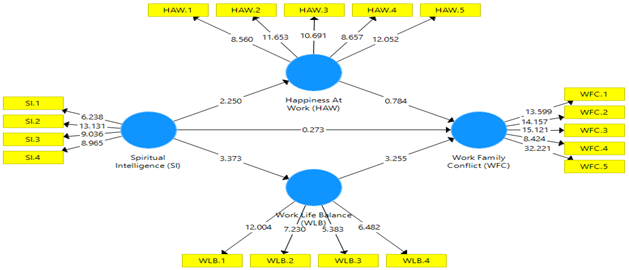
Hypothesis testing is conducted based on the results of the path diagram in Figure 1 and Table 5. The research hypothesis is accepted if the path coefficient direction aligns with the hypothesis and the t-statistic exceeds 1.64 (critical value at α = .05, one-tailed) or the p-value is less than .05 (α = .05).
Path Diagram
Path Coefficient
|
|
Path Coefficient |
T-Statistic |
P-Value |
|
SI -> HAW |
.38 |
2.25 |
.012* |
|
SI -> WFC |
-.04 |
.27 |
.393 |
|
SI -> WLB |
.48 |
3,37 |
.000* |
|
HAW -> WFC |
-.13 |
.78 |
.217 |
|
WLB -> WFC |
-.50 |
3.25 |
.001* |
|
SI -> HAW -> WFC |
-.05 |
.64 |
.261 |
|
SI -> WLB -> WFC |
-.24 |
2.00 |
.023* |
Note. (SI=spiritual intelligence; HAW=happiness at work; WFC=work-family conflict; WLB=work-life balance); * : Significant Result
Discussion
Spiritual Intelligence Has a Significant Positive Effect on Happiness at Work
The study found that spiritual intelligence significantly enhances workplace happiness among Bank Jatim Madiun Branch employees. Employees with high spiritual intelligence experience greater job satisfaction, a sense of being valued, and better Work-Life Balance (WLB) by perceiving their work as meaningful rather than routine. A positive work culture rooted in honesty, integrity, and justice fosters a harmonious environment, benefiting all team members.
Developing spiritual intelligence can enhance workplace happiness through contribution, positive work culture, commitment, and confidence. Organizations that implement strategies to nurture these aspects create a more meaningful and productive work environment, improving employee well-being and organizational success. These findings align with Isfahani and Nobakht (2013), who found a positive link between spiritual intelligence and employee happiness. Similarly, Srivastava et al. (2022) identified an indirect positive relationship between spiritual leadership and workplace happiness, while Aliabadi et al. (2021) confirmed a direct connection between spiritual intelligence and happiness.
Spiritual Intelligence Has a Negative Effect on WFC
This study indicates that spiritual intelligence does not have a significant negative effect on WFC, meaning a higher level of spiritual intelligence does not necessarily reduce WFC among employees at the Bank Jatim Madiun Branch. Previous research supports this finding as (Febriani et al., 2023) found that spirituality in the workplace negatively affects WFC, while Ilyas and Arshad (2017) demonstrated a negative relationship between personal meaning (a factor of spiritual intelligence) and family intervention due to work-related time allocation.
Border and Boundary Theory (Clark, 2000) highlights the importance of managing boundaries between life domains, such as work and family, to mitigate role conflicts. While human values encourage individuals to maintain balance, factors like high job demands and family expectations can disrupt equilibrium. An unsupportive work culture or rigid policies may prevent employees from applying spiritual values effectively, while substantial family responsibilities—such as caregiving—can heighten stress and intensify WFC.
Bank Jatim employees frequently work overtime, reducing family time in the evenings or on weekends. Additionally, out-of-town training sessions require prolonged absences, leading to stress and guilt. To manage WFC effectively, organizations should consider flexible work schedules, supervisor and peer support, and stress management strategies, ensuring employees can maintain a healthier work-life balance.
Spiritual Intelligence Has a Significant Positive Effect on WLB
The results indicate that spiritual intelligence significantly enhances WLB among Bank Jatim employees, suggesting that higher spiritual intelligence improves their ability to balance work and personal life. Spiritual intelligence refers to an individual’s ability to apply spiritual values, principles, and insights in daily life, fostering meaning, purpose, and tranquility. Meanwhile, WLB reflects an individual’s capacity to balance work demands with personal and familial needs. This study finds that employees with higher spiritual intelligence achieve better WLB, likely due to their broader perspective on work’s significance, enhanced stress management, and deeper understanding of life’s purpose.
Border Theory (Clark, 2000) posits that individuals must manage boundaries between work and personal life. This study suggests that spiritual intelligence strengthens employees’ ability to establish and maintain flexible boundaries, allowing for a healthier balance between both domains. Additionally, factors such as contribution, belief, culture, commitment, and confidence are crucial in sustaining WLB. By fostering spiritual intelligence, Bank Jatim employees may experience greater meaning in their professional and personal lives, leading to improved well-being.
These findings align with Singh et al. (2021), who assert that spirituality is becoming a key indicator of WLB, contributing to better management of work and personal life and informing human resource policies. Similarly, Budagavi et al. (2022) found that employees who experience spirituality in the workplace are more capable of maintaining WLB effectively.
Happiness At Work Has a Negative Effect on WFC
The study found that happiness at work does not significantly reduce WFC among Bank Jatim employees, indicating that workplace happiness alone is not a key factor in mitigating conflicts between professional and familial responsibilities. Research by El Keshky and Sarour (2024) suggests a negative correlation between WFC and life satisfaction, mediated by self-compassion. Similarly, Anugrahany (2019) found a significant negative relationship between WFC and happiness, where lower WFC corresponds to higher happiness and vice versa. However, Prasetyo et al. (2019) concluded that happiness at work and WFC share only a minimal negative relationship, suggesting a limited contribution of workplace happiness in reducing WFC.
While increased happiness at work was expected to lower WFC, the association was not statistically significant. Although a negative tendency exists, it is not substantial enough to confirm a direct impact. This outcome may stem from factors such as individual differences, workplace conditions, and resource availability. To effectively reduce WFC, organizations must adopt a more comprehensive approach, including policies supporting work-family balance and initiatives to enhance stress management and emotional intelligence.
WLB Has a Negative Effect on WFC
The study found that WLB negatively affects family-work conflict, meaning individuals who effectively manage their time, energy, and commitments between work and personal life experience less conflict. Maintaining a balance between these domains allows employees to transition smoothly between work and family roles, reducing stress and improving overall well-being. These findings underscore the importance of implementing organizational strategies and policies that support WLB, as they can help mitigate conflicts and enhance employee performance.
Individuals with balanced work and personal lives demonstrate greater flexibility in managing boundaries, enabling them to handle both professional and family responsibilities more effectively. Border Theory (Clark, 2000) explains that WLB fosters flexibility and permeability between work-family roles, leading to lower WFC. Similarly, Balance Theory posits that maintaining equilibrium between work and family demands minimizes role conflicts and enhances well-being. Thus, ensuring proper boundary management and balance is crucial for reducing work-family conflicts and improving employee satisfaction.
This study aligns with Yuswanti et al. (2021), who found that WLB and WFC collectively influence performance, reinforcing the importance of balance in achieving professional and personal success. Additionally, Amran et al. (2022) highlighted that work-from-home arrangements can indirectly moderate WFC through WLB mediation. These findings emphasize that fostering work-life balance is a key factor in minimizing conflicts and enhancing overall workplace harmony.
Happiness At Work Mediates the Influence of Spiritual Intelligence on WFC
The study concluded that happiness at work does not mediate the influence of spiritual intelligence on WFC, indicating that spiritual intelligence directly affects WFC. An individual's capacity to manage stress, derive meaning from life, and integrate spiritual values into daily activities plays a crucial role in mitigating conflicts between work and family roles. While workplace happiness contributes to overall well-being, it does not mediate this relationship. Thus, interventions aimed at enhancing spiritual intelligence can directly reduce WFC without relying on workplace happiness.
Limited research has explored the mediating role of happiness at work in this context. These findings suggest that reducing WFC is more closely tied to an individual’s intrinsic ability to manage stress and find meaning in life—a key aspect of spiritual intelligence—rather than to workplace happiness. While happiness at work remains beneficial, it may not be a decisive factor in mitigating work-family conflicts for individuals with high spiritual intelligence. Since workplace happiness does not significantly affect boundary management between work and family, it cannot serve as a critical mediator. Therefore, strengthening spiritual intelligence may be a more effective approach to reducing WFC than relying on happiness at work.
WLB Mediates the Influence of Spiritual Intelligence on WFC
The results indicate that WLB mediates the influence of spiritual intelligence on WFC among Bank Jatim employees. The results suggest that higher levels of spiritual intelligence significantly enhance WLB, which subsequently leads to a significant reduction in WFC. Individuals possessing high spiritual intelligence tend to exhibit a more positive and constructive perspective on the challenges they encounter, including conflicts between work and family domains. Research by Bian and Sukor (2024) demonstrates that work-family conflict exerts an indirect effect on psychological well-being through work-life balance. This finding suggests that enhancing the quality of work-life balance may mitigate the negative impact of work-family conflict on psychological health. The findings of Joshi et al. (2024) indicate that work-life balance fully mediates the relationship between workplace spirituality and job satisfaction. This research yields significant implications for management practitioners, suggesting the adoption of work-life balance policies to realize the benefits of spirituality in the workplace fully.
Employees with high spiritual intelligence demonstrate enhanced abilities in managing stress through practices such as meditation, self-reflection, and other spiritual approaches. The high spiritual intelligence facilitates their maintenance of calm and focus when dealing with pressures from work and family. Spiritual intelligence also fosters greater self-awareness regarding personal needs and limitations, enabling more effective management of time and energy between professional and personal life. A clear understanding of life's values and goals allows for more informed decision-making in the allocation of time and resources. Employees with high spiritual intelligence are better equipped to achieve a balance between work and personal life, ultimately mitigating conflicts between work and family roles. The results underscore the importance of developing spiritual intelligence and implementing employee well-being programs to enhance overall well-being and productivity in the workplace.
Conclusion
The findings of this study highlight the important connection between spiritual intelligence and employee happiness at work, particularly for those at Bank Jatim Madiun Branch. It shows that when employees possess higher spiritual intelligence, they tend to feel happier in their jobs. Additionally, spiritual intelligence positively affects WLB, meaning that employees with a strong sense of spirituality often enjoy a better balance between their professional and personal lives.
However, the study also reveals that simply having higher spiritual intelligence does not necessarily reduce WFC. In fact, it appears that being happier at work does not directly lead to fewer conflicts between work and family responsibilities either. On a more positive note, the research indicates that improving WLB can significantly help reduce these conflicts. This notion suggests that when employees manage to balance their work and personal lives better, they experience fewer clashes between their job and family obligations.
Interestingly, the study found that happiness at work does not act as a bridge between spiritual intelligence and WFC. In contrast, WLB does play a crucial role in this relationship. Higher spiritual intelligence can enhance work-life balance, which in turn helps to lessen work-family conflict among employees.
From a theoretical standpoint, this research enriches our understanding of how spiritual intelligence contributes to employee well-being and balance. It emphasizes the importance of spiritual intelligence in fostering happiness at work and improving WLB while also identifying WLB as a vital factor in reducing WFC. These insights add depth to existing theories in workplace psychology and underscore the need to consider non-material aspects, like spirituality, in discussions about employee satisfaction and conflict resolution.
On a practical level, the study suggests that organizations, especially in high-pressure environments like banking, should consider implementing programs aimed at boosting employees' spiritual intelligence. These programs could include mindfulness training, self-reflection activities, and leadership development focused on values. Additionally, promoting WLB through flexible work arrangements, supportive policies, and stress management initiatives can significantly help reduce work-family conflict and enhance overall employee well-being.
Future research could explore other factors that might influence the relationship between spiritual intelligence and WFC, such as job stress, emotional intelligence, or organizational support. It would also be beneficial to investigate these dynamics across various industries, cultural contexts, and demographic groups to broaden the applicability of these findings.
Refrences
Agarwal, S., & Lenka, U. (2015). Study on work-life balance of women entrepreneurs – review and research agenda. Industrial and Commercial Training, 47(7), 356–362. https://doi.org/10.1108/ICT-01-2015-0006
Aliabadi, P. K., Zazoly, A. Z., Sohrab, M., Neyestani, F., Nazari, N., Mousavi, S. H., Fallah, A., Youneszadeh, M., Ghasemiyan, M., & Ferdowsi, M. (2021). The role of spiritual intelligence in predicting the empathy levels of nurses with COVID-19 patients. Archives of Psychiatric Nursing, 35(6), 658–663. https://doi.org/10.1016/j.apnu.2021.10.007
Amran, A., Luckieta, M., Alamsyah, D. P., & Suparwo, A. (2022). Work-life balance to decrease work-family conflict during the COVID-19 pandemic. Trikonomika, 21(1), 16–24. https://doi.org/10.23969/trikonomika.v21i1.4491
Anugrahany, A. A. (2019). Studi korelasi happiness pada ibu yang bekerja ditinjau dari work family conflict [Correlation study on happiness in working mothers from the lens of work family conflict]. Intuisi: Jurnal Psikologi Ilmiah, 11(3), 168–176. https://journal.unnes.ac.id/nju/INTUISI/article/view/18807
Bian, X., & Mohd Sukor, M. S. (2024). The mediating effect of work-life balance on the relationship between work-family conflict and psychological well-being among Chinese working women. Scientific Reports, 14(1), 27421. https://doi.org/10.1038/s41598-024-79322-1
Budagavi, A., Immaculate, J. K., & Deepika, G. S. (2022). Workplace spirituality and work-life balance: a critical study. M S Ramaiah Management Review, 8–22. https://doi.org/10.52184/msrmr.v12i01.103
Chang, X., Zhou, Y., Wang, C., & Heredero, C. de P. (2017). How do work-family balance practices affect work-family conflict? The differential roles of work stress. Frontiers of Business Research in China, 11(1), 8. https://doi.org/10.1186/s11782-017-0008-4
Clark, S. C. (2000). Work/family border theory: A new theory of work/family balance. Human Relations, 53(6), 747–770. https://doi.org/10.1177/0018726700536001
El Keshky, M. E. S., & Sarour, E. O. (2024). The relationships between work-family conflict and life satisfaction and happiness among nurses: a moderated mediation model of gratitude and self-compassion. Frontiers in Public Health, 12. https://doi.org/10.3389/fpubh.2024.1340074
Febriani, R., Hasanah, S. N., Roz, K., & Hakim, A. R. (2023). The Impact of Workplace Spirituality, Work-Family Conflict, and Loneliness in Work on Intention to Stay: Case Study on Women Employees in Indonesia. International Journal of Professional Business Review, 8(4), e01473. https://doi.org/10.26668/businessreview/2023.v8i4.1473
Fisher, C. D. (2010). Happiness at Work. International Journal of Management Reviews, 12(4), 384–412. https://doi.org/10.1111/j.1468-2370.2009.00270.x
Fisher, G. G., Bulger, C. A., & Smith, C. S. (2009). Beyond work and family: A measure of work/nonwork interference and enhancement. Journal of Occupational Health Psychology, 14(4), 441–456. https://doi.org/10.1037/a0016737
Gragnano, A., Simbula, S., & Miglioretti, M. (2020). Work–Life Balance: Weighing the Importance of Work–Family and Work–Health Balance. International Journal of Environmental Research and Public Health, 17(3), 907. https://doi.org/10.3390/ijerph17030907
Greenhaus, J. H., & Beutell, N. J. (1985). Sources of Conflict Between Work and Family Roles <sup/>. Academy of Management Review, 10(1), 76–88. https://doi.org/10.5465/amr.1985.4277352
Ilyas, N., & Arshad, T. (2017). Spiritual intelligence, work-family conflict and psychological distress among university teachers. Bahria Journal of Professional Psychology, 16(1). https://bjpp.bahria.edu.pk/index.php/BJPP/article/view/31
Isa, M., & Indrayati, N. (2023). The role of work–life balance as mediation of the effect of work–family conflict on employee performance. SA Journal of Human Resource Management, 21. https://doi.org/10.4102/sajhrm.v21i0.1910
Isfahani, Dr. A. N., & Nobakht, M. (2013). Impact of Spiritual Intelligence on the staff happiness (Case study: Golpayegan Petrochemical Company). International Journal of Academic Research in Business and Social Sciences, 3(7). https://doi.org/10.6007/IJARBSS/v3-i7/43
Joshi, A., & Kumar, D. (2024). Work-Life Balance as Mediator Between Workplace Spirituality, Organizational Commitment, and Job Satisfaction. Prabandhan: Indian Journal of Management, 17(11), 23. https://doi.org/10.17010/pijom/2024/v17i11/174021
Kao, K.-Y., Chi, N.-W., Thomas, C. L., Lee, H.-T., & Wang, Y.-F. (2020). Linking ICT availability demands to burnout and work-family conflict: The roles of workplace telepressure and dispositional self-regulation. The Journal of Psychology, 154(5), 325–345. https://doi.org/10.1080/00223980.2020.1745137
Karatepe, O. M., & Sokmen, A. (2006). The effects of work role and family role variables on psychological and behavioral outcomes of frontline employees. Tourism Management, 27(2), 255–268. https://doi.org/10.1016/j.tourman.2004.10.001
Kumar, V., & Mehta, M. (2011). Gaining adaptive orientation through spiritual and emotional intelligence. In A. Chauhan & S. Nathawat (Eds.), New facets of positivism (pp. 281–301). Macmillan Publishers.
Odriozola, M. D., & Baraibar-Diez, E. (2018). Do work-life balance practices mediate in the relationship between female participation and financial performance? European Journal of Management and Business Economics, 27(3), 249–265. https://doi.org/10.1108/EJMBE-08-2017-0009
Prasetyo, A. R., Ratnaningsih, I. Z., & Prihatsanti, U. (2019). Optimizing Happiness at Work in Female Correctional Officer. Journal of Educational, Health and Community Psychology, 8(3), 334. https://doi.org/10.12928/jehcp.v8i3.12793
Pryce‐Jones, J. (2010). Happiness at work. Wiley. https://doi.org/10.1002/9780470666845
Recuero, L. H., & Segovia, A. O. (2021). Work-family conflict, coping strategies and burnout: A gender and couple analysis. Revista de Psicología Del Trabajo y de Las Organizaciones, 37(1), 21–28. https://doi.org/10.5093/jwop2021a5
Rehman, S., & Azam Roomi, M. (2012). Gender and work‐life balance: a phenomenological study of women entrepreneurs in Pakistan. Journal of Small Business and Enterprise Development, 19(2), 209–228. https://doi.org/10.1108/14626001211223865
Singh, S., Pandey, S., & Islam, T. (2021). The impact of spiritual intelligence on work-life balance of service sector employees. International Journal of Modern Agriculture, 10(2). https://www.modern-journals.com/index.php/ijma/article/view/771/667
Srivastava, S., Mendiratta, A., Pankaj, P., Misra, R., & Mendiratta, R. (2022). Happiness at work through spiritual leadership: a self-determination perspective. Employee Relations: The International Journal, 44(4), 972–992. https://doi.org/10.1108/ER-08-2021-0342
Yahaya, A., Voo, P., Maakip, İ., Rathanakrishnan, B., Arus, B. M., Yusuf, M. Y. M., Jumpo, S. A., Hamdani, N. H., Ramli, S. F., & Yin, K. T. (2019). Factors that contribute to the work-family conflict in permodalan nasional berhad (pnb). IJASOS-International E-Journal of Advances in Social Sciences, 5(14), 724–730. https://dergipark.org.tr/en/download/article-file/800476
Yuswanti, M., Saefuddin, D. T., Said, S., & Suleman, N. R. (2021). The Effect of Work Life Balance, Work Family Conflict and Family Work Conflict Moderated by Job Satisfaction on the Performance of the Midwife Coordinator in the Province of Southeast Sulawesi. Italienisch, 11(2), 648–653. https://www.researchgate.net/profile/Dedy-Takdir-Syaifuddin/publication/362405553_The_Effect_of_Work_Life_Balance_Work_Family_Conflict_and_Family_Work_Conflict_Moderated_by_Job_Satisfaction_on_the_Performance_of_the_Midwife_Coordinator_in_the_Province_of_Southeast_Sulawesi/links/62e866247782323cf193a81d/The-Effect-of-Work-Life-Balance-Work-Family-Conflict-and-Family-Work-Conflict-Moderated-by-Job-Satisfaction-on-the-Performance-of-the-Midwife-Coordinator-in-the-Province-of-Southeast-Sulawesi.pdf
Zakaria, M. F., & Abdullah, A. R. (2018). The influence of spiritual intelligence towards work-life balance among teachers. Proceedings of NHRMC.

Page 1 of
Download Count : 85
Visit Count : 197
Keywords
Spiritual Intelligence; Happiness at Work; Employee Performance; Work-Family Conflict; Work-Life Balance

Author(s) Information




How to cite this article
Suhermin, Palupi, D., & Faisal, M. (2025). Spiritual intelligence and work-family conflict: exploring the role of happiness at work and work-life balance. European Journal of Studies in Management and Business, 33, 18-32. https://doi.org/10.32038/mbrq.2025.33.02
Acknowledgments
Not applicable.
Funding
Not applicable.
Conflict of Interests
No, there are no conflicting interests.
Open Access
This article is licensed under a Creative Commons Attribution 4.0 International License, which permits use, sharing, adaptation, distribution and reproduction in any medium or format, as long as you give appropriate credit to the original author(s) and the source, provide a link to the Creative Commons license, and indicate if changes were made. You may view a copy of Creative Commons Attribution 4.0 International License here: http://creativecommons.org/licenses/by/4.0/