






Original Research
The Power of Atmosphere, Gifts, and Interaction: Exploring Hedonic Value's Mediation in Repurchase Intention for Oppo Smartphones


- Abstract
- Full text
- Metrics
The purpose of this study is to investigate repurchase intention among Oppo smartphone users. The aim of the findings is to reveal the extent to which store atmosphere, gift promotions, and proactive interaction marketing directly and indirectly, through the mediation of hedonic value, impact the repurchase intention of Oppo smartphone users. The study employed accidental sampling, with a sample size of 201 respondents who met the criteria of having purchased an Oppo smartphone from a brand-affiliated outlet, used the device for at least six months, and were at least 15 years old. The data was analyzed using Structural Equation Modeling (SEM). The results indicated that gift promotion and store atmosphere significantly influenced both hedonic value and repurchase intention, while proactive interaction marketing did not significantly impact either variable. Additionally, hedonic value mediated the effects of store atmosphere and gift promotion on repurchase intention but not for proactive interaction marketing.
Niken Suyanti* , Budiyanto , Khuzaini
Indonesia School of Economics (STIESIA), Indonesia
Abstract:
The purpose of this study is to investigate repurchase intention among Oppo smartphone users. The aim of the findings is to reveal the extent to which store atmosphere, gift promotions, and proactive interaction marketing directly and indirectly, through the mediation of hedonic value, impact the repurchase intention of Oppo smartphone users. The study employed accidental sampling, with a sample size of 201 respondents who met the criteria of having purchased an Oppo smartphone from a brand-affiliated outlet, used the device for at least six months, and were at least 15 years old. The data was analyzed using Structural Equation Modeling (SEM). The results indicated that gift promotion and store atmosphere significantly influenced both hedonic value and repurchase intention, while proactive interaction marketing did not significantly impact either variable. Additionally, hedonic value mediated the effects of store atmosphere and gift promotion on repurchase intention but not for proactive interaction marketing.
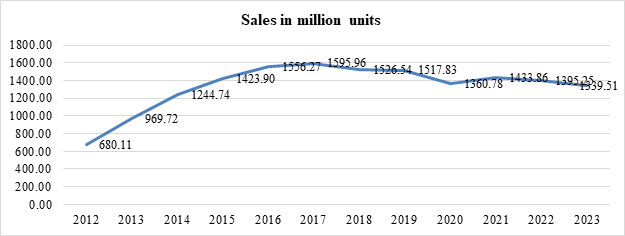
The global smartphone market has experienced a consistent decline in sales since reaching its peak in 2017. In 2017, 1,595.96 million units of smartphones were sold to users globally. Subsequently, in 2018, a year-on-year decline in sales of 4% resulted in sales of only 1,526.54 million units. Furthermore, between 2017 and 2023, the smartphone sales market decreased by 16.1%, with only 1,339.51 million units of smartphones sold in the global market, as illustrated in Figure 1.
Smartphone Sales in Global Markets 2012-2023 (Laricchia, 2024)
In the Indonesian market, despite the absence of a decline in the number of units sold in national smartphone sales, there has been a deceleration in the sales volume growth rate since 2017. The numerical data about smartphone sales in Indonesia from 2015 to 2023 is presented in Table 1.
Number of Smartphone Sales in Indonesia in 2015-2023
|
Year |
Number of Smartphone Units Sold |
Year to Year Growth |
|
2015 |
6,80 |
|
|
2016 |
9,60 |
41% |
|
2017 |
17,10 |
78% |
|
2018 |
24,35 |
42% |
|
2019 |
28,56 |
17% |
|
2020 |
40,90 |
43% |
|
2021 |
32,40 |
-21% |
|
2022 |
27,86 |
-14% |
|
2023 |
30,12 |
8% |
Source: (Andalas, 2024)
Table 1 indicates that 2017 represented the peak of national smartphone sales growth, with total sales reaching 17.1 million units, an increase of 78% from the previous year. In 2018, growth decelerated to 42%, followed by a further reduction to 17% in sales growth from 2018 to 2019. Subsequently, the period from 2022 to 2023 exhibited an 8% increase. Table 1 demonstrates that smartphone sales in Indonesia continue to rise, as the percentage of smartphone users remains at approximately 80% of the Indonesian population in 2023.
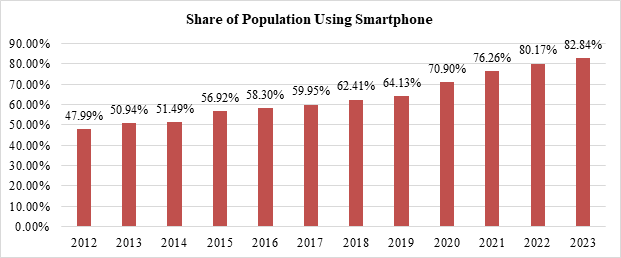
Based on the data presented in Figure 2, it is evident that the smartphone market in Indonesia exhibits substantial growth potential. As of 2023, smartphone penetration has reached 82.84% of the Indonesian population, indicating that approximately 18% has yet to adopt smartphone technology
Smartphone Usage Percentage Population of Indonesia in 2012-2023 (Siahaan, 2023)
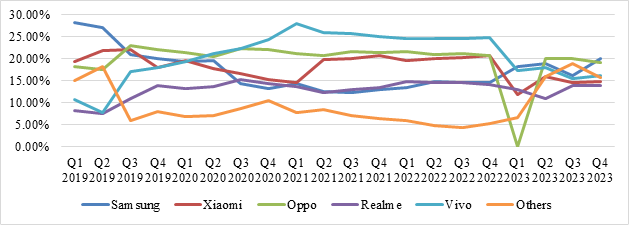
As presented in Figure 3, Oppo led the smartphone market in Indonesia between 2019 and 2021; however, since 2019, Oppo's market share has experienced a decline, and in Q3 2020, Vivo surpassed Oppo's performance. A survey conducted in June 2022 with 100 Oppo users revealed that 72% expressed a lack of interest in repurchasing Oppo products, indicating a significant issue in the brand's repurchase intention. The global decline in smartphone sales, coupled with high ownership levels, necessitates a shift in marketing strategies that emphasize creating repurchase intentions rather than solely targeting new users (Riofita et al., 2024). Consequently, Oppo's marketing strategy, which focuses on increasing short-term sales, requires reevaluation within the context of intensifying competition and market saturation. Customer loyalty offers long-term advantages, including consistent repeat purchases, positive word-of-mouth communication, and reduced promotional expenditures (Chan et al., 2022; Nasır, n.d.).
Market Share of Smartphone Top 5 Brands (Riyanto & Pertiwi, 2023)
Literature Review
The store atmosphere exerts a significant influence on consumer decisions regarding outlet visitation. Most consumers prefer establishments with a favourable atmosphere (Munaro et al., 2019). The store atmosphere is crucial in attracting potential buyers, providing comfort, and serving as a reminder of desired products (Kotler & Armstrong, 2018). A well-designed store atmosphere contributes to customer satisfaction and enhances loyalty, as satisfied customers positively impact the company (Venter de Villiers et al., 2018). Babin and Attaway (2000) posited that store atmosphere affects consumers' emotional states, interest levels, satisfaction, and perceived quality, subsequently influencing repurchase intention (Kezia et al., 2023). A store atmosphere associated with a specific brand may lead to future purchases of similar products. Empirical studies (Rayburn & Voss, 2013; Simanjuntak et al., 2020; Sudaryanto et al., 2020; Tulipa et al., 2014) corroborate a significant relationship between positive store atmosphere and repurchase intention. Based on these studies, the first hypothesis is formulated as follows:
H1: Store atmosphere significantly affects Oppo smartphone repurchase intentions.
Gift promotion aims to create added value and incentivise customers to generate short-term sales (Belch & Belch, 2018). Kotler and Armstrong (2018) emphasized that sales promotions should reinforce product positioning and establish long-term customer relationships. Cummins and Mullin (2004) noted that one of the primary objectives of sales promotion is to enhance loyalty. Peter and Olson (2010) proposed that promotions encourage consumers to maintain loyalty by offering incentives. Tjiptono (2015) asserted that sales promotions aim to stimulate repeat purchases and foster brand loyalty. Providing gifts related to additional product devices promotes loyalty by encouraging repurchases. Studies by Ji & Ha (2021), Park (2016), Lee and Yi (2017), and Lee & Yi (2019) identified a positive correlation between gift promotions and repurchase intentions. Thus, the second hypothesis is:
H2: Gift promotion significantly affects Oppo smartphone repurchase intentions.
Proactive interaction marketing involves initiating customer engagement to cultivate loyalty (Rane et al., 2023). Loyalty programs reward customers based on their purchase history, thereby incentivizing repeat purchases (Czinkota et al., 2021). This strategy can mitigate customer attrition and create barriers for competitors attempting to acquire customers (Lee & Yi, 2017). Moreover, proactive marketing enhances customer trust by offering economic value, rewards, and incentives (Ewah, 2013). Research conducted by Chanthinok et al. (2015), Filieri and Lin (2017), and Kruger and Mostert (2014) demonstrated that proactive marketing positively influences repurchase intention. Consequently, the third hypothesis is formulated as follows:
H3: Proactive interaction marketing significantly affects Oppo smartphone repurchase intentions.
Bakirtaş et al. (2015) elucidated that hedonic value encompasses sensory, emotional, and fantasy-related experiences during consumption. Store atmosphere enhances hedonic value by stimulating the senses, fostering comfort, and promoting extended visits (Kim et al., 2012). This atmosphere influences consumer perceptions of the store and its products (Calvo-Porral & Lévy-Mangin, 2021). An appropriate store atmosphere contributes to hedonic value, promoting repurchase intention (Ballantine et al., 2010; Sinha & Verma, 2020). The hypothesis is formulated as follows:
H4: Store sales atmosphere significantly affects Oppo smartphone repurchase intention.
Gifts enhance purchase intention and retention, serving short-term sales and long-term loyalty (Liu & Chou, 2015; Montaner et al., 2011). Consumers evaluate the benefits and costs, and gifts increase perceived value without raising prices (Gala et al., 2024). Non-monetary promotions, such as gifts, generate emotional benefits and elicit pleasure during purchases (Andrian & Rostiani, 2021). Thus, the hypothesis is formulated as follows:
H5: Gift promotion significantly affects consumer hedonic value in Oppo smartphone products.
Proactive marketing strategies, such as telemarketing and customer retention efforts, enhance engagement and provide hedonic value through personalized attention (Siahaan & Brina, 2024). Digital interactions contribute to sensory pleasure and emotional satisfaction, strengthening customer connections (Kwon & Jain, 2009). Consequently, the hypothesis is formulated as follows:
H6: Proactive interaction marketing significantly affects the hedonic value of Oppo smartphone products.
Hedonic value, derived from pleasurable shopping experiences, serves as a motivator for repurchase behaviour (Kazakevičiūtė & Banytė, 2013; Nejati & Parakhodi Moghaddam, 2013). Research demonstrates a direct correlation between hedonic value and repurchase intention (Akter & Ashraf, 2016; Simanjuntak et al., 2020). Furthermore, hedonic value has been found to substantially influence repurchase intentions more than utilitarian value (Bagyarta, 2014). Based on these findings, the following hypothesis is proposed:
H7: The hedonic value associated with Oppo smartphone purchases significantly affects repurchase intentions.
Store atmosphere significantly influences repurchase intention by enhancing the hedonic value of the shopping experience. A well-designed environment provides sensory gratification, encouraging subsequent visits (Casado-Díaz et al., 2021). Positive experiences increase customer loyalty and repurchase intention (Kim et al., 2007). Consequently, the hypothesis is formulated as follows:
H8: Store atmosphere significantly affects repurchase intention through hedonic value.
The provision of complimentary items enhances the affective bond between consumers and the brand, thereby increasing the probability of repeat purchases (Gan & Wang, 2017). The unanticipated gratification derived from receiving a gift augments the overall shopping experience, fostering a desire to return (Dukes, 2019). Complimentary items also differentiate brands in a competitive market by providing emotional satisfaction (Burns, 2012). Consequently, the hypothesis is formulated as follows:
H9: Gift promotion significantly affects repurchase intention through hedonic value.
Proactive interaction marketing, tailored to individual preferences, enhances customer engagement and hedonic value (Dwivedi et al., 2021). Personalized communications establish emotional connections, improving the shopping experience and promoting repurchase behaviour (Rane et al., 2023). Proactive marketing enhances customer satisfaction and loyalty by anticipating consumer needs (Vivek et al., 2012). Consequently, the hypothesis is formulated as follows:
H10: Proactive interaction marketing significantly affects repurchase intention through hedonic value.
Method
Ferdinand (2014) asserted that when employing SEM (structural equation model) analysis, the sample size should be 5 to 10 times the number of indicators across all research variables. This study implements a formula wherein the parameters are multiplied by 10. Accordingly, 16 indicators multiplied by 10 yields a sample size of 160 (Sukardi, 2021), as a larger sample size provides a more representative depiction of the population.
The study employs accidental sampling conducted in person with Oppo smartphone consumers at Oppo sales outlets. Inclusion criteria for participants comprise purchasing an Oppo smartphone directly from a brand-affiliated outlet to evaluate the store atmosphere, utilizing an Oppo smartphone for a minimum of 6 months to assess proactive interaction marketing, and being at least 15 years of age to ensure adequate comprehension of the questionnaire.
Data were collected directly in the field. While the minimum target was 160 respondents, the researchers aimed to collect a larger sample to account for potential non-responses or invalid data. During a consumer gathering in April at several Oppo outlets, 201 respondents were obtained, exceeding the target by 25%. This data collection was conducted utilizing accidental sampling of Oppo smartphone purchasers.
Result and Discussion
Most Oppo smartphone users who participated as respondents were male, comprising 105 individuals or 52.24%, while female respondents numbered 96, representing 47.76%. The predominant age group among Oppo smartphone users in the study was 20 to 30, accounting for 115 individuals or 57.21%. Additionally, respondents aged 31-40 constituted 42 individuals or 20.90%, those aged 41-50 numbered 33 individuals or 15.42%, and respondents aged 51-60 represented the smallest group with 11 individuals or 5.47%. Most respondents utilizing Oppo smartphones consisted of users who had employed the Oppo brand for 1 to 3 years, totalling 113 respondents or 56.22%. Respondents who had used Oppo for six months to 1 year numbered 44, or 21.89%. Concurrently, those who had used Oppo for more than three years also numbered 44 individuals or 21.89%. As evidenced by Table 2, all indicators demonstrate validity in measuring their respective latent variables. This validity is substantiated by the loading factor values and Average Variance Extracted (AVE) scores, which exceed .50 for all indicators.
Result Loading Factor and Variance Extracted
|
Variable |
Indicators/Dimensions |
Loading Factor |
Variance Extracted |
|
|
Store atmosphere (SA) |
Outside |
SA1 |
.85 |
.71 |
|
General interior |
SA2 |
.82 |
||
|
Displeasure |
SA3 |
.85 |
||
|
Free gift promotion (FG) |
Perceived Fit |
FG1 |
.63 |
.64 |
|
Price |
FG2 |
.84 |
||
|
Expectation |
FG3 |
.91 |
||
|
Proactive interaction marketing (PI) |
Express of customer need |
PI1 |
.86 |
.59 |
|
Consumer Exploration |
PI2 |
.73 |
||
|
Loyalty Program |
PI3 |
.69 |
||
|
Hedonic value (HV) |
New Experiences |
HV1 |
.74 |
.53 |
|
Pleasure |
HV2 |
.75 |
||
|
Social Interaction |
HV3 |
.73 |
||
|
Exploration Experience |
HV4 |
.69 |
||
|
Repurchase intention (RI) |
Repurchase |
RI1 |
.78 |
.60 |
|
WOM |
RI2 |
.84 |
||
|
Information Searching |
RI3 |
.69 |
||
The reliability test results of the instrument with construct reliability demonstrate that the instrument is reliable, as evidenced by the construct reliability value meeting the acceptable threshold. As presented in Table 3, all construct reliability values exceed .70, thus indicating that all indicators across all variables are reliable.
Value Construct Reliability
|
Variable |
Indicators/Dimensions |
Loading Factor |
Construct Reliability |
|
|
Store atmosphere (SA) |
Outside |
SA1 |
.85 |
.88 |
|
General interior |
SA2 |
.82 |
||
|
Displeasure |
SA3 |
.85 |
||
|
Free gift promotion (FG) |
Perceived Fit |
FG1 |
.63 |
.84 |
|
Price |
FG2 |
.84 |
||
|
Expectation |
FG3 |
.91 |
||
|
Proactive interaction marketing (PI) |
Express of customer need |
PI1 |
.86 |
.81 |
|
Consumer Exploration |
PI2 |
.73 |
||
|
Loyalty Program |
PI3 |
.69 |
||
|
Hedonic value (HV) |
New Experiences |
HV1 |
.74 |
.82 |
|
Pleasure |
HV2 |
.75 |
||
|
Social Interaction |
HV3 |
.73 |
||
|
Exploration Experience |
HV4 |
.69 |
||
|
Repurchase intention (RI) |
Repurchase |
RI1 |
.78 |
.81 |
|
WOM |
RI2 |
.84 |
||
|
Information Searching |
RI3 |
.69 |
||
The test results for Goodness of Fit Indices, as elucidated in Table 4, indicate that the TLI, CFI, RSMEA, and GFI values yielded good fit results. The AGFI score demonstrated a marginal fit; however, despite this marginal outcome, Hair et al. (2019) assert that the AGFI value approximates the recommended threshold, thus warranting the continuation of the model.
Goodness of Fit Test
|
Criteria |
Fit Index |
Result |
Information |
|
Significant probability |
≥ .05 |
.02 |
Bad Fit |
|
Degree of freedom (CMIN/DF) |
≤ 2.00 a.m. |
1.31 |
Good Fit |
|
Root mean square error approximation |
≤ 0.08 |
.04 |
Good Fit |
|
Goodness of fit index (GFI) |
≥ .90 |
.93 |
Good Fit |
|
Adjusted goodness of fit index (AGFI) |
≥ .90 |
.89 |
Marginal |
|
Tucker Lewis index (TLI) |
≥ .95 |
.97 |
Good Fit |
|
Comparative fit index (CFI) |
≥ .95 |
.98 |
Good Fit |
Test Results
|
Variable |
|
|
S.E. |
p |
Result |
||
|
Gift Promotion |
à |
Hedonic Value |
|
|
.07 |
.000 |
Sig |
|
Store Atmosphere |
à |
Hedonic Value |
|
|
.09 |
.000 |
Sig |
|
Proactive Interaction Marketing |
à |
Hedonic Value |
|
|
.06 |
.643 |
Not Sig |
|
Store Atmosphere |
à |
Repurchase Intention |
|
|
.13 |
.000 |
Sig |
|
Gift Promotion |
à |
Repurchase Intention |
|
|
.09 |
.003 |
Sig |
|
Proactive Interaction Marketing |
à |
Repurchase Intention |
|
|
.07 |
.625 |
Not Sig |
|
Hedonic Value |
à |
Repurchase Intention |
|
|
.12 |
.007 |
Sig |
|
Store Atmosphere |
à |
Hedonic Value |
à |
Repurchase Intention |
.07 |
.014 |
Sig |
|
Gift Promotion |
à |
Hedonic Value |
à |
Repurchase Intention |
.04 |
.026 |
Sig |
|
Proactive Interaction Marketing |
à |
Hedonic Value |
à |
Repurchase Intention |
.01 |
.55 |
Not Sig |
The data analysis results which are shown in Table 5, indicate that the store atmosphere significantly influences the hedonic value associated with purchasing Oppo smartphones. An enhanced store atmosphere elicits positive emotions, augmenting the consumer's perception of hedonic value. Establishing a more comfortable and aesthetically pleasing store environment is anticipated to evoke a positive emotional response from consumers during the purchasing process (Tulipa et al., 2014). Hedonic value encompasses multisensory, fantasy, and emotional aspects related to product experiences. It reflects the expenditure's entertainment and emotional value (Akdim et al., 2022). Creating a pleasant shopping experience through store design and atmosphere in a highly competitive smartphone industry can enhance hedonic value, foster customer loyalty, and differentiate a brand (Berman & Evans, 2014; Calvo-Porral & Lévy-Mangin, 2021).
The results also demonstrate that gift promotions significantly influence the hedonic value of Oppo smartphone purchases. Superior complimentary items enhance the hedonic value of the purchase by meeting consumers' expectations regarding function, quality, and price. Consumers can perceive the hedonic value when they receive complimentary items, enhancing satisfaction and excitement during the purchase process (Buil et al., 2013). Offering complimentary items creates a distinctive and enjoyable shopping experience, making consumers feel rewarded and increasing their purchase's hedonic value (Chandon et al., 2000). Complimentary items that possess sensory or aesthetic value enhance the overall shopping experience. Consumers experience a sense of exclusivity or privilege when they receive a complimentary item, which increases the hedonic value as they feel recognized and appreciated (Liu & Chou, 2015).
The study found that proactive interaction marketing has a non-significant effect on the hedonic value of Oppo smartphone purchases. Proactive marketing has not demonstrated efficacy in enhancing hedonic value. Active bidirectional communication with consumers can facilitate the creation of an emotional connection, which could potentially augment the hedonic value of the product (Cheung et al., 2020). It can also empower consumers, providing them with increased control over their shopping experience, which could enhance hedonic value. However, several factors contribute to the insignificant effect of proactive interaction marketing on hedonic value. Long-term Oppo users may be familiar with the product features and no longer benefit from proactive interaction marketing efforts. Over time, these users prioritize functional aspects such as battery life and reliability over hedonic experiences (Lee et al., 2023). Long-term users often focus on the product's practical benefits rather than emotional or experiential aspects. Consequently, proactive marketing efforts aimed at pleasure or novelty may have a diminished impact (Hollebeek et al., 2022). The result contrasts with studies that found proactive interaction marketing significantly affects hedonic value (Butcher & Chomvilailuk, 2022).
The study also found that store atmosphere significantly influences repurchase intention for Oppo smartphones. A favourable store environment, including illumination, ambient music, and spatial arrangement, enhances consumer satisfaction and promotes repeat purchases (Situmorang & Kumar, 2022). Store atmosphere can also influence consumer perceptions of product quality. An upscale store atmosphere may lead consumers to associate the brand with high-quality products, enhancing repurchase intentions (Calvo-Porral & Lévy-Mangin, 2021). This finding aligns with previous studies demonstrating that store atmosphere significantly impacts repurchase intention (Rayburn & Voss, 2013).
The analysis also revealed that gift promotions positively impact repurchase intention for Oppo smartphones. Consumers perceive increased value in the transaction when they receive complimentary gifts, which enhances their satisfaction and likelihood of repurchasing (Darke & Chung, 2005). Complimentary gifts also enhance perceptions of product value, encouraging repeat purchases. Positive experiences with complimentary gifts can lead to favourable word-of-mouth recommendations, further strengthening the brand's reputation and motivating others to purchase (Lee & Yi, 2019). The finding aligns with previous research, demonstrating that gift promotions influence repurchase intention (Lee & Yi, 2019).
Proactive interaction marketing demonstrates an insignificant effect on repurchase intention, consistent with (Adekunle & Ejechi, 2018) findings. Proactive marketing may prove ineffective when it fails to adequately communicate or address consumer needs (Dwivedi et al., 2021). Younger consumers prioritize social factors, user experience, and technological innovation over proactive marketing, while older consumers emphasise trust and long-term relationships (Maulid et al., 2022).
The study determined that hedonic value significantly affects repurchase intention. Consumers who experience high hedonic value from a smartphone product are more likely to remain loyal and make repeat purchases (Zhu & Lin, 2019). Positive emotions associated with the smartphone, from the purchase process to its utilization, foster brand loyalty and repurchase intentions (Nejati & Parakhodi Moghaddam, 2013). Consumers who experience high hedonic value from a smartphone purchase demonstrate a greater likelihood of recalling and repurchasing the product in the future. The finding aligns with research indicating that increasing hedonic value is an effective strategy for enhancing consumer satisfaction and loyalty (Bagyarta, 2014).
The study also found that store atmosphere significantly influences repurchase intention, mediated by hedonic value. A well-designed store atmosphere, with elements such as lighting and music, enhances the hedonic value of the shopping experience, increasing repurchase intentions (Shang, 2022). Younger consumers are more attracted to engaging and innovative store elements, while women tend to focus on aesthetic and emotional details such as design and lighting. These factors contribute to a positive shopping experience, increasing repurchase intentions (Ali et al., 2022). Men, conversely, prioritize practical aspects such as efficient layouts (Ali et al., 2022).
Through the mediation of hedonic value, gift promotions considerably impact repurchase intention. Promotions offering gifts strengthen the emotional bond between customers and the business, especially younger customers who frequently form deep emotional connections with satisfying experiences (Khamitov et al., 2019). The relationship between promotions offering gifts and the intention to repurchase is mediated by hedonic value. Gifts perceived as having hedonic value increase customer satisfaction and promote repeat business (Kim et al., 2012).
Furthermore, the study revealed that proactive interaction marketing has a non-significant effect on repurchase intention, even when mediated by hedonic value. Users with higher education and long-term smartphone use prioritize functional benefits over hedonic pleasure, diminishing the impact of proactive marketing on repurchase intentions (Qu & Wu, 2024). Higher-educated consumers emphasise practical benefits rather than the pleasure or novelty offered by proactive marketing, which reduces the influence of hedonic value on their repurchase intention (Akdim et al., 2022).
Conclusion
The study investigated the impact of store atmosphere, gift promotion, and proactive interaction marketing on smartphone Oppo's hedonic value and repurchase intention. The findings reveal that store atmosphere significantly influences hedonic value and repurchase intention. A well-designed store atmosphere stimulates consumers to experience hedonic value, enhancing their overall shopping experience and increasing the likelihood of repeat purchases. Gift promotion also significantly impacts both hedonic value and repurchase intention. The quality of the gift received is positively correlated with the hedonic value experienced, leading to increased satisfaction and a higher likelihood of repeat purchases.
Conversely, proactive interaction marketing was found to have a non-significant impact on both hedonic value and repurchase intention. Excessive proactive interaction can lead to information overload, diminishing the enjoyable experience. Additionally, hedonic value was found to significantly influence repurchase intention, as consumers who experience high hedonic value are more likely to make repeat purchases. The mediation effect of hedonic value was observed in the in-store atmosphere and gift promotion, indicating that these elements enhance the hedonic experience, increasing satisfaction and repeat purchase intentions. Overall, the study emphasizes the importance of store atmosphere and gift promotion in enhancing hedonic value and repurchase intention for smartphone Oppo.
Implication
Theoretically, this study reveals a significant influence of hedonic value on repurchase intention, aligning with existing theories on consumer behaviour. The findings support the importance of emotional and experiential aspects in shaping purchasing decisions. The positive effect of store atmosphere on hedonic value reinforces the Theory of Reasoned Action (TRA) and Theory of Planned Behaviour (TPB), which posits that behaviour is influenced by subjective attitudes, norms, and perceived control (Ajzen, 1991; Nickerson, 2023). A positive hedonic value for smartphone users leads to more favourable attitudes toward the brand (Chatzoglou et al., 2022). The positive influence of gift promotions and proactive interaction on hedonic value strengthens consumer behaviour theory, highlighting how promotions and positive experiences drive purchase decisions and brand loyalty (Catic & Poturak, 2022; McGoey, 2016).
From a practical perspective, Oppo vendors can enhance their marketing strategies by creating attractive store atmospheres, offering relevant gifts, and utilizing customer data for personalized interactions. A well-designed store environment and appropriate gifts can increase product appeal, customer satisfaction, and the likelihood of repurchase. Personalized recommendations and proactive engagement through multiple channels can foster stronger customer relationships and drive repeat purchases.
Suggestions for Future Research
It is necessary to expand the sample size and scope of the survey to encompass additional factors that may influence the repurchase intention of Oppo smartphones. Subsequent research should also consider the impact of various models on consumer behaviour, particularly for high-technology products such as Oppo smartphones. It would be advantageous to develop a research model that integrates consumer behaviour in the context of technology utilization. Incorporating the Technology Acceptance Model (TAM) could provide a more comprehensive analysis from consumers' perspectives as advanced technology users.
References
Adekunle, S. A., & Ejechi, J. O. (2018). Modelling repurchase intention among smartphones users in Nigeria. Journal of Modelling in Management, 13(4), 794–814. https://doi.org/10.1108/JM2-12-2017-0138
Ajzen, I. (1991). The theory of planned behavior. Organizational Behavior and Human Decision Processes, 50(2), 179–211. https://doi.org/10.1016/0749-5978(91)90020-T
Akdim, K., Casaló, L. V., & Flavián, C. (2022). The role of utilitarian and hedonic aspects in the continuance intention to use social mobile apps. Journal of Retailing and Consumer Services, 66, 102888. https://doi.org/10.1016/j.jretconser.2021.102888
Akter, S., & Ashraf, E. (2016). Factors affecting repurchase intention of customers: in the context of retail chain store industry in Bangladesh. European Journal of Business and Management, 8(32), 40–47.
Ali, M. M., Handayanto, E., & Fiandari, Y. R. (2022). The effect of store atmosphere on repurchase intention with customer satisfaction as mediation variable. Jamanika (Jurnal Manajemen Bisnis Dan Kewirausahaan), 2(03). https://doi.org/10.22219/jamanika.v2i03.22752
Andalas, S. F. T. (2024). 209,3 Juta Orang di Indonesia Menggunakan Smartphone pada Tahun 2023 [209.3 Million People in Indonesia Used Smartphones in 2023]. Goodstats.
Andrian, A. L., & Rostiani, R. (2021). How does gift with purchase influence your satisfaction in online buying? Jurnal Siasat Bisnis, 25(2), 177–168. https://doi.org/10.20885/jsb.vol25.iss2.art8
Babin, B. J., & Attaway, J. S. (2000). Atmospheric affect as a tool for creating value and gaining share of customer. Journal of Business Research, 49(2), 91–99. https://doi.org/10.1016/S0148-2963(99)00011-9
Bagyarta, S. D. (2014). Analisa pengaruh hedonic dan utilitarian value terhadap repurchase intention pada industri pusat kebugaran kelas menengah atas di Sidoarjo. [Analysis of the Influence of Hedonic and Utilitarian Value on Repurchase Intention in the Upper-Middle-Class Fitness Industry in Sidoarjo]. Jurnal Strategi Pemasaran, 2(1), 11.
Bakirtaş, İ., Çetin, M. A., & Bakirtaş, H. (2015). Effects of utilitarian and hedonic shopping value and consumer satisfaction on consumer behavioral intentions. Ege Akademik Bakis (Ege Academic Review), 15(1), 91–91. https://doi.org/10.21121/eab.2015118002
Ballantine, P. W., Jack, R., & Parsons, A. G. (2010). Atmospheric cues and their effect on the hedonic retail experience. International Journal of Retail & Distribution Management, 38(8), 641–653. https://doi.org/10.1108/09590551011057453
Belch, G. E., & Belch, M. A. (2018). Advertising and promotion: An integrated marketing communications perspective. Mcgraw-Hill.
Berman, B., & Evans, J. R. (2014). Retail management: A strategic approach. Prentice Hall International.
Buil, I., de Chernatony, L., & Montaner, T. (2013). Factors influencing consumer evaluations of gift promotions. European Journal of Marketing, 47(3/4), 574–595. https://doi.org/10.1108/03090561311297463
Burns, G. W. (2012). Happiness, healing, enhancement: Your casebook collection for applying positive psychology in therapy. John Wiley & Sons.
Butcher, K., & Chomvilailuk, R. (2022). Guest benefits of hedonic value and perceived community value drive hotel CSR participation. Journal of Sustainable Tourism, 30(6), 1262–1279. https://doi.org/10.1080/09669582.2021.1931255
Calvo-Porral, C., & Lévy-Mangin, J.-P. (2021). Examining the influence of store environment in hedonic and utilitarian shopping. Administrative Sciences, 11(1), 6. https://doi.org/10.3390/admsci11010006
Casado-Díaz, A. B., Navarro-Ruiz, S., Nicolau, J. L., & Ivars-Baidal, J. (2021). Expanding our understanding of cruise visitors’ expenditure at destinations: The role of spatial patterns, onshore visit choice and cruise category. Tourism Management, 83, 104199. https://doi.org/10.1016/j.tourman.2020.104199
Catic, L., & Poturak, M. (2022). Influence of brand loyalty on consumer purchase behavior. International Journal of Research in Business and Social Science (2147- 4478), 11(8), 83–91. https://doi.org/10.20525/ijrbs.v11i8.2024
Chan, V. H. Y., Chiu, D. K. W., & Ho, K. K. W. (2022). Mediating effects on the relationship between perceived service quality and public library app loyalty during the COVID-19 era. Journal of Retailing and Consumer Services, 67, 102960. https://doi.org/10.1016/j.jretconser.2022.102960
Chandon, P., Wansink, B., & Laurent, G. (2000). A benefit congruency framework of sales promotion effectiveness. Journal of Marketing, 64(4), 65–81. https://doi.org/10.1509/jmkg.64.4.65.18071
Chanthinok, K., Ussahawanitchakit, P., & Jhundra-Indra, P. (2015). Social media marketing strategy and marketing performance: Evidence from e-commerce firms in Thailand. AU-GSB e-JOURNAL, 8(1).
Chatzoglou, P., Chatzoudes, D., Savvidou, A., Fotiadis, T., & Delias, P. (2022). Factors affecting repurchase intentions in retail shopping: An empirical study. Heliyon, 8(9), e10619. https://doi.org/10.1016/j.heliyon.2022.e10619
Cheung, M. L., Pires, G., & Rosenberger, P. J. (2020). The influence of perceived social media marketing elements on consumer–brand engagement and brand knowledge. Asia Pacific Journal of Marketing and Logistics, 32(3), 695–720. https://doi.org/10.1108/APJML-04-2019-0262
Cummins, J., & Mullin, R. (2004). Sales Promotion: Menciptakan, Mengimplementasikan, dan Mengintegrasikan Program Promosi Penjualan. [Sales Promotion: Creating, Implementing, and Integrating Sales Promotion Programs]. Jakarta: PPM.
Czinkota, M. R., Kotabe, M., Vrontis, D., & Shams, S. M. R. (2021). Understanding the buyer (pp. 135–176). https://doi.org/10.1007/978-3-030-66916-4_4
Darke, P. R., & Chung, C. M. Y. (2005). Effects of pricing and promotion on consumer perceptions: it depends on how you frame it. Journal of Retailing, 81(1), 35–47. https://doi.org/10.1016/j.jretai.2005.01.002
Dukes, N. (2019). Why so much?: An exploration of consumer behaviour and the social dynamics surrounding frequent clothes shopping. Coventry University.
Dwivedi, Y. K., Ismagilova, E., Hughes, D. L., Carlson, J., Filieri, R., Jacobson, J., Jain, V., Karjaluoto, H., Kefi, H., Krishen, A. S., Kumar, V., Rahman, M. M., Raman, R., Rauschnabel, P. A., Rowley, J., Salo, J., Tran, G. A., & Wang, Y. (2021). Setting the future of digital and social media marketing research: Perspectives and research propositions. International Journal of Information Management, 59, 102168. https://doi.org/10.1016/j.ijinfomgt.2020.102168
Ewah, S. O. E. (2013). Marketing research as a proactive strategy for the performance of business: The Nigerian experience. International Journal of Business and Economic Development, 1(3), 108–122.
Laricchia, F. (2024). Number of smartphones sold to end users worldwide from 2007 to 2023. Statista.
Ferdinand, A. (2014). Metode penelitian manajemen: Pedoman penelitian untuk penulisan skripsi tesis dan disertasi ilmu manajemen [Management Research Methods: Research Guidelines for Writing Theses, Dissertations, and Management Science Papers]. Univ. Diponegoro Press.
Filieri, R., & Lin, Z. (2017). The role of aesthetic, cultural, utilitarian and branding factors in young Chinese consumers’ repurchase intention of smartphone brands. Computers in Human Behavior, 67, 139–150. https://doi.org/10.1016/j.chb.2016.09.057
Gala, P., Blair, J., & Lunde, M. (2024). Utilizing gain and loss message framing for consumers: A Machiavellian perspective. Journal of Global Scholars of Marketing Science, 34(3), 305–324. https://doi.org/10.1080/21639159.2024.2322932
Gan, C., & Wang, W. (2017). The influence of perceived value on purchase intention in social commerce context. Internet Research, 27(4), 772–785. https://doi.org/10.1108/IntR-06-2016-0164
Hair, J. F., Babin, B. J., Black, W. C., & Anderson, R. E. (2019). Multivariate data analysis. Cengage. https://books.google.co.id/books?id=0R9ZswEACAAJ
Hollebeek, L. D., Abbasi, A. Z., Schultz, C. D., Ting, D. H., & Sigurdsson, V. (2022). Hedonic consumption experience in videogaming: A multidimensional perspective. Journal of Retailing and Consumer Services, 65, 102892. https://doi.org/10.1016/j.jretconser.2021.102892
Ji, K., & Ha, H.-Y. (2021). An empirical test of mobile service provider promotions on repurchase intentions. Sustainability, 13(5), 2894. https://doi.org/10.3390/su13052894
Kazakevičiūtė, A., & Banytė, J. (2013). The relationship of consumers' perceived hedonic value and behavior. Engineering Economics, 23(5). https://doi.org/10.5755/j01.ee.23.5.1975
Kezia, K., Sutanto, J. E., Soediro, M., & Oktavio, A. (2023). The influence of product quality, service quality, and store atmosphere towards customer repurchase intention at fat-fat restaurant in Bekasi. International Journal of Economics, Business and Accounting Research (IJEBAR), 7(2), 722–731.
Khamitov, M., Wang, X. (Shane), & Thomson, M. (2019). How well do consumer-brand relationships drive customer brand loyalty? Generalizations from a meta-analysis of brand relationship elasticities. Journal of Consumer Research, 46(3), 435–459. https://doi.org/10.1093/jcr/ucz006
Kim, C., Galliers, R. D., Shin, N., Ryoo, J.-H., & Kim, J. (2012). Factors influencing Internet shopping value and customer repurchase intention. Electronic Commerce Research and Applications, 11(4), 374–387. https://doi.org/10.1016/j.elerap.2012.04.002
Kim, H. G., Kim, J. H., & Kim, Y. J. (2007). The influence of store environment on service brand personality and repurchase intention. Journal of Global Academy of Marketing Science, 17(4), 141–173. https://doi.org/10.1080/12297119.2007.9707270
Kotler, P., & Armstrong, G. (2018). Principles of marketing. Pearson Education.
Kruger, L., & Mostert, P. G. (2014). The influence of relationship intention on cell phone users’ attitudes towards complaining and complaint behaviour. Southern African Business Review, 18(2), 35–64.
Kwon, K.-N., & Jain, D. (2009). Multichannel shopping through nontraditional retail formats: variety-seeking behavior with hedonic and utilitarian motivations. Journal of Marketing Channels, 16(2), 149–168. https://doi.org/10.1080/10466690802477418
Lee, C. H., Lee, H. N., & Choi, J. Il. (2023). The Influence of characteristics of mobile live commerce on purchase intention. Sustainability, 15(7), 5757. https://doi.org/10.3390/su15075757
Lee, S., & Yi, Y. (2017). “Seize the deal, or return it losing your free gift”: The effect of a gift‐with‐purchase promotion on product return intention. Psychology & Marketing, 34(3), 249–263. https://doi.org/10.1002/mar.20986
Lee, S., & Yi, Y. (2019). “Retail is detail! Give consumers a gift rather than a bundle”: Promotion framing and consumer product returns. Psychology & Marketing, 36(1), 15–27. https://doi.org/10.1002/mar.21154
Liu, H.-H., & Chou, H.-Y. (2015). The effects of promotional frames of sales packages on perceived price increases and repurchase intentions. International Journal of Research in Marketing, 32(1), 23–33. https://doi.org/10.1016/j.ijresmar.2014.06.005
Maulid, D. L., Hurriyati, R., & Hendrayati, H. (2022). The impact of social media marketing on consumer purchase decisions. https://doi.org/10.2991/aebmr.k.220701.045
McGoey, L. (2016). No such thing as a free gift: The gates foundation and the price of philanthropy. Verso.
Montaner, T., de Chernatony, L., & Buil, I. (2011). Consumer response to gift promotions. Journal of Product & Brand Management, 20(2), 101–110. https://doi.org/10.1108/10610421111121099
Munaro, A., Martins, E., & Kato, H. (2019). The effect of consumption motivation on the perception of gift store attributes in jewelry retail stores and its influence on repurchase intention. Review of Business Management, 21(4), 788–812. https://doi.org/10.7819/rbgn.v21i5.4029
Nasır, S. (n.d.). Customer retention strategies and customer loyalty. In Advertising and Branding (pp. 1178–1201). IGI Global. https://doi.org/10.4018/978-1-5225-1793-1.ch054
Nejati, M., & Parakhodi Moghaddam, P. (2013). The effect of hedonic and utilitarian values on satisfaction and behavioural intentions for dining in fast-casual restaurants in Iran. British Food Journal, 115(11), 1583–1596. https://doi.org/10.1108/BFJ-10-2011-0257
Nickerson, C. (2023). Theory of reasoned action (Fishbein and Ajzen, 1975). Simply Psychology.
Park, K. (2016). Meaning and delightful effect of rewards in online shopping malls : A Hand-written Letter and a Free Gift. Journal of the Korean Society of Clothing and Textiles, 40(5), 867–878. https://doi.org/10.5850/JKSCT.2016.40.5.867
Peter, J. P., & Olson, J. C. (2010). Consumer Behavior & Marketing Strategy (9th ed.). McGraw-Hill.
Qu, K., & Wu, X. (2024). ChatGPT as a CALL tool in language education: A study of hedonic motivation adoption models in English learning environments. Education and Information Technologies. https://doi.org/10.1007/s10639-024-12598-y
Rane, N. L., Achari, A., & Choudhary, S. P. (2023). Enhancing customer loyalty through quality of service: Effective strategies to improve customer satisfaction, experience, relationship, and engagement. International Research Journal of Modernization in Engineering Technology and Science, 5(5). https://doi.org/10.56726/IRJMETS38104
Rayburn, S. W., & Voss, K. E. (2013). A model of consumer’s retail atmosphere perceptions. Journal of Retailing and Consumer Services, 20(4), 400–407. https://doi.org/10.1016/j.jretconser.2013.01.012
Riofita, H., Rifky, M. G., Salamah, L. R., Asrita, R., & Nurzanah, S. (2024). Perubahan Strategi Pemasaran Dalam Menghadapi Tantangan Pasar Konsumen Di Era Digital [Changes in Marketing Strategy to Face Consumer Market Challenges in the Digital Era]. Jurnal Ekonomi Manajemen Dan Bisnis (JEMB), 1(3), 21–26.
Riyanto, G. P., & Pertiwi, W. K. (2023). 5 Besar Merek Smartphone di Indonesia Versi Counterpoint, Oppo Teratas. [Top 5 Smartphone Brands in Indonesia According to Counterpoint, Oppo is on Top]. Kompas.
Shang, E. (2022). How sensory marketing influences consumer shopping experience instore through the decision-making process for the cosmetic industry. The University of Manchester.
Siahaan, M. (2023). Number of smartphone users in Indonesia from 2018 to 2028. Statista.
Siahaan, M., & Brina, M. (2024). Proactive Marketing Strategy: Exploring marketing strategies to increase occupancy through a dynamic sales approach at Madani Hotel Medan. Formosa Journal of Science and Technology, 3(1), 89–102. https://doi.org/10.55927/fjst.v3i1.7888
Simanjuntak, M., Nur, H. R., Sartono, B., & Sabri, M. F. (2020). A general structural equation model of the emotions and repurchase intention in modern retail. Management Science Letters, 801–814. https://doi.org/10.5267/j.msl.2019.10.017
Sinha, S. K., & Verma, P. (2020). Impact of sales Promotion’s benefits on perceived value: Does product category moderate the results? Journal of Retailing and Consumer Services, 52, 101887. https://doi.org/10.1016/j.jretconser.2019.101887
Situmorang, M. A., & Kumar, S. (2022). The influence of store atmosphere and display layout on customer repurchase intention in supermarket (a survey in Jawa Barat Province, Indonesia). Proceeding of the International Conference on Family Business and Entrepreneurship, 3(1).
Sudaryanto, S., Hanim, A., & Utari, W. (2020). Behaviour on repurchase intention in a Moslem ethnic store in Indonesia. International Journal of Innovation, Creativity and Change, 13(12), 1341–1355.
Sukardi, H. M. (2021). Metodologi penelitian pendidikan: Kompetensi dan praktiknya (Edisi Revisi). [Educational Research Methodology: Competencies and Practices (Revised Edition)]. Bumi Aksara.
Tjiptono, F. (2015). Strategi Pemasaran [Marketing Strategy]. Andi Offset.
Tulipa, D., Gunawan, S., & Supit, V. H. (2014). The influence of store atmosphere on emotional responses and re-purchase intentions. Business Management and Strategy, 5(2), 151. https://doi.org/10.5296/bms.v5i2.6144
Venter de Villiers, M., Chinomona, R., & Chuchu, T. (2018). The influence of store environment on brand attitude, brand experience and purchase intention. South African Journal of Business Management, 49(1). https://doi.org/10.4102/sajbm.v49i1.186
Vivek, S. D., Beatty, S. E., & Morgan, R. M. (2012). Customer engagement: Exploring customer relationships beyond purchase. Journal of Marketing Theory and Practice, 20(2), 122–146. https://doi.org/10.2753/MTP1069-6679200201
Zhu, Y., & Lin, P. (2019). Hedonic or utilitarian. Journal of Contemporary Marketing Science, 2(2), 120–136. https://doi.org/10.1108/JCMARS-01-2019-0008

Page 1 of
Download Count : 63
Visit Count : 141
Keywords
Proactive Interaction; Store Atmosphere; Gift Promotion; Hedonic Value; Repurchase Intention

Author(s) Information




How to cite this article
Suyanti, N., Budiyanto., & Khuzaini. (2024). The power of atmosphere, gifts, and interaction: Exploring Hedonic value's mediation in repurchase intention for Oppo smartphones. European Journal of Studies in Management and Business, 31, 48-63. https://doi.org/10.32038/mbrq.2024.31.04
Acknowledgments
Not applicable.
Funding
Not applicable.
Conflict of Interests
No, there are no conflicting interests.
Open Access
This article is licensed under a Creative Commons Attribution 4.0 International License, which permits use, sharing, adaptation, distribution and reproduction in any medium or format, as long as you give appropriate credit to the original author(s) and the source, provide a link to the Creative Commons license, and indicate if changes were made. You may view a copy of Creative Commons Attribution 4.0 International License here: http://creativecommons.org/licenses/by/4.0/