




Original Research
The Rise of Social Behavior in Social Media Marketing During Pandemic


- Abstract
- Full text
- Metrics
The adoption of technology has changed rapidly during the global pandemic Covid-19 especially in the sector of trading. Previous studies found that businesses that are used to utilizing technology in their operational activities tend to be more able to survive during the pandemic, including small and medium businesses. The research aims to investigate the social behavior through social media platforms and how this behavior increases during the Covid-19 pandemic in Indonesia. The study adopts consumer decision-making (CDM) model as a framework with a slight modification in the phase of post-purchase behavior. Data collected thru online questionnaires as many as 377 social media active users in Indonesia and analyzed using paired sample t-test. Paired sample t-test aims to perceive whether the analyzed paired sample experiences significant changes. The results revealed that during pandemic situations, social media as a medium for identifying, collecting information, evaluating, comparing and post-purchase expressions are increased. In addition, the data also shows an increase of consumers’ post-purchase behaviors that voluntarily promote their purchased goods and services during pandemic situations. This paper contributes on a different perspective of post purchase behavior where the main focus of this concept is not only to influence and change public behaviors but to invite the public to act as a social marketer in order to achieve broader social benefits. The article contains a different paradigm about social marketing which should be considered further and push social marketing behavior forward to gain broader benefits for the community.
The Rise of Social Behavior in Social Media Marketing During Pandemic
Gunawan Baharuddin,* Nurul Hilmiyah, Aulia Keiko Hubbansyah, Muhammad Hakimi Syafiai
Faculty of Economic and Business, Universitas Pancasila
Faculty of Economic and Management, Universiti Kebangsaan Malaysia
| ABSTRACT |
|
The adoption of technology has changed rapidly during the global pandemic of COVID-19, especially in the sector of trading. Previous studies found that businesses that are used to utilizing technology in their operational activities tend to be more able to survive during the pandemic, including small and medium businesses. The research aims to investigate social behavior through social media platforms and how this behavior has increased during the COVID-19 pandemic in Indonesia. The study adopts the Consumer Decision-Making (CDM) model as a framework with a slight modification in the phase of post-purchase behavior. Data was collected through online questionnaires from 377 social media active users in Indonesia and analyzed using a paired sample t-test. Paired sample t-test aims to perceive whether the analyzed paired sample experiences significant changes. The results revealed that during pandemic situations, social media as a medium for identifying, collecting information, evaluating, comparing, and post-purchase expressions are increased. In addition, the data also shows an increase in consumers’ post-purchase behaviors that voluntarily promote their purchased goods and services during pandemic situations. This paper contributes to a different perspective of post-purchase behavior where the main focus of this concept is not only to influence and change public behaviors but to invite the public to act as a social marketer in order to achieve broader social benefits. The article contains a different paradigm about social marketing which should be considered further and push social marketing behavior forward to gain broader benefits for the community. |
| Keywords: Social Behavior, Marketing, Post-Purchase, Social Media, Pandemic, ISO |
Introduction
During the coronavirus outbreak three years ago, various phenomena have occurred altering the circumstances and structure of civilization, especially in the economic sector. Markets, businesses, and public venues, for example, are obliged to adapt to precedent situations. Since the enforcement of the lockdown and stay-at-home policies, almost all countries in the world have experienced economic downturns. In March 2020, the International Monetary Fund (IMF) announced a global economic recession which caused thousands of factories and businesses to be closed. As a consequence, the adoption of technology in these circumstances has changed rapidly. For example, many companies previously did not take advantage of the power of the online market in their business strategy, then in order to remain standing inside the competition arena they had to utilize it. E-commerce and social media are the most engaged trading tools in order to survive (Fouskas et al., 2020). According to (LPEM, 2020), the majority of the surveyed MSMEs did not use the internet marketplace prior to the pandemic. Before the epidemic reached Indonesia, just 28% used the internet marketplace. The larger the business, the less likely it was to participate in the internet marketplace prior to the epidemic. Before the pandemic, just 18% of medium and large MSMEs had entered the market, with 32% of small firms and 31% of micro enterprises. However, since the beginning of the epidemic, the number of firms that have entered the online marketplace has risen to roughly 16%. Moreover, Sirclo & Ravenry, (2020) found that 20% out of 2,987 respondents shop online more than 9 times per month and 58% represent women. 95% use smartphones for shopping online via online markets (99%), websites (51%) and social media (44%).[1] WhatsApp, Instagram, and Facebook have been the most chosen social media platforms (Chen & Qasim, 2021).
Social media is an internet channel where communication with another, sharing material, and obtaining information may happen. In business, social media is commonly used to raise awareness about products and services, promote brands, retain current consumers, and locate new possibilities (Varghese & Agrawal, 2021). Social media marketing is the most effective and successful method of advertising (Hanaysha, 2022). Moreover, social media provides customers with the option to provide comments and evaluations on products and services (Liu et al., 2020). Social media usage influences consumer satisfaction in the stages of information search and alternative evaluation, with satisfaction getting amplified as the consumer moves along the process towards the final purchase decision and post-purchase evaluation (Ahmad et al., 2020).
The overall number of social media users worldwide is expected to reach 3.29 billion in 2022, accounting for 42.3% of the world's population (Appel et al., 2020). Marketing programs via social media are broadly documented but fewer references are found that discuss social marketing in terms of trading. The social marketing movement is an activity where people are voluntarily motivated to promote a product or services, they purchased to gain awareness from their networks (Kotler & Keller, 2008). In conducting campaigns for social change, the behavior of individuals is the main instrument. During the pandemic, this behavior was growing as a result of commonalities in the circumstances of unfavorable economic conditions, causing individuals to desire to support other people's businesses through the power of words. Customers who have made a purchase are happy to promote goods or services that have been purchased as a movement to help others maintain their business activities. This concept is not the same as the general economic principle in which every promotional activity is measured by the benefits obtained.
In the scenario of the global COVID-19 pandemic, the utilization of social media was massive and gained importance as a marketing tool (Mason et al., 2021). Kumar et al. (2021) illustrate how social media plays a very important role in the marketing process of a product and service where marketing promotion messages are integrated effectively to affect the perception of consumers on certain product images and eventually influence consumption behaviour. Social media platforms provide opportunities for businesses to enhance product awareness and direct interactions between consumers to share experiences (Thota, 2021). Moreover, Voramontri and Klieb (2019) assert that shared experiences on a particular product by users can provide product-influencing stimuli such as photos, videos, and comments. Marketing activities through social media are believed to have satisfied consumers' emotional needs because they provide complete information before a purchase decision is made (Athwal et al., 2019).
Social behaviour on marketing concepts evolved during the pandemic situation which is quite different from the social marketing concept mentioned earlier. This social behaviour is driven by the voluntary intention of the consumer to help sellers either an individual or small and medium enterprises to gain sales. In fact, this social behaviour is a movement, not only like and dislike emotions, in order to freely promote a product purchased through social media. There is very little literature on this topic, let alone empirical study. Therefore, this study extends research conducted by Mason et al. (2021), entitled social media marketing gain importance after COVID-19 which empirically examines the increase in social media use during the COVID-19 pandemic involving 372 consumers in the U.S. However, in popular social media platforms such as Instagram and Facebook, plenty of evidence indicates its existence.
Adopting the consumer-decision-making model (C-D-M), the study seeks to explain the developing consumer's social behaviour after purchasing a product to influence other consumers' willingness to buy. This research offers a distinct viewpoint on the notion of social behaviour and supports social marketing theory to have a greater societal influence. The research aims to investigate social behaviour through social media platforms and how this behaviour has increased during the COVID-19 pandemic in Indonesia. This article's structural writing is divided into five sections.
Method
This study employs a quantitative method with an approach of exploratory for the purpose of investigating consumers’ social media behaviour with an extension to the marketing aspect.
In the process of consumer purchasing a product, the Consumer Decision Making Model is a well-known paradigm for comprehending how consumers make decisions (Nicosia, 1982). This model proposes five stages in the process of decision making namely identifying product needs, searching for product information, evaluating alternative products, purchasing decisions, and post-purchase behaviour.
Figure 1.
Research Framework (Modified from C-D-M model by Nicosia, 1982)
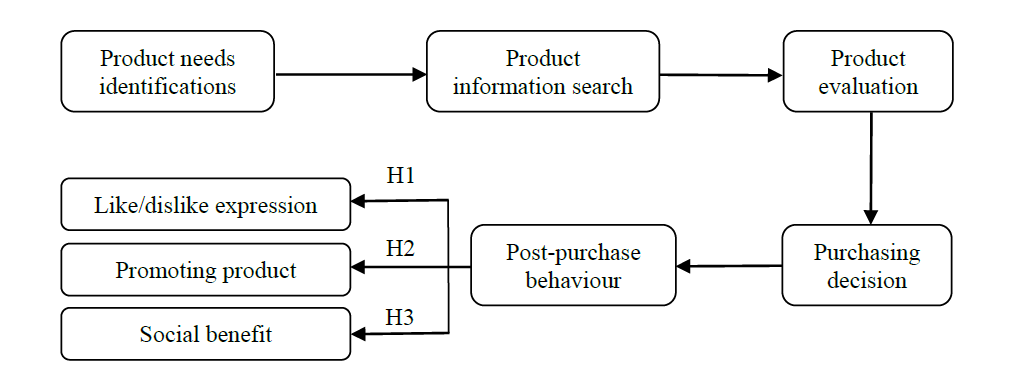
Having a modification of the CDM model, the study seeks to concern the last process (post-purchase behaviour) and extends with three constructs namely like and dislike expression, promoting the product voluntarily, and the gained social benefits. Figure 1 is the research framework that shows the employment of instruments and its sequence of consumer decision-making.
- H1: During the Covid-19 pandemic, there is an increase in the use of social media by consumers to express likes and dislikes of purchased product
- H2: During the COVID-19 pandemic, there is a significant movement promoting products voluntarily.
- H3: Consumers consciously promote products to help local industries to increase sales.
The target population addressed in this study is consumers in the Jabodetabek region who commonly utilize social media and e-commerce technologies to meet their needs for goods and services. The primary data desired outcome in the analytical procedure is 386 respondents, with a 95% confidence level.
Five dependent variables were employed to measure the degree to which respondents utilized social media before and during the pandemic which was adopted from Nicosia (1982). Those variables are: (1) Product needs identification; (2) Product information searches; (3) Product comparison and evaluation; (4) Product purchase; and (5) post-purchase expression. In this context, 13 questions were asked under 5 dimensions of consumer decision-making, and these instruments were adopted from Mason et al. (2021), but slightly modified with three additional questions on the post-purchase dimension to observe the social aspect of respondents in the social marketing aspect. Moreover, 5 points Likert scale was used to assess consumer behavior on pre and post-purchasing activity. The researchers proposed using a five-point Likert scale ranging from 'strongly agree' to strongly disagree' since it would lower the annoyance level of patient responders while increasing response rate and answer quality. For additional personal information, five questions were asked to collect demographic profiles of respondents.
The questionnaire was digitally spread out using WhatsApp chatting platform, Facebook, and Instagram applications in a Google form format. Initially, 440 data were collected but only 377 data were used in the analysis stage due to biased responses. In the data analysis stage, a paired sample t-test was utilized. This test is a component of the comparative hypothesis test, and its objective is to determine whether there is an average difference between two samples (two groups) that are correlated with one another (DeCoster, 2006).
Results and discussion
Data was collected through online questionnaires from 377 social media active users in Indonesia and analysed using a paired sample t-test. Table 1 summarizes the demographic information of respondents based on the analysis findings. The dominant age group was 20-25 years old, with 103 responses (27.3%), followed by 51 years and older with 78 respondents (20.7%). The age groups 41-45 years old and 46-50 years old, on the other hand, had the fewest responders, with 19 (5.0%) and 22 (5.8%), respectively.
Regardless of gender, female respondents made up over two-thirds of all respondents 238 (63.1%) compared to 139 (36.9%) male respondents. Another factor is education level, with over half of all responses being college level or as many as 167 respondents, followed by master's degree and high school level as many as 82 (21.8%) and 71 (18.8%) respectively. The doctorate education level had the fewest replies (23%) and was somewhat below the Diploma degree (34 respondents or 9%).
Table 1.
Profile of respondents
| Categories |
% |
|
Categories |
% |
|
| Age | < 20 years old |
10.9 |
Gender |
Male |
36.9 |
| 20 – 25 years old |
27.3 |
Female |
63.1 |
||
| 26 – 30 years old |
9.5 |
Education level |
> 15.000.000 |
11.9 |
|
| 31 – 35 years old |
12.2 |
High school |
18.8 |
||
| 36 – 40 years old |
8.5 |
Diploma |
9.0 |
||
| 41 – 45 years old |
5.0 |
Undergraduate |
44.3 |
||
| 46 – 50 years old |
5.8 |
Master’s degree |
21.8 |
||
| > 50 years old |
20.7 |
Doctoral degree |
6.1 |
Source: Derived from data analysis
In the hypotheses test analysis, the paired sample t-test is a component of the comparative hypothesis test, and its objective is to determine whether there is an average difference between two samples (two groups) that are correlated with one another (DeCoster, 2006). Before doing that, a Kolmogorov-Smirnov normality test was performed to determine if the data were normally distributed or not. Paired sample t-test aims to perceive whether the analyzed paired sample experiences significant changes. A significant value less than 0.05 shows there is a significant difference between pre-variable and post-variable. Conversely, if the significance value is more than 0.05, it means that there is not a significant difference between pre-variable and post-variable.
Table 2.
Paired sample t-test
|
Hypotheses |
Mean |
Std. Deviation |
Sig |
|
|
H1 |
Influencing others |
3.63 |
1.137 |
.000 |
|
H2 |
Satisfying |
3.89 |
1.024 |
.000 |
|
H3 |
Helping local SMEs |
4.42 |
.802 |
.000 |
Source: Derived from data analysis
Table 2 shows the construct that illustrates social behaviour represented by the willingness to influence others' intentions before purchasing products, expressing satisfaction with the purchased product, and the intention to help local SMEs. The analysis result revealed that the mean of influencing factors is significantly above the average with 3.63 points. The consumer is satisfied not only with the condition of expected products but also if they succeeded in influencing others to purchase the particular product with the computed value of 3.89 points. Lastly, the mean value of 4.42 illustrates that the surveyed consumers are intended to help local industries by carrying out this social behaviour in marketing movements. These findings are in line with the work of Mason et al. (2021) that marketplace opinion leaders can be generated from social media to improve consumer perception and build brand value. Jashari and Rrustemi (2017) further assert that shared experiences on a particular product by users can provide product-influencing stimuli such as photos, videos, and comments. Marketing activities through social media are believed to have satisfied consumers' emotional needs because they provide complete information before a purchase decision is made (Athwal et al., 2019). In addition, this study provides evidence that consumers voluntarily help to promote products to their networks and they are happy to do so.
Conclusion
The overall number of social media users worldwide is massive and increasing. Marketing programs via social media are broadly documented but fewer references are found that discuss social behaviour on marketing concepts. During the pandemic, this behaviour is growing as a result of commonalities in the circumstances of unfavorable economic conditions, causing individuals to desire to support other people's businesses through the power of words. The research aims to investigate social behaviour through social media platforms and how this behaviour has increased during the COVID-19 pandemic in Indonesia.
Adaptation has been made by consumers during the situation of pandemic as the result of policy implementation, what is interesting in this study is the element of human interaction that dominates customer purchasing decisions. Using the five phases of the consumer decision-making model, data analysis demonstrates that the increased activity on social media platforms during the pandemic COVID-19 is rather considerable compared to before the pandemic declaration. The significant values of all variables less than 0.005 (sig. 0.000) and higher estimated means from the paired sample t-test support these findings. However, the social marketing trend applies in the last step of the consumer-decision-making model (C-D-M), namely post-purchase behaviour, in which consumers who have purchased items or utilized a service express their thoughts and experiences on the social media platform's timeline or storyline. Customers who have made a purchase are voluntarily promoting goods or services that have been purchased as a movement to help sellers maintain their business activities and also to provide awareness to other people (in a positive way if they are satisfied and negative way if they dislike the goods purchased).
This specific concept of social behaviour in marketing is expected to make twofold practical contributions. The first is to develop trust in online buying and selling transactions, as well as to shield customers from the disadvantages of online trading, in which sellers and purchasers cannot meet in person to transact an item. This would also limit the number of fraudulent traders who solely utilize images obtained by legitimate traders. The other contribution is helping the small and medium enterprises as the real foundation of the economy through buying and selling activities in the real sector and re-absorb workers who have lost their jobs due to the impact of lockdown and stay-at-home policies during the pandemic of COVID-19. The more the public applies this movement, the more local businesses or SMEs have opportunities to be involved in the economy.
Meanwhile, on the theoretical side, this study provides an alternative insight in regard to the concept of social marketing where the main focus of this concept is not only to influence and change public behavior. Social marketing can be also applied in commercial industries in order to achieve broader social benefits in the field of trading. The basic objective of social marketing is intended to give benefit for either the entire or partial community (Rundle-Thiele et al., 2019).
References
Ahmad, A. H., Masri, R., Chong, C. V., Fauzi, R. U. A., & Idris, I. (2020). Evolution of technology and consumer behavior: The unavoidable impacts. Evolution, 7(11), 2020. http://dx.doi.org/10.31838/jcr.07.19.457
Appel, G., Grewal, L., Hadi, R., & Stephen, A. T. (2020). The future of social media in marketing. Journal of the Academy of Marketing Science, 48(1), 79-95. https://doi.org/10.1007/s11747-019-00695-1
Athwal, N., Istanbulluoglu, D., & McCormack, S. E. (2019). The allure of luxury brands’ social media activities: a uses and gratifications perspective. Information Technology & People, 32(3), 603-626. http://dx.doi.org/10.1108/ITP-01-2018-0017
Chen, X., & Qasim, H. (2021). Does E‐Brand experience matter in the consumer market? Explaining the impact of social media marketing activities on consumer‐based brand equity and love. Journal of Consumer Behaviour, 20(5), 1065-1077. http://dx.doi.org/10.1002/cb.1915
DeCoster, J. (2006). Testing group differences using t-tests, ANOVA, and nonparametric measures. Accessed November, 30(2010), 202006. http://www.stat-help.com/ANOVA%202006-01-11.pdf
Fouskas, K., Pachni-Tsitiridou, O., & Chatziharistou, C. (2020). A systematic literature review on e-commerce success factors. Strategic Innovative Marketing and Tourism: 8th ICSIMAT, Northern Aegean, Greece, 2019, 687-694. https://doi.org/10.1007/978-3-030-36126-6_76
Hanaysha, J. R. (2022). Impact of social media marketing features on consumer’s purchase decision in the fast-food industry: Brand trust as a mediator. International Journal of Information Management Data Insights, 2(2), 100102. https://doi.org/10.1016/j.jjimei.2022.100102
Indonesia, U. N. D. P., & LPEM, F. (2020). Impact of COVID-19 pandemic on MSMEs in Indonesia. Report. Jakarta: University of Indonesia.
Jashari, F., & Rrustemi, V. (2017). The impact of social media on consumer behavior–Case study Kosovo. Journal of Knowledge Management, Economics and Information Technology, 7(1), 1-21. http://dx.doi.org/10.2139/ssrn.2850995
Kotler, P., & Keller, K. L. (2008). Marketing management (13th ed.). Prentice Hall.
Kumar, S., Dhir, A., Talwar, S., Chakraborty, D., & Kaur, P. (2021). What drives brand love for natural products? The moderating role of household size. Journal of Retailing and Consumer Services, 58, 102329. http://dx.doi.org/10.1016/j.jretconser.2020.102329
Liu, Q., Zhang, X., Huang, S., Zhang, L., & Zhao, Y. (2020). Exploring consumers’ buying behavior in a large online promotion activity: The role of psychological distance and involvement. Journal of Theoretical and Applied Electronic Commerce Research, 15(1), 66-80. http://dx.doi.org/10.4067/S0718-18762020000100106
Mason, A. N., Narcum, J., & Mason, K. (2021). Social media marketing gains importance after Covid-19. Cogent Business & Management, 8(1), 1870797. https://doi.org/10.1080/23311975.2020.1870797
Nicosia, F. M. (1982). Consumer decision processes: A futuristic view. ACR North American Advances.
Rundle-Thiele, S., David, P., Willmott, T., Pang, B., Eagle, L., & Hay, R. (2019). Social marketing theory development goals: an agenda to drive change. Journal of Marketing Management, 35(1-2), 160-181. http://dx.doi.org/10.1080/0267257X.2018.1559871
Sirclo, R., & Ravenry, R. (2020). Navigating Indonesia’s e-commerce Covid-19 impact and the rise of social commerce. SIRCLO And Ravenry. https://www.sirclo.com/research-reports/navigating-indonesia-s-e-commerce-covid-19-impact-the-rise-of-social-commerce
Thota, S. C. (2021). What is brandjacking? Origin, conceptualization and effects of perceived dimensions of truth, mockery and offensiveness. International Journal of Advertising, 40(2), 292-310. http://dx.doi.org/10.1080/02650487.2020.1766232
Varghese, S., & Agrawal, M. (2021). Impact of social media on Consumer Buying Behavior. Saudi Journal of Business and Management Studies, 6(3), 51-55. http://dx.doi.org/10.36348/sjbms.2021.v06i03.001
Voramontri, D., & Klieb, L. (2019). Impact of social media on consumer behaviour. International Journal of Information and Decision Sciences, 11(3), 209-233. http://dx.doi.org/10.1504/IJIDS.2019.101994
[1]https://insight.sirclo.com/blog/2019/11/navigating-market-opportunities-in-indonesias-e-commerce [Accessed on 8 November 2022]

Page 1 of
Download Count : 116
Visit Count : 250
Keywords
Social Media; Post-Purchase; Marketing; Social Behavior; Pandemic; ISO


Author(s) Information



How to cite this article:
Baharuddin, G., Hilmiyah, N., Hubbansyah, A. K., & Syafiai, M. H. (2024). The Rise of Social Behavior in Social Media Marketing During Pandemic. European Journal of Studies in Management and Business, 30, 49-56. https://doi.org/10.32038/mbrq.2024.30.03
Acknowledgments
Not applicable.
Funding
Not applicable.
Conflict of Interests
No, there are no conflicting interests.
Open Access
This article is licensed under a Creative Commons Attribution 4.0 International License, which permits use, sharing, adaptation, distribution and reproduction in any medium or format, as long as you give appropriate credit to the original author(s) and the source, provide a link to the Creative Commons license, and indicate if changes were made. You may view a copy of Creative Commons Attribution 4.0 International License here: http://creativecommons.org/licenses/by/4.0/