





Original Research
Employee Happiness and Green Practices: A Case Study of Internal Corporate Social Responsibility


- Abstract
- Full text
- Metrics
The concept of Corporate Social Responsibility (CSR) has arisen as a result of due to the increase in pollution and excessive exploitation of the Earth's resources, as well as the human resources caused by the activities of companies that seek to make profits at any cost. As resources have become increasingly limited and human performance has decreased due to burnout, and also because current generations move from one job to another if they consider that the organizational environment does not provide them a certain degree of comfort, companies have had to adapt certain policies to support both the environment and employees. Thus, the role of the current research is to identify those components of internal CSR that impact employee happiness, as well ase components of internal CSR that impact employee happiness and green practices. In this sense, by applying a questionnaire addressed to a number of 123 respondents whose answers were imported into Smart PLS, it was wanted to validate the hypotheses according to which the variables work-life balance and equal opportunities, adaptability to change, and occupational health and safety have a role in defining employee happiness, as well as green practices within companies.
Employee Happiness and Green Practices: A Case Study of Internal Corporate Social Responsibility
Alexandra-Nicoleta Ciucu (Durnoi), Adina-Iuliana Jigani,
Andra Sandu, Camelia Delcea
Department of Economic Informatics and Cybernetics, Bucharest University of Economic Studies, Bucharest, Romania
Abstract:
The concept of Corporate Social Responsibility (CSR) has arisen as a result of due to the increase in pollution and excessive exploitation of the Earth's resources, as well as the human resources caused by the activities of companies that seek to make profits at any cost. As resources have become increasingly limited and human performance has decreased due to burnout, and also because current generations move from one job to another if they consider that the organizational environment does not provide them a certain degree of comfort, companies have had to adapt certain policies to support both the environment and employees. Thus, the role of the current research is to identify those components of internal CSR that impact employee happiness, as well ase components of internal CSR that impact employee happiness and green practices. In this sense, by applying a questionnaire addressed to a number of 123 respondents whose answers were imported into Smart PLS, it was wanted to validate the hypotheses according to which the variables work-life balance and equal opportunities, adaptability to change, and occupational health and safety have a role in defining employee happiness, as well as green practices within companies.
Introduction
The dynamic nature of our world requires continuous improvement and adaptability. Corporate social responsibility (CSR) and ecological practices have become more popular in the last few years, and their implementation is no longer an option but a necessity for all companies. Hence, enterprises need to prioritize social and environmental considerations in addition to financial ones (Epstein et al., 2012).
It was noticed that there is a direct relationship between green practices, CSR, employee happiness, and job satisfaction, respectively, and the success and financial performance of the businesses (Ciucu et al., 2024; Suganthi, 2019). Taking the employees' happiness as a key component helps reduce staff loss and aid in limiting workforce fluctuations while also enhancing employees’ loyalty, involvement, and satisfaction.
The commitment to environmental protection positively affects both the planet and the employees, who take pride in and feel fulfilled by their company's strong focus on sustainability (Mendes et al., 2022). The ecological practices implemented not only showcase a heightened sense of responsibility toward pressing issues like global warming but also reflect a collective aspiration to create a healthier living environment for everyone (Zhang et al., 2024). Furthermore, internal corporate social responsibility initiatives provide various benefits for a business, attracting the employees’ admiration and involvement, thereby making them feel valued (Jigani et al., 2024; Kocollari et al., 2023). By getting involved in cultural and health-related activities or events, adhering to the highest standards of ethics, and offering a transparent, safe, uncorrupted, and pleasant environment, the organization’s enduring competitiveness, its positive and favorable standing in the society (Ahmadi, 2024), together with the employees’ trustworthiness are guaranteed (Zaidi, 2024).
Some practices that can contribute to a company's long-term success and prosperity include the efficient management of available resources and waste, energy conservation, and reduction of carbon footprint, together with the presence of community partnerships, awareness campaigns, and active involvement in volunteering programs. The improved company’s reputation, employers’ loyalty and dedication, investors’ interest, and customers’ attraction are just a few benefits arising from the adoption of these strategies (Le, 2022).
Therefore, the present study aims to conduct an in-depth examination of the relationship between CSR components and ecological practices, as well as the employees’ level of happiness. Starting from a questionnaire that includes 123 participants and employing one of the most effective statistical modeling techniques, structural equation modeling, the researchers brought to light significant outcomes regarding the relationship between the aforementioned variables.
This paper is the result of considerable work and effort, offering a well-defined structure, along with a clear organization and division of the sections. The first chapter provides information about the topic addressed, while the second one focuses on the existing scientific literature, which more specifically includes the review of some valuable studies oriented to the same area but conducted by other academics. The next section presents the methodology used, followed by the interpretation of the results, discussions, implications, and possible future research directives.
The literature review
The researchers’ increased interest in this topic is further highlighted by the large number of publications associated with this subject matter throughout the scientific literature. It was noticed that many scientists have addressed in their studies the employees’ level of satisfaction and happiness, determined by corporate social responsibility (CSR) and green practices.
The study conducted by Barakagira and Paapa (2023) investigated the benefits and challenges of implementing green practices in a five-star hotel in Uganda, specifically in Kampala. Cost savings, increased profit, customer satisfaction, and loyalty are among the advantages revealed. The authors highlight the importance of enforcing green practices and the necessity of the government’s involvement.
Khattak et al. (2021) examine how employees’ perceptions of CSR impact their green behavior in the hospitality sector. For the analysis, a dataset was collected, including 485 survey responses from people working in this industry in Pakistan and Italy, and the results uncovered the positive impact of CSR on employees’ green behavior.
In a similar manner, the study conducted by Khairy et al. (2023) discusses the effect of environmental CSR on green perceived value and attitude. The paper focuses on the guests of a five-star hotel in Egypt and travel agencies (hospitality and tourism industries) and proves the CSR’s positive impact.
Furthermore, Mahmood et al. (2022) published a paper in the same area and further demonstrated how green practices influence hospitality employees’ well-being in a constructive manner. They also suggested possible strategies.
The research performed by Zhang and Liu (2023) explores the advantages generated by the implementation of CSR initiatives in Chinese companies and investigates their effect on financial performance as well as brand value. The results indicate a strong relationship between these variables and prove the major impact of CSR in enhancing the company’s overall performance.
The issue of higher pollution level is addressed in the paper by Qu and Sun (2024). The authors examine the severe impact of the rising pollution on the economy, together with the substantial influence that CSR has in this challenge, particularly for China. Multiple recommendations are additionally offered to the authorities, highlighting the significance of a healthy environment, a stable and sustainable economy, and the urgent adoption of ecological practices and CSR initiatives.
In the same style, the article by Zhao et al. (2020) explores the impact of CSR initiatives and financial strategies on the innovation of areas that are extremely polluting in China. It was observed that the amount of CSR activities influence the level of innovation in an organization. Apart from this, companies that are more oriented to financial markets and less on CSR initiatives tend not to have satisfactory results in terms of innovation. The authors further observed that the financial challenges may diminish the great impact of CSR on innovation and highlight the imperative need to implement CSR plans and green practices, especially in high-polluting companies, to protect the environment.
The paper belonging to Zhang et al. (2021) shows that the employees’ green behavior enhances their well-being, while strong organizational support further strengthens the relationship between those two. Raza discusses in his article (Raza, 2020) some hotels from Pakistan and draws valuable conclusions about the power of CSR, environmental factors, and their favorable contribution to the well-being of the employees and green behavior of quests. Another relevant paper in the same area is the one written by Rajabi et al. (2023), which uses data from Iran and elucidates the fact that transformational leadership and organizational identity have a significant positive impact on the green behavior of physical education teachers.
The article by Hou (2024) explores how CSR influences Chinese companies’ total productivity, considering various factors (e.g., regional differences, environmental regulations, ownership type, etc.).
Rela et al. (2020) investigate, using structural equation modeling, the association between environmental CSR (ECSR) and well-being, of the communities that live in Indonesia near nickel industries of mining and prove the positive impact that ECSR has on both the community and environment.
Following a similar approach to the one used in this paper, the manuscript written by Aleksandar et al. (2020) employs Smart PLS 3 for studying the impact of CSR on employees, businesses, and the environment in Serbia (more specifically Vojvodina), using some test data collected from corporate entities.
Other noteworthy papers that continue the discussions about CSR and green practices, are listed here, based on the topic addressed: de-carbonization of hospitality (Xu et al., 2022), education (Gigauri et al., 2021; Liu et al., 2019), human (Zhao et al., 2021), health (Ahmad et al., 2023; Droppert & Bennett, 2015), banking (Sun et al., 2020), tourism (Chung et al., 2019), marketing (Tare & Deshmukh, 2023), and media (Pujihartati et al., 2023).
The study
This section outlines the data collection process, research hypotheses, and the software employed to validate them. For the current research, a questionnaire with 36 questions was developed and distributed online through the Google form. The 123 answers provided were imported and processed in Excel in the format desired by the software used. Out of the 36 questions asked, 10 of them correspond to obtaining information about respondents. All other questions are in the form of the Likert scale, with answers ranging from 1 to 5, with one stating total disagreement and five agreeing totally. Although the questions were generated randomly, without giving respondents the opportunity to identify latent variables, three questions were asked to discover information about work-life balance and equal opportunities, and four were destined to identify the adaptability to change, another four about occupational health and safety, eight for green practices and seven to detect their degree of happiness.
Methodology
The articles that were the source of inspiration for the current research are those of Espasandín-Bustelo et al. (2020) and Gyensare et al. (2023), the first analyzing the relationship between internal CSR (composed of the variables work-life balance and equal opportunities, adaptability to change and occupational health and safety). In the case of the second article, the questions on green practices were studied and adapted to form the construct of the same name.
Research model
Research questions
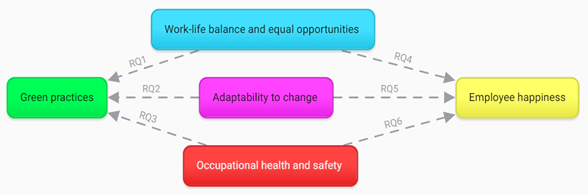
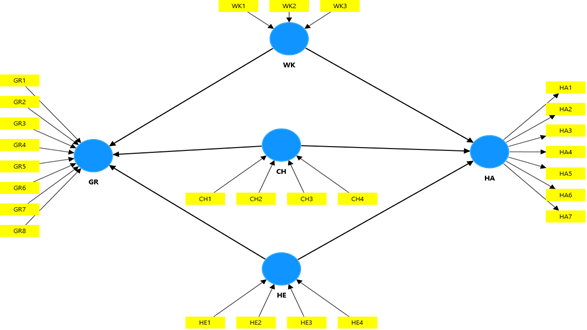
Thus, by adapting the questions from the two research, we arrived at the model presented in Figure 1, with a series of questions that will receive answers in the current study.
Green practices
· RQ1: Can work-life balance and equal opportunities influence the green practices within companies?
· RQ2: Can adaptability to change influence the green practices within companies?
· RQ3: Can occupational health and safety influence the green practices within companies?
Employee happiness
· RQ4: Can work-life balance and equal opportunities influence employee happiness?
· RQ5: Can adaptability to change influence employee happiness?
· RQ6: Can occupational health and safety influence employee happiness?
Constructs evaluation
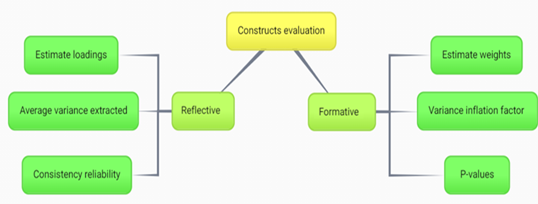
The model validation methodology applied in this study is derived from the approach outlined by Hair and Alamer (2022), which includes two steps: inner mode validation and outer mode validation. The validation of the outer model follows two distinct approaches depending on the construct type. Constructs are classified into two categories: reflective constructs and formative constructs. Over the years, researchers have developed various methodologies for validating reflective and formative constructs, as Hall and Shackman (2020) outlined in their paper "Formative Measurement Scale Development: An Example Using Generalized Structured Component Analysis". While the development of reflective scales involves standardized steps and statistical tests for assessing construct validity and internal consistency, the steps for formative scale development tend to be more subjective and rely heavily on the researcher's judgment (Hall & Shackman, 2020).
Formative constructs are considered an integral part of the construct itself. As Diamantopoulos and Winklhofer (2001) defined this “Omitting an indicator is equivalent to omitting a part of the construct”. This means that each indicator contributes uniquely to the conceptual domain of the formative construct, while the reflective construct operates on the principle that causality flows from the construct to the scale items. All items in a reflective construct are designed to capture the complete domain of the construct, and the overall meaning of the construct remains unchanged if any item is removed (Hall & Shackman, 2020). The main distinction between the two types is that formative constructs define the latent variable, while the reflective one is considered a manifestation of the variable (Diamantopoulos & Winklhofer, 2001; Guyon, 2018).
The assessment of formative constructs involves three steps: testing the size of indicator weights, testing the significance of indicator weights, and checking the multicollinearity indicator–Variance Inflation Factor (VIF) (Hair et al., 2021). The weights assigned to items in formative constructs are analogous to the beta coefficients found in a multiple regression model. As a result, these weights are generally smaller in magnitude than those obtained in reflective relationships. It is important to note that the significance of these weights is typically assessed at p ≤ .05, although a threshold of p ≤ .10 may be acceptable for smaller sample sizes. When a non-significant item is identified within a formative construct, researchers should not hastily discard it. Instead, the item should be evaluated based on its absolute contribution by examining its loading. If the item's loading is both statistically significant and ≥ .50 in magnitude, this provides empirical justification for retaining the item, as it makes a meaningful contribution to the formation of the construct (Hair & Alamer, 2022). Variance Inflation Factor (VIF) is employed to evaluate collinearity among all formative indicators. If the VIF exceeds 5, it indicates substantial collinearity among the indicators, which can lead to construct validity issues. Ideally, VIF values should be below 3 to avoid collinearity between indicators, although values ranging from 5 to 3 may still be deemed acceptable if they are theoretically justified (Cardella et al., 2021). When encountering high multicollinearity, researchers may consider removing one of the indicators from the analysis to mitigate the issue (Kyriazos & Poga, 2023).
The assessment of reflective constructs involves the following steps: estimating the loadings and their p-values, calculating the Average Variance Extracted (AVE), and examining internal consistency reliability (Hair & Sarstedt, 2019). It is recommended that indicator loadings should be approximately .70 and statistically significant at .05 or below (equivalent to a t-statistic of ± 1.96) (Cheung et al., 2024). The Average Variance Extracted (AVE) measures the degree to which items within a construct positively correlate and share a significant amount of variance. AVE values of 0.50 or higher are generally considered to demonstrate convergent validity for the construct (Jigani et al., 2020). In other words, an AVE of 0.50 or greater suggests that, on average, the construct explains more than half of the variance in its indicators. This indicates that the items within the construct are strongly related and measure the same underlying concept. Internal consistency reliability is assessed using Cronbach’s alpha (𝛼) and Composite Reliability (CR). A threshold of 0.70 for both metrics is generally considered acceptable and is commonly employed in PLS-SEM (Taber, 2018).
Results
The study analyzes the perception of Romanian employees regarding the ability of CSR components to impact employee happiness, as well as the implementation of green practices in enterprises. Regarding the respondents, it can be stated that the majority of respondents were women, with approximately three-quarters of the respondents declaring themselves to be female, approximately 40% of the respondents being in the age range of 21-30 years, and 22% belonging to the 31-40 years category. Also, over 65% of the respondents live in the urban environment, while 43.1% are employed in the private sector and only 13% in the public sector. Additionally, when asked if CSR policies influence their decision to apply for a new job, approximately 40% of them said they would take this information into account when deciding.
Based on the research questions formulated in methodology, the model illustrated in Figure 3 was built, in which the constructs and the questions that comprise them are presented. The first step in validating the model consisted of assessing collinearity for the formative indicators, checking if the VIF values exceed the threshold of 5, thus eliminating questions GR1 and GR4. After eliminating these questions, the next step consisted in checking the statistical significance of the weights by comparing the p-values associated with them with the significance threshold of 0.05; this step being possible by applying the Bootstrapping algorithm. Thus, those variables were eliminated for which the p-values exceeded the value of 0.05 (Hair & Alamer, 2022), these variables being HE2, GR2, CH3, WH3, HE1; thus reaching the final model in Figure 4. It should be noted that after abolishing each variable, the algorithm is restarted to recalculate the new values.
Initial model
Proposed model
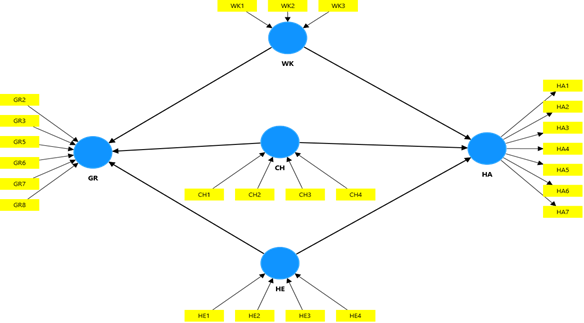
From Table 1, it can be noted that the p-values associated with the remaining formative variables are below the 0.05 threshold, while the VIF presents values lower than five, with most even values lower than three.
In the case of reflective variables, the loading values should exceed the threshold of 0.7, a fact that is validated for all seven questions. Also, it is desirable for AVE or CR to exceed 0.7, noting that the AVE value is 0.820, while the CR value is 0.963.
Assessment of model variables
|
Construct |
Item |
Scale |
Loadings/Weights |
AVE/P-values |
CR/VIF |
|
Adaptability to change |
CH1 |
Formative |
0.253 |
0.032 |
2.136 |
|
CH2 |
0.443 |
0.003 |
2.592 |
||
|
CH4 |
0.421 |
0.000 |
2.255 |
||
|
Occupational health and safety |
HE3 |
Formative |
0.504 |
0.000 |
2.104 |
|
HE4 |
0.573 |
0.000 |
2.104 |
||
|
Work-life balance and equal opportunities |
WK1 |
0.532 |
0.000 |
2.062 |
|
|
WK2 |
0.547 |
0.000 |
2.062 |
||
|
Green practices |
GR3 |
Formative |
0.551 |
0.000 |
3.554 |
|
GR5 |
0.312 |
0.013 |
3.810 |
||
|
GR7 |
0.610 |
0.000 |
2.784 |
||
|
GR8 |
-0.382 |
0.010 |
4.310 |
||
|
Employee Happiness |
HA1 |
Reflective |
0.858 |
0.820 |
0.963 |
|
HA2 |
0.907 |
||||
|
HA3 |
0.887 |
||||
|
HA4 |
0.916 |
||||
|
HA5 |
0.936 |
||||
|
HA6 |
0.927 |
||||
|
HA7 |
0.906 |
The next step consisted of evaluating the formulated hypotheses, finding that only Occupational health and safety influences Green practices, while the only construct that does not influence, based on the answers received, Employee happiness is Adaptability to change. This study seeks to explore the intricate relationships among variables presented in Table 2. A corresponding hypothesis has been meticulously formulated to address each research question systematically. These hypotheses are detailed in Table 2 below, providing a structured framework for the investigation.
Hypothesis results
|
Hypothesis |
Relationship |
P values |
Decision |
|
H1 |
Work-life balance and equal opportunities-> Green practices |
0.199 |
Not accepted |
|
H2 |
Adaptability to change -> Green practices |
0.543 |
Not accepted |
|
H3 |
Occupational health and safety -> Green practices |
0 |
Accepted |
|
H4 |
Work-life balance and equal opportunities -> Employee happiness |
0 |
Accepted |
|
H5 |
Adaptability to change -> Employee happiness |
0.133 |
Not accepted |
|
H6 |
Occupational health and safety -> Employee happiness |
0.046 |
Accepted |
Except that half of the model's hypotheses were not validated, the components that internally encapsulate CSR explain 66.4% of the Green practices variance and 63.2% of the Employee happiness variance (Table 3).
R-square variance determination
|
R-square |
|
|
Green practices |
0.664 |
|
Employee happiness |
0.632 |
Based on the hypothesis tests conducted in this study, it can be concluded that this research highlighted three main points. First, Occupational health and safety (OSH) plays a significant role in predicting Employee happiness. Second, Work-life balance and equal opportunities has a significant impact on Employee happiness. Third, Occupational health and safety (OSH) significantly impacts Green Practices.
Discussion
Given the positive impact of occupational health and safety on employee happiness, companies could consider increasing their employees' happiness by adopting international labor standards and codes of practice. One of the most challenging yet crucial policies to implement is prevention. Improving working conditions will positively impact employee well-being by preventing occupational accidents and work-related diseases. Core OSH principles were identified and presented by the International Labour Organization in the book “Fundamental Principles of Occupational Health and Safety” written by Benjamin O. Alli in 2001 and revised in 2008 (Alli, 2001). There were identified principles such as all workers have rights; continuous improvement of occupational safety and health must be promoted; workers, employers, and competent authorities have certain responsibilities, duties, and obligations; education and training are vital components of safe, healthy working environments; occupational safety and health policies must be established; a national system for occupational safety and health must be established. These principles emphasize the importance of collaboration among policymakers, employers, and employees in decision-making processes. Working in a safer environment involves stakeholders meticulously minimizing job-related risks, including chemical, electrical, mechanical, environmental, and biological hazards, as well as pollution—an often unseen but persistent risk in industries such as construction, manufacturing, agriculture, oil and gas, textile and garment, healthcare, automotive, and power generation. Adopting robust policies will undoubtedly enhance employee well-being and foster greater trust in their employers.
In a report conducted by Aviva (Working Lives Report, 2024) – one of the largest insurance providers in the UK, 1001 full or part-time employees aged 16+ and 203 18+ employers were interviewed. 67% of employers believe their staff are happier due to the opportunity to work from home (WFH), and 63% think that remote work aids in attracting new employees. Additionally, 41% of respondents said that working from home helps them better manage their work-life balance, while 33% feel that it increases productivity. Two Aviva’ studies were also conducted in 2019 and 2022; there are important differences between the results, while in 2022, 57% of respondents said that WFH makes them feel happier 2023, only 44% felt happier.
Green practices were considered an important component of CSR in this research, and integrating green practices into business operations showcases a company's dedication to environmental stewardship and sustainability. This approach aligns with the core principles of CSR, which emphasize the responsibility to minimize negative environmental impacts. Stakeholders—customers, investors, and employees—increasingly expect companies to prioritize sustainability and implement green practices as part of their CSR initiatives. The acknowledgment that environmental factors can impact human health dates to at least the thirteenth century. During this time, the King of England prohibited the burning of sea-coal in London, deeming it "prejudicial to health". Nowadays, most countries enforce forms of environmental regulation. The primary motivation for environmental regulation is human health (Graff Zivin & Neidell, 2013). A well-known documented case is the case of Karen Silkwood, a worker at the Kerr-McGee Cimarron Fuel Fabrication Site in Crescent (Annas, 1984). This case involves radiation contamination and illustrates the severe consequences of environmental hazards in the workplace and the subsequent adoption of stricter safety and green practices. In 1974, Karen Silkwood was contaminated with plutonium during her daily job activities; she reported to the plant’s health physics office, and after further investigation, it was proven that her apartment was also contaminated. A few days after the report, Karen was killed in a car accident (Annas, 1984). Upon Karen’s death, The Nuclear Regulatory Commission (NRC) and the Occupational Safety and Health Administration (OSHA) implemented more stringent regulations for handling radioactive materials and ensuring worker safety.
A recent study published by Kiran and Khurram (2019) revealed a statistically significant positive correlation between the adoption of flexitime arrangements and employee happiness. The findings of this research underscore the significance of flexitime as a key component in facilitating a harmonious work-life balance and promoting equal opportunities in the workplace.
The findings of Schaufeli and Bakker (2004) and van der Klink et al. (2001) are corroborated by the current study, underscoring the substantial influence of occupational health and safety on employee happiness. Specifically, high levels of job strain, low job control, and insufficient social support are detrimental to employee well-being, whereas organizational initiatives that prioritize employee well-being yield positive outcomes.
The research findings could play a crucial role in developing institutional policies focused on improving job quality, which is in line with the United Nations' social policy agenda as articulated in the Sustainable Development Goals.
Implications
The results of the current study are consistent with previous research, and this study makes several contributions to the literature. A longitudinal study by Lari (2024) found that OSH interventions can contribute to a better workplace atmosphere and significantly increase employee satisfaction and productivity. The research study conducted by Sarmuji (Sarmuji & Aryani, 2019) highlighted that OSH has a direct impact on Job Satisfaction and Employee Performance constructs that were included in Employee Happiness questions. The study conducted by Patil and Kumawat (2023) in the banking sector concluded that employees who maintain a balance between their work and personal lives experience significant improvements in their physical, emotional, and mental well-being. Elnanto and Suharti (2021) also emphasize the importance of work-life balance, demonstrating its positive and significant impact on employee happiness. Their study shows that happiness increases when work and life domains are well balanced. Similar research conducted on 250 employees in Turkey yielded results consistent with this study, revealing a positive relationship between work-life balance and happiness (Ötken, 2013). Therefore, achieving work-life balance and offering flexibility can foster a positive working environment, ultimately leading to greater happiness among employees. Bautista-Bernal et al. (2021) conducted a bibliometric analysis of 289 articles published between 1995 and 2018. The study revealed a significant increase in the number of publications from 2013 to 2018, highlighting growing interest in exploring the relationship between Occupational Safety and Health and Corporate Social Responsibility (CSR).
Practical implications may consider management policies that actively support employees in managing both their professional and personal lives, implementing flexible work arrangements based on employee feedback can contribute to increased productivity and satisfaction, organizations may prioritize improving workplace safety to reduce employees’ perceptions of occupational health risks, conducting regular assessments of the work environment can help identify potential health risks and areas for improvement.
Suggestions for Further Research
This case study on the relationship between employee happiness and green corporate practices opens up several avenues for further research in the domain of internal corporate social responsibility (ICSR). For future research, the authors would like to identify the impact of sustainable management practices on mitigating burnout and increasing workplace performance.
Since the current generations are prone to change jobs frequently, we would also like to observe the implications of corporate social responsibility on job satisfaction and employee loyalty regarding the business in which they operate.
Researchers may consider for future explorations including organizations across different cultural contexts, which would allow for cross-cultural comparisons. Cultural values and regional environmental regulations may influence the relationship between employee happiness and green practices. Conducting comparative studies in diverse cultures could provide a more comprehensive understanding of this phenomenon.
References
Ahmad, N., Ullah, Z., Ryu, H. B., Ariza-Montes, A., & Heesup, H. (2023). From corporate social responsibility to employee well-being: navigating the pathway to sustainable healthcare. Psychology Research and Behavior Management, 16, 1079-1095. https://doi.org/10.2147/PRBM.S398586
Ahmadi, M. A. (2024). Positive outcomes of corporate social responsibility for companies and society. IIARD International Journal of Economics and Business Management (IJEBM), 10(2). https://doi.org/10.56201/ijebm.v10.no2.2024.pg74.87
Aleksandar, G., Berber, N., Aleksić, M., & Bjekić, R. (2020). The influence of corporate social responsibility on organizational performance: A research in ap vojvodina. Anali Ekonomskog Fakulteta u Subotici, 43, 3-13. https://doi.org/10.5937/AnEkSub2001003G
Alli, B. O. (2001). Fundamental principles of occupational health and safety. International Labour Office.
Annas, G. J. (1984). The case of karen silkwood. American Journal of Public Health (AJPH), 74(5), 516-518. https://doi.org/10.2105/AJPH.74.5.516
Barakagira, A., & Paapa, C. (2023). Green practices implementation for environmental sustainability by five-star hotels in kampala, uganda. Environment, Development and Sustainability, 26, 9421-9437. https://doi.org/10.1007/s10668-023-03101-7
Bautista-Bernal, I., Quintana-García, C., & Marchante-Lara, M. (2021). Research trends in occupational health and social responsibility: a bibliometric analysis. Safety Science, 137, 105167. https://doi.org/10.1016/j.ssci.2021.105167
Cardella, G. M., Hernández-Sánchez, B. R., & Sánchez-García, J. C. (2021). Development and validation of a scale to evaluate students’ future impact perception related to the coronavirus pandemic (c-19fips). PloS One, 16(11), e0260248. https://doi.org/10.1371/journal.pone.0260248
Cheung, G. W., Cooper-Thomas, H. D., Lau, R. S., & Wang, L. C. (2024). Reporting reliability, convergent and discriminant validity with structural equation modeling: a review and best-practice recommendations. Asia Pacific Journal of Management, 41(2), 745-783. https://doi.org/10.1007/s10490-023-09871-y
Chung, N., Tyan, I., & Lee, S. J. (2019). Eco-innovative museums and visitors’ perceptions of corporate social responsibility. Sustainability, 11(20). https://doi.org/10.3390/su11205744
Ciucu (Durnoi), A. N., Jigani, A. I. Cibu, B., Sandu, A., & Delcea, C. (2024). Greening the workplace for happiness: exploring CSR’s and sustainable practice’s effects on employees well-being. In Proceedings of 23rd International Conference on Informatics in Economy (ie 2024), Timişoara.
Diamantopoulos, A., & Winklhofer, H. (2001). Index construction with formative indicators: an alternative to scale development. Journal of Marketing Research, 38(2), 269-277. https://doi.org/10.1509/jmkr.38.2.269.18845
Droppert, H., & Bennett, S. (2015). Corporate social responsibility in global health: an exploratory study of multinational pharmaceutical firms. Globalization and Health, 11. https://doi.org/10.1186/s12992-015-0100-5
Elnanto, J. G., & Suharti, L. (2021). The impact of work from home to work-life-balance and its implication to employee happiness: the moderating role of organizational support. International Journal of Social Science and Business, 5(3). https://doi.org/10.23887/ijssb.v5i3.35325
Epstein, M. J., Buhovac, A. R., & Yuthas, K. (2012). Managing social, environmental and financial performance simultaneously. Long Range Planning, 48(1), 35-45. https://doi.org/10.1016/j.lrp.2012.11.001
Espasandín-Bustelo, F., Ganaza-Vargas, J., & Diaz-Carrion, R. (2020). Employee happiness and corporate social responsibility: the role of organizational culture. Employee Relations, 43(3), 609-629. https://doi.org/10.1108/ER-07-2020-0343
Gigauri, I., Panait, M., & Palazzo, M. (2021). Teaching corporate social responsibility and business ethics at economic programs. 2nd International Conference Global Ethics - Key of Sustainability (Gekos). https://doi.org/10.18662/lumproc/gekos2021/3
Graff Zivin, J., & Neidell, M. (2013). Environment, health, and human capital. Journal of Economic Literature, 51(3), 689-730. https://doi.org/10.1257/jel.51.3.689
Guyon, H. (2018). The fallacy of the theoretical meaning of formative constructs. Frontiers in Psychology, 9, 179. https://doi.org/10.3389/fpsyg.2018.00179
Gyensare, M. A., Adomako, S., & Amankwah-Amoah, J. (2023). Green hrm practices, employee well-being, and sustainable work behavior: examining the moderating role of resource commitment. Business Strategy and the Environment, 33(4), 3129-3141. https://doi.org/10.1002/bse.3642
Hair, J., & Alamer, A. (2022). Partial least squares structural equation modeling (pls-sem) in second language and education research: guidelines using an applied example. Research Methods in Applied Linguistics, 1(3), 100027. https://doi.org/10.1016/j.rmal.2022.100027
Hair, J., Hult, G. T. M., Ringle, C., Sarstedt, M., Danks, N., & Ray, S. (2021). Partial least squares structural equation modeling (pls-sem) using r: a workbook.
Hair, J., & Sarstedt, M. (2019). Factors vs. Composites: guidelines for choosing the right structural equation modeling method. Project Management Journal, 50(6). https://doi.org/10.1177/8756972819882132
Hall, D., & Shackman, J. D. (2020). Formative measurement scale development: an example using generalized structured component analysis. The Electronic Journal of Business Research Methods, 18(1), 1. https://doi.org/10.34190/JBRM.18.1.002
Hou, J. (2024). How does corporate social responsibility affect corporate productivity? The role of environmental regulation. Sustainability, 16(15). https://doi.org/10.3390/su16156426
Jigani, A. I., Ciucu-Durnoi, A. N., Delcea, C., & Chiriță, N. (2024). Towards sustainable happiness: examining the impact of CSR on employee well-being. In Proceedings of the 18th International Conference on Business Excellence 2024.
Jigani, A. I., Delcea, C., & Ioanăș, C. (2020). Consumers’ behavior in selective waste collection: a case study regarding the determinants from Romania. Sustainability, 12(16). https://doi.org/10.3390/su12166527
Khairy, H. A., Elzek, Y., Aliane, N., & Agina, M. F. (2023). Perceived environmental corporate social responsibility effect on green perceived value and green attitude in hospitality and tourism industry: the mediating role of environmental well-being. Sustainability, 15(7). https://doi.org/10.3390/su15064746
Khattak, S. R., Nouman, M., Fayaz, M., Cismaș, L. M., Negruț, L., Negruț, C. V., & Salem, S. (2021). Corporate social responsibility and employee green behavior in the hospitality industry: a cross-country study. Sustainability, 13(19). https://doi.org/10.3390/su131910534
Kiran, M., & Khurram, S. (2018). Flexitime and employee happiness at workplace: A quantitative study of software houses. Pakistan Journal of Commerce and Social Sciences (PJCSS), 12(3), 1008-1024. https://hdl.handle.net/10419/193457
Kocollari, U., Cavicchioli, M., & Demaria, F. (2023). The 5 E(lements) of employee-centric corporate social responsibility and their stimulus on happiness at work: an empirical investigation. Corporate Social Responsibility and Environmental Management, 31(3). https://doi.org/10.1002/csr.2667
Kyriazos, T., & Poga, M. (2023). Dealing with multicollinearity in factor analysis: the problem, detections, and solutions. Open Journal of Statistics, 13(3). https://doi.org/10.4236/ojs.2023.133020
Lari, M. (2024). A longitudinal study on the impact of occupational health and safety practices on employee productivity. Safety Science, 170(106374). https://doi.org/10.1016/j.ssci.2023.106374
Le, T. T. (2022). How do corporate social responsibility and green innovation transform corporate green strategy into sustainable firm performance? Journal of Cleaner Production 362(6), 132228. https://doi.org/10.1016/j.jclepro.2022.132228
Liu, H., Peng, F., Zeng, X., Zhao, J., & Zhang, X. (2019). Authoritarian personality and subjective well-being in Chinese college students: the moderation effect of the organizational culture context. Personality and Individual Differences, 138, 79-83. https://doi.org/10.1016/j.paid.2018.09.030
Mendes, T., Pereira, L., Gonçalves, R., Dias, A., & Da Costa, R. L. (2022). Sustainable practices impacting employee engagement and well-being. Progress in Industrial Ecology An International Journal, 15(2/3/4), 239-267. https://doi.org/10.1504/PIE.2022.125618
Mahmood, F., Saleem, M., Ariza-Montes, A., & Han, H. (2022). Green attitudes, human values, and well-being among hospitality service employees. International Journal of Mental Health Promotion, 24(6), 917-932. https://doi.org/10.32604/ijmhp.2022.019452
Ötken, A. B., & Erben, G. S. (2013). The relationship between work-life balance and happiness from the perspectives of generation X and Y. Humanities and Social Sciences Review, 2(4), 45-53.
Patil, M., & Kumawat, A. (2023). Work-life balance: a study of physical & mental well-being of employees in the banking sector. Urban India, 43(2), 561-570.
Pujihartati, S. H., Nurhaeni, I. D. A., Kartono, D. T., & Demartoto, A. (2023). New media and green behaviour campaign through corporate social responsibility collaboration. Jurnal Komunikasi: Malaysian Journal of Communication, 39(2), 325-337. https://doi.org/10.17576/JKMJC-2023-3902-18
Qu, W., & Sun, N. (2024). Does CSR improve the quality of economic growth? Based on the perspective of green innovation. Sustainability, 16(15). https://doi.org/10.3390/su16156617
Rajabi, M., Ghaderi, Z., Abdollahnezhad, F., & Mahdavizadeh, M. J. (2023). The effect of transformational leadership style and organizational identity on employees’ green behavior with the mediating role of well-being. Iranian Journal of Management Studies (IJMS), 16(3), 667-680. https://doi.org/10.22059/IJMS.2022.339144.674980
Raza, S. A. (2020). Impact of CSR and environmental triggers on employee green behavior: the mediating effect of employee well-being. Corporate Social Responsibility and Environmental Management, 27(5), 2225-2239. https://doi.org/10.1002/csr.1960
Rela, I. Z., Awang, A. H., Zaimah, R., Sum, M. S., & Meisanti, M. (2020). Effects of environmental corporate social responsibility on environmental well-being perception and the mediation role of community resilience. Corporate Social Responsibility and Environmental Management, 27(5), 2176-2187. https://doi.org/10.1002/csr.1956
Sarmuji, A. L., & Aryani, D. N. (2019). Effect of occupational safety and health, and work environment on performance with job satisfaction as an intervening variable (study of employees of Kebon Agung sugar factory, Malang). International Journal of Business and Management Invention (IJBMI), 8(12), 48-53. https://www.ijbmi.org/papers/Vol(8)12/Series-2/F0812024853.pdf
Schaufeli, W. B., & Bakker, A. B. (2004). Job demands, job resources, and their relationship with burnout and engagement: A multi-sample study. Journal of Organizational Behavior, 25(3), 293-315. https://doi/10.1002/job.248
Suganthi, L. (2019). Examining the relationship between corporate social responsibility, performance, employees’ pro-environmental behavior at work with green practices as mediator. Journal of Cleaner Production, 232, 739-750. https://doi.org/10.1016/j.jclepro.2019.05.295
Sun, H., Rabbani, M. R., Ahmad, N., Safdar Sial, M., Cheng, G., Zia-Ud-Din, M., & Fu, Q. (2020). Csr, co-creation and green consumer loyalty: Are green banking initiatives important? A moderated mediation approach from an emerging economy. Sustainability, 12(24). https://doi.org/10.3390/su122410688
Taber, K. S. (2018). The use of cronbach’s alpha when developing and reporting research instruments in science education. Research in Science Education, 48(6), 1273-1296. https://doi.org/10.1007/s11165-016-9602-2
Tare, H., & Deshmukh, P. (2023). Green marketing and corporate social responsibility: A review of business practices. Multidisciplinary Reviews, 2(1), 1-9. https://doi.org/10.31893/multirev.2024059
van der Klink, J. J., Blonk, R. W., Schene, A. H., & van Dijk, F. J. (2001). The benefits of interventions for work-related stress. American Journal of Public Health, 91(2), 270–276. https://doi.org/10.2105/ajph.91.2.270
Working Lives Report. (2024). Accessed: Jul. 26, 2024. [Online]. Available: https://www.aviva.co.uk/business/workplace-wellbeing/fit-for-future/
Xu, L., Mohammad, S. J., Nawaz, N., Samad, S., Ahmad, N., & Comite, U. (2022). The role of CSR for de-carbonization of hospitality sector through employees: a leadership perspective. Sustainability, 14(9). https://doi.org/10.3390/su14095365
Zaidi, U. (2024). CSR and employee happiness: a systematic review and critique of organizational cultures for employee satisfaction. Open Journal of Social Sciences, 12(4), 440-457. https://doi.org/10.4236/jss.2024.124030
Zhao, F., Kusi, M., Chen, Y., Hu, W., Ahmed, F., & Sukamani, D. (2021). Influencing mechanism of green human resource management and corporate social responsibility on organizational sustainable performance. Sustainability, 13(16). https://doi.org/10.3390/su13168875
Zhao, X. Z., Chen, J., Chen, F. W., Wang, W., & Xia, S. (2020). How high-polluting firms suffer from being distracted form intended purpose: a corporate social responsibility perspective. International Journal of Environmental Research and Public Health, 17(24), 9197. https://doi.org/10.3390/ijerph17249197
Zhang, B., Yang, L., Cheng, X., & Chen, F. (2021). How does employee green behavior impact employee well-being? An empirical analysis. International Journal of Environmental Research and Public Health, 18(4), 1669. https://doi.org/10.3390/ijerph18041669
Zhang, J., & Liu, Z. (2023). The impact of corporate social responsibility on financial performance and brand value. Sustainability, 15(24). https://doi.org/10.3390/su152416864
Zhang, Y., Dong, Y., Zhang, Y., Wang, R., & Jiang, J. (2024). Can organizations shape eco-friendly employees? Organizational support improves pro-environmental behaviors at work. Journal of Environmental Psychology, 93. https://doi.org/10.1016/j.jenvp.2023.102200

Page 1 of
Download Count : 36
Visit Count : 598
Keywords
Well-Being; Green Economy; CSR; Smart PLS 4


Author(s) Information


How to cite this article:
Ciucu, A.N., Jigani, A.I., Sandu, A.,& Delcea, C. (2024). Employee happiness and green practices: A case study of internal corporate social responsibility. International Journal of Behavior Studies in Organizations, 11, 23-37. https://doi.org/10.32038/JBSO.2024.11.03
Acknowledgments
This study was co-financed by The Bucharest University of Economic Studies during the PhD program. The work is supported by a grant of the Romanian Ministry of Research, Innovation and Digitalization, project CF 178/31.07.2023—‘JobKG—A Knowledge Graph of the Romanian Job Market based on Natural Language Processing’.
Funding
Not applicable.
Conflict of Interests
No, there are no conflicting interests.
Open Access
This article is licensed under a Creative Commons Attribution 4.0 International License, which permits use, sharing, adaptation, distribution and reproduction in any medium or format, as long as you give appropriate credit to the original author(s) and the source, provide a link to the Creative Commons license, and indicate if changes were made. You may view a copy of Creative Commons Attribution 4.0 International License here: http://creativecommons.org/licenses/by/4.0/