






Original Research
Strategy to Decrease Counterproductive Work Behavior: Implementation of Interpretive Structural Modeling


- Abstract
- Full text
- Metrics
This study aims to analyze the determinant factors of Counterproductive Work Behavior (CWB) to make plan strategies for overcoming Counterproductive Work Behavior. This research used the Interpretative Structural Modeling (ISM) method. The ISM method is able to show the interrelationships between existing elements. This method can be developed to plan strategic human resource management policies related to CWB. The strategy for managing human resources related to CWB in automotive companies in Bekasi is carried out according to the level of importance based on a problem. The results showed that it is necessary to overcome Counterproductive Work Behavior by handling job stress (Task demands, Role demands, Family problems, and Economic problems) and role ambiguity (Clarity of Responsibilities, Clarity of goals, and Clarity of roles and scope of work).
Strategy to Decrease Counterproductive Work Behavior: Implementation of Interpretive Structural Modeling
Hermansyah*, Didik Notosudjono , Nancy Yusnita
Faculty of Management Science, Pakuan University, Bogor Indonesia
| Abstract |
This study aims to analyze the determinant factors of Counterproductive Work Behavior (CWB) to make plan strategies for overcoming Counterproductive Work Behavior. This research used the Interpretative Structural Modeling (ISM) method. The ISM method is able to show the interrelationships between existing elements. This method can be developed to plan strategic human resource management policies related to CWB. The strategy for managing human resources related to CWB in automotive companies in Bekasi is carried out according to the level of importance based on a problem. The results showed that it is necessary to overcome Counterproductive Work Behavior by handling job stress (Task demands, Role demands, Family problems, and Economic problems) and role ambiguity (Clarity of Responsibilities, Clarity of goals, and Clarity of roles and scope of work). |
Keywords: Workload, Role Ambiguity, Conflict, Job Stress, Counterproductive Work Behavior, ISM
Introduction
The automotive industry is one of the largest industries and its development is very fast in various developing countries, one of which is Indonesia. Every year this industry has very good and very promising developments so this industry is made one of the most reliable industries to make a very large contribution to the Indonesian economy. It was recorded that in the period January - April 2021, the Indonesian automotive industry sector was ranked 6th in non-oil and gas exports with a value of US$3.13 (US) or equivalent to Rp.44.6 trillion. The automotive industry also makes a huge contribution to the economy of Indonesia. However, in reality, the production of this automotive industry experiences fluctuations. The occurrence of fluctuations in production is of course influenced by many factors, one of which is work stress. This is reinforced by the statement of Donald et al. (2005), that psychological well-being, which is influenced by stressors in the workplace, has been identified as the biggest predictor of self-assessed employee productivity. The relationship between stress and productivity suggests that greater stress correlates with less employee productivity. (VanWormer et al., 2011). However, few studies have examined productivity at a worksite in relation to stress (Bui et al., 2021). While, stress is the result of work factors such as expectations required that do not match the abilities of employees, resources, needs, and job demands (Saranani et al, 2022).
Several studies have proven that work stress can be an important predictor of employee behavior at work (Silva & Ranasinghe, 2017; Raza et al., 2017). This behavior can be positive because stress creates conditions for a dynamic work environment as a result of the parties adjusting to challenges in the internal and external environment of the organization (Muhdar, 2012). However, it is not uncommon for the impact to be negative. The behavior that has a negative impact is known as Counterproductive Work Behavior. Counterproductive work behavior is a term that refers to employee behavior that is "harmful to the organization by directly affecting the function or role in the organization, or by hurting employees in a way that will reduce employee effectiveness (Klotz & Buckley, 2013).
Counterproductive work behavior occurs due to reactions to work stress and other factors that can cause negative emotions. The other factor in question is Role stressors (conflict, workload, and role ambiguity). This is reinforced by several studies which state that there is a link between work stress and Counterproductive Work Behavior, including Ma and Li (2019), Mahdi et al. (2018), Mahadiputra and Piartrini (2021) and several other studies using job stress as a mediating variable (Hasanati et al., 2018) and even other studies separating dimensions in job stressors (burden work, conflict and role ambiguity) as separate variables (Zin et al., 2017; Zhang et al., 2019; Ahmad et al., 2021; Sutarmin et al, 2022).
Based on phenomena and previous research, the study's purpose was focused on the predictive effects of Role stressors (workload, role ambiguity, role conflict) on job stress and the degree of Counterproductive Work Behavior. This kind of study may be influential to administrators for better long-term achievements employed in the automotive industry. The study identifies role stressors issues that influence the Counterproductive Work Behavior of automotive employees. For this research, the automotive sector was selected because this sector has been constantly recognized as a group of having high stress at work. Consequently, the problem will be investigated in this study to find out whether a relationship exists among role stressors (role conflict, role ambiguity), job stress, and Counterproductive Work Behavior in the private automotive sector as well as to find out the greater interaction of the four variables with Counterproductive Work Behavior.
Materials and methods
This research was carried out in the private automotive sector in Bekasi, Indonesia. In this study, the data used are primary and secondary. Primary data was collected through observation at the research location. In addition, they also conducted interviews with sources related to this research in order to develop a management strategy for overcoming Counterproductive Work Behavior. However, secondary data was obtained from available data from related agencies. The method in this research is using Interpretive Structural Modeling (ISM). The ISM method is a method used to develop organizations that play the most role in the system. The ISM method is a modeling technique that can summarize the opinions of experts in order to provide specific opinions regarding the hierarchy of sub-elements according to each element contained in the system. The ISM method is a method that can prove the relationship between existing elements. This method can be used to plan strategic policies (Kholil et al., 2008).
The stages in carrying out ISM are divided into two parts, namely the preparation of hierarchies and the classification of sub-elements. The procedure for implementing ISM according to (Fadhil et al., 2018) can be divided as follows: (1) Identify elements; (2) Context relationship; (3) Structural self-interaction matrix (SSIM); (4) Reachability matrix (RM); (5) Distribution fields, (6) Matrix Specifications, (7) Charts, (8) Structural Models.
ISM analysis can be used in HR management strategy planning to overcome Counterproductive Work Behavior. The results of this analysis are a Driver-Dependence matrix and a hierarchy of each element, which this element based on determinant factors of Counterproductive Work Behavior. The data used as input for processing data was obtained from expert interviews. The experts in question are parties from related fields, namely academics, consultants, and related companies. This research uses the following elements: (1) Workload factors, (2) Conflict factors, (3) Role ambiguity factors, and (4) job stress factors (Table 1).
Table 1.
Factors and sub-factors
| Factors | Sub Factors | |
| Workload |
| |
| Conflict |
| |
| Role ambiguity |
| |
| Job stress |
| |
Results
Based on the results of the questionnaire that has been filled in by the respondents, the Structural Self Interaction Matrix (SSIM) matrix is then made in Table 2.
Table 2.
Structural self interaction matrix (ssim)
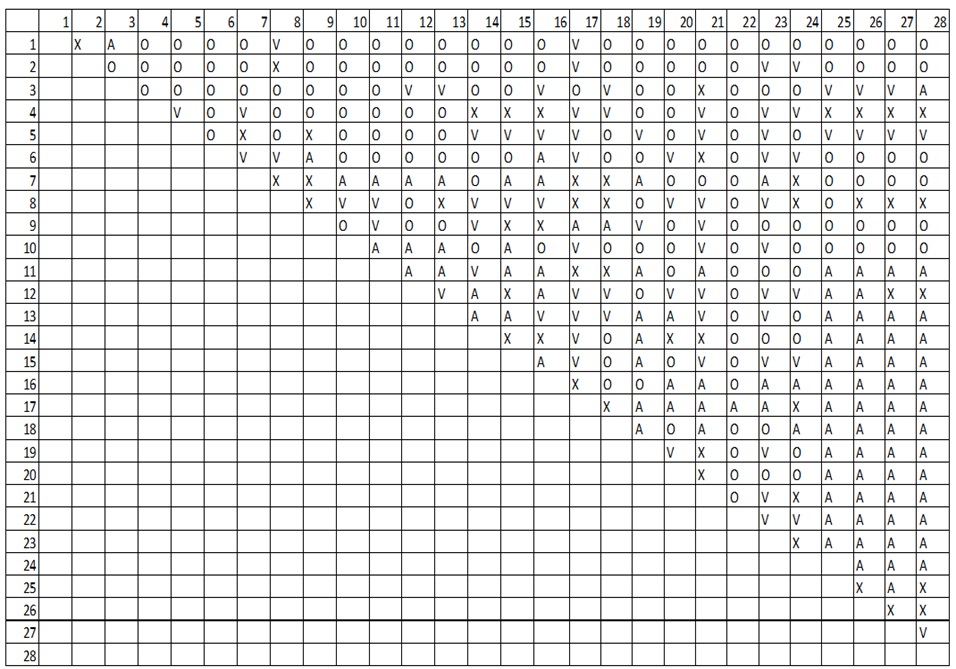
Furthermore, based on Table 2 about the SSIM matrix, it is then made in the form of a Reachability Matrix (RM) table by changing V, A, X, and O to numbers 1 and 0. Thus, the results are obtained in Table3.
Table 3.
Reachability matrix (RM)
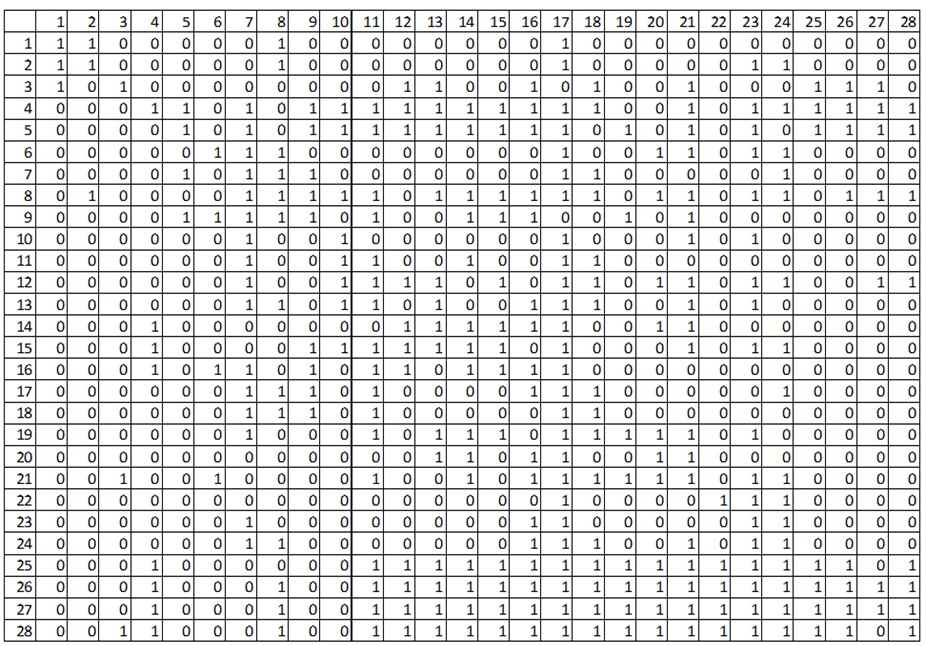
Then, based on the interpretation results of the final Reliability Matrix (RM) matrix, a hierarchy of relationships between factors that influence the occurrence of counterproductive work behavior in automotive companies can be arranged, which can be explained in Figure 1.
Figure 1.
Hierarchical structure among factors affecting Counterproductive Work Behavior
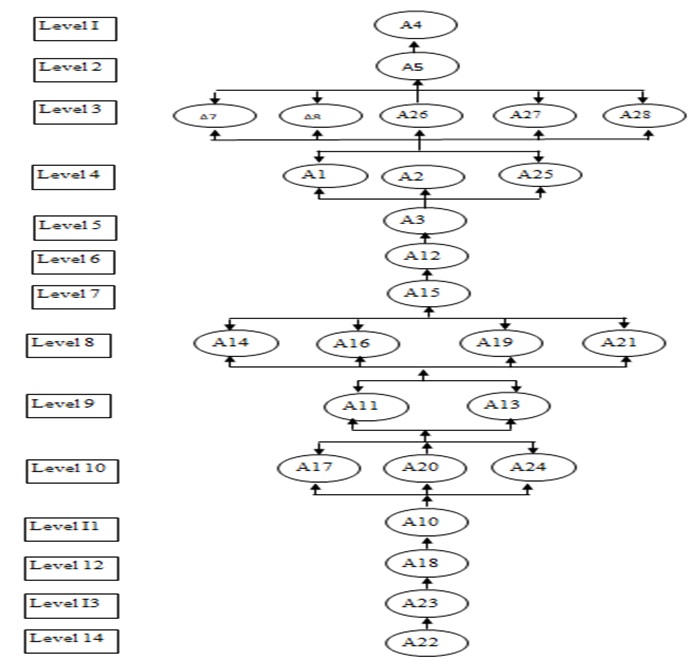
From Figure 1. provides information that in determining the criteria obtained, level 1 is in the task demands criteria (A4), while at level 2 the role demands criteria (A5), at level 3, namely family problems (A7), economic problems (A8), unclear responsibilities (A26), Unclear goals (27) and unclear roles and scope of work (A28), at level 4, namely economic uncertainty (A1), political uncertainty (A2), unclear authority (A25), at level 5, namely the criteria for technological change (A3) at level level 6 there are high work targets (A12), at level 7 there are criteria for unpredictable tasks (A15), at level 8 there are criteria for high concentration (A14), there are criteria for requiring sufficient attention (A16), competing for achievement (A19), encouragement to make changes (A21), at level 9 there are criteria for stacking adjacent activities (A11) and there are criteria for job complexity (A13), at level 10 there are criteria for physiological physical burden (A17), positive movement towards goals (A20) and disputes between individuals (A24). Then at level 11, there is a criterion for the lack of free time (A10), at level 12 there is a criterion for biomechanical (ergonomic) physical load (A18), at level 13 there is a criterion for personality clashes (A23) and at the last level, namely level 14 there is a criterion for dominating discussions (A22).
From the existing model level, there is a MICMAC diagram used to classify which criteria are included in the Independent, Linkage, Dependent, and Autonomous categories.
Figure 2.
MICMAC analysis diagram
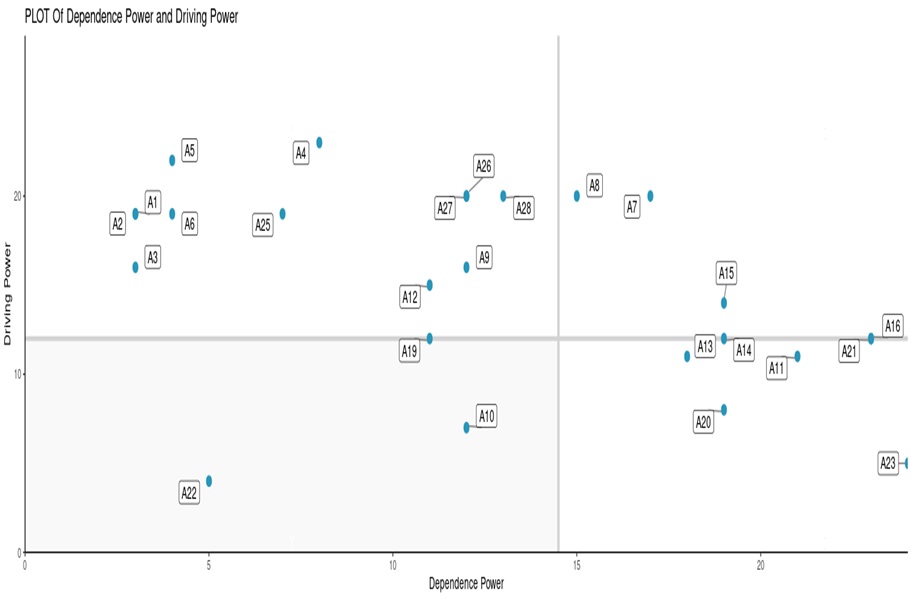
According to the classification diagram in Figure 2. above, the groupings are as follows:
I. Autonomous as a weak driver and low dependence. This variable is located in quadrant I. Elements A22 (Dominating discussions), A19 (Competing for achievement) and A10 (lack of free time) fall into this category.
II. Dependent as a weak driver and high dependency. This variable is located in quadrant II. Elements that fall into this group are non-free elements, there are several research variables that fall into this quadrant, namely: A11 (accumulation of adjacent activities), A13 (complexity of work), A14 (high concentration), A20 (positive movement towards goals), A21 (encouragement to make changes, and A23 (personality clash).
III. Linkage as a strong driver and strong dependency. This variable is located in quadrant III. Research elements A8 (economic problems), A7 (family problems), A15 (unpredictable tasks), and A16 (requires sufficient attention) are in this quadrant.
IV. Independent which means a strong driver and low dependency. Variables in quadrant IV strongly influence the occurrence of counterproductive work behavior and determine the success of handling counterproductive work behavior. Elements A1 (Economic uncertainty), A2 (Political uncertainty), A3 (Technological change), A4 (Task demands), A5 (Role demands), A6 (Personal demands), A9 (Personality), A12 (High work targets in a fairly short time), A25 (Lack of clarity of authority), A26 (Lack of clarity of responsibility), A27 (Lack of clarity of purpose) and A28 (Lack of clarity of role and scope of work) are in this quadrant.
While based on the elements or factors in question are at level 1-level 3 which are also some of the elements of the factors in the independent, namely level 1 there is element A4 (Task demands), at level 2 there is element A5 (Role demands), and level 3 there are elements A7 (Family problems), A8 (Economic problems), A26 (Clarity of Responsibility), A27 (Clarity of purpose) and A28 (Clarity of role and scope of work). The existing elements are then regrouped according to the variables that contain existing elements as indicators, where Level 1 and Level 2 existing elements are indicators of work stress variables, at level 3 elements A7 (Family problems) and A8 (Economic problems) are from work stress variables as well while elements A26 (Clarity of Responsibilities), A27 (Clarity of goals) and A28 (Clarity of roles and scope of work) are indicators of role ambiguity variables.
Discussion
The results of the aggregation of five experts using ISM modeling are the key factors that should be the main concern in the formulation of strategies to overcome the occurrence of counterproductive work behavior. The proposed strategy formulation that can be implemented by the company refers to the following elements:
Work stress
Work stress occurs due to task demands and role demands, family problems, and economic problems. For this reason, the proposed strategy formulation that can be applied by the company refers to standard management elements related to controlling work-related stress, including:
a. Demands ─ Workers demonstrate that they are able to cope with the work demands placed on them. Work demands include issues such as workload, work patterns, and work environment.
Handling:
- The company provides work demands that are appropriate or can be completed within the agreed deadline.
- The company provides work demands that are in line with workers' skills and abilities.
- The company provides workloads that are in accordance with workers' abilities.
- Workers understand which work priorities should be prioritized and which should be postponed.
- Workers' complaints related to their duties must be responded to and ways to resolve them discussed.
b. Roles ─ Workers demonstrate that they understand their roles and responsibilities in the workplace.
Handling:
- The company should ensure workers understand their roles and responsibilities in the organization.
- The company should provide sufficient information to workers regarding their roles and responsibilities.
- Companies should establish clear requirements for each work role and responsibility.
The steps to implement the management standard for handling stress in the workplace:
a. Conduct planning, such as top management commitment to support the program and provide resources or a team that will work for this program.
b. Identify risks related to occupational stress and the factors that influence it.
c. Collecting data on workers who experience occupational stress and its root causes.
d. Evaluate the data related to occupational stress obtained and determine possible control measures.
e. Creating an action plan or program for handling occupational stress on an ongoing basis and its implementation.
f. Conducting periodic measurements and reviews to determine the effectiveness of the implemented stress management program.
Role ambiguity
Elements of role ambiguity that need to be considered relate to elements of unclear responsibilities, unclear goals, and unclear roles and job scope. Elements of role ambiguity are closely related to role demands which are elements of job stress. So that the handling that can be done is also very closely related to role demands on job stress, including:
- Companies must ensure that workers understand the roles, responsibilities, and scope of work in the organization.
- Companies must provide sufficient information to workers regarding the roles, responsibilities, and scope of work in the organization.
- The Company should establish clear requirements for each role, responsibility, and scope of work in the organization.
The steps for handling role ambiguity in the workplace:
a. Give clear and concise instructions to your employees.
Do not perpetuate and expand the ambiguity. Clarify your instructions, reporting guidelines, and benchmarks for success. Trying to read subtext and not knowing if there are subliminal messages can result in crazy thinking that leads to further ambiguity.
b. Make firm decisions.
This sounds like a duplication of words. It is not and does not imply an authoritarian process. A process can be collaborative, but at some point, a decision must be made. Take it and commit to it. Make that decision firmly, communicate it clearly, and take action. Ambiguity leads to uncertainty and confusion. This is bad for morale and ultimately business.
c. Provide resilience and confidence training.
Exposure to any scenario that allows employees to hone their skills will enable them to do their jobs more effectively. Lack of confidence leads to indecision and creates ambiguity. This in turn creates a culture of insecurity.
d. Ensure employees take time off and rest.
In times of uncertainty, a common response is to waste people, time, and energy on a problem. Often the opposite is true. Rested, calm and measured energy is more productive than frantic "busyness".
e. Encourage Mindfulness in the organization.
Mindfulness helps focus on the moment and creates awareness of a situation and potential knee-jerk reactions based on emotions. It also reduces reliance on behaviors rooted in implicit biases and previously learned behavior patterns. The practice eventually results in the ability to step back psychologically and emotionally to make calm decisions. This creates awareness of your other thoughts and physical reactions.
Conclusions
Based on the results of the study conducted related to the strategy of finding solutions to overcome Counterproductive Work Behavior in employees at automotive companies in Bekasi city using the Interpretative Structural Modeling (ISM) Method in automotive companies, Bekasi, Indonesia, it is concluded that:
- The application of the ISM method to be used in selecting strategies to overcome Counterproductive Work Behavior in employees at automotive companies in Bekasi City can be reviewed from its elements. These elements include the goal element, the actor element, the main constraint element, and the desired change element. Strategies to overcome Counterproductive Work Behavior in employees in automotive companies in Bekasi city involve top management and leaders of each division/department and even employees in existing companies.
- Strategies to overcome Counterproductive Work Behavior among employees in automotive companies in Bekasi city are implemented based on the level of importance of a problem. The results obtained from this study show that is necessary to overcome Counterproductive Work Behavior by handling job stress (Task demands, Role demands, Family problems, Economic problems) and role ambiguity (Clarity of Responsibilities, Clarity of goals, and Clarity of roles and scope of work).
References
Ahmad, A., Zahid, S., Wahid, F. F., & Ali, S. (2021). Impact of Role Conflict and Role Ambiguity on Job Satisfaction the Mediating Effect of Job Stress and Moderating Effect of Islamic Work Ethics. European Journal of Business and Management Research, 6(4). https://doi.org/10.24018/ejbmr.2021.6.4.895
Bui, C. N., Peng, C., Mutchler, J. E., & Burr, J. A. (2021). Race and ethnic group disparities in emotional distress among older adults during the COVID‐19 pandemic. The Gerontologist, 61, 262-272. http://doi.org/10.1093/geront/gnaa217
Donald, I., Taylor, P., Johnson, S., Cooper, C., Cartwright, S., & Robertson, S. (2005). Work Environments, Stress and Productivity: An Examination Using ASSET. International Journal of Stress Management, 12(4), 409-423. https://doi.org/10.1037/1072-5245.12.4.409
Fadhil, R., Maarif, M., Bantacut, T., & Hermawan, A. (2018). Formulation for Development Strategy of Gayo Coffee Agroindustry Institution Using Interpretive Structural Modeling (ISM). Acta Universitatis Agriculturae et Silviculturae Mendelianae Brunensis, 66, 487-495. http://doi.org/10.11118/actaun201866020487
Hasanati, N., Winarsunu, T., & Karina, V. D. (2018). The Influence of Interpersonal Conflict on Counterproductive Work Behaviour Mediated by Job Stress. Advances in Social Science, Education and Humanities Research, 133. https://doi.org/10.2991/acpch-17.2018.17
Kholil, E., Sutjahyo, S. H., & Soekarto, S. H. (2008). Pengembangan model kelembagaan pengelola sampah kota dengan metode ISM (interpretative structural modelling) studi kasus di Jakarta Selatan. Sodality: Jurnal Transdisiplin Sosiologi, Komunikasi, dan Ekologi Manusia, 2(1), 31-48. https://doi.org/10.22500/sodality.v2i1.5894
Klotz, A. C., & Buckley, M. R. (2013). A historical perspective of counterproductive work behavior targeting the organization. Journal of Management History, 19(1), 114-132. http://dx.doi.org/10.1108/17511341311286222
Ma, L., & Li, W. L. (2019). The Relationship between Stress and Counterproductive Work Behavior: Attachment Orientation as a Moderate. Open Journal of Social Sciences, 7(4), 413-423. https://doi.org/10.4236/jss.2019.74033
Mahadiputra, I. G. E. S., & Piartrini, P. S. (2021). The Moderating Role of Emotional Intelligent on the Relationship among Job Stress, Organizational Justice and Counterproductive Behavior. American Journal of Humanities and Social Sciences Research (AJHSSR), 5(1), 672-683.
Mahdi, S.., Ibrahim, M. ., & Armia, S., (2018). The Role of Negative Emotions on the Relationship of Job Stress and Counterproductive Work Behavior (Research on Public Senior High School Teachers). International Journal of Asian Social Science, 8(2), 77–84. https://doi.org/10.18488/journal.1.2018.82.77.84
Muhdar, H. M. (2012). Stres kerja dan kinerja dalam perspektif teori dan bukti empiric. Jurnal Ekonomika-Bisnis, 3(2), 111-120. https://doi.org/10.22219/jibe.v3i2.2234
Raza, M. A., Khan, M. M., & Mujtaba., B. G. (2017). The Impact of Organizational Change on Employee Turnover Intention: Does Stress Play a Mediating Role? Public Organization Review,18(6). https://doi.org/10.1007/s11115-017-0380-8
Saranani, F., Setiawan, M., & Asraf., (2022). Stres Kerja. Bandung: Media Sains Indonesia.
Silva, H. M., & Ranasinghe, R. M. (2017). The Impact of Job Stress on Deviant Workplace Behavior: A Study of Operational Level Employees of Comfort Apparel Solutions Company in Sri Lanka. International Journal of Human Resource Studies, 7, 74-85.
Sutarmin, D., Nurmayanti, S., & Hermanto, (2022). The Influence of Role Ambiguity and Role Conflict on Job Stress and Cyber loafing of Employees at the Department of Communication, Information and Encryption, East Lombok Regency, West Nusa Tenggara Province, Indonesia, International Journal of Multicultural and Multireligious Understanding, 9(12), 421-429. http://dx.doi.org/10.18415/ijmmu.v9i12.4280
VanWormer, J. J., Fyfe-Johnson, A. L., Boucher, J. L., Johnson, P. J., Britt, H. R., Thygeson, N. M., & Dusek, J. A. (2011). Stress and Workplace Productivity Loss in the Heart of New Ulm Project. Journal of Occupational and Environmental Medicine, 53(10), 1106-1109. https://doi.org/10.1097/jom.0b013e318229ab18
Zhang, Y., Crant, J. M., & Weng, Q. D. (2019). Role stressors and counterproductive work behavior: The role of negative affect and proactive personality. International Journal of Selection and Assessment, 27(1), 1-13. http://doi.org/10.1111/ijsa.12255
Zin, M. L. M., Ibrahim, H., & Noor, M. H. M. (2017). Determinants of Job Stress among Royal Malaysian Police (RMP): A Conceptual Framework. Journal of Advanced Research in Business, Marketing, and Supply Chain Management, 1(1), 49-53. Retrieved from https://ojs.aibma.org/index.php/jarims/article/view/13

Page 1 of
Download Count : 116
Visit Count : 705
Keywords
Conflict; Role Ambiguity; Workload; Job Stress; Counterproductive Work Behavior; ISM

Author(s) Information


How to cite this article:
Hermansyah, Notosudjono, D., & Yusnita, N. (2024). Strategy to Decrease Counterproductive Work Behavior: Implementation of Interpretive Structural Modeling. International Journal of Behavior Studies in Organizations, 11, 1-11. https://doi.org/10.32038/JBSO.2024.11.01
Acknowledgments
Not applicable.
Funding
Not applicable.
Conflict of Interests
No, there are no conflicting interests.
Open Access
This article is licensed under a Creative Commons Attribution 4.0 International License, which permits use, sharing, adaptation, distribution and reproduction in any medium or format, as long as you give appropriate credit to the original author(s) and the source, provide a link to the Creative Commons license, and indicate if changes were made. You may view a copy of Creative Commons Attribution 4.0 International License here: http://creativecommons.org/licenses/by/4.0/