




Original Research
The Mediating Effect of Recovery Experience and Emotional Contagion on Work Stressor and Job Burnout among Nigeria Corporate Employees


- Abstract
- Full text
- Metrics
In human resource management and regarding employee mental health in the workplace, job burnout, and work stressors are fundamental issues as they affect not only the employees' wellness but also the organization's sustainability as a whole. Embedded in the Conservation of Resources theory and the Effort–Recovery model of working time, this quantitative study aims to answer questions of how recovery experience and emotional contagion affect the effect of work stressors on job burnout. In putting our hypotheses to the test, we targeted a sample of 305 corporate employees from different industry sectors in Nigeria. The results showed that work stressors led to an increase in job burnout. The results also showed that work stressors and recovery experience were correlated in such a way that work stressor caused recovery experience, which, in turn, enhanced the work-stressor-job burnout relationship. In this study, work stressor had no relationship or influence with emotional contagion; consequently, there was no mediation effect of emotional contagion between work stressors and job burnout. On the other hand, there was a direct relationship between emotional contagion and job burnout, although no relationship existed between the recovery experience and job burnout. These findings are in accordance with the Conservation of Resources theory and the Effort-Recovery model, thereby increasing understanding of job burnout as experienced by workers in organizations as a result of work demands. This will be beneficial to the organization whose intention is to reduce employees´ burnout and their welfare.
The Mediating Effect of Recovery Experience and Emotional Contagion on Work Stressor and Job Burnout among Nigeria Corporate Employees
Fidelis Ejeh Abba
Final International University, Turkiye
Abstract:
In human resource management and regarding employee mental health in the workplace, job burnout, and work stressors are fundamental issues as they affect not only the employees' wellness but also the organization's sustainability as a whole. Embedded in the Conservation of Resources theory and the Effort–Recovery model of working time, this quantitative study aims to answer questions of how recovery experience and emotional contagion affect the effect of work stressors on job burnout. In putting our hypotheses to the test, we targeted a sample of 305 corporate employees from different industry sectors in Nigeria. The results showed that work stressors led to an increase in job burnout. The results also showed that work stressors and recovery experience were correlated in such a way that work stressor caused recovery experience, which, in turn, enhanced the work-stressor-job burnout relationship. In this study, work stressor had no relationship or influence with emotional contagion; consequently, there was no mediation effect of emotional contagion between work stressors and job burnout. On the other hand, there was a direct relationship between emotional contagion and job burnout, although no relationship existed between the recovery experience and job burnout. These findings are in accordance with the Conservation of Resources theory and the Effort-Recovery model, thereby increasing understanding of job burnout as experienced by workers in organizations as a result of work demands. This will be beneficial to the organization whose intention is to reduce employees´ burnout and their welfare.
Keywords: Work Stressor, Job Burnout, Recovery Experience, Emotional Contagion, Conservation of Resource Theory, Effort-Recovery Model
Work-related stress has always been on the rise and is negatively affecting workers’ health, leading to exhaustion, lack of motivation, and burnout. Reasons could be a lack of support, unfair treatment, long hours, and excessive workload (Maslach & Leiter 2022; Tamunomiebi & Mezeh, 2021). However, this persistent issue is very problematic for organizations as well since unmanageable stress levels can lead to low productivity and poor morale (Calin et al., 2022; Edú-Valsania et al., 2022; Govindaras et al., 2023; Turato et al., 2022). Therefore, to improve such issues and their outcomes, leaders and organizations must be aware of the significance of effective treatment of stress and employees’ well-being.
In recent years, there have been increasing reports of work stress and burnout in the workforce. This has, of course, raised serious concerns considering the negative effects of work stress and burnout on employees in the workplace (Hayes et al., 2021; Peasley et al., 2020). It is appropriate, if not more correct, to understand workplace burnout as the effects suffered by individuals who interact at work as the former states an ultimate catastrophe in the psychosomatic of people (Salama et al., 2022). Contestably one of the most common issues that has attracted much international concern in organizational psychology and human resource management are problems of job exhaustion syndrome or burnout (Dorta-Afonso et al., 2023; Kelly & Hearld, 2020; Mäkikangas et al., 2021). The reason for burnout can be work-related body stressors, resulting from extended periods at work, leading to emotional distress, negative feelings, and feeling profoundly unfulfilled (Ungur et al., 2024). Stress can be derived from environmental factors as well as from internal expectations, both of which can result in physical distress or pain (Arnold & Fletcher, 2021). Such stressors encompass excessive job demands, long working hours, inadequate managerial support as well as perceptions of inequity. The interrelationship of these stress factors creates pressure for employers and employees, which has dire consequences for the employees and the organization at large (Elshaer et al., 2024; Saleem et al., 2024).
As frameworks for understanding stress responses, the Resources Conservation Theory (Hobfoll, 1989) along with the Effort-Recovery Model (Meijman & Mulder 1998) are relevant in explaining the mechanisms of emotional contagion and recovery experiences in reducing job burnout. Also, the ‘Conservation Of Resources’ (COR) theory has been subsumed within a family of general stress theories which explain why certain circumstances are stressful and the pattern of persons’ behaviors during such significantly stressful events (Hobfoll, 1988, 1989, Hobfoll & Lilly, 1993). It is plausible that it can assist in understanding the disparities and the commonalities in the experience of traumatic stress and that from other major stressors, daily irritative stresses, and minor hassles. If the reason is that it is genuinely beneficial, then it can also help in the suitable education of policies and practices that aim at helping those who have suffered through traumatic stress. Focusing on work stressors, the COR model holds the view that there is a specific reaction triggered by the demand it seeks to load onto employees. When employees are faced with heavy workloads or lack of support, they may feel that their resources are threatened, which in turn increases their stress levels, ultimately leading to burnout.
The theory has been extensively used and tested in the area of occupational stress, and it has been established that individuals having no control and support or having a barren landscape of resources are prone to burnout (Park et al., 2020; Peasley et al., 2020). This helps the firms to remarkably determine the activities which can increase the level of resources and, therefore, the welfare of the employees (Meijman & Mulder, 1998). The E-R model defines the process by which the staff's recollection of certain experiences serves as a pause in a deprivation that is undergoing. Reconstruction is defined as a process during which a person's operative systems that were utilized in stressful conditions get deactivated, with the result that disturbing tasks are performed at some ‘normal’ level (Meijman & Mulder 1998), and allows the recovery of altered levels of mood or preparatory actions (Lyall et al., 2021).
Even though there is an increase in the literature on work stress and burnout, there is still a distinct lack of research base with regard to certain specific mediating factors that might have a bearing on this relationship (Brady et al., 2023; Noor et al., 2024; Ryan et al., 2023). Earlier studies, for instance, have emphasized levels of different psychological factors like self-efficacy and hope (Rajeswari & Prakasha, 2024; Szcześniak et al., 2024), but not enough on recovery experiences and emotional contagion as mediators. Recovery experiences are activities that enable the employee to recover from the stress that is caused by the workload, while emotional contagion is where emotions are shared across different people interacting in a workplace (Anitha et al., 2024; Kujanpää & Olafsen, 2024). Both aspects are important in determining how employees react towards stressors and more; they may also impact how burnout is experienced.
This research based on the mediating role of recovery experience and emotional contagion in the relationship between work stressors and professional burnout among Nigerian corporate workers, has implications for organizational psychology and human resource management. By including recovery experiences among the mediating variables, the research demonstrates that the view of burnout can be extended beyond only the traditional direct relations between stressors and burnout. It emphasizes the significance of recovery in minimizing the negative impact of work stressors, thereby adding to the body of knowledge on employee welfare and recovery management in organizations. Moreover, the use of emotional theory offers an original angle into understanding the role that emotions at the workplace have on individual involvement in burnout, claiming that employees are exposed to their stressors and those of their peers. This point deepens the discussion concerning the emotional aspect of health in the workplace and its relation to the phenomenon of burnout. Moreover, this study examines the relationship between specific work stressors like work overload, critical and unhelpful supervisors, and injustice with recovery and emotional contagion theory. This multi-faceted view focuses on how such mediating variables as recovery and emotional contagion are influenced by each of these stressors and, in turn, affect burnout.
The results suggest that organizations aiming at lessening the burnout of their employees can employ targeted strategies that improve recovery practices and the positive emotional climate. Equally, this study raises the research design bar in areas such as studies through the application of very basic quantitative methods. This pre-empts future studies’ attempts to develop new and better methodologies to examine such intricate psychological variables in an organizational environment. Moreover, building on the identified gaps, this study aims to investigate how recovery experiences and emotional contagion mediate the relationship between work stressors and job burnout among corporate employees in Nigeria. By mapping out these mediating variables, the study seeks to better understand the mechanisms of employee burnout and offer suggestions related to specific strategies that improve the working environment.
Literature Review and Hypothesis
Work Stressor and Job Burnout
Work-related stress is regarded as one of the great risks to the health of employees globally (Cooke & Hastings, 2024). Stress can be understood as a force exerted on an individual by management (Scott et al., 2024). Job stress has been viewed as incapability, poor emotional response mechanisms, an overload, emote to job contexts, and a dependant nature (Shang et al., 2023). Occupational stress indicates the ineptness to overcome the challenge or pressure sound stemming from the job due to poor congruence between the employee’s capacity and the physical and mental demands the job entails (Singh et al., 2020). Work stress arises from both solitary and collective sources (Heidari et al., 2024; Salama et al., 2022) and effects of various aspects of work such as counterproductive work behavior (Hermansyah et al., 2024). The internal causes relate to how a person thinks and perceives himself. These do harm to the individual and are acquisitive in nature. They depend on how one perceives the external stimuli that come from other people and the environment. Even where there is no considerable threat in the external environment, a person can feel endangered by some people or situations and get tired.
There are many external factors within an organization that can negatively affect the performance of a worker; they include internal policies or factors such as working conditions, management style and level of control, job security, and workload (Arndt et al., 2022; Hermansyah et al., 2024). However, it is noted that at some times, the situations that necessitate fulfillment of the desired behavior may be stressful to any of the employees. Supervisors and managers sometimes have social control over subordinates (Schwarzer & Reuter, 2023). Stringent psychosocial risks due to stress have many forms. Some of them include job insecurity, integrating more work tasks, and the conflicts faced in balancing work and family (Ramaci et al., 2021). Employees are susceptible to stress caused by external factors which include high demands at work, job insecurity, and heavy workloads (Wielers et al., 2022) which in interaction with internal determinants such as features and individual components of the self-actualization can culminate in feelings of burnout (Voitenko, 2020).
Burnout is a response to stress that develops in persons who have significant and prolonged contact with other individuals, such as students, clients, or guests (Abubakar et al., 2022). It occurs when individuals feel an overwhelming obsession to complete many tasks, exaggerated by tight deadlines, multiple projects, and numerous meetings. Stress, at times, is not something people will be able to avoid, but everyone has their limits.
The work-related stress that leads to burnout is quite common in all sectors. The work that an employee or employer provides gets reduced along with the turnover rate of employees because of this stressful`` work-related environment. The potential shrink in productivity and performance owing to burnout is concerning. Bakker and de Vries (2021) describe burnout as a form of emotional depletion that comes from being tightly engaged in work but lacking the commitment and motivation towards it, especially in young volunteers. Indeed, there is work-related mental fatigue along with stress, and the interplay between the two is associated with job culture and gung-ho work-related emotions. As a severe form of stress, chronic stress has both occupational and emotional components. Wu (2020) and Wu et al. (2021) highlight job burnout in their research and stress that it is one of the top causes of work-related stress.
According to Sun et al. (2022) and Li et al. (2021), there exists a link between job burnout and work stress and from this, it is evident that jobs in the health sector are highly stressful. The work environment is so bad that, together with occupational history, interpersonal relations, work duties, and excessive work, contribute to occupational stress in the health sector. Other researchers on violence at work suggested that work stress was a dominant factor in burnout among educators (Agyapong et al., 2022). They concentrated more on education burnout syndrome and stress impact on teachers, and job stress is associated with burnout. About work-related stress leading to job burnout, employees in five-star hotels stated that this has happened to them even when they are not working too hard but only experiencing work stress (Wen et al., 2020). They clarified that they feel tired because of unsatisfied work requirements. Many employees indicated that exposure to the stressors left them employees feeling burned out. There is a positive correlation between general work stress and career burnout.
The relationship between job stressors and burnout can be seen from the perspective of the COR theory (Akirmak & Ayla, 2021). The COR theory argues that human beings aspire to acquire and uphold or to hold and defend personal characteristics, contexts, and energies which would facilitate their survival in a job environment (Bon & Shire, 2022). As per the COR theory, physical, cognitive, or emotional expenditure towards overcoming exposure to high-end job demands is a work stressor. Under such circumstances, if the pressure to meet the expectations of the workplace is resorted to autonomously not possessing the physical and mental necessary relevant resources in addition to resources available at the workplace, then high burnout can be a phenomenon that would afflict people (Hsieh et al., 2021; Otto et al., 2021). Therefore, in line with the empirical evidence already stated and this particular area-focus on the COR theory, we sought to replicate this association between high job stressors and the level of burnout.
Work Stressor and Recovery Experience
According to Yin et al. (2023) and Zhang et al. (2024), work-associated stressors can result in poor mental health and other challenges to employees, such as lack of support from management, heavy workloads, or extra long work hours. These stressors will these times encourage people to become terribly worn out emotionally, become less enthusiastic about their work overall, and at worst, be entirely consumed by their workloads. Luckily, each employee has some form of recovery level or other establishment that can help them deal with this emotional and physical stress. Recovery experiences include gaining strength and equilibrium through various activities and mental shifts designed to combat stress.
Some key aspects of recovery experiences, as identified, include inclining oneself away from work, relaxation, and leisure, affecting mastery and control of the time squished in between (Song et al., 2021). It has been demonstrated that recovery experiences constitute an important bridge between the value of the demand resource and the rest and well-being (Czakert & Beger, 2024). Recovery is composed of psychologically moving away from work, relaxation, being in control, and engaging in master experiences carved out of leisure time (Trzebiatowski, 2024). Santuzzi and Barber (2018) noted that psychological detachment, which is the perceived physical and mental separation from work, could provide a buffer to the negative impact of work stressors on the strain reaction and general dependability. Relaxation decreases sympathetic activation, which could assist in coping with stress in a better way and also generate a positive effect (Drigas & Mitsea, 2021). Mastery experiences have to do with the activities that people do off the job, which are socially and physically engaging, like taking a class in a new language or engaging in a hobby, which was found to reduce tiredness (Ouyang et al., 2019). Engaging in preferable leisure activities that promote the recovery process and hence have the potential to enhance well-being and action regulation according to The E-R model (Newman et al., 2014).
An organization should maintain a healthy work culture, work freedom, and encourage their employees to engage in activities that focus on relaxation and psychological establishment. The work environment has a stress-alleviating ability along with the enhancement of concentration and effectiveness; therefore, active recovery occurs due to the provision of proper non-work-related breaks. As Bennett et al. (2023) assert, there is a continual struggle against trade-offs. They also emphasize that dependencies like excessive workload associated with various issues tend to stop people from effectively recovering. Such dependencies further initiate continual and undesired invasive thoughts directed towards work issues, allowing employees to seek answers for these issues at hand, which ultimately leads to the self-defeating mental approach. In such cases, it is unnatural to expect an enhanced presence of motivational factors that enable an employee to work efficiently. Losing a balance of work and self-care leads to social strain concurrently creating a gradual mistrust in notions aimed at increasing employee motivation. According to the E-R model, the presence of work-related stressors in constant sufficient amounts tends to situations where employees regard work issues as a more frequent hindrance to their well-being (Bennett et al., 2023).
Studies show that a good recovery experience helps achieve life satisfaction and even contributes to mental health - something necessary when it comes to overcoming work stress (Song et al., 2021; Yang & Jo, 2022). A perfect example would include engaging in free time activities such as sports, reading, or meeting friends. This lets the mind and body recover immensely from stress and does not put one under any threat of ‘burnout’ (Muhamad Nasharudin et al., 2020). There are also instances where employees employ themselves in recovery methods that help them master control over a situation, for instance, learning a new skill or adjusting their timetable, making them strong enough to address challenges at work like theirs. Therefore, improving the company’s recovery experiences promotes improved individual well-being at the same time enhances job performance and satisfaction levels (Rodríguez-Muñoz et al., 2018). When organizations are aware of how recovery experiences act when one is under stress at work, they are then able to create programs that encourage and give room for employees to recover and heal.
The last several research, which used diverse study designs and samples from different occupational groups, confirmed a positive relationship between work stressors and the need to recover after work (Sciotto & Pace, 2022; Sonnentag, 2018; Sonnentag & Fritz, 2015). For instance, research conducted using samples from educators confirmed that work stressors were significant predictors of the need for recovery experience (Gu et al., 2020). It was also reported that psychological work demands have a higher impact on the need for recovery experience than physical work demands (Pace & Sciotto, 2021).
Work Stressor and Emotional Contagion
Emotional Contagion (EC) occurs in the workplace when people tend to copy the emotions of their counterparts without even realizing it (Hatfield et al., 1993). A stressful work environment or the general pressure at work including too much work, pressing tasks, and lack of management, can worsen the emotional atmosphere; when one or more of these pressures are felt by employees, they may turn anxious or irritated. People close to these employees who are under stress start to notice their emotional expressions and imitate their behavior, which spreads negativity around the workplace (Hatfield & Rapson, 1998). This phenomenon provides insight into the extent to which work overloads draw stress that enables the spread of encompassed negative feelings and hence leads to low levels of morale in employees. This research focuses on how an individual absorbs the emotions from social interactions that happen at work. In particular, we look into how nonsupportive supervisors and tight deadlines impact taking in various wholesome emotions like happiness and anger.
Emotional contagion is indeed predicted by work-related stress, according to Petitta et al. (2023). Workplace stressors, according to COR research, have the potential to affect emotional contagion in workplaces (Xerri et al., 2023). As Jabeen et al. (2022) have elucidated, COR theory suggests that people work hard to acquire, secure, and defend a number of resources including time, energy, and social support. Employees who face work-related stressors like high volume of work, close deadlines, or uncooperative supervisors view them as risks to their resources, as Bolliger et al. (2022) mention. This perspective potentially produces emotional challenges and fatigue, which, in turn, affect the interactions of employees with one another. For instance, an employee who just had too much to take on or is simply stressed is likely to show feelings like annoyance or nervousness. Such feelings are each ‘caught’ by a colleague by emotional contagion, and the feeling grows in the rest of the team, culminating in a negative atmosphere among the team.
In studies with different study designs work stressors were found to be related to the need for emotional contagion. Blanco-Donoso et al. (2021), Jia and Cheng (2021), and Prikhidko et al. (2020) provide evidence for the effect. For example, a study confirmed that work stressors were significant predictors of the need for emotional contagion (Grande et al., 2024).
Recovery Experience and Job Burnout
It has been proven that there is a measurable negative impact on work burnout due to effective recovery activities (Song et al., 2021; Singh et al., 2016). Employees with better recovery activity participation seem to suffer lower levels of emotional exhaustion and depersonalization, which characterize burnout (Kilroy et al., 2020; Toker & Melamed, 2017). Also, recovery experiences can enhance the quality of life (QOL) as they provide a sense of achievement that enhances an individual’s well-being. For example, nurses who had a high recovery experience managed to buffer the harmful effect of work stress on their health and job satisfaction (Chen et al., 2019). Hence, an organizational culture that promotes the recovery experiences of employees should suffice for companies that intend to contain employee burnout rates and improve their well-being. Work and life balance programs, availability of leisure resources, and the promotion of psychological distance are some of the measures that can help enhance employees' recovery experiences. In the context of job burnout, the Effort-Recovery (E–R) model identifies the effect of recovery experiences on workplace burnout by emphasizing the sequential nature of work and the critical need for recovery after each phase of high investment.
In the E-R model, employees expend psychological and physical resources when work demands are too high, resulting in fatigue and strain. Leaving this resource deteriorated and unrecovered leads to circumscribed health including occupational burnout (Meijman & Mulder, 1998). Recovery experiences are a prerequisite for resourcing employees to perform at the pre-stressor level.
A study conducted by Sonnentag and Fritz (2015) found that recovery experience may be fibbed as a job demand that can somehow minimize the feeling of burnout from job dependency. There is a reciprocal exchange between feeling and caring; stressful events require the patient to heal through time or alternatives. Increased detachment through task-oriented orientation assists in decreased tension; however, far too much detachment and the change may alter the set-out goal. At the same time, the period from recovery to work can form irreversible moves under burnout if not ideal. Sonnentag et al. (2017) also address workplace recovery and Occupational burnout positively. The study by Chen et al. (2020) also stated that improving the recovery experience will minimize the adverse effects of chronic fatigue.
Emotional Contagion and Job Burnout
There are active workplace situations worth discussing in some detail regarding the implications of emotional contagion. For example, it has been observed that the spreading of negative emotions, such as anger, leads to sleep problems and stress-related illness, which then, in turn, increases the feeling of burnout experienced among individuals (Petitta & Naughton, 2015). On the contrary, positive emotions such as sharing joy and enthusiasm at the workplace constitute positive forms of emotional contagion, increasing the possibility of a supportive work environment and reducing the adverse effects of potential stressors (Kumar, 2021). Taking into consideration the lack of positive interaction in most high-stress environments, it is logical that the focus for these organizations should be on finding out the emotional interactions that result in individuals feeling burnt out.
It has become apparent that organizations are now making attempts to understand how people relate to each other to minimize the negative impact on the work environment and avoid staff burnout (Barsade et al., 2018). The COR theory would argue that this cheating depression would be mediated through the emotionally depleting resources that employees hold (Hobfoll et al., 2018). According to the COR theory, people seek to insulate themselves against loss by acquiring, retaining, or defending resources, such as time, energy, or even social assets (Hobfoll & Freedy, 2017). With the said transfer of depression or sadness through interpersonal interaction, which is stress-induced, employees’ resources become depleted and this is because they are confronted with an outpour of aggression from colleagues (Bakker & de Vries, 2021). As a result, as the factors of depression and sadness are broadened among employees, the strain levels become heightened, with the result being scissors and sleepiness, anger, and exhaustion (Elfenbein, 2014; Moreno-Jiménez et al., 2023).
Recent research conducted in the healthcare context by Petitta et al. (2017) posited that the contagion of anger may serve as a job demand that mediates an increase in levels of occupational burnout, whereas the contagion of joy may serve as a job resource that is inversely related with the level of burnout. Accordingly, with the aid of interaction theories, it can be argued that the contagion of positive emotions (e.g., joy) may serve as a job resource by synchronizing opportunities, social bonding, and cooperation while removing neutral or negative affective states (Petitta et al., 2020). On the contrary, together with some other negative emotions, the contagion of anger has much to say with respect to occupational stress and, therefore, creates processes that contribute to the weariness of employees or, as it is called - occupational burnout (Petitta et al., 2020). Available literature suggests that working together brings people stress, frustration, and exhaustion, which can be described as collective emotions (Zagenczyk et al., 2020). This cycle of sharing emotions, absorbing and reflecting negative emotions of other people raises the women’s depressive rate and increases emotional depletion, which Chun et al. (2022) revealed. Several literatures support these findings that women bear the brunt of stress and carry a greater emotional load than men, especially regarding workplace conditions. Many authors have shown that the emotion of joy and the emotion of anger in interactions create the concept of work-related burnout in one crossover to the other (Clarkson et al., 2024; Moylan, 2019; Tutar & Ay, 2024).
Mediating Role of Recovery Experience and Emotional Contagion
The Conservation of Resources (COR) and Effort–recovery (E–R) models help to explain how work stressors affect burnout from a job through emotional recovery and emotional pressure. Stressors at work can be disabled through effective employment of recovery activities including taking breaks, leisure activities, and mindfulness exercises, which help to relieve the feeling of stress and provide emotional. As stated by Riedl et al. (2024), Kujanpää and Olafsen (2024), and Selander et al. (2024), workshops can help relieve workplace stress. The E-R approach encourages this; however, the emphasis is on autofocus recovery after stress lines that need to be put after aggressions and disturbances. Not allowing proper recovery in between intervals creates fatigue. At best, without focusing on closing sight, a tarp would take care of that, removing other needs to obstruct it; using such triggering behavior as a tool for putting out the stress might not allow for effective coping even for some time. Thus, this study suggests that the need for recovery and emotional contagion will moderate the effect of stressors on job burnout.
In particular, job stressors are considered to have a positive correlation with the need for recovery experience (Sonnentag & Kruel, 2020; Wach et al., 2021) and emotional contagion (Meredith et al., 2020; Taube et al., 2024) and high need for recovery experience and emotional contagion, in turn, is projected to be related to higher levels of burnout. The findings from the literature suggest that recovery experiences function as mediators between certain work characteristics and the well-being outcome measures (Headrick et al., 2023; Kinnunen & Feldt, 2013; Sianoja et al., 2018; Yang & Jo, 2022). In the same way, findings from the literature suggest that emotional contagion also serves as a mediator in the relationship between work characteristics and well-being outcomes (Chen et al., 2019; Paganin et al., 2023; Petitta et al., 2020). More specifically, it was demonstrated that the psychological detachment from work was more strongly related to fatigue than any other recovery experience, which further supports the belief that effective recovery strategies promote employee well-being (Singh et al., 2016). Also, Maslach and Leiter's (2016) study indicated that as employees take in negative emotions from peers, the chances of them getting burned out increase, thus meandering the motion of emotion in high-pressure sites even more.
Conceptual Model of the role of Recovery Experience and Emotion Contagion in the relationship between Perceived Stress and Job Burnout
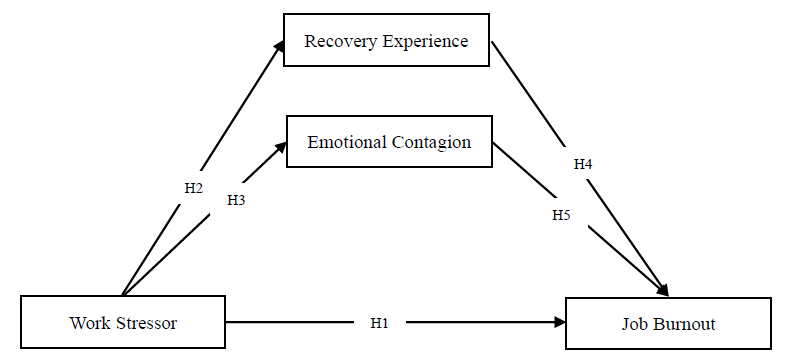
As presented in Figure 1, the dependent variable was Job burnout. Work stressors were taken as the independent variable or predictor, while the mediating variables were recovery experience and emotional contagion. Based on the preceding literature review and conceptual model (Figure 1), we assumed the following:
H1: Work stressor significantly impact job burnout
H2: Work stressor significantly impact recovery experience
H3: Work stressor significantly impact emotional contagion
H4: Recovery experience significantly impacts job burnout
H5: Emotional contagion significantly impacts job burnout
H6: Recovery experience significantly and positively mediates the relationship between work stress and employees’ job burnout.
H7: Emotional contagion significantly and positively mediates the relationship between work stress and employees’ job burnout.
Method
Sample
In this study, a cross-sectional survey was conducted through convenience sampling and targeted professionally working people in various fields. For this particular research, it was intended that the respondents would be recruited through social networks such as Facebook and Instagram, and later on, other respondents were obtained by snowballing with the primary criteria for inclusion being corporate employment, snowballing. The data was collected using the Google form application. The questionnaire was launched on 2nd August 2024 and was closed on respect out 5th 2024. This study had three hundred and five professionals as the respondents. As the English language is spoken in the region of the study, the questionnaire was prepared in English. Then, a consent form was sent to the participants to solicit their consent to participate in the research and ensure anonymity and voluntary involvement in the study.
Measurement
Work stressor was constructed by adapting the Copenhagen psychosocial questionnaire (kristensen et al., 2006). We followed the pattern developed in this study, where 34 items were worked out. Its primary focus is to address the assessment of the “stressful” factors of working situations: a: working conditions that are unfavorable (where an item example is “Your job requires you to work very fast.”) and b: employment insecurity (“Are you worried about getting fired?”). All the items have the five-point Likert-type response format except for the job insecurity subscale, which has a dichotomous response format of yes/no. For this research, only the subscale of adverse working conditions was used. The Cronbach Alpha for work stressor is .863 and within the acceptable threshold of above .70 (Kennedy, 2022).
Recovery experiences were assessed with a preliminary Japanese Version of REQ which was modified by Shimazu et al. (2012). The items of REQ can be grouped into four subscales representing the four QE dimensions of recovery experience: Psychological detachment (4 items), Relaxation (4 items), Control (4 items), and Mastery (4 items). A five-point Likert scale (1: do not agree at all; 5: fully agree) was used to rate all items. For each subscale, the total number of respondents from each subscale was calculated and averaged to arrive at the average score for each subscale for the data analysis. The Cronbach Alpha for recovery experiences is .72 and within the acceptable threshold.
The study utilized the Emotional Contagion Scale, which relied on self-reporting measures modified from Doherty’s (1997) work. The 15-item ECS measures the emotion contagion susceptibility of an individual including three basic negative emotions: anger, fear, and sadness, and two basic positive ones: love and happiness. There were two revisions made: first from 38 to 18 items (Doherty et al., 1995), and then the current one from 18 to 15 items (Doherty, 1997). According to Doherty (1997), the ECS appears to have a one-dimensional structure based on analysis by principal components and is a better fit than a two-factor solution obtained (positive and negative affect). The Cronbach Alpha for emotional contagion is .708 and within the acceptable threshold
The Job burnout scale measures work-related physical and psychological fatigue adapted from the studies by Kristensen et al. (2005). It consisted of 7 items (e.g., “Do you find your job emotionally exhausting?”). The respondents were required to respond to them using the 5-point Likert-type scale (from “almost not at all” to “to a great extent”). The Cronbach Alpha for job burnout is .86 and within the acceptable threshold.
Data Analysis
All the analyses were carried out with the assistance of the Statistical Package for Social Sciences (SPSS) version 27. There were no issues with missing data. All variables were tested for normal distribution in terms of skewness and kurtosis, which were not greater than ±2. The assessment of the strengths of Pearson's correlations relied on Ratner's (2009) classification, which indicates a weak correlation to be lower than .30, a moderate correlation between 0.3 and .70, and a strong correlation of more than .70.
The demographic variables were also analyzed through their frequency distribution. To assess the emotion mediating hypothesis and the recovery experience emotional contagion mediating high positive effect, a multiple mediation model with three parallel mediators, Model no 4, was tested with PROCESS Macro, version 4.3. We used 5000 bootstrap samples and 95% confidence intervals to estimate the indirect effects.
Results
Demographics
Table 1 shows the summary of all the characteristics of the participants in the study. Most of the participants in the survey were quite young, with 34% of the participants being under the age of 30 and another 34% between the ages of 31 and 39. These two groups combined made up a significant proportion of the sample size of 68%. While 40 to 50 years of age comprised 22% of the participants, those aged 51 and above only accounted for 10% of the participants. With regard to gender balance, the sample had a slight male predominance, as 55% (167 participants) indicated being male, and 45% (138 participants) indicated being female. As for the participants’ marital status, there were more married individuals (59%) than single (35%) and divorced (6%) persons. Looking at the education level of the participants, the sample appears to be quite well-educated. About 40% are holders of bachelor’s degrees, and 32% hold master’s degree. 15% are diploma degree holders, while 13% are PhD degree holders. This means that a larger percentage of the respondents have achieved higher education. Looking at the number of years spent in their current places of work, close to half (48%) of the respondents had worked for four to nine years. This points to a relatively well-established working group that has worked at their current workplaces for some time.
18% of participants in this study have worked at their current organization for less than three years, while 30% have been there for 10 to 20 years. Also, the percentage of participants that have worked with the same employer for over twenty years is a small number of four percent. As per the findings, seventy percent of the sample has six to fifteen years of work experience, which makes the sample mature enough to provide working insights and challenges. According to the sample, 23% have less than five years’ work experience, whereas 25% have 16 to 25 years’ experience. At two percent, very few of the sample have worked for over 25 years. It is also worth noting that the participants worked in different industries. Most of the participants came from the finance sector, at twenty-nine percent, followed by hospitality at 24% and real estate at 19%. 18% of the participants came from the education sector, while ten percent came from manufacturing, which had the least participants. Hence, findings from this study can be placed within various working environments and can, therefore, be applied in relevant industries.
Participant Characteristics
|
|
Frequency (%) |
|
Age |
|
|
Below 30 |
102(34%) |
|
31 -39 |
105(34%) |
|
40-50 |
68(22%) |
|
Above 51 |
30(10%) |
|
Gender |
|
|
Male |
167(55%) |
|
Female |
138(45%)
|
|
Marital Status |
|
|
Single |
106(35%) |
|
Married |
181(59%) |
|
Divorce |
18(6%) |
|
Level of Education |
|
|
Diploma Degree |
47(15%) |
|
Bachelor’s Degree |
122(40%) |
|
Master’s Degree |
96(32%) |
|
PhD Degree |
40(13%) |
|
Years at Present Workplace |
|
|
Less than 3 years |
55(18%) |
|
4-9years |
147(48%) |
|
10-20years |
91(30%) |
|
More than 20 years |
12(4%) |
|
Years of Work Experience |
|
|
Less than 5 years |
69(23%x) |
|
6-15 years |
152(50%) |
|
16-25years |
79(25%) |
|
More than 25 years |
5(2%) |
|
Industry |
|
|
Manufacturing |
31(10%) |
|
Education |
56(18%) |
|
Finance |
87(29%) |
|
Hospitality |
72(24%) |
|
Real Estate |
59(19%) |
Descriptive and Correlation
Preliminary analyses showed that none of the variables considered exceeded the value of ±2, suggesting their normal distribution (Table 2). Correlational analysis reveals significant relationships among the variables. Notably, Work stressor is also negatively correlated with job burnout (r = -.22, p < .001). Work stressor shows a moderate positive correlation with recovery experience (r = .45, p < .001) but has no significant correlation with emotional contagion, indicating that work stresses are associated with the need for a greater recovery experience and insignificant association with emotional contagion. Recovery experience has an insignificant correlation with job burnout (r = -.40, p = .48). Emotional Contagion demonstrates a weak negative correlation Job Burnout (r = -.13, p = .01), indicating that emotional dynamics in the workplace may play a role in influencing recovery and burnout outcomes.
Descriptive and Correlations of the Study Variables
|
|
M |
SD |
Skewness |
Kurtosis |
1 |
2 |
3 |
4 |
|
Work Stressor |
3.46 |
.49 |
-.71 |
.56 |
1 |
|
|
|
|
Recovery Experience |
3.71 |
.45 |
-.16 |
-.15 |
.457** (.000) |
1 |
|
|
|
Emotional Contagion |
3.36 |
.52 |
.02 |
-.62 |
.070 (.221) |
.161** (.005) |
1 |
|
|
Job Burnout |
3.72 |
.74 |
-1.31 |
1.98 |
.229** (.000) |
-.40 (.484) |
-.136* (.010) |
1 |
Note. Mean (M), standard deviation (SD), Note: **p < .01.
Hypothesis Testing
Table 3 presents the path coefficients from the structural equation modeling analysis, illustrating the relationships among work stressor (WS), recovery experience (RE), emotional contagion (EC), and job burnout (JB). The results indicate that the relationship between WS and JB is significant, with a path coefficient of .31 (t = 5.05, p = .000), suggesting that higher levels of WS are associated with increased JN. Additionally, the path from WS to RE is also significant (β = .45, t = 8.94, p = .000), indicating that greater WS leads to enhanced RE. Conversely, the path from work stressor to EC is not statistically significant (β = .07, t = 1.22, p = .22), leading to its rejection, suggesting that WS does not significantly influence EC among participants. Furthermore, the analysis reveals that RE does not significantly predict JB (β = -.04, t = -.70, p = .48), which also leads to its rejection. This finding implies that RE may not play a crucial role in mitigating JB within this sample. However, EC shows a significant negative relationship with JB (β = -.13, t = -2.39, p = .01), indicating that higher levels of EC are associated with lower levels of JB. This suggests that positive emotional exchanges in the workplace may help buffer against feelings of burnout. These findings highlight the complex interplay between WS, RE, and EC and their impact on employee JB.
Path Co-efficient
|
|
β |
t |
p |
Remark |
|
WS-JB |
.31 |
5.05 |
.000 |
Supported |
|
WS-RE |
.45 |
8.94 |
.000 |
Supported |
|
WS-EC |
.07 |
1.22 |
.221 |
Rejected |
|
RE-JB |
-.04 |
-0.70 |
.484 |
Rejected |
|
EC-JB |
-.13 |
-2.39 |
.01 |
Supported |
Table 4 presents the indirect effects of WS on JB through RE and EC. The analysis reveals a significant indirect effect of WS on JB via RE, with an effect size of .125 (β = .04) and a confidence interval ranging from .03 to .21, indicating that higher WS positively influences JB through enhanced RE. This relationship is supported, suggesting that RE plays a mediating role in the impact of WS on JB Conversely, the indirect effect of WS on JB through EC is not significant (β = -.01, SE = .01), as indicated by the confidence interval spanning from -.04 to .008, which includes zero; thus, this path is rejected. This finding implies that emotional contagion does not serve as a mediating factor in the relationship between WS and JB in this study.
Indirect Effect
|
|
Effect |
β(SE) |
Lower CI |
Upper CI |
Remark |
|
WS-RE-JB |
.12 |
.04 |
.21 |
.03 |
Supported |
|
WS-EC-JB |
-.01 |
.01 |
-.04 |
.00 |
Rejected |
Discussion
Hypothesis 1 demonstrates that it would be expected as the level of work stress increases due to its positive and significant path coefficient about JB, then there is an increase in the level of job burnout, a finding that is consistent with other studies that seek to understand the negative effects of work stress on one’s health (Wen et al., 2020; Wu, 2020; Wu et al., 2021).
Also, Hypothesis 2 indicates the opposite conclusion concerning the WS and RE relationships. This suggests that higher levels of work stress are better recovered after such exposure. It has been evident in past research that stress can lead to some employees using recovery as a strategy (Gu et al., 2020; Sciotto & Pace, 2022; Sonnentag, 2018; Sonnentag & Fritz, 2015).
Hypothesis 3 indicates that emotional contagion clustering and work stress do result from some level of discretion. This then means that work stress is not said to have a great set weight in terms of control among the participants. This is opposite to previous research in which work stress and emotional contagion correlate (Blanco-Donoso et al., 2021; Jia & Cheng, 2021; Prikhidko et al., 2020). One plausible explanation for this non-significance would be because it is argued that work stress, remaining on its own, does not significantly contribute to emotional crying outbursts but rather other factors within the team like their emotional perspective and work engagements do (Van Kleef & Fischer, 2016). Past research indicates that in the presence of an able team, open sharing of emotions tends to bring forth powerful collective emotions. However, this may not happen in cases of elevated stress levels when team members are engrossed in their issues (Barsade et al., 2018).
Hypothesis 4 reveals that experience of recovery has no predictive power to burnout. Such a result is in contrast with the idea which appears in a great number of literature that improved recovery experiences directly reduce the levels of burnout (Kilroy et al., 2020; Song & Jeong, 2020; Toker & Melamed, 2017). This finding indicates that although recovery experience may be affected by work stress, it is not sufficient in achieving a desirable outcome of eliminating all stress, pointing out the probable requirement for more focused approaches to assist with adequate recovery strategies and eliminate work burnout.
However, in hypothesis 5, we argue that emotional contagion is significantly and negatively associated with job burnout, which means that positive emotions among colleagues can prevent them from experiencing burnout. This is consistent with the COR theory in workplaces, which suggests that engaging in negative social interactions can reduce buffering against stress (Elfenbein, 2014; Moreno-Jiménez et al., 2023).
Hypothesis 6 indicates a mechanism by demonstrating the significant mediating effect of recovery experience in the relationship between WS and JB, while at the same time, the mediating effect of EC hypothesized in hypothesis 7 is not supported. This is consistent with the E-R model, which also states that because these resources are needed to combat stress and can be exhausted from work, efficient recovery is necessary to prevent stress (Kujanpää & Olafsen, 2024; Riedl et al., 2024; Selander et al., 2024). This lack of support for the mediating role of emotional contagion is also consistent with the literature concerning the role of emotional processes that are often multi-faceted in organizations and suggests that emotional contagion is also related to stress, but other factors as well (Petitta et al., 2023). In general, these findings suggest that work-related stressors and a working atmosphere with good moods should be properly managed to improve employees’ overall welfare and decrease occurrences of burnout.
Conclusion and Implication
To conclude this study, the results accentuate the intricate interplay between work stress, recovery experience, emotional contagion, and job burnout. It is worth noting that the adverse effects of Work Stress on employees' well-being are not only reinforced via its significant direct effects on Job Burnout but also through its direct effects on Recovery Experience. The endorsement of RE in this case as a substantial intervening variable in the relationship between WS and JB implies that one of the most effective ways of curbing burnout is the development of proper recovery tactics. In contrast, the refusal of EC as an intervening variable points out the imperative necessity to deepen the understanding of the emotional mechanisms in the teams, especially in highly demanding conditions.
The theoretical implications of this study, which combines COR theory and the Effort-Recovery model, make it possible to understand the significance of work stressors on the well-being and burn-out of employees. To prevent stress, the COR theory maintains that people will try to gather, retain, and defend their resources, which are the means, ways, and capabilities for living (Hobfoll, 1989). In this perspective, the findings show that those with high levels of work stress tend to aggravate job burnout as it diminishes their available resources. Quite noticeably, recovery experience was found to have mediating influences which seem to suggest that when effective recovery strategies for depleted resources are put in place, the negative impact that work stress causes on burnout can be significantly lessened. This agrees with the resource conservation tenets of the COR theory and points out the role of organizations in providing the necessary conditions for the recovery of employees.
Further, the E-R model emphasizes the need for recovery based on the frequency of intense workload experienced at work. The model specifies that a worker’s determination to perform well at the job will lead to load responses such as fatigue and stress, which will require adequate recovery to become replenished on both the physiological and psychological levels (Meijman & Mulder, 1998). This study also confirms the WS with JB mediated through RE, indirectly which stresses both the need to manage sufficient recovery periods and opportunities for the employees to avoid muscular fatigue and stress. This integration makes it clear that the concern of managing workload should not be restricted to the employees' striving and efforts but should include planning for sufficient rewards. In the end, this would enable the organization to increase its workforce endurance and general wellness together with work output and employee well-being.
This study sheds light on the practical implications of integrating recovery strategies in the working environment to deal with stressors at work and job burnout among employees. Considering the crucial role intermediate factors have in the effect of work-related stress and burnout, employers must focus on the facilitation of recovery. This can be done through practices that encourage individuals to forget about work, such as flexible working arrangements, regular work breaks, and promoting hobbies to employees. Organizations can create a healthy balance between work and life by focusing on recovery, thereby making employees strong-minded, resulting in less burnout and satisfaction and better output. The above findings also imply that training regimens designed to increase recovery experience should be integral to the training courses offered. This training would teach employees self-help rhythms and strategies for relaxation and stress management, e.g., mindfulness, progressive muscle relaxation, and planned periods of rest and inactivity. In addition, leaders should relax these recovery measures. Employees should feel enabled to take a break away from work and focus on their mental health, which is integrating relaxation into training programs. Companies may foster a healthier workplace culture by managing both individual employees and organizations by preventing the consequences of stress and encouraging employee participation and well-being.
This research is limited by three factors. This means that one can only suggest relationships among work stressors, recovery experiences, emotional contagion, and job burnout though they may exhibit interrelations due to the cross-sectional designs of the study. It would be worthwhile to pursue longitudinal studies to reinforce the causation and emphasize the focus on changes in these variables over time. Second, the data were collected using self-report measures that might increase desirability bias and affect the validity of the results. Therefore, users of the results are strongly cautioned against misuse of the results. Finally, the study's location focus (Nigeria) could make findings less applicable elsewhere because the nature and sources of occupational stress may not be the same in all countries. For example, future studies should examine individual differences in work and recovery experiences, such as work roles or personality, that could help explain individual differences in stress and recovery efforts among different employees. Another area for exploration could be the impact of organizational culture on emotional contagion and recovery experiences; exploring the effects of various leadership styles on these dynamics might additionally improve understanding of the well-being of employees.
References
Abubakar, A. M., Rezapouraghdam, H., Behravesh, E., & Megeirhi, H. A. (2022). Burnout or boreout: A meta-analytic review and synthesis of burnout and boreout literature in hospitality and tourism. Journal of Hospitality Marketing & Management, 31(4), 458–503. https://doi.org/10.1080/19368623.2022.1996304
Agyapong, B., Obuobi-Donkor, G., Burback, L., & Wei, Y. (2022). Stress, burnout, anxiety and depression among teachers: a scoping review. International Journal of Environmental Research and Public Health, 19(17), 10706. https://doi.org/10.3390/ijerph191710706
Akirmak, U., & Ayla, P. (2021). How is time perspective related to burnout and job satisfaction? A conservation of resources perspective. Personality and Individual Differences, 181, 109667. https://doi.org/10.1016/j.paid.2019.109667
Anitha, E. G., Suganthi, L., Rajesh, J. I., & Sumathi, G. N. (2024). Emotional contagion—As a moderator in personality and organizational citizenship behavior relationship. Business Perspectives and Research, 12(2), 277–295. https://doi.org/10.1177/22785337221148857
Arndt, S. S., Goerlich, V. C., & van der Staay, F. J. (2022). A dynamic concept of animal welfare: The role of appetitive and adverse internal and external factors and the animal’s ability to adapt to them. Frontiers in Animal Science, 3, 908513. https://doi.org/10.3389/fanim.2022.908513
Arnold, R., & Fletcher, D. (2021). Stressors, hassles, and adversity. Stress, well-being, and performance in sport, 31–62. https://doi.org/10.4324/9780429295874-3
Bakker, A. B., & de Vries, J. D. (2021). Job demands–resources theory and self-regulation: New explanations and remedies for job burnout. Anxiety, Stress & Coping: An International Journal, 34(1), 1–21. https://doi.org/10.1080/10615806.2020.1797695
Barsade, S. G., Coutifaris, C. G., & Pillemer, J. (2018). Emotional contagion in organizational life. Research in Organizational Behavior, 38, 137–151. https://doi.org/10.1016/j.riob.2018.11.005
Bennett, S., Robb, K. A., Zortea, T. C., Dickson, A., Richardson, C., & O'Connor, R. C. (2023). Male suicide risk and recovery factors: A systematic review and qualitative metasynthesis of two decades of research. Psychological Bulletin, 149(7-8), 371. https://doi.org/10.1037/bul0000397
Blanco-Donoso, L. M., Moreno-Jiménez, J., Amutio, A., Gallego-Alberto, L., Moreno-Jiménez, B., & Garrosa, E. (2021). Stressors, job resources, fear of contagion, and secondary traumatic stress among nursing home workers in face of the COVID-19: The case of Spain. Journal of Applied Gerontology, 40(3), 244–256. https://doi.org/10.1177/0733464820964153
Bolliger, L., Lukan, J., Colman, E., Boersma, L., Luštrek, M., De Bacquer, D., & Clays, E. (2022). Sources of occupational stress among office workers—a focus group study. International Journal of Environmental Research and Public Health, 19(3), 1075. https://doi.org/10.3390/ijerph19031075
Bon, A. T., & Shire, A. M. (2022). Review of conservation of resources theory in job demands and resources model. International Journal of Global Optimization and Its Application, 1(4), 236–248. http://dx.doi.org/10.56225/ijgoia.v1i4.102
Brady, L. L., McDaniel, S. C., & Choi, Y. J. (2023). Teacher stress and burnout: The role of psychological work resources and implications for practitioners. Psychology in the Schools, 60(6), 1706–1726. https://doi.org/10.1002/pits.22805
Calin, M. F., Tasente, T., & Seucea, A. (2022). The effects of burnout on the professional activity of teachers. Technium Social Sciences Journal, 34, 430. https://doi.org/10.47577/tssj.v34i1.7156
Chen, Q., Kong, Y., Niu, J., Gao, W., Li, J., & Li, M. (2019). How leaders’ psychological capital influence their followers’ psychological capital: social exchange or emotional contagion. Frontiers in Psychology, 10, 1578. https://doi.org/10.3389/fpsyg.2019.01578
Chun, Y., Sagas, M., & Wendling, E. (2022). The intervening effects of perceived organizational support on COVID-19 pandemic stress, job burnout and occupational turnover intentions of collegiate sport athlete-facing professionals. Sustainability, 14(11), 6807. https://doi.org/10.3390/su14116807
Clarkson, B. G., Wagstaff, C. R., Arthur, C. A., & Thelwell, R. C. (2024). Measuring emotional contagion as a multidimensional construct: the development and initial validation of the contagion of affective phenomena scales. The Journal of Social Psychology, 1–23. https://doi.org/10.1080/00224545.2024.2348486
Cooke, C. D., & Hastings, J. F. (2024). Black women social workers: Workplace stress experiences. Qualitative Social Work, 23(3), 499–514. https://doi.org/10.1177/14733250231151954
Czakert, J. P., & Berger, R. (2024). The influence of leadership on employees’ work-nonwork interface and wellbeing: A scoping review. Current Psychology, 43(7), 6075–6100. https://doi.org/10.1007/s12144-023-04762-3
Doherty, R. W. (1997). The emotional contagion scale: A measure of individual differences. Journal of Nonverbal Behavior, 21, 131–154. http://dx.doi.org/10.1023/A:1024956003661
Doherty, R. W., Orimoto, L., Singelis, T. M., Hatfield, E., & Hebb, J. (1995). Emotional contagion: Gender and occupational differences. Psychology of Women Quarterly, 19(3), 355–371. https://psycnet.apa.org/doi/10.1111/j.1471-6402.1995.tb00080.x
Dorta-Afonso, D., Romero-Domínguez, L., & Benítez-Núñez, C. (2023). It’s worth it! High performance work systems for employee job satisfaction: The mediational role of burnout. International Journal of Hospitality Management, 108, 103364. https://doi.org/10.1016/j.ijhm.2022.103364
Drigas, A., & Mitsea, E. (2021). Metacognition, Stress-Relaxation Balance & Related Hormones. Int. J. Recent Contributions Eng. Sci. IT, 9(1), 4–16. https://doi.org/10.3991/ijes.v9i1.19623
Edú-Valsania, S., Laguía, A., & Moriano, J. A. (2022). Burnout: A review of theory and measurement. International Journal of Environmental Research and Public Health, 19(3), 1780. https://doi.org/10.3390/ijerph19031780
Elfenbein, H. A. (2014). The many faces of emotional contagion: An affective process theory of affective linkage. Organizational Psychology Review, 4(4), 326–362. https://doi.org/10.1177/2041386614542889
Elshaer, I. A., Azazz, A. M., Ghaleb, M. M., Abdulaziz, T. A., Mansour, M. A., & Fayyad, S. (2024). The impact of work-related ICT use on perceived injustice: exploring the effects of work role overload and psychological detachment. Journal of Open Innovation: Technology, Market, and Complexity, 10(1), 100208. https://doi.org/10.1016/j.joitmc.2024.100208
Govindaras, B., Wern, T. S., Kaur, S., Haslin, I. A., & Ramasamy, R. K. (2023). Sustainable environment to prevent burnout and attrition in project management. Sustainability, 15(3), 2364. https://doi.org/10.3390/su15032364
Grande, A. H., Farr-Wharton, B., Sharafizad, F., Darcy, S., & Gavin, M. (2024). Catching on: Work stress, employee wellbeing, and the moderating role of team-level emotional contagion. Journal of Management & Organization, 1–14. https://doi.org/10.1017/jmo.2024.44
Gu, Y., Wang, R., & You, X. (2020). Recovery experiences moderate the impact of work stressors on well-being: a two-wave study of preschool teachers. Early Childhood Education Journal, 48(2), 189–202. https://doi.org/10.1007/s10643-012-0526-9
Hatfield, E., & Rapson, R. L. (1998). Emotional contagion and the communication of emotions. Progress in Communication Sciences, 14, 73–89.
Hatfield, E., Cacioppo, J. T., & Rapson, R. L. (1993). Emotional contagion. Cambridge University Press. https://doi.org/10.1017/CBO9781139174138
Hayes, S. W., Priestley, J. L., Moore, B. A., & Ray, H. E. (2021). Perceived stress, work-related burnout, and working from home before and during COVID-19: An examination of workers in the United States. Sage Open, 11(4), 21582440211058193. https://doi.org/10.1177/21582440211058193
Headrick, L., Newman, D. A., Park, Y. A., & Liang, Y. (2023). Recovery experiences for work and health outcomes: A meta-analysis and recovery-engagement-exhaustion model. Journal of Business and Psychology, 38(4), 821–864. https://doi.org/10.1007/s10869-022-09821-3
Heidari, S., Tavakkoli-Moghaddam, R., Salimi, B., Mehdizadeh-Somarin, Z., & Hamid, M. (2024). An integrated approach for evaluating and improving the performance of hospital ICUs based on ergonomic and work-motivational factors. Computers in Biology and Medicine, 168, 107773. https://doi.org/10.1016/j.compbiomed.2023.107773
Hermansyah, Notosudjono, D., & Yusnita, N. (2024). Strategy to decrease counterproductive work behavior: Implementation of interpretive structural modeling. International Journal of Behavior Studies in Organizations, 11, 1-11. https://doi.org/10.32038/JBSO.2024.11.01
Hobfoll, S. E. (1988). The ecology of stress. Hemisphere. https://doi.org/10.4236/ojpp.2013.33062
Hobfoll, S. E. (1989). Conservation of resources: A new attempt at conceptualizing stress. American Psychologist, 44, 513–524. https://doi.org/10.1037/0003-066X.44.3.513
Hobfoll, S. E., & Freedy, J. (2017). Conservation of resources: A general stress theory applied to burnout. In Professional burnout (pp. 115-129). Routledge. https://doi.org/10.4324/9781315227979-9
Hobfoll, S. E., & Lilly, R. S. (1993). Resource conservation as a strategy for community psychology. Journal of Community Psychology, 21, 128–148. https://doi.org/10.1002/1520-6629(199304)21:2%3C128::AID-JCOP2290210206%3E3.0.CO;2-5
Hobfoll, S. E., Halbesleben, J., Neveu, J. P., & Westman, M. (2018). Conservation of resources in the organizational context: The reality of resources and their consequences. Annual Review of Organizational Psychology and Organizational Behavior, 5(1), 103–128. https://doi.org/10.1146/annurev-orgpsych-032117-104640
Hsieh, C. C., Ho, S. S. H., Li, H. C., & Liang, J. K. (2021). Mindfulness as moderator against emotional exhaustion due to online teaching during COVID-19 pandemic: An investigation using job demands-resources model and conservation of resource theory. Frontiers in Psychology, 12, 781804. https://doi.org/10.3389/fpsyg.2021.781804
Jabeen, Q., Nadeem, M. S., Raziq, M. M., & Sajjad, A. (2022). Linking individuals’ resources with (perceived) sustainable employability: Perspectives from conservation of resources and social information processing theory. International Journal of Management Reviews, 24(2), 233–254. https://doi.org/10.1111/ijmr.12276
Jia, M., & Cheng, J. (2021). Emotional experiences in the workplace: Biological sex, supervisor nonverbal behaviors, and subordinate susceptibility to emotional contagion. Psychological Reports, 124(4), 1687–1714. https://doi.org/10.1177/0033294120940552
Kelly, R. J., & Hearld, L. R. (2020). Burnout and leadership style in behavioral health care: A literature review. The Journal of Behavioral Health Services & Research, 47(4), 581–600. https://doi.org/10.1007/s11414-019-09679-z
Kennedy, I. (2022). Sample size determination in test-retest and Cronbach alpha reliability estimates. British Journal of Contemporary Education, 2(1), 17–29. https://www.doi.org/10.52589/BJCE-FY266HK9
Kilroy, S., Bosak, J., Flood, P. C., & Peccei, R. (2020). Time to recover: The moderating role of psychological detachment in the link between perceptions of high-involvement work practices and burnout. Journal of Business Research, 108, 52–61. https://doi.org/10.1016/j.jbusres.2019.10.012
Kinnunen, U., & Feldt, T. (2013). Job characteristics, recovery experiences and occupational well‐being: Testing cross‐lagged relationships across 1 year. Stress and Health, 29(5), 369–382. https://doi.org/10.1002/smi.2483
Kristensen, T. S., Borritz, M., Villadsen, E., & Christensen, K. B. (2005). The Copenhagen Burnout Inventory: A new tool for the assessment of burnout. Work & Stress, 19(3), 192–207. https://doi.org/10.1080/02678370500297720
Kristensen, T. S., Hannerz, H., Høgh, A., & Borg, V. (2006). Copenhagen psychosocial questionnaire. Scandinavian Journal of Work, Environment & Health, 31(6), 438–49. https://doi.org/10.5271/sjweh.948
Kujanpää, M., & Olafsen, A. H. (2024). Take action, recover well? The role of daily proactive recovery strategies for recovery, stress, affect, and next-day performance. Journal of Business and Psychology, 39(6), 1471–1490. https://psycnet.apa.org/doi/10.1007/s10869-024-09978-z
Kumar, U. (2021). Positive emotions at workplace. In Emotion, Well-Being, and Resilience (pp. 283-296). Apple Academic Press. https://doi.org/10.1201/9781003057802
Li, X., Jiang, T., Sun, J., Shi, L., & Liu, J. (2021). The relationship between occupational stress, job burnout and quality of life among surgical nurses in Xinjiang, China. BMC Nursing, 20(1). https://bmcnurs.biomedcentral.com/articles/10.1186/s12912-021-00703-2
Lyall, K., Mikocka-Walus, A., Evans, S., & Cummins, R. A. (2021). Linking homeostatically protected mood, mindfulness, and depression: A conceptual synthesis and model of moodfulness. Review of General Psychology, 25(3), 304–320. https://doi.org/10.1177/10892680211017523
Mäkikangas, A., Leiter, M. P., Kinnunen, U., & Feldt, T. (2021). Profiling development of burnout over eight years: Relation with job demands and resources. European Journal of Work and Organizational Psychology, 30(5), 720–731. https://doi.org/10.1080/1359432X.2020.1790651
Maslach, C., & Leiter, M. P. (2016). Burnout. In Stress: Concepts, cognition, emotion, and behavior (pp. 351-357). Academic Press. https://doi.org/10.1016/B978-0-12-800951-2.00044-3
Maslach, C., & Leiter, M. P. (2022). The burnout challenge: Managing people’s relationships with their jobs. Harvard University Press. https://doi.org/10.2307/j.ctv30hx4qc
Meijman, T. F., & Mulder, G. (1998). Psychological aspects of workload. In P. J. D. Drenth, H. Thierry, & C. J. de Wolff (Eds.), Handbook of work and organizational psychology, Vol. 2, Work psychology (2nd ed., pp. 5–33). Psychology Press. https://www.scirp.org/reference/referencespapers?referenceid=1813198
Meredith, C., Schaufeli, W., Struyve, C., Vandecandelaere, M., Gielen, S., & Kyndt, E. (2020). ‘Burnout contagion’among teachers: A social network approach. Journal of Occupational and Organizational Psychology, 93(2), 328–352. https://doi.org/10.1111/joop.12296
Moreno-Jiménez, J. E., Demerouti, E., Blanco-Donoso, L. M., Chico-Fernández, M., Iglesias-Bouzas, M. I., & Garrosa, E. (2023). Passionate healthcare workers in demanding intensive care units: its relationship with daily exhaustion, secondary traumatic stress, empathy, and self-compassion. Current Psychology, 42(33), 29387–29402. https://doi.org/10.1007/s12144-022-03986-z
Moylan, D. (2019). The dangers of contagion. In The unconscious at work (pp. 19-27). Routledge. https://doi.org/10.4324/9781351104166-3
Newman, D. B., Tay, L., & Diener, E. (2014). Leisure and subjective well-being: A model of psychological mechanisms as mediating factors. Journal of Happiness Studies, 15, 555–578. https://doi.org/10.1007/s10902-013-9435-x
Noor, S., Aslam, A., & Md Isa, F. (2024). Causes of occupational stress and burnout amongst administrative staff in public universities: case of Pakistan. Journal of Applied Research in Higher Education. https://doi.org/10.1108/JARHE-03-2024-0120
Otto, M. C., Van Ruysseveldt, J., Hoefsmit, N., & Van Dam, K. (2021). Examining the mediating role of resources in the temporal relationship between proactive burnout prevention and burnout. BMC Public Health, 21(1), 599. https://doi.org/10.1186/s12889-021-10670-7
Ouyang, K., Cheng, B. H., Lam, W., & Parker, S. K. (2019). Enjoy your evening, be proactive tomorrow: How off-job experiences shape daily proactivity. Journal of Applied Psychology, 104(8), 1003. https://doi.org/10.1037/apl0000391
Pace, F., & Sciotto, G. (2021). The effect of emotional dissonance and mental load on need for recovery and work engagement among Italian fixed-term researchers. International Journal of Environmental Research and Public Health, 18(1), 99. https://doi.org/10.3390/ijerph18010099
Paganin, G., Avanzi, L., Guglielmi, D., Alcover, C. M., & Mazzetti, G. (2023). How emotional contagion among teachers affects the relationship between transformational leadership and team cohesion. Behavioral Sciences, 13(8), 685. https://doi.org/10.3390/bs13080685
Park, I. J., Kim, P. B., Hai, S., & Dong, L. (2020). Relax from job, Don't feel stress! The detrimental effects of job stress and buffering effects of coworker trust on burnout and turnover intention. Journal of Hospitality and Tourism Management, 45, 559–568. https://doi.org/10.1016/j.jhtm.2020.10.018
Peasley, M. C., Hochstein, B., Britton, B. P., Srivastava, R. V., & Stewart, G. T. (2020). Can’t leave it at home? The effects of personal stress on burnout and salesperson performance. Journal of Business Research, 117, 58–70. https://doi.org/10.1016/j.jbusres.2020.05.014
Petitta, L., & Naughton, S. (2015). Mapping the association of emotional contagion to leaders, colleagues, and clients: Implications for leadership. Organization Management Journal, 12(3), 178–192. https://doi.org/10.1080/15416518.2015.1073577
Petitta, L., Jiang, L., & Härtel, C. E. (2017). Emotional contagion and burnout among nurses and doctors: Do joy and anger from different sources of stakeholders matter? Stress and Health, 33(4), 358–369. https://doi.org/10.1002/smi.2724
Petitta, L., Probst, T. M., Ghezzi, V., & Barbaranelli, C. (2020). Economic stress, emotional contagion and safety outcomes: A cross-country study. Work, 66(2), 421–435. https://psycnet.apa.org/doi/10.3233/WOR-203182
Petitta, L., Probst, T. M., Ghezzi, V., & Barbaranelli, C. (2023). The impact of emotional contagion on workplace safety: Investigating the roles of sleep, health, and production pressure. Current Psychology, 42(3), 2362–2376. https://doi.org/10.1007/s12144-021-01616-8
Prikhidko, A., Long, H., & Wheaton, M. G. (2020). The effect of concerns about COVID-19 on anxiety, stress, parental burnout, and emotion regulation: the role of susceptibility to digital emotion contagion. Frontiers in Public Health, 8, 567250. https://doi.org/10.3389/fpubh.2020.567250
Rajeswari, S. A., & Prakasha, G. S. (2024). Perceived stress, resilience and hope among special educators. Indian Journal of Positive Psychology, 15(1). https://journals.indexcopernicus.com/api/file/viewByFileId/1950537
Ramaci, T., Faraci, P., Santisi, G., & Valenti, G. D. (2021). Employability and job insecurity: The role of personal resources on work-related stress. Europe's Journal of Psychology, 17(2), 28. https://doi.org/10.5964/ejop.1904
Ratner, B. (2009). The correlation coefficient: Its values range between+ 1/− 1, or do they? Journal of Targeting, Measurement and Analysis for Marketing, 17(2), 139–142http://dx.doi.org/10.1057/jt.2009.5
Riedl, E. M., Perzl, J., Wimmer, K., Surzykiewicz, J., & Thomas, J. (2024). Short mindfulness meditations during breaks and after work in everyday nursing care: A simple strategy for promoting daily recovery, mood, and attention? Workplace Health & Safety, 72(11), 491–502. https://doi.org/10.1177/21650799241262814
Rodríguez-Muñoz, A., Sanz-Vergel, A. I., Antino, M., Demerouti, E., & Bakker, A. B. (2018). Positive experiences at work and daily recovery: Effects on couple’s well-being. Journal of Happiness Studies, 19, 1395–1413. https://doi.org/10.1007/s10902-017-9880-z
Ryan, E., Hore, K., Power, J., & Jackson, T. (2023). The relationship between physician burnout and depression, anxiety, suicidality and substance abuse: A mixed methods systematic review. Frontiers in Public Health, 11, 1133484. https://doi.org/10.3389/fpubh.2023.1133484
Salama, W., Abdou, A. H., Mohamed, S. A. K., & Shehata, H. S. (2022). Impact of work stress and job burnout on turnover intentions among hotel employees. International Journal of Environmental Research and Public Health, 19(15), 9724. https://doi.org/10.3390/ijerph19159724
Saleem, S., Sajid, M., Arshad, M., Raziq, M. M., & Shaheen, S. (2024). Work stress, ego depletion, gender and abusive supervision: A self-Regulatory perspective. The Service Industries Journal, 44(5-6), 391–411. https://doi.org/10.1080/02642069.2022.2059073
Santuzzi, A. M., & Barber, L. K. (2018). Workplace telepressure and worker well-being: The intervening role of psychological detachment. Occupational Health Science, 2(4), 337–363. https://doi.org/10.1007/s41542-018-0022-8
Schwarzer, R., & Reuter, T. (2023). Manage stress at work through preventive and proactive coping. Principles of Organizational Behavior: The Handbook of Evidence‐Based Management 3rd Edition, 463–482. https://doi.org/10.1002/9781119206422.ch27
Sciotto, G., & Pace, F. (2022). The role of surface acting in the relationship between job stressors, general health and need for recovery based on the frequency of interactions at work. International Journal of Environmental Research and Public Health, 19(8), 4800. https://doi.org/10.3390/ijerph19084800
Scott, S., Limbert, C., & Sykes, P. (2024). Work-related stress among headteachers in Wales: Prevalence, sources, and solutions. Educational Management Administration & Leadership, 52(1), 208–229. https://doi.org/10.1177/17411432211054630
Selander, K., Korkiakangas, E., & Laitinen, J. (2024). What alleviates the harmful effect of strain on recovery from work of 4478 health and social services workers? A cross‐sectional study. Journal of Advanced Nursing, 1–11. https://doi.org/10.1111/jan.16215
Shang, Y., Zhao, R., & Richards, M. (2023). Do work stressors facilitate or impede job crafting? The role of employee trait and work regulatory focus. Career Development International, 28(2), 250–274. https://doi.org/10.1108/CDI-02-2022-0028
Shimazu, A., Sonnentag, S., Kubota, K., & Kawakami, N. (2012). Validation of the Japanese version of the recovery experience questionnaire. Journal of Occupational Health, 54(3), 196–205. https://doi.org/10.1539/joh.11-0220-oa
Sianoja, M., Syrek, C. J., de Bloom, J., Korpela, K., & Kinnunen, U. (2018). Enhancing daily well-being at work through lunchtime park walks and relaxation exercises: Recovery experiences as mediators. Journal of Occupational Health Psychology, 23(3), 428. https://doi.org/10.1037/ocp0000083
Singh, C., Cross, W., Munro, I., & Jackson, D. (2020). Occupational stress facing nurse academics—A mixed‐methods systematic review. Journal of Clinical Nursing, 29(5-6), 720–735. https://doi.org/10.1111/jocn.15150
Singh, P., Burke, R. J., & Boekhorst, J. (2016). Recovery after work experiences, employee well-being and intent to quit. Personnel Review, 45(2), 232–254. https://doi.org/10.1108/PR-07-2014-0154
Song, Y., Jia, Y., Sznajder, K., Ding, J., & Yang, X. (2021). Recovery experiences mediate the effect of burnout on life satisfaction among Chinese physicians: a structural equation modeling analysis. International Archives of Occupational and Environmental Health, 94, 31–41. https://doi.org/10.1007/s00420-020-01554-1
Sonnentag, S. (2018). The recovery paradox: Portraying the complex interplay between job stressors, lack of recovery, and poor well-being. Research in Organizational Behavior, 38, 169–185. https://doi.org/10.1016/j.riob.2018.11.002
Sonnentag, S., & Fritz, C. (2015). Recovery from job stress: The stressor‐detachment model as an integrative framework. Journal of Organizational Behavior, 36(S1), S72–S103. https://doi.org/10.1002/job.1924
Sonnentag, S., & Kruel, U. (2020). Psychological detachment from work during off-job time: The role of job stressors, job involvement, and recovery-related self-efficacy. In Work and rest: A topic for work and organizational psychology (pp. 197-217). Psychology Press. http://dx.doi.org/10.4324/9781003059714-5
Sonnentag, S., Venz, L., & Casper, A. (2017). Advances in recovery research: What have we learned? What should be done next? Journal of Occupational Health Psychology, 22(3), 365. https://doi.org/10.1037/ocp0000079
Sun, J., Sarfraz, M., Ivascu, L., Iqbal, K., & Mansoor, A. (2022). How did work-related depression, anxiety, and stress hamper healthcare employee performance during COVID-19? The mediating role of job burnout and mental health. International Journal of Environmental Research and Public Health, 19(16), 10359. DOI: 10.3390/ijerph191610359
Szcześniak, M., Falewicz, A., Wnuk, M., Bielecka, G., & Madej, D. (2024). The mediating effect of hope agency on perceived stress and professional burnout among Polish corporate employees. Scientific Reports, 14(1), 1859. https://doi.org/10.1038/s41598-024-52289-9
Tamunomiebi, M. D., & Mezeh, A. A. (2021). Workplace stressors and employee performance: A conceptual review. Asian Journal of Economics, Business and Accounting, 21(4), 57–66. https://doi.org/10.9734/ajeba/2021/v21i430371
Taube, M. E., Carlotto, M. S., Gondim, S. M. G., & Carvalho, C. (2024). Burnout syndrome and emotional labor in leaders and subordinates: A dyad analysis. Social Sciences, 13(4), 211. https://doi.org/10.3390/socsci13040211
Toker, S., & Melamed, S. (2017). Stress, recovery, sleep, and burnout. The Handbook of Stress and Health: A Guide to Research and Practice, 168–185. https://doi.org/10.1002/9781118993811.ch10
Trzebiatowski, T. (2024). A key to recovery for working mothers? Psychological detachment and the roles of relaxation, mastery and control on boundary violations. Equality, Diversity and Inclusion: An International Journal, 43(1), 132–152. https://doi.org/10.1108/edi-11-2022-0305
Turato, G., Whiteoak, J., & Oprescu, F. (2022). Allied health front-line manager perceptions of factors impacting workplace morale and burnout risk. Journal of Health Organization and Management, 36(7), 857–874. http://dx.doi.org/10.1108/JHOM-09-2021-0355
Tutar, H., & Ay, G. (2024). A study on the potential of emotional contagion to predict emotional states in organizations. Ekonomik ve Sosyal Araştırmalar Dergisi, 20(1), 197–214. https://search.trdizin.gov.tr/tr/yayin/detay/1244001
Ungur, A. P., Bârsan, M., Socaciu, A. I., Râjnoveanu, A. G., Ionuț, R., Goia, L., & Procopciuc, L. M. (2024). A narrative review of burnout syndrome in medical personnel. Diagnostics, 14(17), 1971. http://dx.doi.org/10.3390/diagnostics14171971
Van Kleef, G. A., & Fischer, A. H. (2016). Emotional collectives: How groups shape emotions and emotions shape groups. Cognition and Emotion, 30(1), 3–19. https://doi.org/10.1080/02699931.2015.1081349
Voitenko, E. (2020). Emotional burnout as a result of professional stress in the work of managers. International Journal of Behavior Studies in Organizations, 3, 5-12. https://doi.org/10.32038/JBSO.2020.03.02
Wach, D., Stephan, U., Weinberger, E., & Wegge, J. (2021). Entrepreneurs' stressors and well-being: A recovery perspective and diary study. Journal of Business Venturing, 36(5), 106016. https://doi.org/10.1016/j.jbusvent.2020.106016
Wen, B., Zhou, X., Hu, Y., & Zhang, X. (2020). Role stress and turnover intention of front-line hotel employees: the roles of burnout and service climate. Frontiers in Psychology, 11, 36. https://doi.org/10.3389/fpsyg.2020.00036
Wielers, R., Hummel, L., & van der Meer, P. (2022). Career insecurity and burnout complaints of young Dutch workers. Journal of Education and Work, 35(2), 227–240. https://doi.org/10.1080/13639080.2021.2018412
Wu, D. (2020). Relationship between job burnout and mental health of teachers under work stress. Revista Argentina de Clínica Psicológica, 29(1), 310. DOI: 10.24205/03276716.2020.41
Wu, F., Ren, Z., Wang, Q., He, M., Xiong, W., Ma, G., ... & Zhang, X. (2021). The relationship between job stress and job burnout: the mediating effects of perceived social support and job satisfaction. Psychology, Health & Medicine, 26(2), 204–211. https://doi.org/10.1080/13548506.2020.1778750
Xerri, M. J., Cozens, R., & Brunetto, Y. (2023). Catching emotions: the moderating role of emotional contagion between leader-member exchange, psychological capital and employee well-being. Personnel Review, 52(7), 1823–1841https://doi.org/10.1108/PR-11-2021-0785
Yang, X., & Jo, W. (2022). Roles of work-life balance and trait mindfulness between recovery experiences and employee subjective well-being: A moderated mediation model. Journal of Hospitality and Tourism Management, 52, 459–468. https://doi.org/10.1016/j.jhtm.2022.08.005
Yin, C., Ji, J., Cao, X., Jin, H., Ma, Q., & Gao, Y. (2023). Impact of long working hours on depressive symptoms among COVID-19 frontline medical staff: the mediation of job burnout and the moderation of family and organizational support. Frontiers in Psychology, 14, 1084329. https://doi.org/10.3389/fpsyg.2023.1084329
Zagenczyk, T. J., Powell, E. E., & Scott, K. L. (2020). How exhausting!? Emotion crossover in organizational social networks. Journal of Management Studies, 57(8), 1589–1609. https://doi.org/10.1111/joms.12557
Zhang, Z., Li, Y., Wang, S., Wang, J., Huang, Y., Wang, X., ... & Zhou, J. (2024). Exploring the impact of workplace violence on the mental health of Chinese correctional officers: a JD-R model approach. Psychology Research and Behavior Management, 2865–2874. https://doi.org/10.2147/PRBM.S468370

Page 1 of
Download Count : 41
Visit Count : 310
Keywords
Work Stressor; Job Burnout; Recovery Experience; Emotional Contagion; Conservation of Resource Theory; Effort-Recovery Mode

Author(s) Information


How to cite tis article
Abba, F. E. (2025). The mediating effect of recovery experience and emotional contagion on work stressor and job burnout among Nigeria corporate employees. International Journal of Behavior Studies in Organizations, 13, 8-31. https://doi.org/10.32038/jbso.2025.13.02
Acknowledgments
Not applicable.
Funding
Not applicable.
Conflict of Interests
No, there are no conflicting interests.
Open Access
This article is licensed under a Creative Commons Attribution 4.0 International License, which permits use, sharing, adaptation, distribution and reproduction in any medium or format, as long as you give appropriate credit to the original author(s) and the source, provide a link to the Creative Commons license, and indicate if changes were made. You may view a copy of Creative Commons Attribution 4.0 International License here: http://creativecommons.org/licenses/by/4.0/