
 Language Teaching Research Quarterly
Peer Review and Editorial Decision Procedure
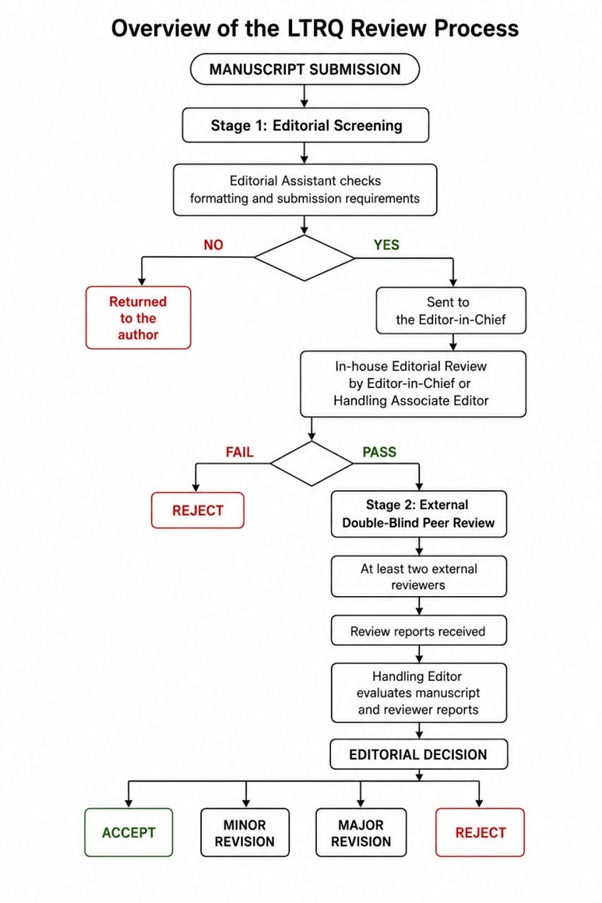
Language Teaching Research Quarterly (LTRQ) follows a structured two-stage editorial and peer-review procedure designed to ensure that manuscripts are relevant to the journal, meet its basic submission requirements, and are evaluated rigorously and independently by qualified external reviewers.
LTRQ does not offer fast-track review or bulk and fast-track publication. All manuscripts, including invited manuscripts, special-issue submissions, and manuscripts submitted by members of the editorial board, are subject to the journal's established editorial and peer-review procedures. No author or manuscript receives preferential treatment in the review or publication process.
The review process consists of:
1. Stage 1: Internal Editorial Review
2. Stage 2: External Double-Blind Peer Review
Only manuscripts that successfully pass the internal editorial review proceed to external peer review.
Stage 1: Internal Editorial Review
Step 1. Manuscript Submission
All manuscripts must be submitted through the journal's designated submission system and must comply with LTRQ's submission requirements.
Upon submission, the manuscript enters the journal's editorial workflow. Submission does not imply acceptance or guarantee external peer review.
Step 2. Initial Formatting and Submission Check
The Editorial Assistant conducts the initial administrative and formatting check.
This check determines whether the manuscript substantially complies with LTRQ's submission requirements, including, where applicable:
- manuscript structure and required sections;
- file format and presentation;
- word length and other stated submission requirements;
- anonymization required for double-blind review;
- formatting of tables and figures;
- references and citation style;
- APA 7th edition requirements;
- required declarations and submission information;
- completeness of author and manuscript information.
Outcome of the Initial Check
If the manuscript does not meet the basic submission requirements:
The Editorial Assistant returns the manuscript to the corresponding author with a request for correction. The manuscript may be resubmitted after the identified deficiencies have been addressed.
If the manuscript meets the basic submission requirements:
The manuscript is forwarded to the Editor-in-Chief for editorial assessment. This stage is an administrative and preliminary quality check. It does not constitute external peer review.
Step 3. In-House Editorial Review
The Editor-in-Chief conducts the internal editorial review or assigns the manuscript to an appropriate Handling Associate Editor.
The purpose of this review is to determine whether the manuscript is sufficiently suitable for external peer review. The editor evaluates, as appropriate:
- alignment with LTRQ's aims and scope;
- originality and potential scholarly contribution;
- clarity and significance of the research problem;
- adequacy of the theoretical foundation and literature review;
- appropriateness and apparent rigor of the research design;
- methodological soundness;
- appropriateness of the data and analytical approach;
- clarity and completeness of reporting;
- quality of the discussion and interpretation;
- ethical suitability;
- apparent compliance with publication and research-integrity standards;
- overall scholarly quality and readiness for external review.
Outcome of the In-House Review
If the manuscript does not pass the in-house review:
The Editor-in-Chief or Handling Associate Editor rejects the manuscript without external peer review.
If the manuscript passes the in-house review:
The manuscript proceeds to external double-blind peer review.
Passing the in-house review does not imply that the manuscript is likely to be accepted. It means only that the manuscript is considered suitable for external evaluation.
Stage 2: External Double-Blind Peer Review
Manuscripts that pass the internal editorial review are sent to at least two qualified external reviewers.
LTRQ uses a double-blind peer-review procedure, under which the identities of the authors and reviewers are not disclosed to one another through the journal's review process.
Reviewers are selected according to their:
- relevant subject-matter expertise;
- methodological expertise where appropriate;
- experience with the research area;
- independence from the authors;
- availability to complete the review within the requested period;
- absence of relevant conflicts of interest.
The journal seeks to ensure that reviewers can provide an objective and academically informed assessment of the manuscript.
External Review Criteria
Reviewers evaluate the manuscript primarily in relation to:
1. relevance to LTRQ's aims and scope;
2. originality, novelty, and contribution;
3. theoretical foundation and engagement with relevant literature;
4. research design and methodological rigor;
5. completeness and accuracy of research reporting;
6. appropriateness and accuracy of data analysis;
7. quality and validity of the results;
8. criticality and completeness of the discussion;
9. theoretical and/or practical implications;
10.research ethics and publication integrity;
11.coherence, organization, and scholarly presentation;
12.compliance with the journal's submission and APA 7th edition requirements.
Reviewers are expected to provide specific, constructive, and evidence-based comments rather than simply indicate whether they recommend acceptance or rejection.
Step 4. Review Reports and Editorial Evaluation
The Handling Editor evaluates the manuscript together with the reports received from at least two external reviewers.
The editor considers:
- the reviewers' substantive assessments;
- the quality and validity of the reviewers' comments;
- the manuscript's strengths and weaknesses;
- the extent and significance of any required revisions;
- the manuscript's contribution to the field;
- methodological and analytical soundness;
- ethical and publication-integrity considerations.
The editor is not required to follow the reviewers' recommendations mechanically. Reviewers provide expert advice, while the editorial decision remains the responsibility of the Handling Editor. Where reviewer recommendations substantially conflict, the editor may seek an additional review or clarification when considered necessary.
Step 5. Editorial Decision
After evaluating the manuscript and the available external review reports, the Handling Editor makes one of the following decisions:
1. Accept
The manuscript is considered suitable for publication in its present form, subject only to any final editorial or production requirements.
2. Minor Revision
The manuscript is fundamentally sound and potentially publishable, but limited revisions are required. These may involve clarification, additional explanation, correction of minor methodological or analytical issues, improvement of presentation, or other relatively limited amendments. The revised manuscript may be checked by the Handling Editor and, where necessary, returned to the reviewers.
3. Major Revision
The manuscript has sufficient potential for publication but requires substantial revision before a final decision can be made. Major revisions may concern the theoretical framework, literature review, methodology, analysis, reporting, interpretation, discussion, or other substantive aspects of the study.
A major-revision decision does not constitute an acceptance or guarantee of publication. The revised manuscript may be returned to the original reviewers or evaluated by other qualified reviewers.
4. Reject
The manuscript is not considered suitable for publication in LTRQ. Rejection may result from fundamental problems concerning relevance, originality, contribution, theoretical foundation, methodology, analysis, research integrity, interpretation, or overall scholarly quality.
Editorial Decision-Making Principles
LTRQ's editorial decisions are based on the overall scholarly quality and suitability of the manuscript, rather than on a simple numerical count of positive or negative reviewer recommendations.
In reaching a decision, editors may give greater weight to substantive concerns involving:
- research validity;
- methodological rigor;
- reliability of the data or analysis;
- research ethics;
- originality and scholarly contribution;
- serious deficiencies in interpretation;
- publication or research misconduct.
Minor disagreements between reviewers do not necessarily prevent publication when the editor determines that the manuscript is scientifically and academically sound. Conversely, favorable reviewer recommendations do not require acceptance when the editor identifies substantive concerns that affect the manuscript's suitability or integrity.
Revision and Resubmission
When a revision is requested, authors should submit:
1. a revised version of the manuscript; and
2. a detailed response explaining how each substantive reviewer and editorial comment has been addressed.
Authors should clearly identify changes made in the revised manuscript and provide a reasoned explanation for any recommendation they do not adopt. The revised manuscript remains subject to editorial evaluation and, when appropriate, further external review. Submission of a revised manuscript does not guarantee acceptance.
Final Editorial Decision
The editorial decision made by the Editor-in-Chief or the authorized Handling Editor is final within LTRQ's editorial process.
An appeal may be considered only where there is a substantive reason, such as a significant factual or procedural error, a relevant conflict of interest, or a demonstrable misunderstanding that materially affected the decision. An appeal is not intended simply to provide an additional opportunity to challenge an unfavorable scholarly judgment.
No Fast-Track Review or Publication
LTRQ does not provide a fast-track, expedited, priority, or paid review/publication service.
All manuscripts follow the same established editorial and peer-review procedure regardless of:
- the identity or affiliation of the authors;
- the author's academic position;
- the funding status of the research;
- the potential citation impact of the manuscript;
- whether the manuscript is invited;
- whether the manuscript is submitted to a special issue;
- any other non-scholarly consideration.
The duration of the review process may vary according to reviewer availability, the complexity of the manuscript, the need for additional review, revision requirements, and other legitimate editorial circumstances. LTRQ therefore does not guarantee a particular review or publication timeframe. Authors are advised to study the journal metrics.
Special Issues, Invited Papers, and Editorial Board Submissions
Manuscripts submitted to special issues and invited papers are subject to the same fundamental standards of editorial assessment and external peer review as regular submissions.
If an Editor-in-Chief, Associate Editor, Editorial Board Member, Guest Editor, or other person directly involved in editorial decision-making submits a manuscript to LTRQ, the manuscript must be handled independently and without preferential treatment. The submitting editor must not participate in the editorial decision concerning their own manuscript.
Confidentiality and Independence
Throughout both stages of the review process:
- manuscript content and review materials are treated as confidential;
- reviewers must not disclose or use unpublished manuscript information without authorization;
- editors must maintain the confidentiality of editorial and peer-review information;
- editorial decisions must be based on scholarly and ethical considerations;
- personal, commercial, institutional, or other inappropriate interests must not influence editorial decisions.
LTRQ expects all editors and reviewers to disclose relevant conflicts of interest and to withdraw from the process where their impartiality may reasonably be questioned.
If authors have any question with respect to the submission, they can contact the journal secretariat office:
Esma Yildiz
After Acceptance
Journal Contributor's Publishing Agreement (Copyright and Author's Metadata Form)
After acceptance, the corresponding author will receive the copyright and author's metadata form to complete and sign before production begins. Before publication, Language Teaching Research Quarterly requires the author, as the rights holder, to sign a Journal Contributor's Publishing Agreement. This is an exclusive licence agreement, meaning the author retains copyright in the work but grants the journal the sole and exclusive right and licence to publish for the full legal term of copyright.
Proofs
Once an article is accepted and the corresponding author has completed and signed the copyright and metadata form, the production team begins copyediting, typesetting, and formatting. The corresponding author will then receive the galley proof file before publication. After this stage is completed, no further editing is possible.
Publication
Once the corresponding author confirms the final galley proof, the paper is published online.
Open-Access Policy
Like all articles published in EUROKD journals, papers published in Language Teaching Research Quarterly are fully open access.
If authors have any questions regarding the production process, they may contact the production team:
Yasin Demirci
production@EUROKD.com