
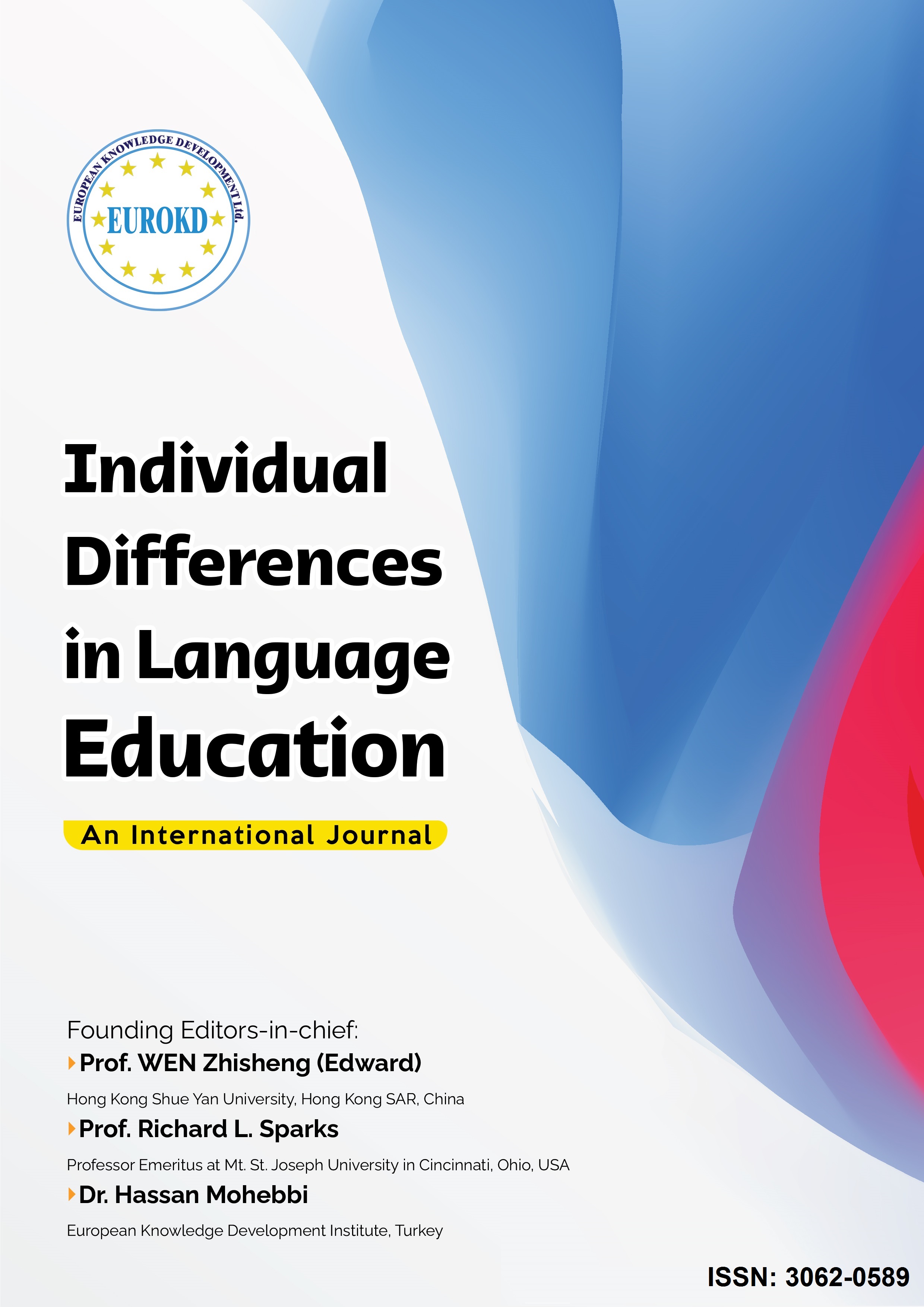
 Individual Differences in Language Education: An International Journal
Submission Guidelines
Submission Guidelines
Updated Submission Guidelines (Enforced as of September 2025)
Individual Differences in Language Education: An International Journal is a multidisciplinary journal that aims to advance research and understanding of the role of individual differences in language learning and teaching. The journal provides a platform for researchers, educators, and practitioners to share their insights and perspectives on the complex and dynamic interplay between individual differences, language learning, and language teaching. The scope of the journal encompasses a broad range of topics, including but not limited to, cognitive, affective, and social factors that influence language learning, individual differences in language aptitude and proficiency, language learning strategies, metacognition, self-regulation, and the implications of individual differences for language teaching and assessment. We also welcome contributions exploring the role emerging technologies play in language learning and teaching, such as those related to personalized learning or personal learning environment. Through its rigorous peer-review process, the journal seeks to promote high-quality research that informs theory and practice in language education. Individual Differences in Language Education: An International Journal is published by EUROKD Egitm Danismanlik Group (EUROKD). The journal is open access. It publishes two issues per year. The journal has a two-stage review procedure: an internal review by the editor(s) and an external double-blind review.
Article Types:
The journal publishes:
- Empirical Research (quantitative, qualitative, mixed-method)
- Review (systematic literature reviews, umbrella reviews, scoping reviews, literature reviews or narrative reviews)
- Meta-analysis
- Book Reviews (solicited by the editor)
- Test Reviews
- Interview (solicited by the editor)
- A Country in Focus
- Editor’s Recommended Readings
- Research Issues
- Special Issues
Book Reviews
Individual Differences in Language Education: An International Journal publishes reviews of books in the scope of individual differences in language education and applied linguistics. Unsolicited book reviews are not accepted for publication in IDLE, but if you wish to contribute to the Book Reviews section, you are encouraged to contact the journal’s book review editor, Yike Yang (yyang@hksyu.edu), before writing and submitting your book review
1. Book Reviews should not exceed 2000 words, including references (with a maximum of 5 references). Book reviewers should ensure that there are no conflicts of interest between publisher/authors and reviewer.
2. We aim to publish balanced critical reviews, not a report of the content of the book. Reviewers should focus on the critical evaluation of the book compared to the available titles in the market.
3. Authors are recommended to read the papers by Hartley and Sealey before writing their book reviews.
Individual Differences in Language Education: An International Journal publishes a series of special issues. Publication in special issues series for accepted papers is free of article processing charge. The papers are invited ones by the guest-editors and open submissions. All invited and open submissions go under a two-stage internal and external double-blind review. At first stage, submissions are reviewed by guest-editors; then, if a submission passes this stage, it goes under external-double blind review. A decision is made by guest-editors on each submission. Final decision is made by the guest editors and the journal's handling editor. The procedure is monitored by editor-in-chief and publisher's supervising editor. Any proposals or inquiries regarding the special issues series should be sent to Hassan Mohebbi (PhD), as lead editor of special issues series: Hassan Mohebbi (PhD), Independent Research, Turkey, hassan.mohebbi973@gmail.com.
Peer Review Policy
Individual Differences in Language Education: An International Journal has a well-defined and implemented two-stage reviewing procedure. All articles are first reviewed by the editor-in-chief and handling associate-editors to determine their suitability for external review. Articles accepted for external review are submitted to a double-blind peer review by at least two reviewers.
We do not have fast-tracking review and publication option. All papers should pass the defined review procedure. Final editorial decision on acceptance, acceptance with major or minor revisions, or rejection is generally reached within 6-10 weeks after submission. The editor's decision is final and is not negotiable.
Plagiarism
Individual Differences in Language Education: An International Journal takes issues of plagiarism and copyright infringement seriously. All submissions are checked with software for two purposes:
Similarity Index
The major plagiarised submissions (+ 60% similarity index) are desk rejected and the author is not allowed to submit any manuscript for three years. Minor and major revised submissions are checked by software at different stages of review, editing, and publication (the acceptable rate for similarity index is -15%).
AI Detection:
The submissions are checked for any potential AI usage. The acceptable rate for AI use is -20%.
Generative AI Disclosure
Based on the journal’s updated policies, generative AI use should be declared precisely by authors based on APA journals policy on generative AI (November 2023), in particular, the updated policy published on August 2025:
APA Journals policy on generative AI
https://www.apa.org/pubs/journals/resources/publishing-tips/policy-generative-ai
Authors need to disclose completely any generative AI use in their manuscript when they submit their research to Individual Differences in Language Education: An International Journal based on the below framework, in addition to the general exploratory statement on their cover letter based on the journal’s updated template for publication:
Generative AI disclosure framework on what to disclose and where in submissions
|
Generative AI Use |
How to Disclose |
Similar Principle |
|
Generate a resource list on a topic to inform your literature review, metasynthesis, meta-analysis, or similar |
In the introduction section, including your prompts, keywords, and AI used. (Preserve the output in case of inquiry) |
Listing databases queried with what keywords and filters were used when describing literature search strategy for a literature review, metasynthesis, or meta-analysis |
|
Translate text included in the manuscript or implement extensive copyediting (more than you’d traditionally find in Microsoft Word and similar tools) |
In a general note in the author note, including the tool used |
Similar to the Writing – Review and Editing CRediT role, only generative AI may not be listed as an author |
|
Create or refine code |
In the Method section, including the tool used and number of iterations (preserve the output in case of inquiry) |
Describing the statistical package used in analysis, such as R or SPSS |
|
Analyze, refine, format, or visualize data |
In the Method section, including the tool used and number of iterations (preserve the output in case of inquiry) |
Describing the statistical package and visualization tools used in analysis, such as R or SPSS |
|
Write or draft manuscript content, including literature summaries and outlines |
In the introduction section, including your prompts and tool used |
|
|
Create or edit figures, tables, and/or images |
In the section where the figures, tables, and/or images appear (e.g., Results section), including your prompts and tool used (preserve the output in case of inquiry) |
|
|
Create or edit research design elements, data, or results |
In the Method section (preserve the output in case of inquiry) |
|
Source: https://www.apa.org/pubs/journals/resources/publishing-tips/policy-generative-ai
Consequences of Misuse
If authors do not follow these guidelines, their submission will be rejected and no resubmission is allowed for this infringement.
EUROKD, as publisher of Individual Differences in Language Education: An International Journal, enjoys the right to retract any paper even after publication when a serious issue is found in this regard. Notably, publisher may take steps to contact the authors’ affiliated universities and institution in line with the international and national policies and regulations regarding infringement of code of ethics and research malpractice.
Authorship
Please note that No Change is made in contributing authors’ order or name after original submission. Email address, ORCID, and affiliation of all authors should be included in the original submission.
CRediT Author Statement
Individual Differences in Language Education: An International Journal strives to enhance transparency and integrity in authors’ roles, contributions, and responsibilities in their research projects submitted to Individual Differences in Language Education: An International Journal. Hence, all author(s) need to specify their role in their research based on the CRediT framework (https://www.niso.org/publications/z39104-2022-credit). CRediT statements should be provided on the first page of submission file, which is cover letter:
CRediT Taxonomy:
Contributor Roles
§ Conceptualization
§ Data curation
§ Formal analysis
§ Funding acquisition
§ Investigation
§ Methodology
§ Project administration
§ Resources
§ Software
§ Supervision
§ Validation
§ Visualization
§ Writing – original draft
§ Writing – review & editing
Conceptualization – Ideas; formulation or evolution of overarching research goals and aims.
Data curation – Management activities to annotate (produce metadata), scrub data and maintain research data (including software code, where it is necessary for interpreting the data itself) for initial use and later re-use.
Formal analysis – Application of statistical, mathematical, computational, or other formal techniques to analyze or synthesize study data.
Funding acquisition - Acquisition of the financial support for the project leading to this publication.
Investigation – Conducting a research and investigation process, specifically performing the experiments, or data/evidence collection.
Methodology – Development or design of methodology; creation of models. Project administration – Management and coordination responsibility for the research activity planning and execution.
Resources – Provision of study materials, reagents, materials, patients, laboratory samples, animals, instrumentation, computing resources, or other analysis tools.
Software – Programming, software development; designing computer programs; implementation of the computer code and supporting algorithms; testing of existing code components.
Supervision – Oversight and leadership responsibility for the research activity planning and execution, including mentorship external to the core team.
Validation – Verification, whether as a part of the activity or separate, of the overall replication/reproducibility of results/experiments and other research outputs.
Visualization – Preparation, creation and/or presentation of the published work, specifically visualization/data presentation.
Writing – original draft – Preparation, creation and/or presentation of the published work, specifically writing the initial draft (including substantive translation).
Writing – review & editing – Preparation, creation and/or presentation of the published work by those from the original research group, specifically critical review, commentary or revision – including pre- or post-publication stages.
Source: https://www.niso.org/publications/z39104-2022-credit
Brand, A., Allen, L., Altman, M., Hlava, M., & Scott, J. (2015). Beyond authorship: Attribution, contribution, collaboration, and credit. Learned Publishing, 28(2), 151–155. https://doi.org/10.1087/20150211
World Medical Association (WMA) Declaration of Helsinki – Ethical Principles for Medical Research Involving Human Participants
Authors need to state adherence to the World Medical Association (WMA) Declaration of Helsinki, the ethical principles to conduct any medical research involving human participants.
Authors are required to explain any procedure in which they recruited human participants in their research. They should report the details in the Study, Method, and Participants sections. For instance, the written free and informed consent of all participants should be obtained before the research starts based on the requirements of WMA. This information ought to be provided in the paper completely. In addition, adherence to the World Medical Association (WMA) Declaration of Helsinki should be stated in the cover letter of the submission. This statement will be published in the accepted paper too.
The full information about World Medical Association (WMA) Declaration of Helsinki – Ethical Principles for Medical Research Involving Human Participants is provided at the journal website (Click here for guidelines).
How to submit your manuscript
Individual Differences in Language Education: An International Journal adheres strictly to APA 7th Edition. The manuscript should not normally exceed 9000 words (except special issue and invited papers and an editor's permission based on the design, nature, and depth of a study) including references. Submissions' acceptable format is Word DOC. All manuscripts can be submitted online by signing up on publisher's submission system. Also, you may submit to idlesubmissions@gmail.com.
You need to submit one office word file including:
- First Page: Cover Letter:
Please submit a cover letter confirming and mentioning:
- Manuscript's title name, affiliation, country, ORCID, and mailing address of all authors
- The manuscript is not under review by another journal.
- Length of manuscript (including references)
- The manuscript has been formatted according to the APA 7th Edition (DOIs have been included in the reference list).
- Acknowledgements
- Funding
- Generative AI Disclosure Statement
- CRediT Author Statement
- World Medical Association (WMA) Declaration of Helsinki – Ethical Principles for Medical Research Involving Human Participants
- Competing Interests
- Data Availability
- The author(s) have studied and agreed with the APC of the journal.
- Second Page: Title page:
a separate title page with author name(s), affiliations, country, and ORCID.
- Third Page: The Full Paper
From the third page, authors should put title, abstract (150-200 words), 3-5 keywords, the main text, and references.
Submission Format
- Submissions need to be formatted based on APA 7th Edition:
Acknowledgements
Any acknowledgements should appear at the end of your article, followed by declaration of conflicting interests and funding (if applicable) prior to references.
Declaration of Conflicting Interests
Authors need to declare any conflicting interests at the end of manuscript prior to references.
Funding Acknowledgement
All Authors need to acknowledge the funding with sufficient details at the end of manuscript prior to references. If there is no funding, you need to add a note at the end of manuscript prior to references: This research received no specific grant from any funding agency in the public, commercial, or not-for-profit sectors.
If authors have any question with respect to the submission, they can contact the journal secretariat office:
Yasin Demirci
After Acceptance
Journal Contributor’s Publishing Agreement (Copyright and Author's Metadata Form)
After acceptance, the corresponding author will receive the copyright and author's metadata form to be filled in and signed before the production starts. Before publication, Individual Differences in Language Education: An International Journal requires the author as the rights holder to sign a Journal Contributor’s Publishing Agreement. The Journal Contributor’s Publishing Agreement is an exclusive licence agreement which means that the author retains copyright in the work but grants the journal the sole and exclusive right and licence to publish for the full legal term of copyright.
Proofs
When an article is accepted and the corresponding author completes and signs the copyright and metadata form, the production team starts the copyeditting, typesetting, and formatting stages. The corresponding author receives the galley proof file before publication. After completing this stage, no editing is possible as the journal does not publish erratum.
Publication
After receiving the final galley proof confirmed by the corresponding author, the paper is published online.
Open-access Policy:
Like all articles published in EUROKD journals, papers published in Individual Differences in Language Education: An International Journal are fully open access.
If authors have any question with respect to the production, they can contact the production team:
Zeynep Gunen